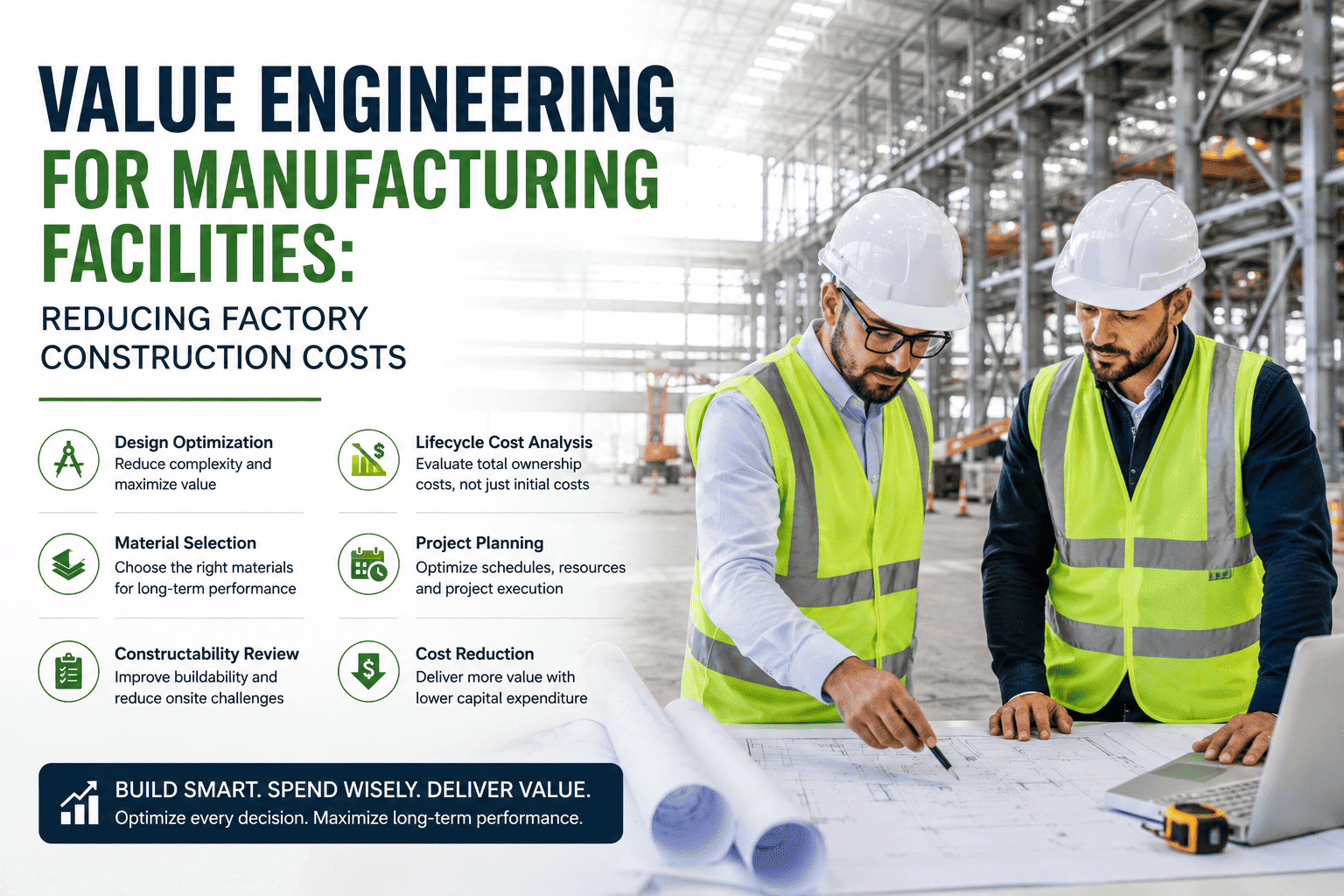
Most factory construction projects could deliver the same functional outcome for 15-25% less — if value engineering happened at the right moment. The catch: that moment is during schematic design, not after bids come in 30% over budget. Value engineering isn't cost-cutting; it's surgical optimization of function-to-cost ratio across structure, materials, MEP, equipment, and constructability. This guide breaks down how VE actually works, when it pays off, and the pitfalls that turn it into late-stage scope stripping. Book a value engineering assessment to apply this to your factory project.
Ability to Influence Cost
Cost of Making Changes
Engaging VE in concept & schematic captures 80-95% of available savings. Past CDs, it becomes scope reduction in disguise.
What Value Engineering Actually Is (And What It Isn't)
Value engineering gets misused as a polite word for budget cuts. Real VE is a structured methodology — pioneered by Lawrence Miles at GE in the 1940s — that examines every project component through one question: "What function does this serve, and is there a lower-cost way to deliver the same or better function?" Done right, VE preserves performance while removing cost. Done wrong, it strips function to hit a number on a spreadsheet and creates 20 years of operational regret.
What VE Is
Function-First Optimization
+ Systematic analysis of function vs cost
+ Lifecycle cost focus, not just initial
+ Cross-functional team workshops
+ Preserves or improves performance
+ Engages during schematic design
What VE Isn't
Late-Stage Scope Stripping
− Cutting features after bids come in
− Downgrading specs to hit budget
− Single-source contractor decisions
− Sacrificing operating cost for CAPEX
− Engaged after CDs are 90% complete
VE Done Right
Typical Outcomes
+ 10-25% CAPEX reduction
+ 15-30% lifecycle cost savings
+ Faster construction schedule
+ Better operational performance
+ 5-10x ROI on VE effort
The 6-Phase Value Engineering Job Plan
Real VE follows a structured workshop methodology — not a meeting where someone asks "how do we cut $5M?" The six phases below come from SAVE International's certified VE methodology and produce defensible cost savings without compromising function. Most VE workshops for a mid-sized factory project run 3-5 days of intensive cross-functional work.
01
Information Phase
Gather complete project data: drawings, specs, cost estimates, schedule, owner requirements, performance criteria. No optimization happens here — only fact-gathering.
Output: Project baseline document
02
Function Analysis
Break every component into basic + secondary functions using FAST diagrams (Function Analysis System Technique). Identify which functions justify their cost and which don't.
Output: Function/cost matrix
03
Creative Phase
Brainstorm alternatives for high-cost / low-value functions. No evaluation yet — just idea generation. Quantity over quality at this stage.
Output: 50-200 alternative ideas
04
Evaluation Phase
Score alternatives against function, cost, schedule, risk, and operational impact. Drop ideas that compromise performance. Rank survivors by savings-to-effort ratio.
Output: Ranked shortlist (10-20 ideas)
05
Development Phase
Develop top alternatives into implementation-ready proposals. Detailed cost analysis, lifecycle modeling, risk assessment, and implementation plan for each.
Output: VE proposals with quantified savings
06
Presentation Phase
Present proposals to owner and design team for decision. Each accepted proposal gets formally incorporated into the design with documented rationale and savings.
Output: Approved VE change log
Where the Money Hides · VE Savings Categories
Not all factory components offer equal savings potential. The five categories below typically contain 80% of available VE opportunities in a manufacturing facility project. Understanding the distribution helps focus your VE workshop on high-leverage targets instead of nibbling at low-value items.
Typical VE Savings Distribution · Manufacturing Facility Projects
25%
Structure & Foundation
15%
Architectural / Envelope
MEP & Utilities
30%
Right-sized HVAC (not oversized for "future-proofing"), variable-speed pumps replacing throttled flow, daylight harvesting + LED, heat recovery, modular electrical distribution
Structure & Foundation
25%
Optimized bay spacing for standard steel lengths, pre-engineered metal building (PEMB) where appropriate, tilt-up panels vs CMU, slab thickness matched to actual loads
Process Equipment
20%
Refurbished tier-1 equipment vs new, common-platform machines, right-sized capacity matched to actual demand, lease-vs-buy on specialty equipment
Architectural / Envelope
15%
Insulated metal panels vs custom curtainwall, standardized window sizes, optimized roof slopes, value-engineered finishes in non-process zones
Site & Civil
10%
Cut/fill balance to eliminate import/export, pervious paving where allowed, right-sized stormwater, shared utility corridors
Apply Value Engineering to Your Factory Project
iFactory's greenfield consulting team runs VE workshops during your schematic design phase — when 80% of available savings are still on the table. Cross-functional. Function-first. Lifecycle-focused. No late-stage scope stripping.
Lifecycle Cost vs Initial Cost · The Real Math
The biggest VE mistake CFOs make: optimizing for the wrong number. A factory's 30-year lifecycle cost dwarfs its initial construction cost by 5-7x. The "cheaper" HVAC system that saves $500K upfront often costs $3-5M more in operating energy over 25 years. Real VE compares total cost of ownership, not just sticker price.
Typical 30-Year Factory Lifecycle Cost Breakdown
Maintenance & Repairs
22%
Initial CAPEX is only 18% of total lifecycle cost.
VE focused only on CAPEX optimizes the smallest cost bucket and often makes the other 82% worse. The factories with lowest 30-year TCO are designed by teams that model all five buckets together — not by squeezing the budget at bid time.
Need a defensible TCO model before approving design choices? Schedule a lifecycle cost analysis session with our greenfield advisory team.
When to Engage VE · Why Timing Drives ROI
The single biggest predictor of VE success isn't the workshop facilitator's skill or the savings target — it's when in the project lifecycle VE happens. The chart below shows the actual savings potential at each project stage based on typical greenfield manufacturing projects. The numbers don't lie: VE engaged at schematic design captures 5-10x more value than VE engaged at construction.
Concept Planning
~30%
Maximum savings potential
Schematic Design
~25%
Optimal VE workshop window
Design Development
~15%
Limited by frozen decisions
Construction Documents
~7%
Rework cost rises sharply
Bid & Award
~3%
Becomes scope reduction
Construction
~1%
Damaging change orders
Where is your factory project on the timing curve? Connect with our greenfield advisors to scope a VE workshop at the right stage.
Common VE Pitfalls That Destroy More Value Than They Save
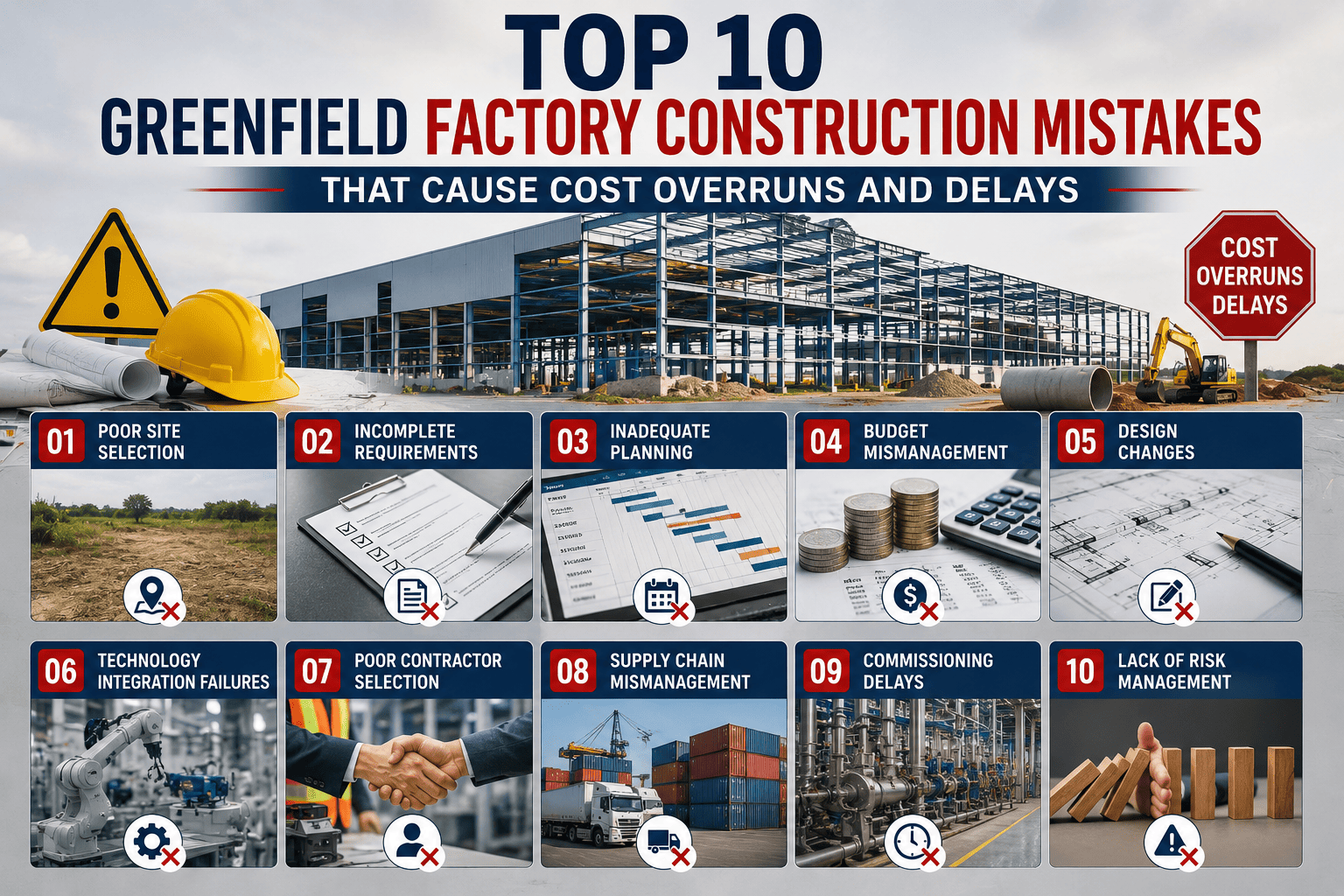
The top reason VE workshops fail isn't lack of effort — it's predictable mistakes that get repeated project after project. The five pitfalls below account for roughly 80% of failed VE efforts in industrial construction. Avoid them and your VE workshop becomes a strategic asset; commit any one and it becomes scope reduction wearing a better name.
01
Engaging Too Late
VE after 90% CDs is scope reduction, not value engineering. By construction phase, change orders cost 10-20x more than equivalent changes in schematic design.
FixEngage VE during schematic design when influence is high and change cost is low.
02
Optimizing CAPEX Only
Cutting initial cost without modeling 30-year operating expense often increases lifecycle cost by 2-3x. Cheap HVAC, single-pane glazing, undersized utilities all backfire.
FixRequire LCCA on every VE proposal. CAPEX cuts that raise TCO get rejected.
03
Excluding Subcontractors
Subs know labor-saving assemblies and alternate materials better than the design office. Excluding them from VE workshops leaves 30-40% of savings on the table.
FixPre-qualify subs early and bring them into the VE workshop as collaborators.
04
Skipping Function Analysis
Going straight from "we need to cut $5M" to "let's downgrade finishes" skips the function analysis that protects performance. Every VE proposal must answer: does this preserve function?
FixRequire a FAST diagram or function-cost matrix before any proposal is approved.
05
No Implementation Tracking
VE workshops generate proposals; most never get implemented. Without owner-led tracking of accepted proposals through construction, projected savings evaporate.
FixMaintain a VE change log with owner, status, projected vs actual savings through closeout.
Avoiding these pitfalls requires experienced facilitation. Book a VE workshop scoping session to plan yours right.
Expert Perspective
Every failed factory budget I've reviewed had the same pattern. Owner sets aggressive target. Design team designs to program. Bids come back 20-30% over. Panic sets in. Someone calls a "value engineering meeting" — which is really an emergency cost-cut session. They strip insulation R-values, downgrade HVAC, eliminate redundancy. The project hits budget. Five years later operations is paying $2M/year more in energy than they would have, and the maintenance team is fighting equipment that should never have been spec'd. Real VE happens during schematic design, with the right team in the room, asking the right question: what does this serve, and is there a better way to serve it?
— Industrial Construction Value Engineering Best Practice
10-25%
CAPEX reduction from properly timed VE
5-10x
ROI on VE workshop investment
82%
Lifecycle cost that isn't CAPEX
3-5 day
Typical VE workshop duration
Bottom Line · Engineer Value, Don't Cut Costs
Value engineering and cost-cutting are not the same thing. Value engineering is a function-first methodology that delivers 10-25% CAPEX savings while preserving or improving performance — but only when engaged during schematic design with the right cross-functional team. Cost-cutting after bids is the opposite: it strips function to hit a number and creates 25 years of operational regret. Schedule your VE workshop before design development freezes. Demand lifecycle cost modeling on every proposal. Track implementation through construction closeout. Get this right and you build a better factory for less money. Get it wrong and you save 5% today and pay 30% more for 30 years.
Make Value Engineering Pay Off on Your Factory Project
iFactory's greenfield consulting team brings the methodology, the cross-functional facilitation, and the lifecycle cost modeling that turns VE workshops into real savings. Engaged at the right phase, on the right scope, for the right outcome.
Frequently Asked Questions
What is value engineering in manufacturing construction?
Value engineering (VE) is a structured methodology — pioneered by Lawrence Miles at General Electric in the 1940s — that systematically analyzes a manufacturing facility's design, materials, and systems to identify alternative solutions delivering the same or better function at lower cost. VE is not cost-cutting or scope reduction. Instead, it breaks every component into its basic and secondary functions, then asks whether each function justifies its cost and whether better-value alternatives exist. The methodology follows a 6-phase job plan: information gathering, function analysis, creative ideation, evaluation, development, and presentation. Done right during schematic design, VE typically delivers 10-25% CAPEX savings while preserving or improving operational performance.
When should value engineering be applied in a factory construction project?
Value engineering delivers maximum value when applied during the schematic design phase, before design development freezes major decisions. At schematic design, the ability to influence cost is approximately 80% while the cost of making changes is still only 15% of what construction-phase changes cost. By design development, savings potential drops to ~15%. By construction documents, it drops to ~7%. During construction itself, VE devolves into damaging change orders that cost 10-20x more than equivalent schematic-phase changes. The optimal VE workshop window is between concept approval and the start of design development — typically a 4-8 week window where the design team, owner, and select subcontractors can collaborate on function-vs-cost optimization without rework penalties.
How much can value engineering save on factory construction costs?
Properly executed VE typically delivers 10-25% CAPEX reduction on manufacturing facility projects, with 15-30% lifecycle cost savings over the 30-year operating period. Savings distribution across categories: MEP and utilities typically yield 30% of total savings (right-sized HVAC, variable-speed pumps, daylight harvesting, heat recovery), structure and foundation 25% (optimized bay spacing for standard steel lengths, pre-engineered buildings where appropriate), process equipment 20% (refurbished tier-1 equipment, common platforms, right-sized capacity), architectural and envelope 15% (insulated metal panels, standardized window sizes), and site and civil 10% (cut/fill balance, shared utility corridors). ROI on VE workshop investment typically runs 5-10x — meaning a $50K VE workshop returns $250K-$500K+ in project savings.
What's the difference between value engineering and cost-cutting?
Value engineering is function-first optimization that preserves or improves performance while reducing cost. Cost-cutting is scope reduction that hits a budget number by stripping function and capability. The two diverge on three dimensions: methodology (VE uses structured function analysis and FAST diagrams; cost-cutting jumps to spec downgrades), timing (VE engages during schematic design when changes are cheap; cost-cutting happens after bids when changes are damaging), and outcomes (VE delivers lower CAPEX AND lower lifecycle cost; cost-cutting saves initial cost but typically raises 30-year operating expense by 2-3x). The clearest test: a real VE proposal answers "does this preserve function?" with documented evidence. A cost-cutting proposal just lists what's being eliminated. If your "value engineering meeting" is actually an emergency budget-cut session after bids came in over, you're doing cost-cutting wearing a better name.
Who should participate in a value engineering workshop?
An effective VE workshop requires a cross-functional team. Core participants: an experienced VE facilitator (ideally Certified Value Specialist or CVS-credentialed), the owner's project director and CFO representative, the lead architect and structural engineer, MEP engineers, the EPC contractor's project manager, key process equipment engineers, operations and maintenance representatives (who will operate the facility for 30 years), and finance for ROI validation. For greenfield factory projects, pre-qualified subcontractors should join — they know labor-saving assemblies and alternate materials better than the design office. Excluding subs leaves 30-40% of potential savings on the table. The workshop runs 3-5 days of intensive collaboration following the 6-phase methodology, with strict separation between idea generation (no judgment) and evaluation (rigorous scoring).
Book a VE workshop scoping session to plan team composition for your specific project.