A specialty chemicals manufacturer approved a $340 million greenfield facility with a board-approved budget and 36-month timeline. Eighteen months in, the project was $78 million over budget — a 23% overrun driven by scope creep in utility infrastructure, equipment procurement delays that triggered cascading change orders, and contingency reserves exhausted by month 14. The CFO later admitted that the original estimate was built on vendor quotes, historical averages, and executive assumptions — none of which had been stress-tested against real-world variance data. An AI cost intelligence platform would have flagged the budget exposure in week six, modelled the procurement risk scenarios in advance, and kept the project within 3% of its approved budget. The most expensive number in manufacturing is the one nobody questioned.
AI-Based CAPEX Optimization & Cost Intelligence
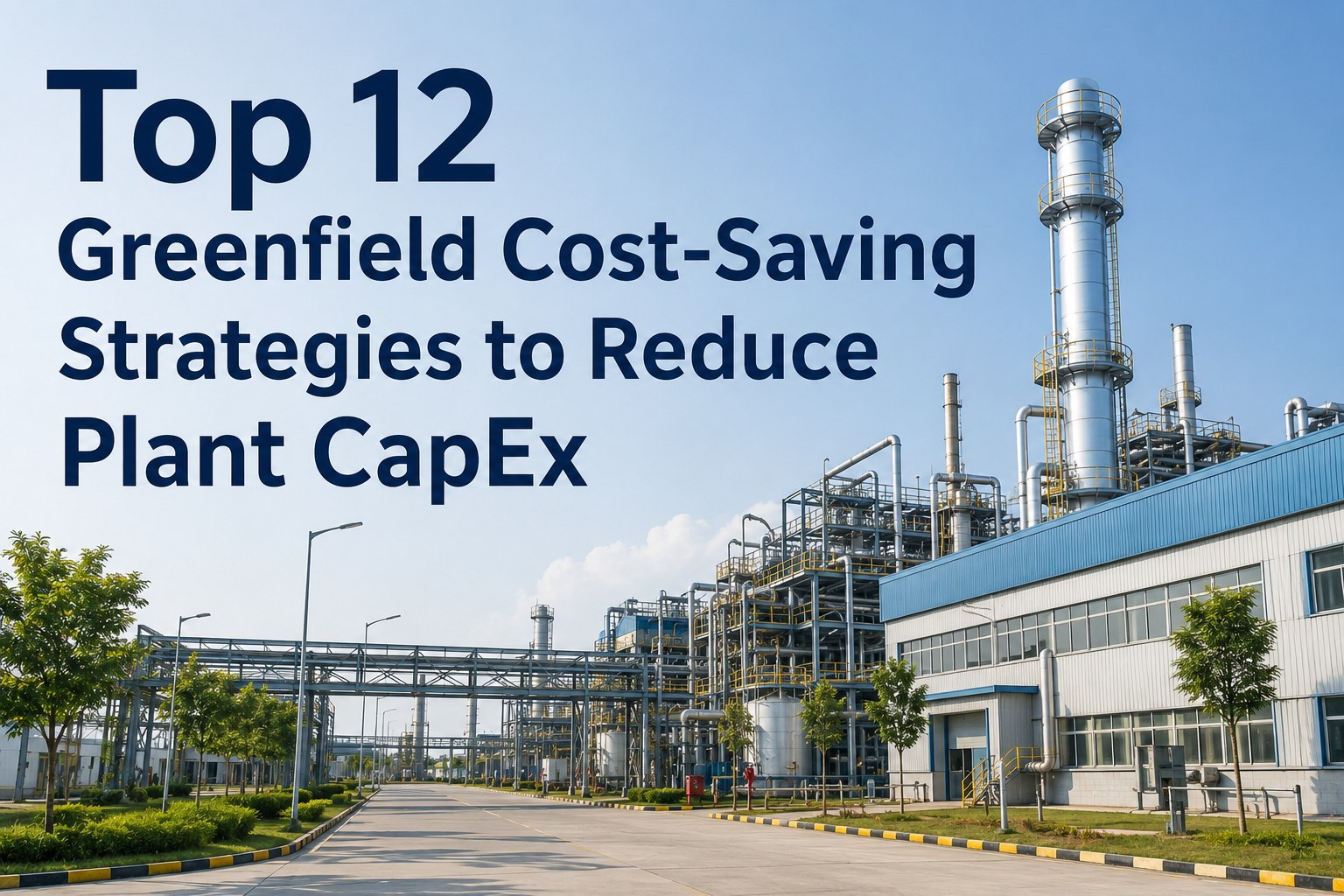
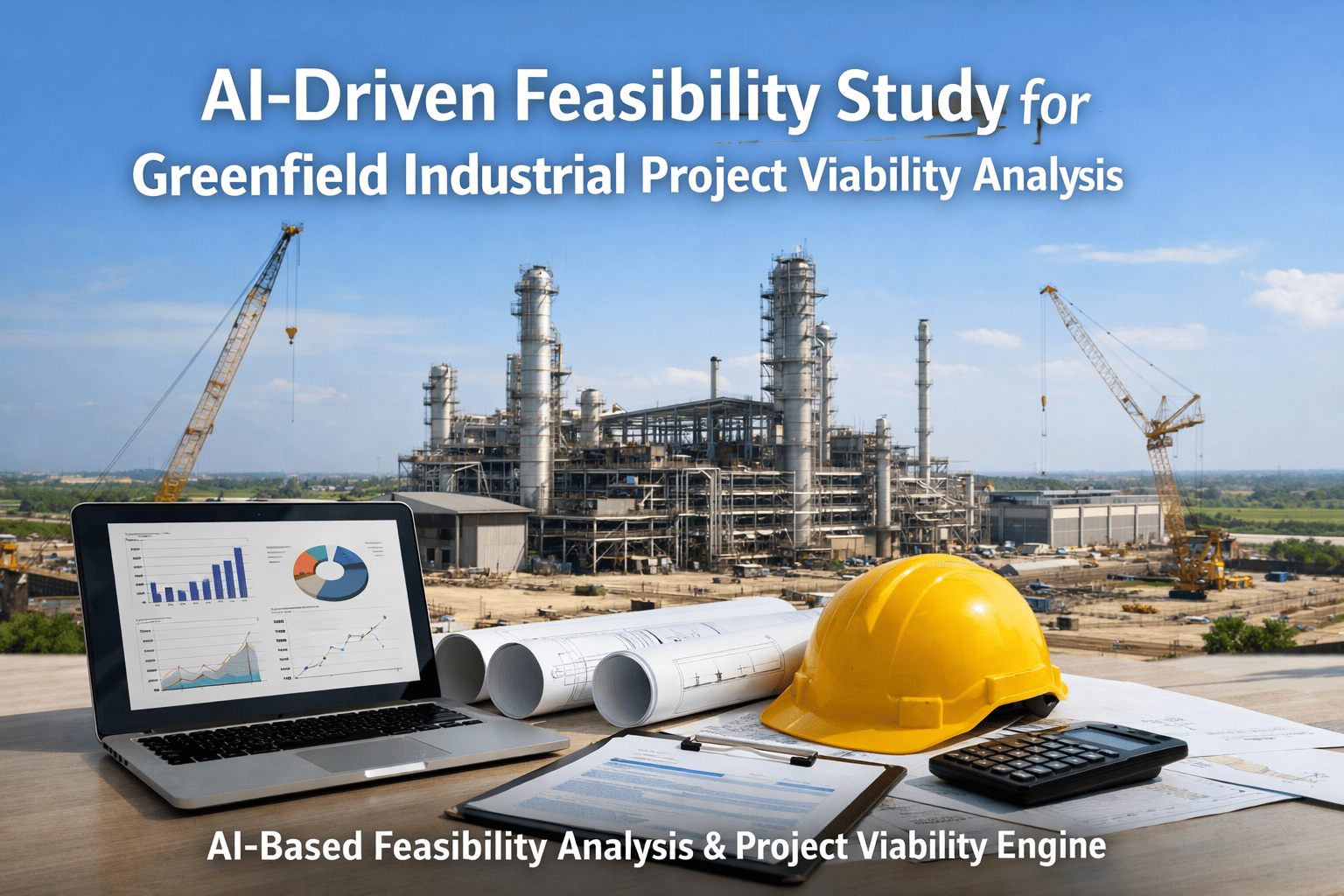
AI-Based Greenfield Project Cost Estimation and CAPEX Optimization
How AI transforms capital project budgeting from spreadsheet guesswork into predictive, continuously calibrated cost intelligence
70%+
Of large capital projects exceed their budget (McKinsey)
Industry Average
25%
CAPEX reduction achievable with mature AI-driven planning
Documented Savings
Why Traditional CAPEX Estimation Fails
Greenfield cost estimation has not fundamentally changed in decades. Teams compile vendor quotes, apply percentage-based contingencies, and produce a single-point budget that the board approves. Then reality happens — material prices shift, procurement timelines slip, design changes cascade, and the contingency reserve is consumed before the project is half complete. AI replaces this static process with a living, continuously recalibrating cost model that predicts overruns before they become irreversible.
The Four Structural Failures of Traditional Cost Estimation
1
Single-Point Estimates in a Multi-Variable World
Traditional budgets produce one number — a fixed estimate based on assumptions that are outdated the moment they are approved. AI models generate probability-weighted cost ranges across best-case, base-case, and worst-case scenarios with continuously updated confidence intervals.
2
Contingency as a Percentage, Not a Model
Adding 10–15% contingency to a budget is not risk management — it is a confession that the estimate is unreliable. AI quantifies specific risks — procurement delays, material inflation, design change probability — and allocates contingency against each identified exposure, not as a blanket percentage.
3
No Early Warning System
In traditional projects, cost overruns are discovered in monthly reports — weeks or months after the spending occurred. AI monitors actual spend against forecast continuously, flagging trajectory deviations in real time so corrective action happens before overruns become locked in.
4
Change Orders Without Impact Visibility
Design changes are approved without understanding their full cost cascade. Moving one machine changes utility routing, foundation requirements, and construction sequencing — but traditional systems evaluate each change in isolation. AI models the total downstream impact of every proposed change before approval.
Is your greenfield budget built on assumptions or data? Book a free CAPEX risk assessment.
What AI-Driven CAPEX Optimization Delivers
AI transforms cost estimation from a one-time budgeting exercise into a continuous cost intelligence system. It ingests historical project data, real-time market pricing, vendor performance records, and construction progress metrics — producing cost forecasts that get more accurate every week, not less.
Monte Carlo simulation
Probability-weighted ranges
Sensitivity analysis
Cost driver identification
Confidence intervals
What AI Does
Runs thousands of cost scenarios against historical project data and current market conditions — producing probability-weighted budget ranges with identified risk exposures instead of single-point estimates.
Proven Impact
Reduces forecasting variance from ±20% to under ±5% through data-driven calibration.
Spend vs forecast tracking
Variance alerts
Earned value analysis
Cost trajectory prediction
Cash flow forecasting
What AI Does
Continuously reconciles actual expenditure against the approved budget, predicting cost-at-completion trajectories and flagging overrun risks weeks before they materialise — not months later in a quarterly review.
Proven Impact
Enables course correction when overruns are $50K, not $5M. Prevents silent budget drift.
Cascade modelling
Schedule impact
Utility rerouting cost
Construction sequencing
Approval workflow
What AI Does
Before any change order is approved, AI models the full downstream cost cascade — not just the direct cost of the change, but the impact on utility routing, construction sequence, timeline, and every dependent work package.
Proven Impact
Prevents the scope creep that causes 15–20% of all greenfield cost overruns.
Vendor benchmarking
Lead time prediction
Price trend forecasting
Bulk purchase timing
Supplier risk scoring
What AI Does
Analyses vendor pricing history, material market trends, and lead time reliability to optimise procurement timing — buying when prices are favourable and flagging supplier risk before it becomes a project delay.
Proven Impact
Equipment procurement is the largest CAPEX line item — even 5% savings yields millions.
Best/base/worst case
NPV calculation
IRR projection
Payback modelling
Sensitivity testing
What AI Does
Builds multi-scenario financial models that project ROI, NPV, IRR, and payback under varying conditions — production ramp rates, market pricing, operating costs, and financing scenarios — giving the board investment-grade confidence.
Proven Impact
Replaces static pro-formas with dynamic models that update as project reality unfolds.
Estimate vs actual analysis
Variance root cause
Lessons learned capture
Model recalibration
Future project training
What AI Does
After project completion, AI compares every cost estimate against actual expenditure — identifying where models were accurate, where they diverged, and why. These learnings automatically calibrate future project estimates.
Proven Impact
Each completed project makes the next estimate more accurate — compounding precision over time.
The AI CAPEX Intelligence Lifecycle
Traditional budgeting is a point-in-time exercise. AI cost intelligence is a continuous lifecycle — estimating, monitoring, predicting, and learning across every phase of the greenfield project. The model gets smarter as the project progresses, not staler.
Continuous Cost Intelligence — From Estimate to Optimization
Estimate
AI-Calibrated Budgeting
Probability-weighted cost models replace single-point estimates. Historical data, market intelligence, and risk quantification produce budgets with defined confidence intervals.
Monitor
Real-Time Spend Tracking
AI continuously reconciles actual spend against forecast, tracking cost-at-completion trajectories and flagging deviations the moment they emerge — not in monthly reports.
Predict
Overrun Forecasting
Predictive analytics forecast where overruns will occur based on current trajectory, vendor performance, and market conditions — providing weeks of lead time for corrective action.
Learn
Model Recalibration
Estimate-vs-actual analysis at every milestone recalibrates the cost model. Each project completion improves accuracy for the next — building institutional cost intelligence.
Know What Your Factory Will Cost — Before You Commit
iFactory's AI cost intelligence platform delivers probability-weighted CAPEX estimates, real-time budget monitoring, and predictive overrun alerts — turning greenfield budgeting from guesswork into precision.
The Scale of the Problem
Greenfield CAPEX overruns are not exceptions — they are the statistical norm. Understanding the scale of the problem is the first step toward solving it. These are industry-wide figures, not edge cases.
Budget Overruns
Over 70% of large capital projects exceed their approved budget. The average overrun on mega-projects reaches $1.3 billion. Design change orders, procurement delays, and underestimated utility costs are the top three drivers.
70%+ over budget
Schedule Delays
60% of capital projects exceed their approved timeline. Every month of delay carries financing costs, lost revenue from delayed production, and competitive positioning damage that compounds over the facility's lifetime.
60% over schedule
Estimation Accuracy
Traditional CAPEX estimates carry ±20% variance or worse. AI-calibrated estimates reduce this to under ±5% through data-driven modelling, continuous recalibration, and real-time market intelligence integration.
±20% → under ±5%
Achievable CAPEX Reduction
Companies with mature AI-driven CAPEX processes reduce capital spend by up to 25% and improve return on invested capital by 2–4 percentage points through better planning, cost control, and execution precision.
Up to 25% savings
The Technology Behind AI Cost Intelligence
AI-driven CAPEX optimization combines predictive analytics, real-time financial monitoring, and machine learning cost models into an integrated platform that evolves with your project. Here is the technology stack.
Layer 1
Historical Cost Database
AI models are trained on historical project data — actual costs vs estimates, vendor performance, material price trends, and change order patterns from completed greenfield projects. This institutional knowledge calibrates every new estimate with real-world variance data.
Layer 2
Monte Carlo Simulation Engine
Runs thousands of cost scenarios with varying inputs — material prices, labour rates, procurement timelines, design change probability, and weather delays — producing probability distributions instead of single numbers. Decision-makers see the full range of possible outcomes.
Layer 3
Real-Time Market Intelligence
Continuous feeds of commodity pricing, steel and concrete indices, equipment lead times, and labour market data. AI adjusts cost projections as market conditions change — ensuring estimates reflect current reality, not last quarter's assumptions.
Layer 4
Earned Value & Progress Analytics
Tracks actual progress against planned milestones and expenditure, computing cost performance index (CPI), schedule performance index (SPI), and estimate-at-completion (EAC) in real time. Deviations trigger alerts before they compound.
Layer 5
ERP & Financial System Integration
Bi-directional integration with ERP, procurement, and project management systems. Purchase orders, invoices, change orders, and payment milestones flow into the AI model automatically — eliminating manual data entry and ensuring cost intelligence is always current.
See how AI cost intelligence works on a live greenfield project. Schedule a live demonstration.
Documented CAPEX Optimization Results
Industries Where AI CAPEX Optimization Creates the Most Value
AI cost intelligence delivers value across any capital-intensive industry. The greatest impact occurs where project complexity is high, timelines are long, and the cost of overruns is measured in hundreds of millions.
Semiconductor & Electronics Fabs
Multi-billion dollar greenfield fabs with 4–7 year timelines, extreme precision requirements, and thousands of equipment items. A 1% cost improvement on a $10B fab saves $100M — AI cost intelligence is not optional at this scale.
Largest CAPEX projects in manufacturing — AI saves hundreds of millions per facility
EV & Battery Gigafactories
Rapid-build gigafactories under intense competitive pressure to produce first cells on schedule and on budget. AI monitors construction progress, predicts procurement bottlenecks, and optimises equipment commissioning sequence.
Speed-to-production is the competitive advantage — AI prevents the delays that destroy it
Chemical & Process Plants
Complex process facilities with interlinked utility systems, stringent safety requirements, and long regulatory approval cycles. AI models the cost impact of permitting delays and design changes across the entire project dependency chain.
Utility infrastructure is the largest cost overrun driver — AI catches it in planning
Pharma & Food Manufacturing
GMP-compliant facilities where design changes after validation trigger costly re-qualification cycles. AI ensures design-right-first-time by simulating regulatory compliance during the planning phase — not discovering gaps during commissioning.
Every design change post-validation multiplies cost — AI eliminates them in simulation
Frequently Asked Questions
How does AI improve CAPEX estimation accuracy?
AI analyses historical project data — actual costs vs estimates, vendor performance, material price trends — and calibrates new estimates against real-world variance patterns. Monte Carlo simulation produces probability-weighted cost ranges instead of single-point numbers. Continuous recalibration with real-time market data ensures estimates stay current. The result is budget accuracy under ±5% versus ±20% with traditional methods.
When should AI cost intelligence be implemented in a greenfield project?
From day one of the planning phase. The planning stage determines 80% of a greenfield project's total cost — and this is where AI delivers the most value through predictive modelling, scenario analysis, and risk quantification. Starting after construction begins means the highest-impact budget decisions have already been made without data-driven validation.
Can AI predict cost overruns before they happen?
Yes. AI continuously monitors spend trajectories, vendor delivery performance, and market price movements against the project model. When the system detects a deviation pattern that historically correlates with overruns, it flags the risk with a specific exposure estimate and recommended corrective action — providing weeks of lead time that traditional monthly reporting cannot match.
What is the ROI of AI-driven CAPEX management?
Companies with mature AI CAPEX processes reduce capital spend by up to 25% and improve ROIC by 2–4 percentage points. On a $200M greenfield project, that represents $50M in savings. The AI platform cost is a fraction of a single prevented overrun — most projects achieve ROI within the first quarter of deployment.
Does this integrate with our existing financial systems?
Yes. The platform integrates bi-directionally with all major ERP, procurement, project management, and financial planning systems. Purchase orders, invoices, change orders, and payment milestones flow into the AI model automatically. Your finance team works with familiar tools while gaining AI-powered predictive capabilities layered on top.
The Budget Number Your Board Approved Is Probably Wrong. AI Fixes That.
Stop discovering overruns in quarterly reviews. Start predicting them in real time. iFactory's AI cost intelligence platform turns greenfield CAPEX from your biggest financial risk into your most tightly controlled investment.