McKinsey research shows 85% of capital projects exceed budget by an average of 28%, with the largest projects running $1.3 billion over. Yet the same research shows companies with mature CapEx optimization processes reduce capital spend 15 to 35% and improve ROIC by 2 to 4%. The difference is not luck — it is the application of 12 specific strategies across planning, design, procurement, and execution. Book a greenfield CapEx optimization consultation to apply these 12 strategies to your project before budgets are locked.
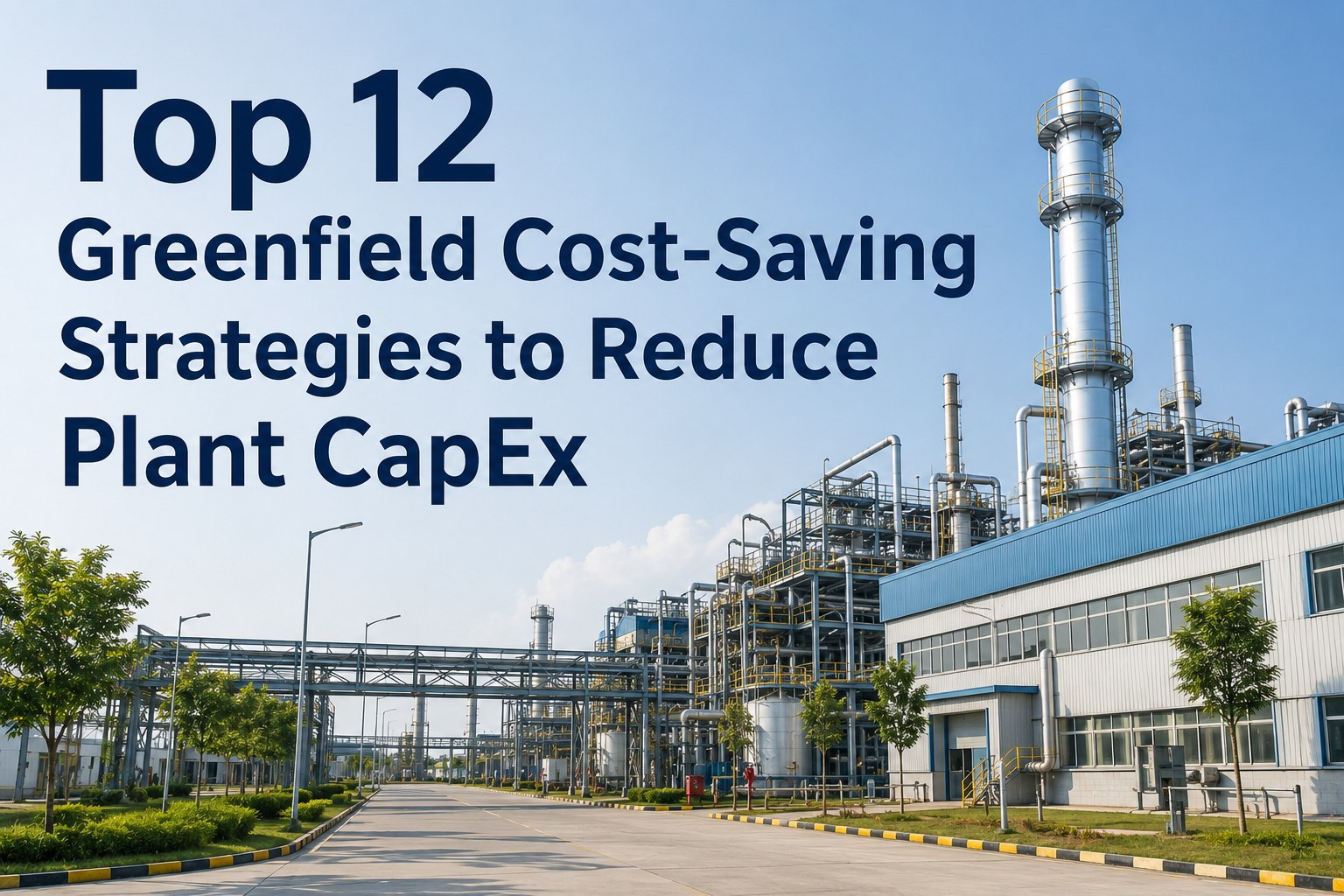
Top 12 Greenfield Cost-Saving Strategies — Reduce Plant CapEx 2026
Where the 15–35% CapEx Reduction Actually Comes From
Phase 1 — Planning
−5 to 12%
Right-sizing · AI scenario modeling · Site selection
Phase 2 — Design
−4 to 10%
AI layout · Utility right-sizing · Modular prefab
Phase 3 — Procurement
−3 to 8%
Vendor competition · Long-lead timing · Open protocols
Phase 4 — Execution
−3 to 5%
Virtual commissioning · BIM clash · Phased automation
Optimized CapEx
65–85%
15–35% cumulative reduction
15–35%CapEx reduction at mature optimization (McKinsey)
10–50×Cost of mid-project design changes vs. catch at planning
20–30%Timeline compression from modular prefabrication
2–4%ROIC improvement from disciplined CapEx optimization
Phase 1 — Planning Strategies (5–12% CapEx Reduction)
Planning-phase savings are the highest leverage and the cheapest to capture. Every dollar of optimization at concept design returns 10 to 50× compared to fixing the same issue mid-project. Three strategies dominate.
01
Right-Size Plant Capacity Against Demand Scenarios
Impact: 3 to 8% of total CapEx
Build too large → stranded capital + 15+ years of OpEx waste. Build too small → lost market share + Phase 2 expansion at 2 to 3× greenfield cost. AI scenario modeling tests demand against capacity options before structural design begins.
02
Six-Factor Site Selection Model
Impact: 2 to 5% of total CapEx (plus OpEx)
Score sites on energy, workforce, supply chain, permitting, incentives, digital infrastructure — not land cost alone. Energy availability is now the #1 site factor for advanced manufacturing.
03
Phased Master Planning From Day One
Impact: 2 to 4% of Phase 1 CapEx
Phase 1 operates at 40 to 60% capacity with Phase 2 and 3 pre-planned in layout, utilities, infrastructure. Avoids 2 to 3× retrofit cost when capacity needs grow. Micron, Texas Instruments, Rivian all use this pattern.
Phase 2 — Design Strategies (4–10% CapEx Reduction)
Design-phase savings come from applying AI simulation, utility right-sizing, and modular prefabrication before construction drawings are finalised. These strategies require disciplined FEED — not last-minute value engineering.
04
AI-Driven Facility Layout Optimization
Impact: 2 to 5% of total CapEx
Generative design evaluates thousands of layout configurations in 6 to 8 weeks vs. 3 to 6 months traditional. Optimises material flow, footprint, utility routing. Prevents the costly modifications 60%+ of manufacturers face within 3 years.
05
Utility Right-Sizing With AI Load Modeling
Impact: 1 to 3% of total CapEx
AI models actual load profiles vs. nameplate sums. Avoids 20 to 40% over-specification on transformers, compressors, HVAC — the most common utility CapEx waste. Maintain 20% headroom; eliminate the rest.
06
Modular Prefabrication & Skid-Mounted Systems
Impact: 1 to 4% of total CapEx + 20–30% timeline
Prefab modular plant sections, skid-mounted utilities, pre-assembled MEP racks. Factory-built quality, faster site install, lower site labor cost. 20 to 30% timeline compression compounds across all phases.
Want AI-driven layout and utility right-sizing applied to your FEED? Book a CapEx optimization consultation — we will run the simulation before construction drawings are finalised.
Phase 3 — Procurement Strategies (3–8% CapEx Reduction)
Procurement is where vendor lock-in, late long-lead orders, and bespoke specifications quietly inflate the budget. Three strategies break the pattern.
07
Open-Protocol Equipment Specifications
Impact: 1 to 3% of equipment CapEx
Specify OPC-UA, MQTT, REST API compliance — not vendor-specific protocols. Enables 3+ vendor competition per major equipment category. Avoids 15 to 30% bespoke-spec premium and ongoing spares captivity.
08
Long-Lead Procurement at 70% FEED
Impact: 1 to 3% of total CapEx + critical path
Release transformers, switchgear, custom vessels at 70% FEED — not 100%. Avoids rush premiums, expediting fees, and commissioning compression. AI lead-time modeling identifies optimal release windows.
09
AI Procurement Timing & Commodity Hedging
Impact: 1 to 2% of total CapEx
AI models commodity price forecasts, supplier capacity utilization, currency exposure. Identifies optimal ordering windows. Avoids both rush premiums (late orders) and excess inventory carrying costs (early orders).
Apply All 12 Strategies Before Your Budget Is Locked
iFactory's CapEx optimization consultation runs all 12 strategies against your project — AI scenario modeling, layout optimization, utility right-sizing, modular prefab evaluation, procurement timing, virtual commissioning planning. Delivered before FEED is final and procurement begins.
Phase 4 — Execution Strategies (3–5% CapEx Reduction)
Execution-phase savings come from catching problems virtually before they cost real money — and from phasing automation investment so it follows demand rather than gambling on it.
10
Virtual Commissioning Before Physical
Impact: 1 to 2% of total CapEx + 30–50% commissioning time
Digital twin commissioning validates PLC code, controls integration, utility loads before physical commissioning. Errors fixed in software at FEED-equivalent cost — not at 50 to 100× the cost during plant startup.
11
BIM Clash Detection & Coordination
Impact: 1 to 2% of total CapEx + 20% RFI reduction
Navisworks federated model with ±3mm structural / ±5mm MEP tolerances. Every RFI costs 3 to 14 days schedule. BIM Level 2+ with clash detection eliminates the most common construction-phase cost driver.
12
Phased Automation — Buy When Demand Lands
Impact: 1 to 2% of Phase 1 CapEx
Design AI-native infrastructure into the plant. Phase actual robot, cobot, AMR investment to demand growth. Avoids stranded automation capital when ramp-up is slower than forecast.
Before vs. After: What Disciplined Cost Optimization Actually Looks Like
The difference between an unoptimized and optimized greenfield is visible in every line item. Two side-by-side examples on identical scope.
Unoptimized Approach
$100M
Baseline plant CapEx
Land & site$8M
Building shell$22M
Utilities (over-specified)$18M
Equipment (vendor lock-in)$32M
IT/OT (under-budgeted)$6M
Contingency & rework$14M
Mid-project changes, RFIs, utility retrofits, commissioning compression — all baked into the baseline.
12-Strategy Optimized
$78M
22% CapEx reduction
Land & site$8M
Building shell (modular)$18M
Utilities (right-sized + 20% headroom)$14M
Equipment (open protocol, multi-vendor)$26M
IT/OT (10–18% as AI-native)$10M
Contingency & rework$2M
Virtual commissioning, BIM clash detection, and AI scenario modeling eliminate most rework — contingency drops to bare minimum.
Expert Perspective: Where the 22% CapEx Reduction Actually Hides
The biggest source of CapEx savings isn't a single line item. It's the contingency. Unoptimized greenfields carry 12 to 18% contingency because the project knows it will be wrong — utilities will be undersized, equipment will need rework, RFIs will multiply during construction. Optimized greenfields carry 2 to 4% contingency because the planning, simulation, and coordination work eliminated the predictable surprises. The reduction in contingency alone funds the entire optimization effort. Plants that skip this work pay the same money — they just pay it as variation orders, rework, and schedule slip instead of as planning effort.
— iFactory Greenfield Consulting, Capital Projects Practice 2025 to 2026
12–18%
Contingency carried by unoptimized greenfields
2–4%
Contingency on disciplined, optimized projects
60%+
Of manufacturers face costly layout modifications within 3 years
Ready to capture the 15–35% CapEx reduction before budgets lock? Talk to our CapEx optimization team — we will apply all 12 strategies to your project.
Cut 15–35% CapEx Before Construction — Not After
iFactory's CapEx optimization consultation applies all 12 strategies — AI scenario modeling, six-factor site scoring, phased master planning, AI layout optimization, utility right-sizing, modular prefab evaluation, open-protocol procurement, AI long-lead timing, virtual commissioning, BIM clash, and phased automation — delivered before FEED is locked.
Frequently Asked Questions
How much CapEx reduction is realistically achievable on a greenfield manufacturing project?
McKinsey research shows companies with mature CapEx optimization processes reduce capital spend 15 to 35% and improve ROIC by 2 to 4% through better planning, benchmarking, and execution control. The reduction is cumulative across planning, design, procurement, and execution phases — not a single line-item cut. Plants applying all 12 strategies typically land in the 20 to 30% reduction range on equivalent scope.
Why does catching design issues at planning save 10 to 50× vs. catching them during construction?
At planning, a design issue is a redline on a drawing — hours of engineering time. At construction, the same issue requires structural modification, RFI processing, change orders, and contractor delay claims. At commissioning, it can require equipment swap, line shutdown, and schedule slip into the next quarter. The cost multiplier compounds at every phase boundary — making early discipline the highest-ROI investment in any greenfield project.
Does modular prefabrication actually deliver the 20 to 30% timeline compression promised?
Yes, when applied correctly. Prefab modular plant sections, skid-mounted utility systems, and pre-assembled MEP racks are built in factory conditions while site work proceeds in parallel. Site install time drops dramatically. The 20 to 30% compression is real but requires upfront design discipline — modular benefits are lost if the design isn't structured for modular delivery from FEED.
Should IT/OT budget really be 10 to 18% of CapEx — that seems high compared to traditional builds?
For AI-ready facilities, yes. Traditional 5 to 8% allocations cover basic networking and a simple CMMS. The 10 to 18% range covers edge computing, private 5G or Wi-Fi 6E, unified data architecture, MES, CMMS, cybersecurity, and the 2 to 3× higher electrical capacity AI-powered operations require. Retrofitting these later costs 4 to 6× the greenfield specification — making the higher upfront allocation the lower total cost path.
How does iFactory's CapEx optimization consultation actually work?
iFactory's consultation applies all 12 strategies to your project — AI scenario modeling for capacity, six-factor site scoring, phased master planning, AI layout optimization in 6 to 8 weeks, utility right-sizing with load modeling, modular prefab evaluation, open-protocol equipment specifications, AI long-lead timing, virtual commissioning roadmap, BIM clash detection plan, and phased automation strategy. Output is a working CapEx model with documented savings per strategy.
Book your CapEx optimization consultation here.