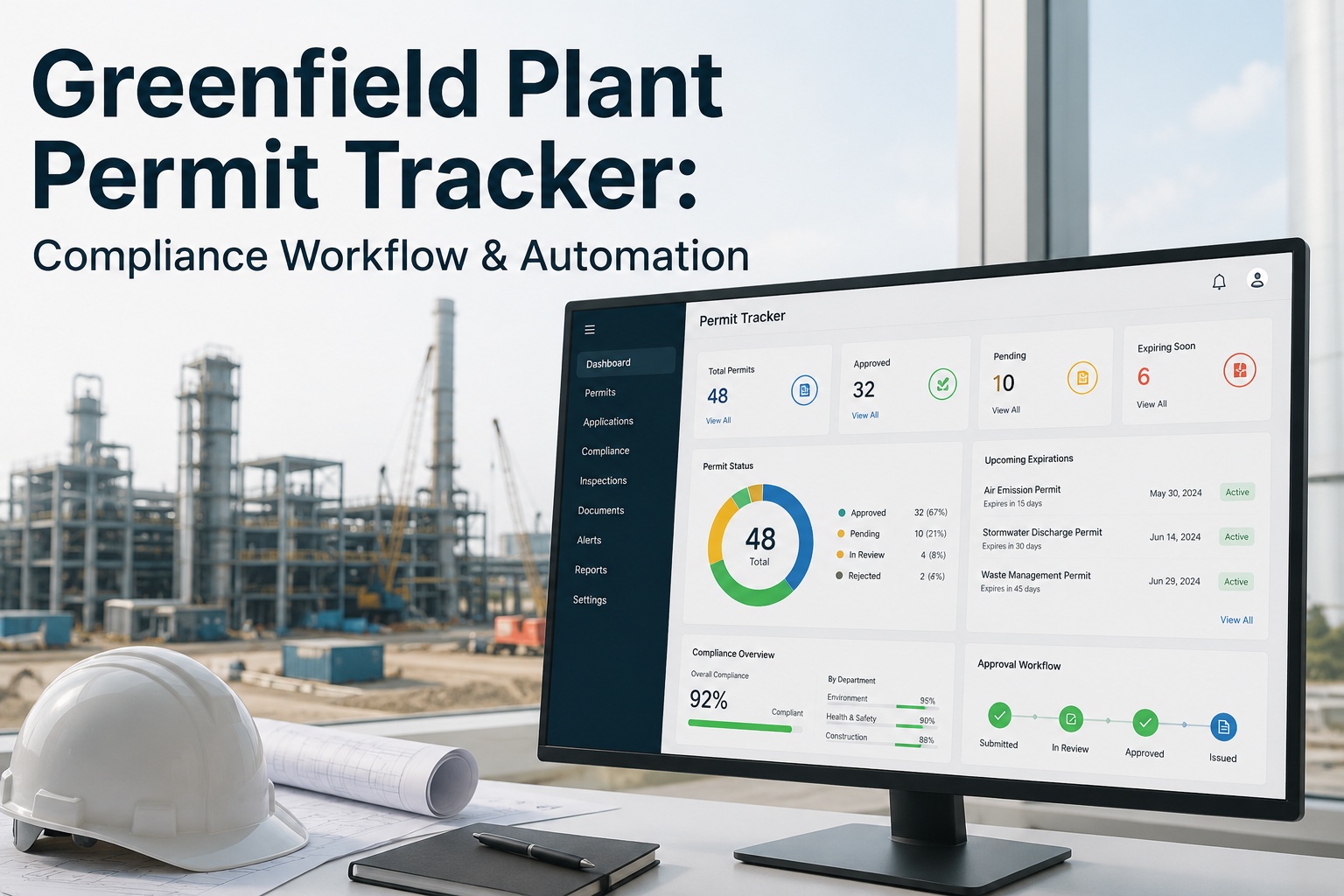
A single missed Title V air permit deadline can halt production. A failed OSHA inspection can carry penalties up to $170,735 per willful violation. A greenfield plant juggles 40 to 80 distinct permits across federal, state, and local agencies — each with its own approval cycle, renewal cadence, monitoring requirement, and audit trail. Spreadsheets and shared inboxes cannot manage that surface area. The permit tracker architecture below covers the dashboard, workflow, and automation required for audit readiness from day one. Book a permit tracker consultation to design the compliance workflow before construction begins.
Every Permit. Every Deadline. Every Inspector Visit. One Dashboard.
42
Permits Approved & Current
Air, water, building, occupancy, equipment
7
Pending Submission & Review
Awaiting EPA, OSHA, state agency action
3
Renewals Due < 60 Days
Title V air, stormwater, hazmat storage
12
Reports Due This Quarter
Tier II, TRI Form R, GHG, air emissions
40–80Distinct permits a typical greenfield plant manages
$170,735OSHA maximum penalty per willful violation
24 hrFSMA 204 recall data response window for food plants
365Days a year of audit readiness — not the week before
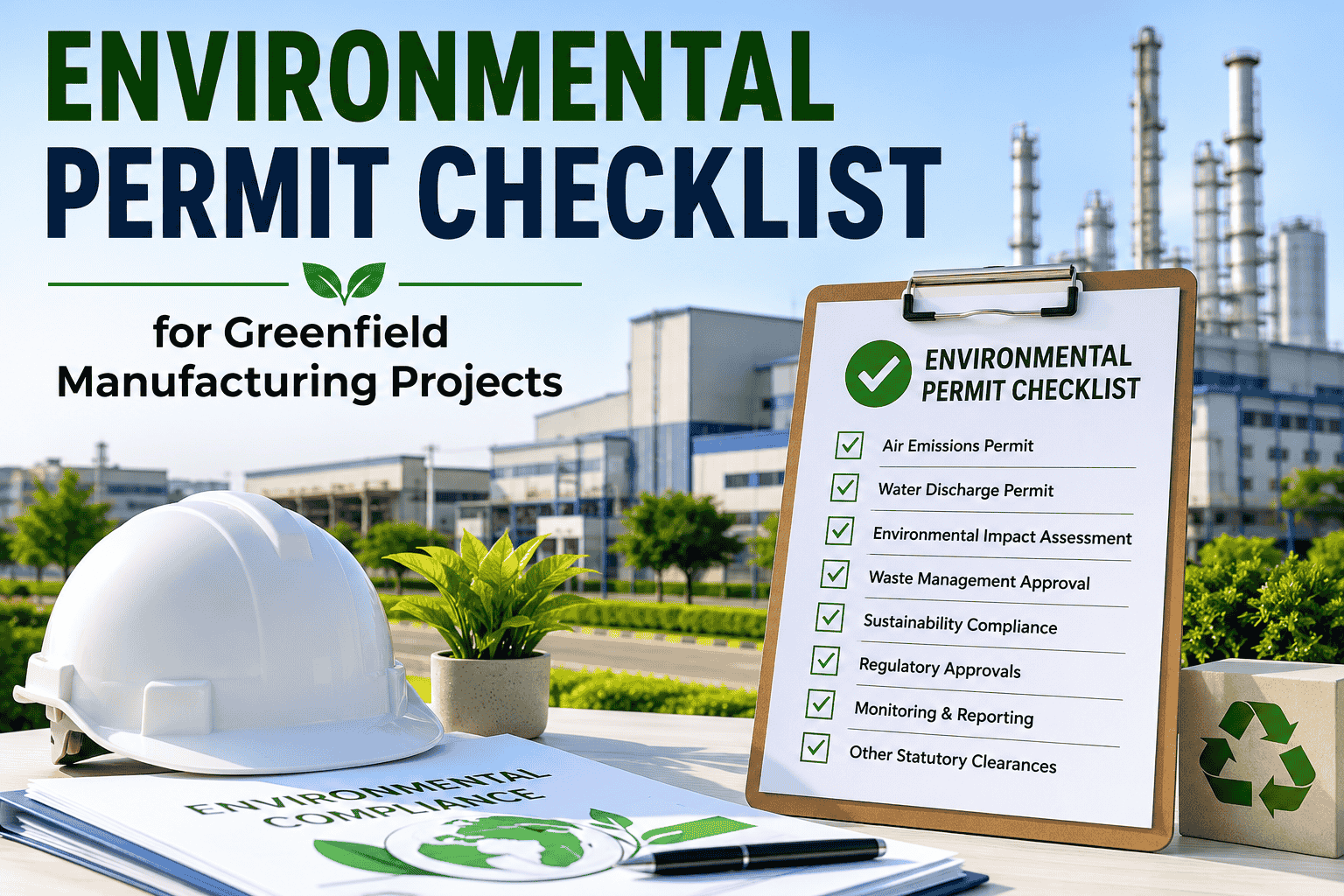
The Permit Universe: 6 Categories Every Greenfield Plant Must Manage
Permits are not a single category. They span environmental, safety, building, equipment, operational, and sector-specific frameworks — each with its own agencies, cycles, and renewal cadences. Mapping the full universe before construction starts prevents the gaps that surface during inspections.
Environmental (EPA)
Title V Air · NPDES Water · RCRA Hazardous Waste · Stormwater · SARA Tier II · TRI Form R · GHG Emissions
Renewal: Annual to 5-year cycles
Safety (OSHA)
PSM 1910.119 · HazCom · Lockout/Tagout · Confined Space · Hot Work · Process Safety · Worker Training Records
Renewal: Continuous + annual certification
Building & Occupancy
Building permit · Foundation · Electrical · Plumbing · Fire suppression · Certificate of Occupancy
Wastewater discharge · Stormwater Pollution Prevention Plan · Spill prevention · Chemical inventory · Emergency response
Renewal: Annual + immediate updates
Sector-Specific
FDA registration · FSMA 204 traceability · USDA · IEC 62443 cyber · DEA controlled substances · DOT hazmat shipping
Renewal: Varies by sector
The Permit Lifecycle: From Application to Renewal — Automated
Every permit moves through the same 5-stage lifecycle. What changes is how the cycle is managed: spreadsheets and email reminders create gaps; automated workflows close them. The lifecycle below is what a modern compliance platform owns end-to-end.
1
Identify & Apply
Permit need triggered by activity (new equipment, process change, capacity increase). Application filed with the right agency on the right schedule.
2
Track Approval
Status monitored from submission through agency review. Conditions and modifications captured. Approval date and expiry recorded.
3
Monitor Compliance
Permit conditions translated into operational tasks: monitoring schedules, reporting cadences, training records, inspection logs.
4
Report & Audit
Regulatory reports auto-generated from operational data. Audit trail maintained. Documents retrieved in sub-minute for inspections.
5
Renew
90-day automated reminders. Renewal filed before expiry. Continuous coverage maintained. Zero compliance gaps.
Want the full 5-stage lifecycle automated across all 6 permit categories? Book a permit tracker consultation — we will design the workflow before construction begins.
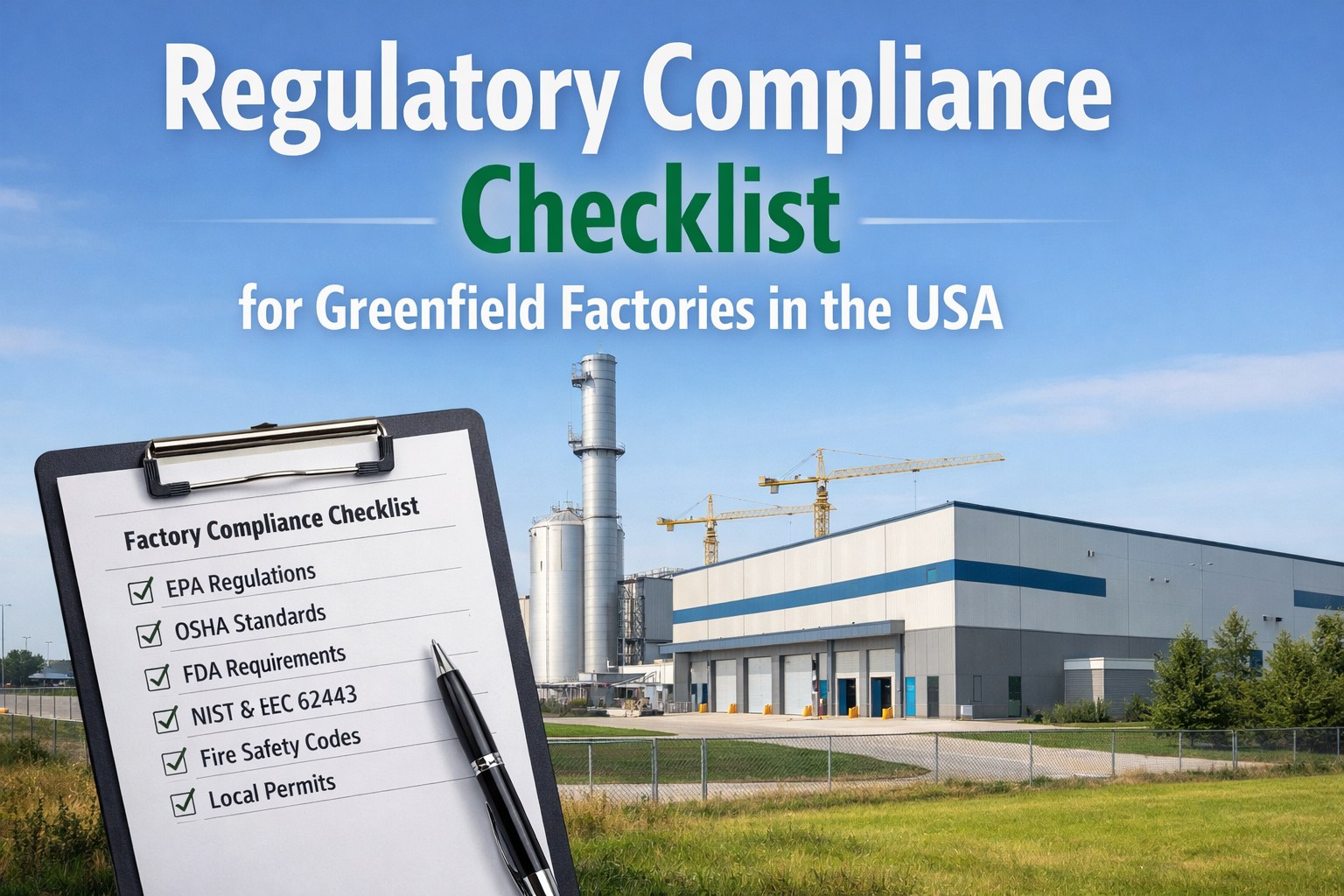
Critical 2026 Compliance Deadlines a Permit Tracker Must Catch
Every greenfield plant inherits a calendar of recurring federal deadlines. Missing one triggers citations, fines, or permit revocation. The dates below are non-negotiable — and a proper permit tracker fires automated reminders 90, 60, 30, and 7 days ahead of each.
FEB 1
OSHA Annual Injury & Illness Summary
Post visibly from Feb 1 through April 30 · Required for all employers with 11+ workers
MAR 1
EPCRA SARA Tier II Chemical Reports
Hazardous chemical inventory above thresholds · Filed with state, fire department, LEPC
MAR 1
Hazardous Waste Biennial Reports
Large Quantity Generators · Due every even year · RCRA compliance
MAR 2
OSHA Electronic Injury & Illness Reporting
Form 300A submission · Expanded industry coverage in 2026
MAR 31
Greenhouse Gas Emissions Report
EPA mandatory GHG reporting · California deadline June 30
APR 1
Air Emissions Inventory
Class I and Class II air sources · State EPA filing
Semi-annual deviation reporting · Annual full certification
Stop Running Compliance on Spreadsheets — Switch to a Designed Permit Tracker
iFactory's permit tracker consultation maps your full permit universe across all 6 categories, builds the 5-stage lifecycle automation, sets 90/60/30/7-day reminder cadences, and integrates with CMMS work orders — delivered before commissioning so you launch audit-ready.
Spreadsheets vs. Permit Tracker: What Changes When You Switch
Plants still running compliance on binders, spreadsheets, and email reminders face exponentially higher audit risk and operational overhead than those on purpose-built platforms. The side-by-side below is the operational difference.
Spreadsheet Approach
Permit data scattered across multiple files
Manual deadline reminders from one person's memory
Audit document retrieval: hours to days
Email-based approval routing without trail
No visibility into renewal status across sites
Compliance gaps discovered during inspections
Permit Tracker Platform
Single dashboard for all permits, all sites
Automated multi-channel reminders (email + SMS)
Sub-minute audit document retrieval
Workflow approval routing with audit trail
Real-time renewal status across portfolio
Compliance gaps surfaced 90 days ahead
Expert Perspective: Why Compliance Must Be Designed at FEED — Not Added After Commissioning
Retrofitting compliance into an operating factory means halting production, ripping out systems, retraining staff, and paying premium rates for emergency remediation. Designing compliance into the blueprint costs a fraction — and ensures you pass every audit from day one. The greenfield window is the only time you can map all 40 to 80 permits, build the workflow automation, integrate compliance with the CMMS and MES, and train operations teams on the platform before anything goes wrong. Skip this step and the first OSHA citation pays for the system you should have built upfront.
— iFactory Greenfield Consulting, Compliance & Regulatory Practice 2025 to 2026
$170,735
OSHA maximum per willful violation
90 days
Standard automated reminder lead time before expiry
365
Days a year audit-ready — not just the inspection week
Ready to launch your greenfield plant audit-ready from day one? Talk to our compliance team — we will design the full permit tracker architecture before commissioning.
Launch Audit-Ready From Day One — Not Year Two
iFactory's permit tracker consultation maps your full permit universe, designs the 5-stage lifecycle automation, sets multi-channel reminder cadences, integrates compliance workflow with CMMS work orders, and trains operations on day-one audit readiness — all delivered before commissioning.
How many permits does a typical greenfield manufacturing plant manage?
A typical greenfield plant manages 40 to 80 distinct permits across environmental, safety, building, equipment, operational, and sector-specific categories. Process industries and food plants with FSMA 204 traceability requirements run toward the upper end. The count compounds across multi-site operations, and even small plants face the same federal frameworks at reduced scope. The volume is why spreadsheet-based tracking consistently fails by year 2 of operation.
What are the most commonly missed compliance deadlines in 2026?
The most commonly missed deadlines are SARA Tier II (March 1), TRI Form R (July 1), Title V semi-annual certifications, OSHA annual injury summary posting (Feb 1 through April 30), and equipment permit renewals (boilers, pressure vessels, cranes). These miss because they sit in one person's calendar rather than an automated tracker. A modern permit tracker fires 90/60/30/7-day reminders on every recurring obligation across the portfolio.
What is the actual penalty exposure for missing permits or OSHA violations?
OSHA penalties run up to $170,735 per willful violation as of 2026, with serious violations around $17,000 per item and repeated violations stacking quickly. EPA penalties for Title V air violations, RCRA hazardous waste violations, and Clean Water Act discharges can reach similar or higher levels per day of non-compliance. Beyond fines, missed permits can trigger production shutdown, certification loss, and customer disqualification under quality and sustainability auditing.
Should a permit tracker integrate with the CMMS and EHS platforms?
Yes. Permit conditions translate into operational tasks — monitoring schedules, inspection logs, training records, equipment certifications — that live naturally in the CMMS work order system. Integration eliminates double-entry, ensures compliance tasks get crew assignments, and produces audit trails automatically. Plants running separate compliance and CMMS systems consistently develop master data drift between the two within 12 months — defeating the purpose of either tool.
How does iFactory's permit tracker consultation work?
iFactory's consultation maps your full permit universe across all 6 categories, builds the 5-stage lifecycle automation, sets 90/60/30/7-day reminder cadences across multiple channels, integrates compliance workflow with your CMMS and MES, designs audit-ready document retrieval, and trains operations on the platform — all delivered before commissioning. Book your permit tracker consultation here.