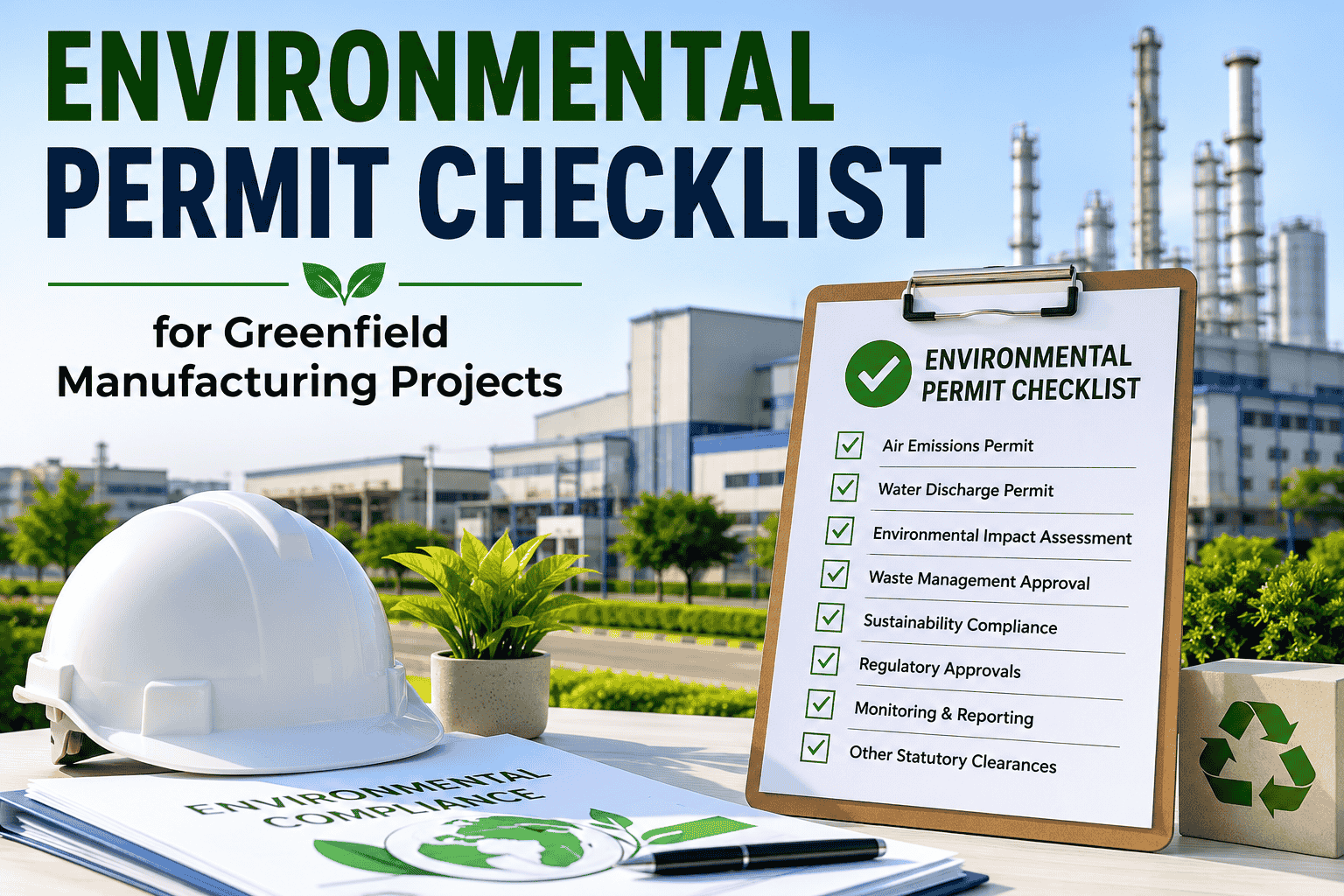
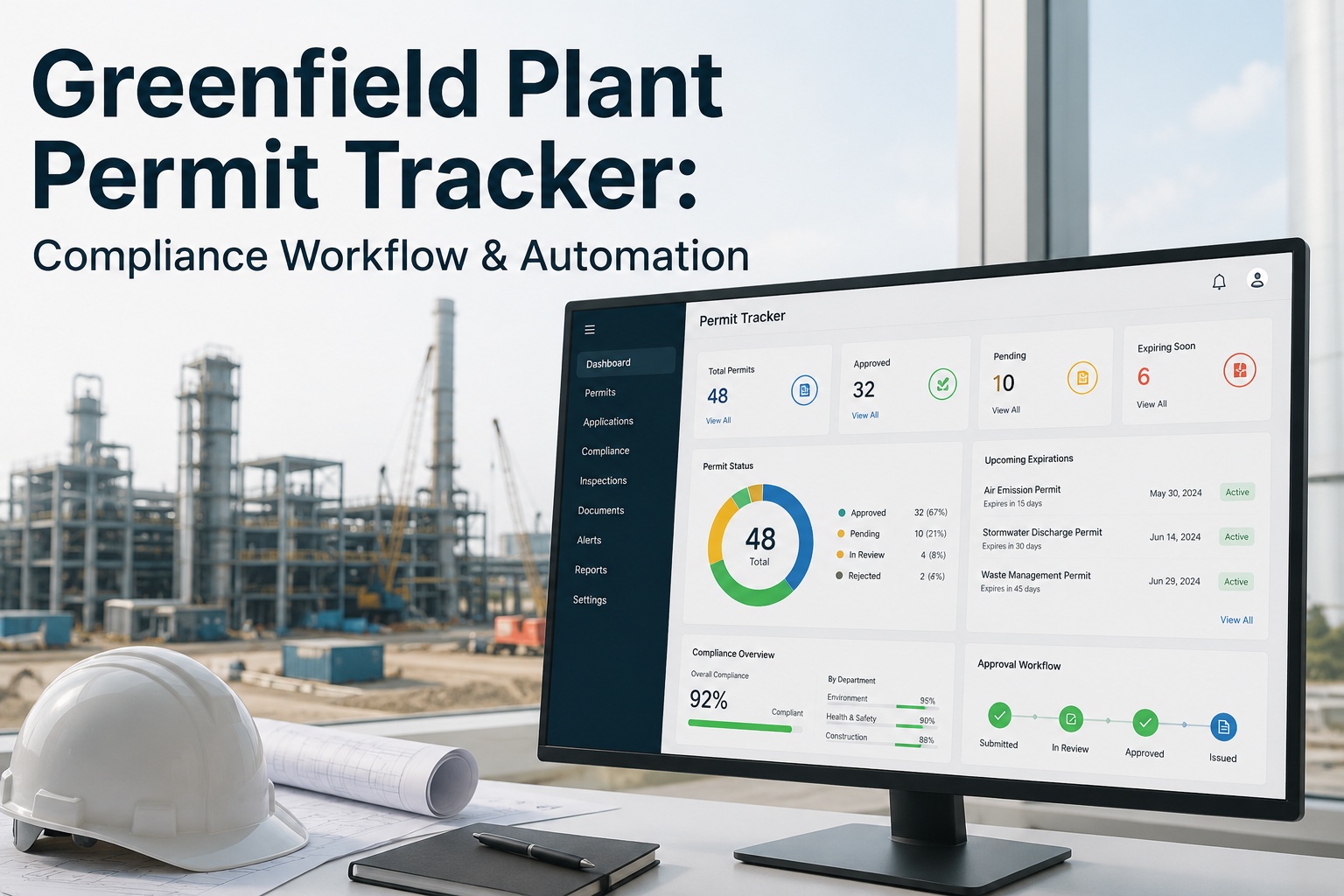
Environmental permitting is one of the highest-risk workstreams in greenfield manufacturing projects — not because individual permits are technically difficult but because the cumulative timeline, agency coordination, and documentation burden consistently consume more calendar time than project teams plan for. Most greenfield project delays trace to environmental permitting issues that surfaced late: an air permit modification required after process design finalized, an NPDES discharge limit that constrained production capacity, an Endangered Species Act consultation that extended NEPA review by 12 months, a Tier II reporting threshold crossed without preparation. This checklist covers the federal and state environmental permits required for U.S. greenfield manufacturing projects, organized into four categories with timing, documentation, and agency responsibility for each. Book a greenfield consultation to map environmental permitting against your specific facility timeline.
Clean Air Act permits governing emissions from combustion, process equipment, and HAPs.
Title V Operating
PSD / NSR
NESHAP
NSPS
Begin: 18–24 months pre-construction
CATEGORY 02
Water Quality
Clean Water Act permits for discharge, stormwater, spills, and wetlands impact.
NPDES
Industrial Stormwater
SPCC Plan
Section 404 Wetlands
Begin: 12–18 months pre-construction
CATEGORY 03
Waste & Chemicals
RCRA hazardous waste, TSCA chemical management, EPCRA emergency planning, reporting.
RCRA Generator
TSCA / CDR
EPCRA Tier II
TRI (Form R)
Begin: 9–15 months pre-construction
CATEGORY 04
Environmental Reviews
NEPA, ESA, NHPA, and state environmental review processes plus sustainability certifications.
NEPA EA / EIS
ESA Section 7
NHPA Section 106
State EQA
Begin: 24+ months pre-construction
The Greenfield Environmental Permitting Challenge
Environmental permitting for greenfield manufacturing projects is harder than most project teams expect for five reasons that compound. First, federal baseline requirements layer with state-specific programs that vary by operating geography. Second, permit applications require process design data that may not be finalized when applications must be submitted. Third, public comment periods and agency review cycles cannot be compressed regardless of project urgency. Fourth, permit modifications mid-construction trigger restart of review cycles. Fifth, post-issuance compliance obligations continue for the life of the facility. The five challenges below define what makes environmental permitting particularly demanding for greenfield projects.
01
Multi-Jurisdictional Complexity
Federal permits (EPA-administered) layer with state programs (often delegated authority from EPA) and local approvals. Each jurisdiction has distinct application requirements, timelines, fees, and review processes. State delegated authority varies — some states impose stricter requirements than federal baseline; California (CARB, CEQA) is the strictest. Project teams must navigate all three levels simultaneously.
02
Long Lead Times Compound
Major permits take 6–24 months from application to issuance. NEPA Environmental Impact Statements alone can take 24–48 months. Air PSD permits 12–18 months. NPDES individual permits 9–15 months. When permits sequence (one required before another can be filed), cumulative timeline can exceed 36 months. Compression options are limited.
03
Public Comment & Stakeholder Engagement
Major permits require public notice and comment periods that cannot be waived for project urgency. Local opposition can trigger contested case hearings adding 12–24 months. Tribal consultation, environmental justice considerations, and stakeholder engagement requirements have expanded substantively since 2022 and continue evolving in 2026.
04
Permit Modifications Trigger Restart
Material changes to process design after permit issuance trigger permit modification review — effectively restarting the review cycle. Common triggers: production capacity expansion, equipment substitution, new HAP emissions, discharge limit changes. Project teams must lock process design before permitting or accept timeline restart risk.
05
Ongoing Compliance Obligations
Permits create life-of-facility compliance obligations: emissions monitoring, discharge sampling, hazardous waste manifesting, annual reporting (TRI, GHG, Tier II), recordkeeping. Permit conditions become operational constraints. Compliance management systems must be designed during facility planning, not added after operations begin.
06
Penalties for Permit Failures
Operating without required permits or violating permit conditions triggers significant civil and potentially criminal penalties. EPA penalty matrices treat unpermitted operation differently from permitted operation with violations. Construction or operation before permit issuance is among the highest-penalty violations. Avoid through proper permit sequencing.
Air Quality Permits Checklist
Air quality permits under the Clean Air Act are typically the longest-lead and highest-risk category for greenfield manufacturing projects. Begin air permitting 18–24 months before construction. The checklist below covers the four primary federal air permits plus state-specific programs. The applicable permits depend on facility location (attainment vs non-attainment area), process emissions profile, and operational status as major or minor source.
Federal operating permit required for major sources of air emissions. Major source thresholds: 100 tpy criteria pollutants, 10 tpy single HAP, 25 tpy total HAPs (lower in non-attainment areas). Title V consolidates all applicable Clean Air Act requirements into a single permit.
Confirm major source determination based on potential to emit (PTE)
Compile emissions inventory for all units (boilers, dryers, ovens, vents, fugitives)
Document control technology applied (RACT, BACT, MACT)
Submit application to state air agency (delegated from EPA)
Respond to agency completeness review and technical comments
Public comment period (30 days minimum)
EPA review (45 days; can object)
Final permit issuance before commencement of operation
Pre-construction permit for major sources or major modifications. PSD applies in attainment areas; Nonattainment NSR (NNSR) applies in non-attainment areas. Triggers stringent control technology requirements (BACT or LAER) and air quality impact analysis.
Confirm attainment status of project location (PSD vs NNSR)
Perform Best Available Control Technology (BACT) analysis
Conduct air quality dispersion modeling (AERMOD or equivalent)
Evaluate impacts on Class I areas (national parks, wilderness)
Submit application with engineering analysis and impact assessment
Receive permit before commencing physical construction
Track BACT requirements through construction and equipment selection
National Emission Standards for Hazardous Air Pollutants (NESHAP) and New Source Performance Standards (NSPS) apply to specific industry source categories. Subpart-specific requirements for emissions limits, monitoring, recordkeeping, and reporting.
Identify applicable NESHAP subparts for your industry source category
Identify applicable NSPS subparts for new equipment
Document MACT (Maximum Achievable Control Technology) requirements
Implement initial compliance demonstration (testing, monitoring)
Set up ongoing monitoring per subpart-specific requirements
Configure recordkeeping for required reports (semiannual, annual)
State-issued operating permits for sources below Title V thresholds. Programs vary by state — California (SCAQMD, BAAQMD, etc.), Texas (TCEQ), New York (DEC) each have distinct programs. State permits often more stringent than federal baseline.
Identify applicable state air agency (state EPA, regional air districts)
Determine state-specific permit thresholds and applicability
Coordinate state operating permit with Title V if both applicable
Document state-specific control requirements (often stricter than federal)
Submit applications with required engineering supporting documentation
Need help mapping air quality permits against your specific facility profile? Book a greenfield consultation — we’ll walk through applicable air permits based on your industry, process emissions profile, and operating geography.
Water Quality & Discharge Permits Checklist
Water quality permits under the Clean Water Act cover process water discharge, stormwater management, spill prevention, and wetlands impact. Most water permits are administered by states with EPA-delegated authority. Begin water permitting 12–18 months before construction. The checklist below covers the four primary water permits required for most greenfield manufacturing projects.
National Pollutant Discharge Elimination System permit required for any point source discharge to waters of the United States. Individual permits for direct discharges; general permits available for some categories. Effluent limits, monitoring, and reporting required.
Determine if facility will discharge directly to surface water
Identify applicable effluent limitation guidelines (ELGs) for your industry
Conduct process water characterization (flow, pollutants, variability)
Design treatment system to meet anticipated permit limits
Submit NPDES individual permit application (Form 1 + Form 2C)
Engage state water agency through technical review
Establish discharge monitoring report (DMR) program before startup
NPDES Multi-Sector General Permit (MSGP) covers stormwater discharges from industrial activities. Sector-specific monitoring and best management practices. Most manufacturing facilities require coverage under applicable sector.
Identify applicable industrial sector (Sectors A-AD per SIC code)
Develop Stormwater Pollution Prevention Plan (SWPPP)
Identify potential pollutant sources and control measures
Submit Notice of Intent (NOI) for general permit coverage
Plan benchmark and effluent monitoring per sector requirements
Document operator training and inspection schedules
Spill Prevention, Control, and Countermeasure (SPCC) plan required for facilities with aggregate aboveground oil storage capacity exceeding 1,320 gallons (or 42,000 gallons underground). Plan must be PE-certified for facilities over 10,000 gallons.
Inventory all oil-containing equipment (tanks, drums, transformers)
Calculate aggregate storage capacity to determine applicability
Design secondary containment for storage areas
Prepare written SPCC plan addressing all required elements
Obtain Professional Engineer certification (if >10,000 gallons)
Train personnel on spill response procedures before operations
U.S. Army Corps of Engineers permit required for discharge of dredged or fill material into waters of the United States, including wetlands. Nationwide Permits cover routine activities; Individual Permits required for larger impacts. Triggers Section 401 state water quality certification.
Conduct wetlands delineation during site characterization
Identify any wetlands, streams, or other waters of the U.S. on site
Design site to avoid or minimize impacts where feasible
Determine permit type required (Nationwide or Individual)
Submit application to USACE district office
Coordinate Section 401 state water quality certification
Plan compensatory mitigation if impacts unavoidable
Want help structuring water quality permitting for your project? Book a greenfield consultation — we’ll evaluate discharge characteristics, stormwater management approach, and wetlands impact for your specific site.
Waste, Chemicals & Hazmat Compliance Checklist
Waste and chemical management requirements span multiple federal statutes — RCRA for hazardous waste, TSCA for chemicals, EPCRA for emergency planning and reporting. Most don’t require pre-approval permits like air or water but create ongoing notification, registration, and reporting obligations. Begin waste and chemical compliance planning 9–15 months before startup. Set up systems before operations to avoid early compliance gaps.
Resource Conservation and Recovery Act (RCRA) classifies hazardous waste generators based on monthly generation rates: VSQG (less than 100 kg/mo), SQG (100–1,000 kg/mo), LQG (more than 1,000 kg/mo). Different requirements apply at each tier.
Identify all hazardous waste streams from process design
Estimate monthly generation rates per waste code
Determine generator status (VSQG/SQG/LQG)
Obtain EPA ID number (Form 8700-12)
Establish hazardous waste accumulation areas with required signage
Set up manifesting system for off-site shipments
Contract with permitted TSD facility for waste disposal
Develop hazardous waste personnel training program
Toxic Substances Control Act (TSCA) regulates manufacturing, processing, importing, and use of industrial chemicals. Chemical Data Reporting (CDR) required every four years for manufacturers and importers above thresholds. Premanufacture Notification (PMN) required before manufacturing new chemicals.
Inventory all chemicals used or produced at facility
Verify all chemicals listed on TSCA Inventory
Submit Premanufacture Notification (PMN) for any new chemicals 90 days pre-manufacture
Plan Chemical Data Reporting (CDR) submission cycle
Document use of restricted substances (PCBs, asbestos, lead-based paint)
Track PFAS reporting requirements (expanding rapidly in 2025–2026)
Emergency Planning and Community Right-to-Know Act (EPCRA) Section 302 emergency planning notification and Section 312 Tier II hazardous chemical reporting. Annual reporting to State Emergency Response Commission (SERC), Local Emergency Planning Committee (LEPC), and fire department.
Identify Extremely Hazardous Substances (EHS) above Threshold Planning Quantity
Submit Section 302 notification to SERC and LEPC if applicable
Designate facility emergency coordinator
Identify hazardous chemicals above Tier II reporting thresholds
Submit Tier II inventory annually by March 1
Coordinate with LEPC for community emergency response planning
Toxic Release Inventory (TRI) reporting under EPCRA Section 313 for facilities in covered SIC codes that manufacture, process, or otherwise use TRI-listed chemicals above reporting thresholds. Public database with significant stakeholder visibility.
Verify facility falls under covered SIC codes (manufacturing 20-39)
Identify TRI-listed chemicals used at facility
Calculate threshold quantities (manufacture/process/otherwise use)
Track releases (air, water, land, off-site transfers) for reportable chemicals
Submit Form R or Form A by July 1 of each year
Update PFAS reporting per expanded 2024–2026 requirements
Want a complete waste and chemical compliance roadmap for your greenfield project? Book a greenfield consultation — we’ll structure RCRA, TSCA, and EPCRA compliance programs based on your specific process chemistry and waste profile.
Environmental Reviews & Sustainability Certifications Checklist
The final permit category covers environmental review processes (NEPA and state equivalents) and voluntary sustainability certifications. Environmental reviews are mandatory for projects with federal nexus — federal land, federal permits, federal funding. State environmental review applies in some states regardless of federal nexus (California CEQA, New York SEQR, Washington SEPA). Sustainability certifications are voluntary but increasingly expected by customers and investors. Begin environmental reviews 24+ months before construction.
National Environmental Policy Act review for projects requiring federal permits or federal funding. Environmental Assessment (EA) for projects with uncertain impacts; Environmental Impact Statement (EIS) for projects with significant impacts. EIS timeline typically 24–48 months from scoping to ROD.
Determine federal nexus (federal permits, funding, or lands)
Identify lead federal agency for NEPA review
Participate in scoping meetings and stakeholder consultation
Prepare technical studies (air, water, biology, cultural resources)
Support draft EA/EIS preparation by federal agency
Respond to public comment on draft EA/EIS
Obtain FONSI (Finding of No Significant Impact) or ROD (Record of Decision)
ESA Section 7 consultation with U.S. Fish & Wildlife Service (and/or NOAA Fisheries) for projects with federal nexus that may affect listed species or critical habitat. NHPA Section 106 consultation for impacts on historic properties. Tribal consultation requirements expanded substantially in recent years.
Conduct biological surveys for listed species and critical habitat
Initiate informal consultation with USFWS / NMFS
Determine if formal consultation required (effect determination)
Develop conservation measures to minimize impacts
Conduct cultural resource survey for NHPA Section 106
Initiate tribal consultation through lead federal agency
Document Section 106 mitigation if historic properties affected
State environmental quality act reviews where applicable. California CEQA, New York SEQR, Washington SEPA, Massachusetts MEPA. State review may run in parallel with NEPA or independently. State reviews often more rigorous than federal NEPA.
Identify if state environmental review applies (varies by state)
Determine lead state agency for review
Prepare state-required environmental documentation
Coordinate state review with federal NEPA if both apply
Participate in public hearings and stakeholder engagement
Obtain required state environmental determinations
Voluntary sustainability certifications increasingly expected by customers, investors, and corporate sustainability commitments. LEED v4.1 BD+C, LEED Zero Carbon, ENERGY STAR, GHG inventory verification, Science Based Targets initiative alignment.
Determine target LEED level (Certified, Silver, Gold, Platinum)
Register project with USGBC at design phase
Integrate LEED requirements into design and construction documents
Plan ENERGY STAR certification if applicable to facility type
Establish GHG inventory baseline for SBTi target setting
Plan third-party verification of GHG inventory (ISO 14064-3)
Build a Complete Permitting Roadmap for Your Greenfield Project
A greenfield consultation produces a documented environmental permitting roadmap covering all four categories aligned to your facility design, operating geography, and commissioning timeline. Output: prioritized permit list with timing, agency responsibility, and resource requirements.
Expert Perspective
"Environmental permitting consistently underdelivers against project schedules in greenfield manufacturing for one structural reason: the cumulative permit timeline exceeds what most project teams plan for, and permit modifications during construction trigger restart of review cycles that can add 6–18 months. The greenfield projects that complete environmental permitting on schedule do three things differently. First, they start environmental permitting at site selection, not after process design. Second, they lock major process parameters before submitting air and water permit applications — changes after submission trigger restart. Third, they treat NEPA, state environmental review, and ESA consultation as serial dependencies with the longest poles in the schedule, sequencing them at the earliest possible phase. For projects with federal nexus, NEPA EIS alone can take 24–48 months from scoping to Record of Decision, and the Endangered Species Act consultation often determines whether the schedule holds. The good news is that environmental permitting is well-understood territory — the agencies, requirements, and timelines are predictable when planned for. The bad news is that the consequences of treating environmental permitting as parallel rather than critical-path are severe: penalties for unpermitted operation, restart of review cycles for late modifications, and litigation risk that can delay projects by years. For 2026 greenfield projects, environmental permitting deserves the same project management rigor as facility construction itself."
— Greenfield Environmental Practice, 2026 perspective
4 Categories
air, water, waste/chemicals, environmental review
24–48 mo
NEPA EIS timeline from scoping to ROD
18–24 mo
PSD / NSR air permit from application to issuance
Map Environmental Permitting to Your Construction Schedule
A greenfield consultation walks through all four environmental permit categories, identifies critical-path permits for your specific facility and operating geography, and produces a documented permitting roadmap with phased milestones aligned to construction and commissioning timelines.
Frequently Asked Questions
When should we start environmental permitting for a greenfield project?
At site selection, not after process design. The cumulative environmental permitting timeline for a major greenfield manufacturing project can exceed 36 months when accounting for environmental review (NEPA), air permits (PSD/NSR), water permits (NPDES), and state-specific reviews. Starting environmental permitting after process design is locked typically delays facility startup by 12–24 months versus starting at site selection. The general sequencing: site characterization and environmental review begin at site selection (24+ months pre-construction), air permits begin 18–24 months pre-construction, water permits 12–18 months pre-construction, waste and chemical compliance 9–15 months pre-construction. Environmental reviews are the longest poles and should drive the master schedule.
What’s the difference between NEPA, EIS, and state environmental reviews?
NEPA (National Environmental Policy Act) is the federal environmental review process triggered when projects have federal nexus (federal permits, federal funding, federal land). Two NEPA documents: Environmental Assessment (EA) for projects with uncertain impacts, leading to either FONSI (Finding of No Significant Impact) or determination that EIS is required. Environmental Impact Statement (EIS) for projects with significant impacts — 24–48 month timeline from scoping to Record of Decision. State environmental reviews are separate state-level processes that apply regardless of federal nexus in states like California (CEQA), New York (SEQR), Washington (SEPA), and Massachusetts (MEPA). State reviews often more rigorous than NEPA. Projects subject to both can sometimes coordinate parallel reviews.
Schedule a consultation to assess applicability for your specific project.
Can we start construction before all permits are issued?
It depends on the permit type. Pre-construction permits (PSD/NSR air construction permits, Section 404 wetlands permits) prohibit physical construction before issuance. Operating permits (Title V, NPDES) can be applied for and issued during construction provided coverage exists by startup. Some agencies allow limited site preparation work before permit issuance under conditions. The general rule: never begin construction of permitted units before pre-construction permits are issued. The penalties for unpermitted construction are severe — EPA penalty matrices treat this as among the highest-tier violations. Construction that proceeds based on draft permits faces risk if final permits differ. Many greenfield projects experience pressure to start construction before permits are final; this pressure should be resisted because the penalty exposure and schedule restart risk usually exceeds the perceived schedule benefit.
What happens if process design changes after permits are issued?
Material changes trigger permit modification review — effectively restarting the review cycle for the modified permit. Common triggers: production capacity expansion, equipment substitution, new emissions sources, discharge limit changes, new HAP emissions. Modification review timelines depend on permit type and modification significance: minor modifications may take 3–6 months, significant modifications 9–15 months, fundamental modifications can equal original permitting timeline. The greenfield projects that complete permitting on schedule lock major process parameters before permit application and discipline downstream changes to be incremental within the permitted envelope. Mid-construction process changes are particularly costly because they create timeline restart risk during the highest-spending project phase. This is why process design lock before permit application is essential.
How is environmental permitting changing in 2025–2026?
Several substantive changes affecting greenfield environmental permitting in 2025–2026. PFAS regulation expanding rapidly — new TRI listings, drinking water standards, CERCLA designation, EPCRA reporting. Environmental justice requirements expanding under federal and state programs, particularly for projects in disproportionately impacted communities. Tribal consultation requirements expanding under multiple statutes. CSRD (EU) mandatory compliance phasing in for EU operations and large EU-trading companies, requiring detailed environmental disclosure. SEC climate disclosure rules requiring climate risk reporting from U.S. public companies. State climate disclosure laws (California SB-253, SB-261) layering additional requirements. The trend is toward more comprehensive disclosure, more rigorous consultation, and more stringent emissions standards. Greenfield projects designed to current standards face guaranteed retrofitting within their first decade as standards continue tightening.