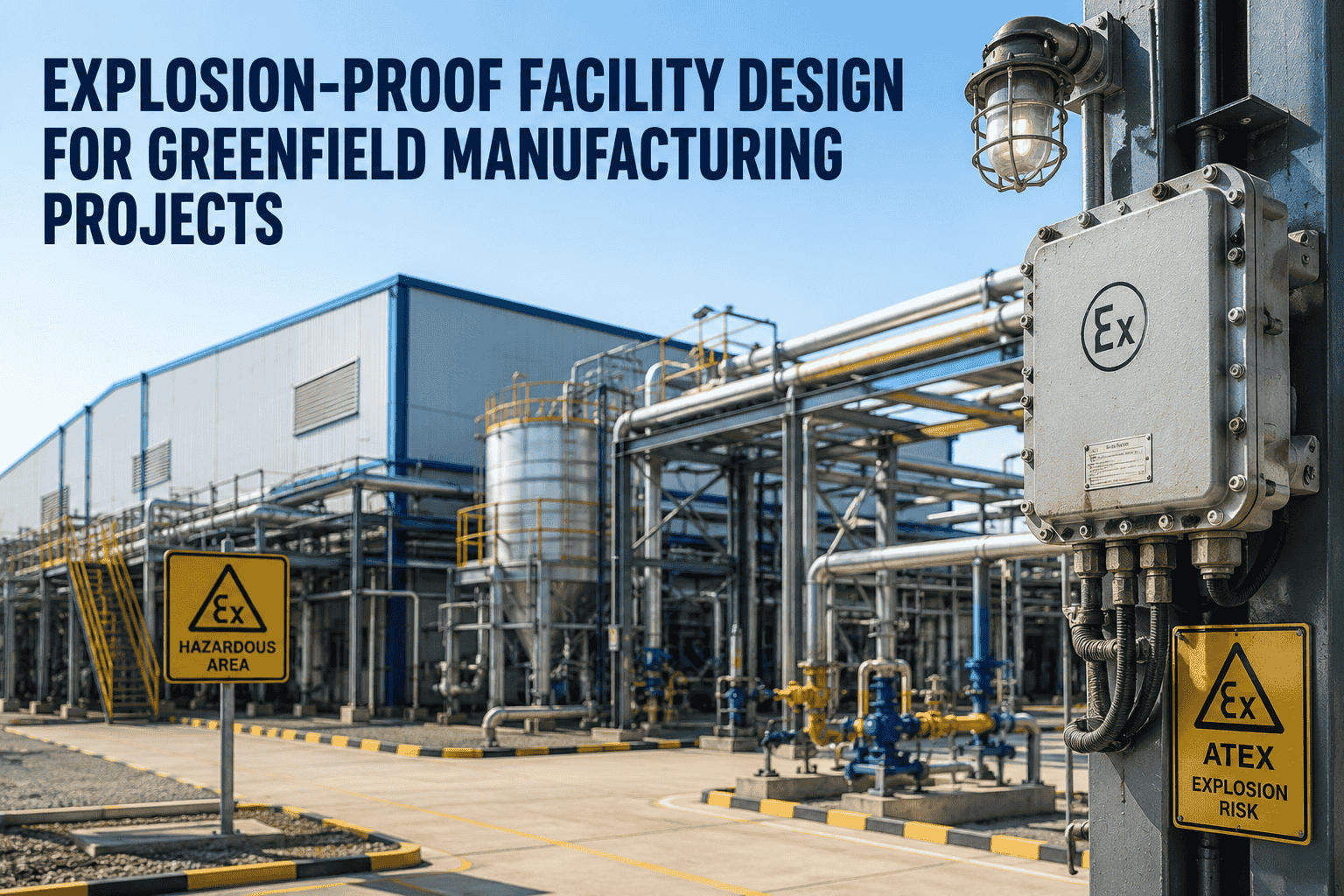
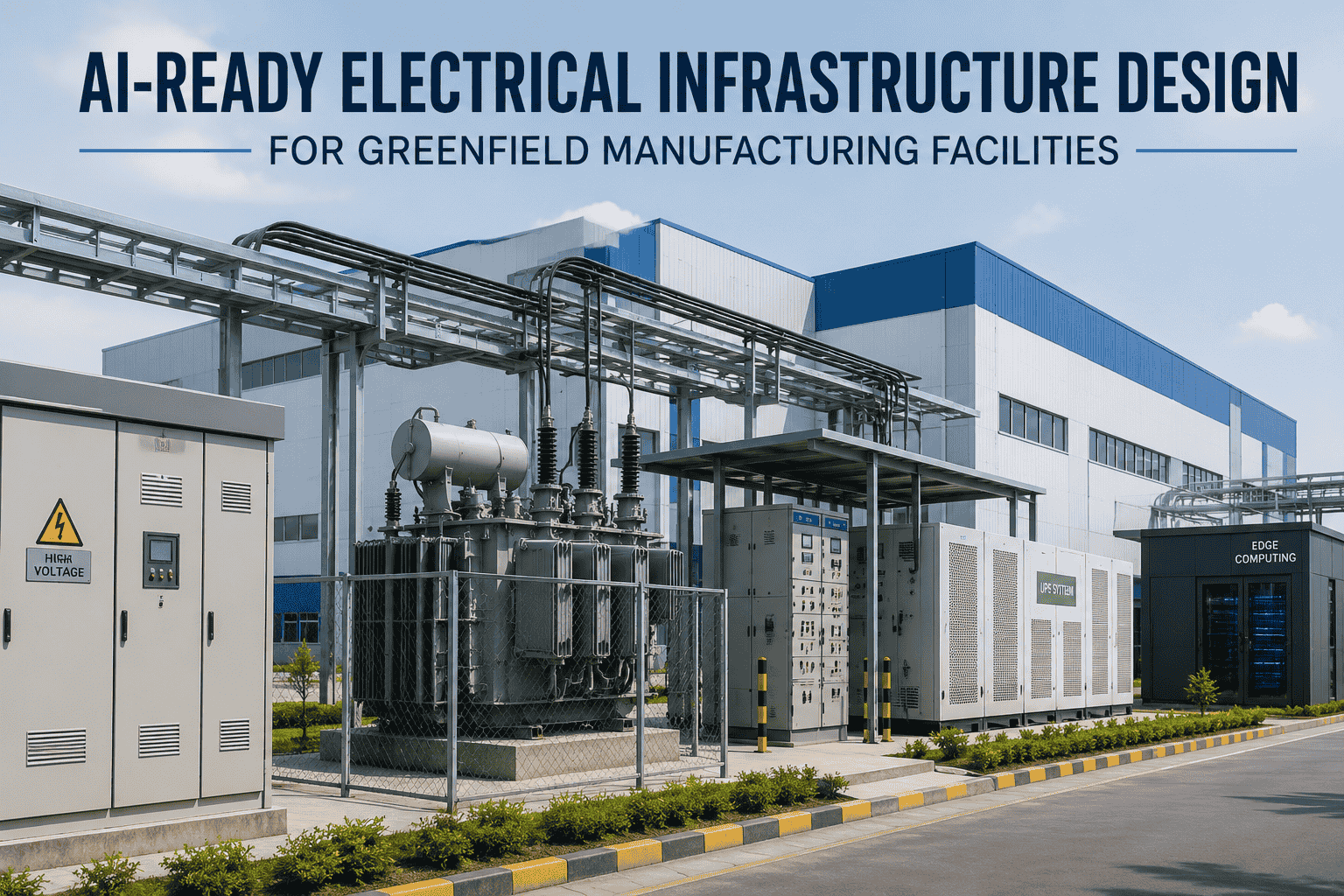
Explosion-proof facility design for greenfield manufacturing projects governs one of the highest-consequence categories of process safety. A correctly designed hazardous area system prevents catastrophic events that can kill workers, destroy facilities, and impose multi-year regulatory consequences. An incorrectly designed system creates risks that may go undetected until a triggering event occurs. The technical complexity sits in the intersection of two parallel regulatory frameworks — ATEX (European, Directive 2014/34/EU) and NEC (North American, Articles 500–506) — combined with industry-specific hazard identification (combustible dust, flammable vapors, hybrid mixtures), equipment protection method selection (Ex d, Ex e, Ex i, Ex p, Ex n), and ventilation design. This guide covers hazardous area classification, equipment selection, and explosion mitigation strategy for greenfield manufacturing projects with hazardous atmospheres. Book a greenfield consultation to map explosion-proof design against your specific facility plan.
TIER 01
HIGHEST RISK
ATEX
Zone 0 / Zone 20
NEC
Class I Div 1 (continuous)
Explosive atmosphere present continuously, for long periods, or frequently. Inside vessels, pipes, mixers handling flammable liquids/dusts.
Equipment required:
EPL Ga / Da · Ex ia intrinsic safety
TIER 02
ELEVATED RISK
ATEX
Zone 1 / Zone 21
NEC
Class I Div 1 (likely)
Explosive atmosphere likely to occur in normal operation. Process equipment vicinity, dust generation points, sampling stations, filling points.
Equipment required:
EPL Gb / Db · Ex d, Ex e, Ex ib, Ex p
TIER 03
MODERATE RISK
ATEX
Zone 2 / Zone 22
NEC
Class I Div 2 (abnormal)
Explosive atmosphere not likely in normal operation; only short periods if at all. Process room perimeter, ventilation discharge, peripheral areas.
Equipment required:
EPL Gc / Dc · Ex nA, Ex nC, Ex tc
Why Explosion-Proof Design Matters for Greenfield Projects
Explosion-proof design is the area of process safety where engineering decisions have the most direct life-safety consequences and the highest regulatory consequence for failure. Unlike many engineering disciplines where conservatism adds cost but rarely creates problems, under-designing hazardous area protection creates latent failure modes that may not surface until a triggering event occurs — at which point catastrophic loss is the consequence. The six drivers below explain why greenfield manufacturing projects should treat hazardous area classification and explosion-proof design as critical-path engineering work rather than electrical specification details.
01
Catastrophic Consequence Profile
Hazardous area protection failures cause explosion events with potential for multiple fatalities, total facility destruction, and multi-year operational suspension. Unlike many process safety risks where consequences scale with severity, hazardous area failures concentrate at the catastrophic end of the consequence distribution. Engineering rigor at the design phase prevents events that no operational response can fully mitigate.
02
Dual Regulatory Frameworks
North American operations follow NEC Articles 500–506 (and NFPA 70 by reference). European operations follow ATEX Directive 2014/34/EU and the IEC 60079 series. The two frameworks classify hazardous areas with similar logic but different terminology — Zone 0/1/2 (ATEX) versus Class I Division 1/2 (NEC). Multi-region operations must navigate both. IECEx provides international certification recognition across jurisdictions.
03
Equipment Cost Multipliers
Hazardous area equipment costs 2–10x equivalent general-purpose equipment depending on protection level. Zone 0/Class I Div 1 equipment is the most expensive; Zone 2/Class I Div 2 the least premium. Conservative over-classification (treating a Zone 2 area as Zone 1) wastes capital but is safe; under-classification (treating a Zone 1 as Zone 2) creates latent risk and regulatory non-compliance. Classification rigor matters.
04
Documentation & Certification Burden
Hazardous area equipment requires specific certification: ATEX certificates from Notified Bodies, IECEx certification, UL/FM approval for NEC. Each piece of equipment in a classified area must have documented certification matching the zone’s protection level requirements. Hazardous Area Drawings (HAD) must be developed during design and maintained for the life of the facility. Documentation gaps create regulatory exposure.
05
Process Design Interlock
Hazardous area classification follows from process design decisions — chemicals handled, operating temperatures, pressures, ventilation, containment. Changes to process design after hazardous area classification typically trigger reclassification and equipment respecification. Locking process design before hazardous area classification is essential; revisiting after equipment procurement is expensive.
06
Combustible Dust Underestimation
Combustible dust hazards are widely underestimated in industries that don’t historically consider themselves "hazardous" — food processing (flour, sugar, starch), pharmaceutical (APIs), plastics, metal (aluminum, magnesium, titanium), woodworking. NFPA 652 mandates Dust Hazard Analysis (DHA) for facilities handling combustible dusts. Greenfield F&B, pharma, and metal manufacturing projects routinely overlook dust hazard classification with regulatory and safety consequences.
Hazardous Area Classification: ATEX vs NEC Frameworks
The first technical step in explosion-proof design is hazardous area classification — dividing the facility into zones based on the likelihood and duration of explosive atmospheres. Two parallel frameworks govern: ATEX in Europe (and ATEX-aligned jurisdictions including UK UKEX post-Brexit), and NEC Articles 500–506 in North America. The IECEx international scheme provides certification recognition across both frameworks. The five framework dimensions below cover what greenfield projects need to understand when choosing classification approach and equipment specification.
Framework 01
ATEX Directive 2014/34/EU & IEC 60079
European framework using Zone designations. Gases/vapors: Zone 0 (continuous), Zone 1 (likely), Zone 2 (abnormal only). Dusts: Zone 20, 21, 22 (corresponding likelihoods). Equipment Group I (mining) vs Group II (other industry). Categories 1, 2, 3 correspond to zones. Equipment Protection Levels (EPL) Ga/Gb/Gc for gases, Da/Db/Dc for dusts.
Application: Mandatory for EU operations and EU-trading manufacturers. ATEX certificates from Notified Bodies. IEC 60079 series provides underlying technical standards.
Framework 02
NEC Articles 500–506 (NFPA 70)
North American framework using Class/Division/Group system. Class I (gases/vapors), Class II (dusts), Class III (fibers/flyings). Division 1 (normally present) vs Division 2 (abnormal). Groups A-D for gases (A = acetylene most reactive), Groups E-G for dusts. Article 506 adopts Zone system as alternative for new installations.
Application: Mandatory for U.S. and Canadian operations. UL or FM Approval for hazardous location equipment. NEC adoption varies by state and local jurisdiction with amendments.
Framework 03
IECEx International Scheme
International certification scheme administered by IEC providing mutual recognition of equipment certification across countries. Based on IEC 60079 series of standards. Certificate of Conformity issued by IECEx Certification Bodies enables multi-region equipment use without re-certification.
Application: Voluntary but increasingly preferred for multi-region manufacturers. Streamlines procurement for projects spanning multiple regulatory jurisdictions. Recognized in 30+ countries.
Framework 04
NFPA Combustible Dust Standards
NFPA 652 (fundamental requirements for combustible dusts), NFPA 654 (chemicals/plastics), NFPA 484 (combustible metals), NFPA 61 (agricultural), NFPA 664 (wood products). Mandates Dust Hazard Analysis (DHA) every 5 years. Specific design requirements for dust collection, electrical classification, and explosion mitigation.
Application: Mandatory for U.S. operations handling combustible dusts. State adoption varies. OSHA enforces under General Duty Clause where applicable. Insurance underwriter typically requires DHA documentation.
Framework 05
API RP 500/505 (Oil & Gas)
American Petroleum Institute Recommended Practice 500 (Division system) and RP 505 (Zone system) for hazardous area classification in petroleum facilities. Specific guidance for refineries, gas plants, and offshore facilities. Widely adopted beyond oil & gas for facilities with similar hazards.
Application: Standard reference for petroleum and petrochemical operations. Engineering firms working in these industries apply API RP 500/505 by default for hazardous area drawings.
Need help determining which classification framework applies to your greenfield project? Book a greenfield consultation — we’ll evaluate operating geography, multi-region considerations, and industry-specific frameworks to recommend the right classification approach.
Equipment Protection Methods for Hazardous Areas
Once hazardous areas are classified, equipment within each zone must be selected with appropriate protection methods. Multiple protection methods exist, each suited to different applications and zone risk levels. Method selection drives capital cost, installation complexity, and maintenance approach for the life of the facility. The six primary protection methods below cover the most common applications in industrial manufacturing. Most facilities use combinations of methods optimized to zone classification and equipment function.
Method 01
Ex d — Flameproof Enclosure
Equipment enclosed in housing designed to contain internal explosion without propagating to surrounding atmosphere. Heavy cast or machined enclosures with flame paths. Suitable for Zone 1 / Class I Div 1. Common for motors, switchgear, junction boxes, control panels in hazardous areas.
Best for: Zone 1, Class I Div 1 · Motors, switchgear, junction boxes
Method 02
Ex e — Increased Safety
Construction techniques providing additional safety against arcs, sparks, and excessive temperatures. No internal ignition source possible. Suitable for Zone 1. Common for terminal boxes, light fittings, induction motors. Lower cost than Ex d but limited to non-sparking equipment.
Best for: Zone 1 · Terminal boxes, lighting, non-sparking motors
Method 03
Ex i — Intrinsic Safety
Circuit energy limited to levels insufficient to ignite explosive atmosphere even under fault conditions. Ex ia suitable for Zone 0 / Class I Div 1 continuous; Ex ib for Zone 1. Universal for instrumentation, control systems, sensors. Most commonly used method for process control in hazardous areas.
Best for: Zone 0/1 · Sensors, transmitters, control systems
Method 04
Ex p — Pressurization
Enclosure pressurized with inert gas or clean air to prevent explosive atmosphere from entering. Continuous pressure maintained during operation. Suitable for Zone 1 (Type px) and Zone 2 (Type pz). Common for analyzer enclosures, control rooms within Zone 2 areas, large equipment.
Best for: Zone 1/2 · Analyzer cabinets, large enclosures, control rooms
Method 05
Ex n — Non-Sparking
Equipment designed for safe operation in Zone 2 / Class I Div 2 areas. Various subtypes: Ex nA (non-arcing), Ex nC (sparking with restricted breathing), Ex nR (restricted breathing). Lower cost than Zone 1 methods. Suitable only for Zone 2 abnormal-condition areas.
Best for: Zone 2, Class I Div 2 · General electrical equipment
Method 06
Ex m & Ex t — Encapsulation & Dust
Ex m: Electrical parts encapsulated in resin to prevent contact with explosive atmosphere. Ex t (dust ignition protection): Enclosure designed to prevent dust ingress and limit surface temperatures. Ex t common for dust-classified Zone 21/22 areas in food, pharma, and metals processing.
Best for: Zone 1/2 (Ex m), Zone 21/22 (Ex t) · Small components, dust areas
Want help selecting equipment protection methods for your hazardous area equipment? Book a greenfield consultation — we’ll walk through method selection for your specific zone classifications and equipment functions.
Industry-Specific Hazardous Atmospheres
Hazardous atmospheres concentrate in specific manufacturing industries based on chemicals, dusts, and processes used. The six industries below represent the highest-frequency applications of explosion-proof design in greenfield manufacturing. Each has characteristic hazards, typical zone classifications, and specific code requirements. Industries that don’t typically self-identify as "hazardous" — particularly food & beverage and pharmaceutical — routinely have significant Zone 21/22 dust hazards that require explosion-proof design despite the industry’s general perception.
Industry 01
Petrochemical & Refining
Flammable hydrocarbon gases and vapors throughout process areas. Extensive Zone 0/1/2 classification. Most mature application of hazardous area design with API RP 500/505 standard practice. Group A-D gas hazards depending on specific hydrocarbons.
Zone 0/1/2
Class I Div 1/2
Groups A-D
Industry 02
Pharmaceutical Manufacturing
Solvent handling (ethanol, isopropanol, acetone, methanol) creates flammable vapor zones. API powder handling creates combustible dust zones. Hybrid hazards from solvent + powder operations. ATEX widely adopted for global pharmaceutical manufacturing.
Zone 1/2
Zone 21/22
Hybrid
Industry 03
Food & Beverage
Combustible dust hazards from flour, sugar, starch, powdered milk, cocoa, spices. Often underestimated by F&B operators who don’t self-identify as "hazardous." NFPA 652 Dust Hazard Analysis mandatory. Zone 21/22 classification common around milling, mixing, conveying.
Zone 21/22
Class II Div 1/2
Group G
Industry 04
Metals & Battery Manufacturing
Aluminum, magnesium, titanium, lithium powders — the most reactive combustible dust category. NFPA 484 governs combustible metals specifically. Lithium-ion battery manufacturing combines metal dust with electrolyte flammability. EV and battery production growth driving rapid expansion.
Zone 20/21/22
Class II Div 1/2
Group E
Industry 05
Chemical Processing
Diverse hazardous atmospheres including flammable solvents, monomers, intermediates. Specific Groups dependent on chemistry (Group B hydrogen, Group C ethylene, Group D propane, etc.). Process safety management (OSHA 1910.119) typically applies for facilities above threshold quantities.
Zone 0/1/2
Class I Div 1/2
Groups A-D
Industry 06
Hydrogen & Specialty Gases
Green hydrogen production, fuel cell manufacturing, hydrogen refueling. Group B (most reactive after acetylene) classification. Special considerations: low ignition energy, invisible flame, wide flammable range, leak detection challenges. NFPA 2 governs hydrogen-specific requirements.
Zone 0/1/2
Class I Div 1/2
Group B
Need help identifying hazardous atmospheres specific to your manufacturing process? Book a greenfield consultation — we’ll walk through industry-specific hazards, combustible dust analysis requirements, and classification approach for your operating geography and process chemistry.
Explosion Prevention & Mitigation Systems
Beyond equipment protection methods, hazardous area design includes active and passive systems that prevent explosive atmospheres from forming or mitigate consequences when explosions occur. The five strategy categories below cover the major prevention and mitigation approaches. Most facilities deploy combinations rather than relying on a single strategy. Defense-in-depth applies: ventilation prevents atmosphere formation, detection provides early warning, equipment protection prevents ignition, suppression/venting limits explosion consequences.
Mechanical ventilation maintains atmospheres below Lower Explosive Limit (LEL) by diluting flammable gases/vapors or capturing dust at source. ACR (Air Changes per Hour) requirements scale with hazard severity. Combined with continuous LEL monitoring for high-hazard areas. Source capture for dust (NFPA 654) more effective than general ventilation. Failed ventilation must trigger alarms and process shutdown for Zone 0 areas.
ApproachDilution + capture
TargetAtmosphere below 25% LEL
StandardsNFPA 91, NFPA 654
Continuous monitoring for combustible gases (catalytic, infrared, ultrasonic for hydrogen) and dust accumulation. LEL detection at 10–25% alarm thresholds. Hydrogen detection requires specialized sensors (electrochemical). Dust accumulation monitoring increasingly automated through camera-based AI systems. Integration with ventilation, suppression, and process shutdown systems.
DetectionCombustible gas + dust
ResponseAlarm, ventilation boost, shutdown
StandardsNFPA 72, ANSI/ISA 92
Rupture panels or vents designed to release explosion pressure to safe location before vessel/enclosure failure. Sized per NFPA 68 for combustible dust applications. Common on dust collectors, silos, mills, dryers. Vent direction and discharge area must be carefully designed to avoid personnel exposure. Combined with isolation systems to prevent flame propagation.
MechanismPressure relief venting
TargetVessel/equipment protection
StandardsNFPA 68, NFPA 69
Active explosion suppression systems detect incipient explosion (pressure rise) and discharge suppression agent within milliseconds to extinguish before reaching damaging pressures. Used where venting is impractical (indoor enclosed equipment). NFPA 69 governs suppression system design. More expensive than venting but enables protection in space-constrained applications.
MechanismDetection + rapid suppression
Response timeMilliseconds
StandardsNFPA 69
Isolation valves/barriers prevent flame and pressure propagation between connected equipment (ducts, conveyors, silos). Chemical or mechanical isolation per NFPA 69. Inerting replaces atmospheric oxygen with inert gas (nitrogen, CO2) in vessel headspace, eliminating combustion requirement. Combined approach: isolate connected equipment + inert vessels containing reactive materials.
MechanismPropagation prevention + O2 displacement
ApplicationConnected equipment + closed vessels
StandardsNFPA 69
Design Explosion-Proof Systems from Project Inception
A greenfield consultation walks through hazardous area classification, equipment protection method selection, industry-specific atmospheres, and explosion prevention/mitigation systems for your specific facility. Output: documented explosion-proof design plan integrated with process design and electrical engineering.
Expert Perspective
"Explosion-proof design is the area of process safety where greenfield projects most commonly under-invest in early engineering rigor relative to the catastrophic consequence profile of getting it wrong. The pattern repeats across industries: process design proceeds in parallel with general electrical design, hazardous area classification enters late, equipment specification scrambles to match zone requirements, and discoveries during construction force expensive retrofits or operational compromises. The greenfield projects that complete explosion-proof design on schedule treat it as primary engineering work from project inception. Hazardous Area Drawings (HAD) developed during conceptual design. Dust Hazard Analysis (DHA) per NFPA 652 completed early. Process Safety Management integration aligned with hazardous area classification. Equipment procurement specifications include explicit zone designation, protection method, and certification requirements. The 2025–2026 environment adds complexity through lithium-ion battery manufacturing growth (combustible metal dust + electrolyte hazards), hydrogen economy expansion (Group B specialty hazards), and continued tightening of combustible dust standards (NFPA 652 enforcement). For greenfield projects in any industry handling flammable gases, vapors, or combustible dusts — which includes most F&B, pharma, chemical, and energy manufacturing — explosion-proof design deserves the same engineering investment as the production processes themselves. The consequence asymmetry between conservative design and inadequate design makes engineering rigor at the design phase the highest-ROI safety investment in greenfield manufacturing."
— Greenfield Process Safety Practice, 2026 perspective
3 Tiers
hazardous area risk classification
2–10x
cost multiplier for hazardous area equipment
NFPA 652
mandatory DHA every 5 years for dust hazards
Build Explosion-Proof Design Into Your Greenfield Engineering
A greenfield consultation evaluates hazardous area classification, equipment protection requirements, industry-specific hazards, and explosion prevention/mitigation strategy for your specific facility. Output: documented explosion-proof design framework with ATEX/NEC compliance pathway, equipment specifications, and integration with process design and construction phases.
Frequently Asked Questions
What’s the practical difference between ATEX and NEC hazardous area classification?
The two frameworks classify hazardous areas with similar underlying logic but different terminology and structure. ATEX (European, Directive 2014/34/EU) uses Zone designations: Zone 0/1/2 for gases (continuous/likely/abnormal), Zone 20/21/22 for dusts. NEC (North American, Articles 500-506) uses Class/Division/Group: Class I (gases), Class II (dusts), Class III (fibers); Division 1 (normally present) or Division 2 (abnormal); Groups A-D for gases by reactivity, Groups E-G for dusts. The ATEX system is more granular for high-risk areas (separates continuous from likely), while NEC traditionally combined these into Division 1. NEC Article 506 now allows Zone classification as alternative for new installations. For multi-region greenfield projects, IECEx certification provides international recognition across both frameworks, simplifying procurement. The practical guidance: use the framework mandated by operating geography, but prefer IECEx-certified equipment for multi-region operations.
When should hazardous area classification begin for a greenfield project?
At process design completion, not at electrical engineering. Hazardous area classification follows directly from process design decisions: chemicals handled, operating temperatures, pressures, containment integrity, ventilation. Classification done before process design is finalized creates rework when process changes. Classification done after equipment procurement is too late to optimize equipment specifications. The right sequence: complete process flow diagrams and P&ID development, identify hazardous materials and operating conditions, classify hazardous areas per applicable framework, develop Hazardous Area Drawings (HAD), specify equipment with explicit zone designations, procure with certification documentation requirements. For typical greenfield manufacturing projects, hazardous area classification should be complete 12-18 months before equipment procurement begins to allow proper lead time for hazardous area equipment which has substantially longer delivery than general-purpose equivalents.
Does combustible dust really require explosion-proof design in food and pharmaceutical facilities?
Yes, and this is the most commonly underestimated hazard in greenfield F&B and pharmaceutical projects. Combustible dust hazards exist wherever fine particulate organic or metallic materials are handled: flour, sugar, starch, powdered milk, cocoa, spices, APIs, vitamins, plastics, aluminum, magnesium. NFPA 652 mandates Dust Hazard Analysis (DHA) for all facilities handling materials with combustible dust potential. NFPA 654 (chemicals/plastics), NFPA 484 (metals), NFPA 61 (agricultural), and NFPA 664 (wood) provide industry-specific requirements. The catastrophic dust explosion at Imperial Sugar in 2008 (14 fatalities) remains a reference event that drove regulatory tightening. Zone 21/22 classification typically applies to areas around milling, mixing, conveying, and dust collection. F&B and pharma operators that don’t self-identify as "hazardous industry" often have substantial Zone 21/22 areas requiring proper electrical classification and dust hazard mitigation.
Schedule a consultation to evaluate dust hazard exposure for your specific products.
How much does explosion-proof design add to greenfield project capital cost?
Capital cost impact varies widely based on hazardous area scope, but useful ranges: hazardous area equipment costs 2-10x equivalent general-purpose equipment depending on zone classification (Zone 0/Class I Div 1 most expensive, Zone 2/Class I Div 2 least premium). For a facility with substantial Zone 1/Class I Div 1 areas (chemical processing, petrochemical, large-volume solvent handling), total electrical and instrumentation costs can be 30-60% higher than non-hazardous equivalent. For facilities with primarily Zone 2/Class I Div 2 (most pharmaceutical solvent areas) the premium is 15-25%. For facilities with limited Zone 21/22 dust areas (typical F&B), the premium concentrates in specific equipment (motors, switchgear, lighting in classified zones) representing 5-15% of total electrical budget. Engineering hours for hazardous area design also add to project costs: typical 15-25% premium on electrical and instrumentation engineering. The cost is real but predictable when properly estimated during conceptual design.
Can existing facilities be retrofitted to explosion-proof, or must this be designed from inception?
Both retrofit and greenfield are feasible, but cost differentials favor greenfield design substantially. Retrofitting an existing facility to add or upgrade hazardous area protection typically costs 3-5x the equivalent greenfield capital because: existing equipment must be removed and replaced, conduit and wiring rerouted, ventilation systems modified, building modifications often required, production downtime for installation, engineering complexity higher than greenfield. Greenfield projects have the structural advantage that all design decisions can be made with hazardous area requirements in mind from inception. Process layout optimizes around classified zone boundaries. Building HVAC integrates with hazardous area ventilation. Equipment specifications include hazardous area requirements from procurement. For greenfield projects in industries with hazardous atmospheres, the cost advantage of designing-in is substantial enough that it should drive treating explosion-proof design as critical-path engineering rather than late-stage compliance work.