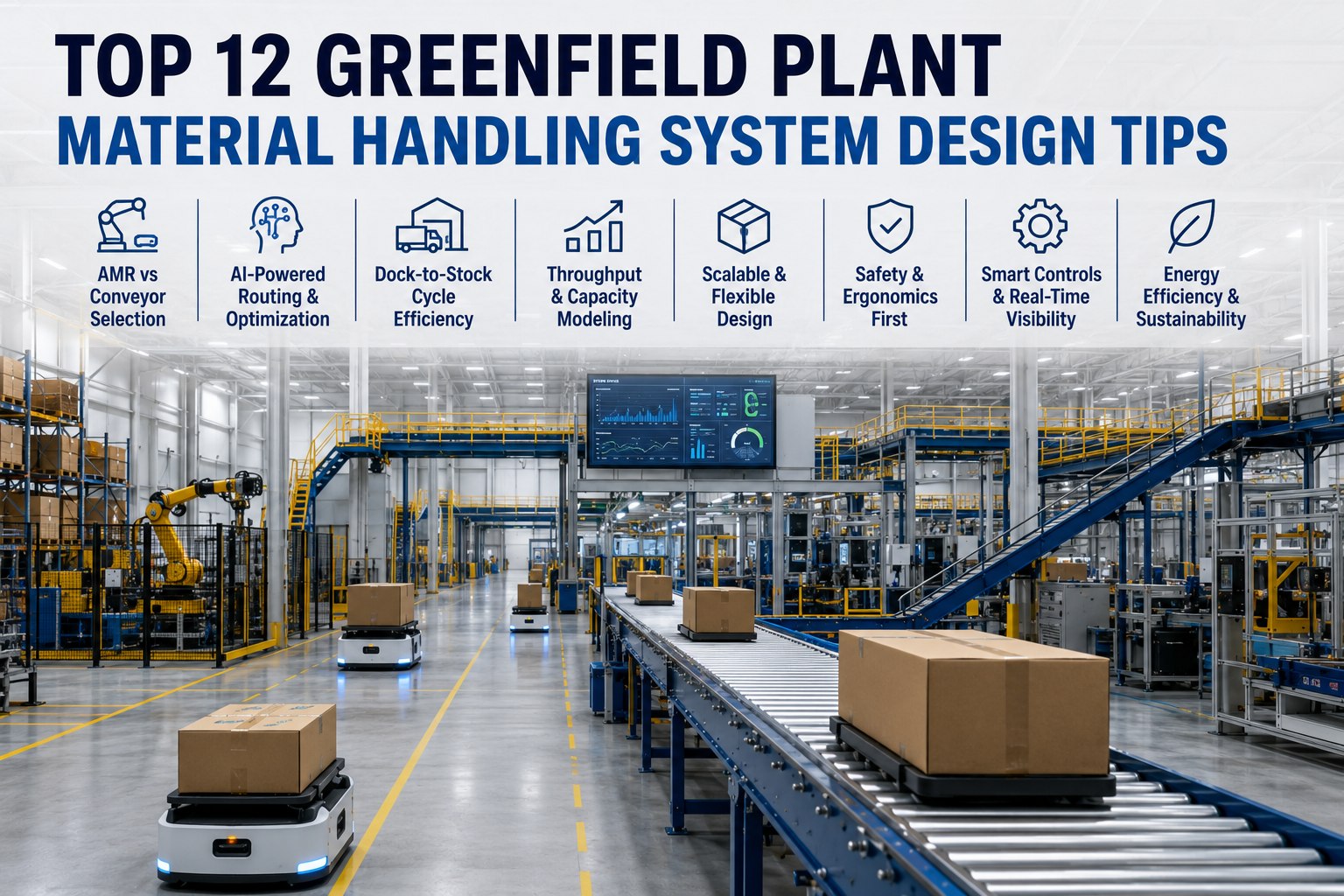
The material handling system is the circulatory system of a greenfield manufacturing plant — every raw material, WIP component, finished good, and waste stream flows through it, and every flow decision made at FEED compounds for the 20-year life of the facility. The plants that achieve the fastest dock-to-stock cycles and lowest material handling labor costs in 2026 are not the ones that spent most on automation: they are the ones that matched the right technology to each flow category, designed the orchestration layer before procuring any equipment, and validated throughput with discrete event simulation before pouring a single concrete aisle.
Design your greenfield material handling system with iFactory — AMR vs. conveyor selection, AI routing architecture, throughput modeling, and dock-to-stock design before your facility layout is finalized.
Technology Selection Framework
AMR vs. Conveyor vs. AGV vs. Manual: Choosing the Right Technology for Each Flow
No single material handling technology is optimal for every flow category. The best greenfield designs mix technologies — matching each to the flow pattern it handles most efficiently.
Tips 1–4: Flow Design and Layout Fundamentals
The first four tips address the decisions that lock in material flow efficiency for the life of the facility. These are structural decisions — once the building is poured and equipment is bolted down, changing them costs 5–10× what designing them correctly at FEED would have cost.
Map Every Flow Before Selecting Any Technology
Before specifying a single conveyor or AMR, document every material flow in the facility as a flow matrix: origin, destination, frequency, volume, unit load type, and time sensitivity. This flow matrix is the specification document that drives technology selection — not vendor brochures. Flows with high volume and fixed routes point to conveyors; variable-route, medium-frequency flows point to AMRs; exception and oversized flows point to manual handling.
Design for Separation of Flows — Not Sharing of Aisles
The most common material handling bottleneck in greenfield plants is shared aisles between AMRs, forklifts, pedestrians, and process equipment. Cross-traffic at aisle intersections is the number-one source of AMR downtime — robots must stop and yield, creating cascading delays. Separate AMR corridors from forklift aisles from pedestrian walkways in the facility layout before any equipment is specified. A dedicated AMR corridor costs nothing at layout design; reconfiguring one costs weeks of production disruption.
Validate Throughput with Discrete Event Simulation Before Committing
Discrete event simulation (DES) models the entire material flow network — all flows, vehicle populations, aisle intersections, loading/unloading stations, and production schedule variability — and runs millions of production cycles to find bottlenecks before they exist in concrete. DES typically cuts material handling distances by 35%+ and identifies aisle conflicts that static layout drawings never reveal. AI-driven layout simulation validates AMR fleet size, conveyor throughput, WIP buffer sizing, and dock-to-stock cycle time before a single purchase order is issued.
Design the Dock-to-Stock Sequence as a Single System
Dock-to-stock cycle time — the elapsed time from truck arrival to material available at the production line — is the most important upstream material handling metric and the most commonly undesigned one. Each handoff in the dock-to-stock sequence (unloading, staging, identification, depalletizing, transport, putaway, verification) adds time. Design the full sequence at FEED, assign a technology to each step, and set a cycle time target before equipment is specified. A 2-hour dock-to-stock target and a 4-hour target require completely different MHS designs.
Tips 5–8: AMR, Conveyor, and Orchestration Architecture
The middle four tips address technology-specific design decisions that determine whether each component of the MHS performs at specification. Each tip addresses a failure mode that appears repeatedly in greenfield post-mortem analyses — equipment that was correctly specified in isolation but failed to deliver when integrated into the full system.
Size the AMR Fleet for Peak Demand — Not Average Demand
AMR fleet sizing based on average daily throughput consistently underestimates peak requirements. Material handling demand peaks at shift changeovers, production startups, and MRP push waves — exactly when the MHS must perform most reliably. Size the fleet for peak hour throughput using the 95th percentile demand from the DES model, not the daily average. An undersized AMR fleet at peak causes WIP accumulation, production line starvation, and operator intervention — which defeats the purpose of automation.
Specify Zero-Pressure Accumulation on Every Conveyor Zone
Zero-pressure accumulation (ZPA) conveyors hold each item in its zone without applying pressure to the item ahead — preventing product damage on contact-sensitive items and eliminating the "accordion effect" that causes gaps and throughput loss. ZPA is not the default specification for most conveyor vendors; it must be explicitly required. For any greenfield application handling packaged goods, electronics, or products with surface finish requirements, ZPA is non-negotiable. The cost premium over standard accumulation conveyors is 15–30% and is recovered in the first quarter through scrap reduction.
Design the Orchestration Layer Before Procuring Any Equipment
The WES (Warehouse Execution System) or MHS orchestration layer is the software that coordinates AMR missions, conveyor zone priorities, pick-and-place robot commands, and dock scheduling in real time. Designing this layer after equipment procurement leads to integration failures — vendors use incompatible APIs, AMRs and conveyors use different task priority schemas, and the full system cannot be tested as a unit before go-live. The orchestration architecture — data model, API standards, task assignment logic, and fallback protocols — must be defined at FEED before any vendor is selected.
Require Fleet-Agnostic AMR Management — Not Vendor-Locked
Single-vendor AMR deployments are operationally risky: lead time shortages, vendor bankruptcy, or discontinued models leave the fleet stranded. Specify fleet management software that supports multi-vendor AMRs through a vendor-agnostic orchestration layer (VDA 5050 or MassRobotics AMR Interop standard). A mixed-fleet environment can coordinate AMRs from multiple vendors under one task assignment engine, providing procurement flexibility without operational fragmentation. 59% of facilities now plan multi-brand AMR deployments — the orchestration standard exists and works.
Need AMR fleet sizing and orchestration architecture designed for your facility? Book a material handling design session with iFactory — we produce fleet sizing models, orchestration specifications, and technology selection recommendations before your FEED package closes.
Tips 9–12: AI Routing, Predictive Maintenance, and Scalability
The final four tips address the layer of capability that separates a material handling system that performs at specification on day one from one that continuously improves and scales without major re-engineering. These tips address the AI routing and predictive maintenance capabilities that must be designed in at FEED — not added after the first breakdown.
Implement AI Dynamic Routing — Not Fixed Mission Scripts
Fixed AMR mission scripts assign predefined paths to each task and fail to account for real-time floor conditions — blocked aisles, robot failures, or production sequence changes. AI dynamic routing computes the optimal path and robot assignment for each mission in real time, considering current fleet positions, battery states, aisle congestion, and priority weights. Plants using AI routing achieve 25–40% higher AMR utilization than fixed-script systems with identical fleet sizes — because every robot is always working the highest-priority task via the most efficient available route.
Design Predictive Conveyor Maintenance Into the MHS from Day One
Conveyor failures cascade — a single undetected idler failure can damage belt, transfer chute, and downstream equipment within hours of continuous full-load operation. Vibration sensors on drive motors and idlers, belt tracking sensors, and motor current monitoring enable AI to detect degradation patterns 2–6 weeks before failure. Specifying this sensor suite at conveyor procurement adds 3–5% to equipment cost and prevents unplanned stops that typically cost 10–50× the sensor investment per event. Plants with AI conveyor monitoring achieve 45–55% reduction in unplanned stoppages in Year 1.
Build WIP Buffer Capacity Into the Layout — Not into the Schedule
Production schedules are optimistic; material flow is not. WIP buffers at every production handoff point — between processes, at conveyor merge points, before manual stations — absorb the inevitable flow variability without cascading stoppages. Specifying WIP buffer capacity in the discrete event simulation and reserving the floor space in the layout costs nothing at FEED. Discovering that buffers are insufficient after commissioning requires either slowing production throughput or rearranging equipment to make physical space — both are expensive and slow.
Design for 2× Day-One Throughput — Not Current Requirement
The most common MHS retrofit is capacity expansion — adding conveyors to an aisle that was not designed to accommodate them, or adding AMRs to a fleet management system that cannot scale beyond its original count. Design the floor layout with 2× the current throughput in mind: aisle widths that accommodate additional AMR lanes, conveyor frames that support additional drive units, charging station capacity for double the fleet, and an orchestration platform licensed for scale. The cost of designing in growth capacity at FEED is 5–10% of the MHS budget; the cost of retrofitting it post-commissioning is 30–50%.
Need all 12 tips applied to your specific facility and product mix? Talk to iFactory's material handling design team — we produce a complete MHS specification covering flow matrix, technology selection, AMR fleet sizing, orchestration architecture, and throughput validation before your equipment RFQ closes.
Material Handling Design — The Numbers That Drive the Business Case
reduction in material handling distances achievable through AI-driven layout simulation before construction — iFactory / industry DES benchmarks
reduction in unplanned conveyor stoppages in Year 1 with AI predictive monitoring vs. time-based maintenance schedules
higher AMR utilization with AI dynamic routing vs. fixed mission scripts on identical fleet size and facility footprint
labor efficiency gain from WMS + AMR orchestration in the first year of greenfield operation — 12–24 month ROI typical
All 12 items on this checklist covered before your FEED package closes? Book an MHS FEED readiness session with iFactory — we review your current design against all 12 criteria and identify gaps before your equipment RFQ is issued.
All 12 Tips Applied to Your Facility — Before Your FEED Package Closes
iFactory's material handling design service covers all 12 tips: flow matrix, technology selection, DES throughput modeling, AMR fleet sizing, orchestration architecture, conveyor specification, predictive PM sensor suite, and scalability design — delivered as a complete MHS specification before your equipment RFQ closes.
Expert Perspective
The facilities I audit that have the worst material handling performance share one characteristic: every technology decision was made by the equipment vendor, not by the facility designer. The conveyor vendor specified conveyors everywhere. The AMR vendor recommended AMRs everywhere. Nobody ran a flow matrix first, nobody ran a simulation, and nobody designed the orchestration layer before the purchase orders were issued. The plants that get this right are the ones that treat material handling as a system design problem — not a procurement problem. The technology follows the flow design. The flow design follows the facility strategy. And both must be complete before any vendor is invited to quote.
of facilities now plan multi-brand AMR deployments — vendor-agnostic orchestration is no longer optional
higher cost to retrofit MHS changes post-commissioning vs. designing correctly at FEED
of AMHS operating cost can be represented by material handling — making system design the highest-leverage cost reduction lever
Your Material Handling System Designed Right — Before the First Vendor Quote
iFactory produces the flow matrix, technology selection rationale, DES throughput validation, AMR fleet sizing model, orchestration specification, conveyor specification with ZPA and predictive PM, WIP buffer plan, and 2× scalability design — delivered as a complete MHS design package before your equipment RFQ closes and your layout is locked.
Frequently Asked Questions
When should a greenfield plant use AMRs instead of conveyors?
AMRs outperform conveyors when flows are variable in route, frequency, or volume — kitting, WIP transport between flexible cells, and exception handling that changes with the production schedule. Conveyors outperform AMRs when flows are fixed, high-volume, and continuous — assembly line feeding, sortation, and packing. Most greenfield AI factories use both: conveyors for the fixed high-volume backbone flows and AMRs for the variable-route feeder flows. The flow matrix identifies which category each flow belongs to, and that drives the technology assignment — not vendor preference.
What is discrete event simulation and why is it essential for MHS design?
Discrete event simulation (DES) models the material flow network as a dynamic system — all flows, vehicle populations, aisle intersections, loading stations, and production variability — and runs millions of simulated production cycles to find bottlenecks before they exist in physical form. Static layout drawings show where equipment will be; DES shows whether the system will work at the throughput, mix, and variability required. DES typically identifies aisle conflicts, undersized WIP buffers, and incorrect AMR fleet sizes that would not become visible until commissioning. Any facility with more than one transport technology type requires DES at FEED.
What is VDA 5050 and why should it be specified for AMR procurement?
VDA 5050 is the internationally adopted interoperability standard for AMR communication — it defines the data format and protocol by which AMRs from any vendor can receive missions from a common fleet management system. Specifying VDA 5050 compliance in the AMR RFQ prevents vendor lock-in by ensuring that robots from different manufacturers can be managed under one orchestration platform. With 59% of facilities now planning multi-brand AMR environments, VDA 5050 compliance is the procurement clause that preserves future fleet flexibility — including the ability to change vendors if lead times extend or product lines are discontinued.
How should AMR fleet size be calculated for a greenfield plant?
AMR fleet sizing starts with the transport task volume from the flow matrix — total missions per shift, broken down by origin-destination pair and unit load type. Each mission is assigned a cycle time (travel loaded, transfer, travel empty, charge time amortized) and the fleet size is calculated to complete all missions within the shift window at 95th percentile peak demand — not average demand. The DES model validates this calculation under the full variability of the production schedule. Add 15–20% as operational reserve for robot downtime, charging, and demand spikes. Starting fleet size often increases by 20–30% from initial estimates after DES validation reveals peak demand concentrations.
What sensors should be specified for predictive conveyor maintenance?
The minimum predictive sensor suite for conveyors is: vibration sensor on each drive motor (detects bearing and gearbox degradation), belt tracking sensor at each return pulley (detects misalignment before belt edge damage), motor current monitoring per drive zone (detects overload from material buildup or mechanical resistance), and temperature sensor on drive motors above 5 kW. These four measurement types give the AI model the inputs to detect idler seizure, belt misalignment, motor bearing degradation, and overload conditions 2–6 weeks before they cause a breakdown. Specifying this suite at conveyor procurement adds 3–5% to equipment cost; the first prevented breakdown typically returns 10–50× that cost.