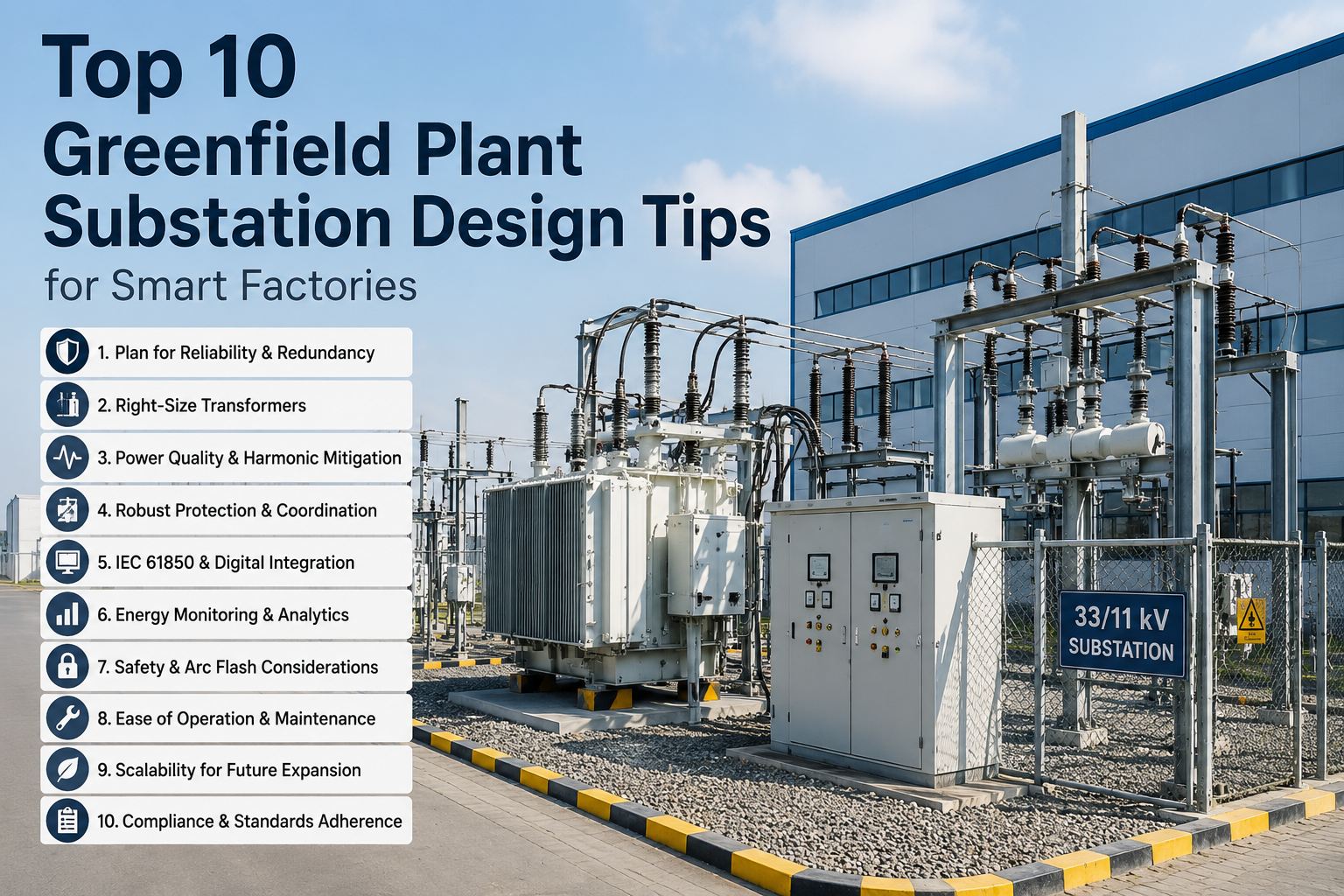
Industrial Substation Design for Greenfield Smart Factories | iFactory
By Riley Quinn on June 22, 2026
A greenfield smart factory's substation is the single most critical asset on site — failure stops production, voltage instability degrades AI vision and process control, and missed protection design can damage millions in equipment in milliseconds. Modern substation engineering goes well beyond transformer sizing — IEC 61850 digital protection, harmonic mitigation, power quality monitoring, and SCADA integration are now baseline expectations. The 10 design tips below cover what every plant electrical engineer should specify at FEED. Book a substation design consultation to validate your architecture before procurement.
From Utility Grid to Production Floor — The Voltage Cascade Every Plant Engineer Specifies
IEC 61850Global standard for digital substation communications
2–3×Electrical capacity AI-powered plants require vs. traditional
<5%THD target — IEEE 519 voltage limit at point of common coupling
99.99%Power availability target for AI-native plants
Theme 1 — Substation Architecture (Tips 1 to 3)
Architecture decisions made at FEED determine 80% of long-term substation cost. Capacity, redundancy, and physical layout drive everything from cable routing to protection coordination. Three foundational tips.
01
Size for 2× AI-Native Capacity
AI-powered plants require 2 to 3× the electrical capacity of traditional facilities — edge compute, robotics, vision systems, and digital twins all draw continuous power. Size the main transformer and MV distribution for 2× day-one load, not 1.2×.
Prevents retrofit transformer upgrade at 4–6× greenfield cost
02
N+1 Redundancy on Critical Paths
Specify dual transformer feeds with auto-transfer switch (ATS). Two utility incomers where geography allows. Critical bus split between transformers. Single-fault tolerance for AI-native production where downtime cost runs $100K+ per hour.
99.99% availability target — supports continuous AI operations
03
Modular Switchgear & Expansion Bays
Specify switchgear with 30 to 50% spare cubicles and pre-wired expansion bays. Adding feeders to an operating substation requires planned outages and 4 to 6× greenfield cost per feeder.
Future-proofs plant expansion without major outages
Theme 2 — Protection & Automation (Tips 4 to 7)
Modern substation protection has moved from electromechanical relays to digital IEDs (Intelligent Electronic Devices) running IEC 61850 over redundant Ethernet. The protocols, redundancy, and coordination decisions made here determine plant safety and response speed.
04
Specify IEC 61850 Native — Not Retrofitted
IEC 61850 is the current global standard for protection and substation communications. Specify IEC 61850 native IEDs across all bays — not legacy devices with bridging gateways. Native deployment unlocks GOOSE messaging, sampled values, and full digital station bus architecture.
10–100× faster fault clearing vs. hardwired protection
05
Redundant Station & Process Bus LANs
Two redundant Substation LANs per IEC 61850 — typically PRP (Parallel Redundancy Protocol) or HSR (High-availability Seamless Redundancy). Loss of one LAN cannot disable protection. Required for any plant with downtime cost above $50K per hour.
Eliminates single-network-point failure in protection
06
Merging Units & NCITs for Digital Stations
Greenfield digital substations replace traditional CTs/VTs with Non-Conventional Instrument Transformers (NCITs) feeding Merging Units that publish sampled values over the process bus. Lower CapEx than copper-intensive traditional designs and eliminates CT saturation issues.
30–40% reduction in instrumentation copper cost
07
Coordinated Protection Scheme Per IEEE 242
Protection coordination study per IEEE 242 ensures upstream breakers don't trip for downstream faults. Time-current curves, arc-flash hazard analysis (IEEE 1584), and selectivity must be modeled in software before commissioning — not adjusted in the field.
Eliminates nuisance trips and limits arc-flash boundaries
Need IEC 61850 architecture and protection coordination specified before procurement? Book a substation consultation — we will design the protection scheme before tender release.
Theme 3 — Power Quality & Monitoring (Tips 8 to 10)
VFDs, robotics, and switch-mode power supplies inject harmonics into the plant network — degrading transformer life, tripping breakers spuriously, and corrupting sensitive AI vision and process control systems. Modern substations design power quality in from day one.
08
Harmonic Mitigation Per IEEE 519
Target <5% voltage THD at point of common coupling per IEEE 519. Specify active or passive harmonic filters on MV buses serving large VFD populations. 12-pulse or 18-pulse rectifier topologies for large drives. Static VAR Compensators (SVC) for plants with arc-flash loads.
Protects sensitive AI vision and control electronics
09
Continuous Power Quality Monitoring
Install Power Quality (PQ) meters at every MV bus and critical LV panel. Monitor voltage sag, swell, transient, THD, flicker, and unbalance continuously. PQ events correlated against AI vision defects and process control faults reveal hidden electrical root causes.
Reveals power-related causes of AI quality issues
10
SCADA & CMMS Integration
Substation SCADA integrated to plant MES and CMMS — every breaker operation, PQ event, and protection trip becomes a tagged work order. IED firmware versions, relay test records, and arc-flash labels managed as CMMS assets with renewal schedules.
Closes the loop between electrical events and operations
Design the Substation Around 2× AI Capacity, IEC 61850 & Power Quality — Before Procurement
iFactory's substation design consultation covers AI-native capacity sizing, N+1 redundancy strategy, IEC 61850 architecture, protection coordination per IEEE 242, harmonic mitigation per IEEE 519, and SCADA/CMMS integration — delivered before equipment specifications go to tender.
The IEEE Standards Stack: Every Substation Designer Should Reference
Substation engineering is governed by a specific stack of IEEE standards covering grounding, lightning, protection, arc flash, and harmonic limits. Use these as the design baseline — not the procurement minimum.
IEEE 80
Grounding Safety
Ground grid design · Touch and step voltage limits · Field resistivity validation per IEEE 81
IEEE 242
Protection & Coordination
Time-current curve coordination · Selective tripping · Buff Book for industrial protection
IEEE 519
Harmonic Limits
Voltage and current THD limits at PCC · Harmonic filter sizing · VFD impact assessment
IEEE 998
Lightning Protection
Shielding mast and wire design · Direct stroke protection · Asset survival modeling
IEEE 1584
Arc Flash Hazard
Incident energy calculation · Boundary determination · PPE category labeling
IEC 61850
Digital Substation Communications
GOOSE messaging · Sampled values · Station and process bus architecture · IED interoperability
Expert Perspective: Why Substations Designed for 2020 Will Cripple a 2026 Plant
The substations we audit at year 3 of operation in AI-native plants almost always have the same problem — they were sized, specified, and protection-coordinated for the plant of 2020, not the plant of 2026. Edge compute density, robot charging, AI vision lighting, and continuous digital twin operations consume 2 to 3 times the electrical capacity that traditional manufacturing planning assumed. Harmonic injection from larger VFD populations corrupts AI vision systems. Legacy electromechanical protection cannot match the fault-clearing speed digital production requires. Designing the substation for the 2026 plant — IEC 61850 native, harmonic mitigation in from day one, 2× capacity headroom — costs 5 to 10% more at FEED and prevents the retrofit project that costs 4 to 6× per upgrade.
— iFactory Greenfield Consulting, Electrical Infrastructure Practice 2025 to 2026
10–100×
Faster fault clearing — IEC 61850 GOOSE vs. hardwired
5–10%
CapEx premium for 2026-native substation specification
4–6×
Retrofit cost penalty for undersized greenfield substation
Ready to specify a substation that supports AI-native operations from day one? Talk to our substation engineering team — we will validate the architecture before procurement.
Specify a 2026-Native Substation — Not a 2020 Substation With Retrofit Risk Baked In
iFactory's substation consultation covers AI-native capacity sizing, N+1 redundancy, IEC 61850 architecture with redundant station and process bus, protection coordination per IEEE 242, harmonic mitigation per IEEE 519, arc-flash analysis per IEEE 1584, continuous power quality monitoring, and full SCADA / CMMS integration — all delivered before equipment specifications go to tender.
What is IEC 61850 and why does it matter for a greenfield plant substation?
IEC 61850 is the current global standard for protection and communications in digital substations. It defines protocols for Intelligent Electronic Devices (IEDs), GOOSE messaging for protection inter-tripping, and sampled values for digital instrumentation. Greenfield plants specifying IEC 61850 native get 10 to 100 times faster fault clearing than hardwired protection and full interoperability across vendors. Legacy electromechanical relays cannot match the response time required for AI-native plant operations.
How much electrical capacity should an AI-native plant substation be sized for?
AI-powered plants consume 2 to 3 times the electrical capacity of traditional manufacturing facilities. Edge compute, robotics, AI vision lighting, and continuous digital twin operations all draw continuous power. Best practice is to size the main transformer and MV distribution for 2× day-one load, not the typical 1.2× headroom that traditional planning assumed. Retrofitting transformer capacity later costs 4 to 6 times the greenfield specification.
What harmonic limits should be designed into a smart factory substation?
IEEE 519 sets the global benchmark — less than 5% voltage Total Harmonic Distortion at the Point of Common Coupling. Plants with large VFD populations need active or passive harmonic filters on MV buses, 12-pulse or 18-pulse rectifier topologies on large drives, and Static VAR Compensators where arc-flash loads create voltage fluctuations. Excess harmonics damage transformers, trip breakers spuriously, and corrupt AI vision and sensitive control systems.
What is a digital substation and when should a greenfield plant specify one?
A digital substation uses Non-Conventional Instrument Transformers (NCITs) and Merging Units to digitize current and voltage signals at the source, publishing sampled values over an IEC 61850 process bus. This eliminates copper-intensive traditional CT/VT wiring and CT saturation issues. For greenfield smart factories above approximately 15 MW peak load with IEC 61850 native protection, digital substation architecture is now the recommended baseline.
How does iFactory's substation design consultation work?
iFactory's consultation covers AI-native load modeling, capacity sizing with 2× headroom, N+1 redundancy strategy, IEC 61850 architecture with PRP/HSR LANs, protection coordination per IEEE 242, harmonic mitigation per IEEE 519, arc-flash analysis per IEEE 1584, IEEE 80 grounding and IEEE 998 lightning protection design, continuous power quality monitoring, and full SCADA / CMMS integration. All outputs are tender-ready specifications. Book your consultation here.