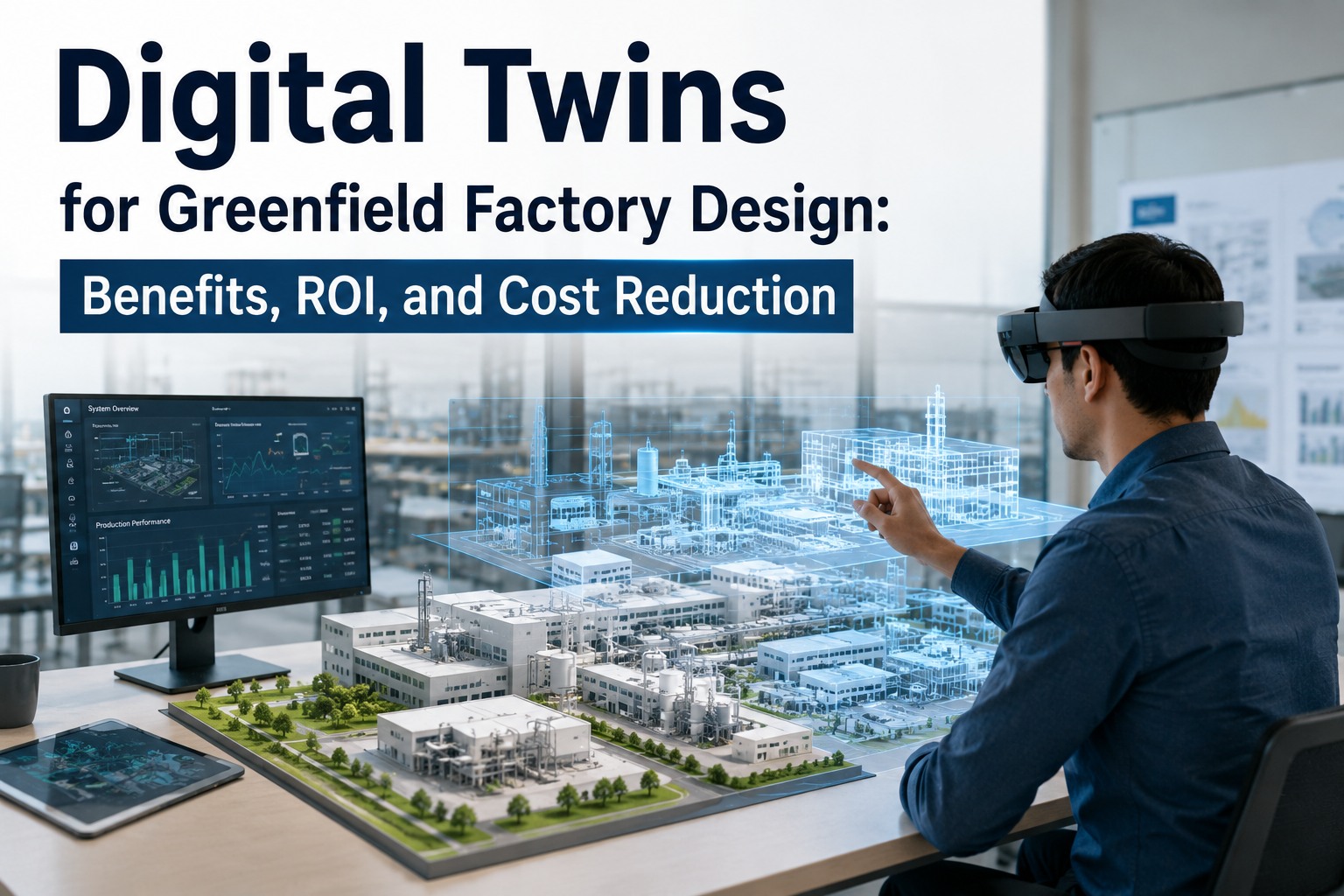
Every greenfield factory represents a once-in-a-generation opportunity to get things right from the start. Yet 70% of new plant projects exceed their budget, and nearly half face delays that erode competitive advantage before production even begins. Digital twin technology is changing this equation entirely—allowing manufacturers to build, test, and optimize their entire factory in a virtual environment before breaking ground. With the digital twin market projected to grow from $21 billion in 2025 to nearly $150 billion by 2030, this isn't emerging technology anymore—it's the new standard for smart factory design.
The Digital Twin Advantage
Build Your Factory Twice. Get It Right the First Time.
Digital twins let you simulate, optimize, and de-risk your greenfield factory—before pouring the foundation.
$149.8B
Projected digital twin market by 2030
47.9%
Annual market growth rate (CAGR)
50%
Reduction in development time reported
Sources: MarketsandMarkets, McKinsey Research, Grand View Research
What Is a Digital Twin—and Why Greenfield Factories Need One
A digital twin is a real-time virtual replica of a physical asset, process, or entire factory system. Unlike static 3D models or CAD drawings, a digital twin is continuously updated with live data from IoT sensors, SCADA systems, and production databases—creating a living, breathing mirror of your operations. For greenfield factories, this means you can design, simulate, and stress-test your entire production environment in a virtual space before committing billions to physical construction. Every layout decision, equipment placement, workflow design, and energy system can be validated against real-world performance models.
Digital Twin vs. Traditional Factory Planning
Static CAD models and 2D floor plans
Spreadsheet-based capacity estimates
Assumptions tested only after construction
Change orders cost millions post-build
Siloed design across engineering teams
VS
Dynamic 3D simulation with real-time data
AI-driven throughput and bottleneck analysis
Thousands of scenarios tested virtually
Design changes cost nothing in simulation
Single source of truth for all stakeholders
5 Ways Digital Twins Transform Greenfield Factory Design
Building a new factory from scratch gives you a blank canvas—digital twins ensure every stroke is intentional. Here are the five critical areas where this technology delivers the greatest impact during the design and construction phase.
01
Layout Optimization & Clash Detection
Validate equipment placement, material flow paths, ergonomic clearances, and utility routing in a virtual space. Detect spatial conflicts months before they become expensive on-site problems.
30%+
savings in operation and maintenance costs
02
Production Simulation & Bottleneck Prediction
Run thousands of production scenarios to identify optimal line balancing, buffer sizing, and sequencing strategies—before purchasing a single piece of equipment.
5-7%
monthly cost reduction through schedule optimization
03
Energy & Sustainability Modeling
Simulate HVAC loads, lighting requirements, and energy consumption patterns across seasons and production volumes. Design for net-zero from day one, not as a costly retrofit.
7%
carbon emission reduction via embedded optimization
04
Predictive Maintenance from Day One
Build maintenance intelligence into the factory DNA. Digital twins establish equipment baselines during commissioning, enabling predictive maintenance from the first production cycle.
20%
reduction in unplanned downtime
05
Supply Chain & Logistics Integration
Model inbound material flows, warehouse storage capacity, and outbound logistics to ensure the factory operates as a seamlessly connected node in your supply chain.
20%
improvement in consumer promise fulfillment
Want to see how digital twin simulation can optimize your factory layout? Book a simulation walkthrough.
The ROI of Getting It Right Before You Build
The business case for digital twins in greenfield projects is compelling—and well-documented. Companies across industries are reporting significant returns that pay for the technology many times over within the first year of operation.
Automotive
General Motors – Spring Hill, TN
25%
Reduction in unplanned downtime
Stamping press digital twins with real-time monitoring
Consumer Goods
Unilever – 8 Global Factories
Production line optimization with 20% energy cut and 15% scrap reduction
Cement Manufacturing
Smart Green Cement Factory – China
3.5M kWh
Annual electricity saved
$2M
Maintenance cost reduction
iTwin-powered digital twin for visual monitoring and preventive maintenance
See Your Factory Before It Exists
iFactory's AI platform combines digital twin capabilities with maintenance and production intelligence—helping you design, simulate, and optimize your greenfield facility from concept to commissioning.
The Digital Twin Technology Stack
A greenfield digital twin isn't a single software tool—it's an integrated ecosystem of technologies working in concert. Understanding the stack helps you plan infrastructure investments that deliver maximum simulation fidelity and operational value from day one.
Layer 4
Decision Intelligence
AI/ML Optimization
Scenario Planning
Prescriptive Analytics
Layer 3
Simulation Engine
Discrete Event Simulation
Physics-Based Modeling
Digital Twin Platform
Layer 2
Data Integration
BMS / SCADA
MES / ERP
CMMS
Unified Namespace
Layer 1
Physical & Sensor Layer
IoT Sensors
Smart Meters
PLCs & VFDs
Edge Computing
Implementation Roadmap: From Concept to Connected Factory
Implementing a digital twin for a greenfield factory follows a phased approach that mirrors the construction lifecycle. Starting early maximizes the return—design-phase twins cost a fraction of retrofit implementations and capture far more value.
Design & Virtual Build
Create 3D factory model from architectural plans
Define equipment specifications and spatial constraints
Run initial layout optimization simulations
Validate material flow and logistics paths
Simulation & Stress Testing
Run production scenarios across demand volumes
Simulate energy loads, HVAC, and utility demands
Identify bottlenecks and single points of failure
Test maintenance access and safety compliance
Construction & Commissioning Sync
Connect IoT sensors and edge devices as installed
Sync real-time data with virtual model
Commission equipment with twin-based validation
Establish predictive maintenance baselines
Live Operations & Continuous Optimization
Enable real-time performance monitoring dashboards
Activate AI-driven scheduling and optimization
Iterate production models based on live data
Scale twin to cover supply chain and logistics
Ready to start planning your digital twin implementation? Schedule a roadmap consultation.
What Early Adopters Are Achieving
The numbers tell a clear story—manufacturers who invest in digital twin technology during the design phase are seeing returns that compound over time, creating sustainable competitive advantages that late adopters struggle to match.
54%
Production cost reduction in automotive digital twin deployments
37%
Total machine downtime reduction
15%
Cost reduction achieved in first year of adoption
25%+
Operational efficiency gains within 12 months
Frequently Asked Questions
What is the difference between a digital twin and a 3D simulation?
A 3D simulation is a static model that predicts what might happen under hypothetical conditions. A digital twin is a dynamic, continuously connected virtual replica that mirrors what is happening right now in the physical world. It ingests real-time data from IoT sensors, SCADA systems, and production databases to provide live operational intelligence. For greenfield factories, the twin starts as a simulation during design and evolves into a connected operational tool once the facility is built and commissioned.
How much does a digital twin cost for a greenfield factory?
Costs vary significantly based on facility size, complexity, and scope. However, implementing digital twin technology during the design phase costs substantially less than retrofitting an existing facility—often 40-60% less. The investment typically includes IoT sensor infrastructure, simulation software, data integration platforms, and cloud or edge computing resources. Most manufacturers report positive ROI within the first 12-18 months through reduced change orders, optimized layouts, and faster time-to-production.
What infrastructure is needed to support a factory digital twin?
A production-grade digital twin requires four technology layers: a physical sensor layer with IoT devices, smart meters, and edge computing; a data integration layer connecting BMS, SCADA, MES, CMMS, and ERP systems through a unified namespace; a simulation engine using discrete event modeling or physics-based simulation; and a decision intelligence layer powered by AI and machine learning for optimization and prescriptive analytics. Planning this infrastructure during the design phase ensures seamless integration and maximum data fidelity.
Can small and mid-size manufacturers benefit from digital twins?
Yes. The rise of cloud computing and more affordable IoT sensors has made digital twin solutions increasingly accessible to manufacturers of all sizes. SMBs can start with a focused approach—creating a digital twin for a single critical production line or high-value piece of equipment—and scale from there. The key is starting with a high-impact use case that delivers measurable ROI, then expanding the twin's scope as the business case is proven.
How does iFactory support digital twin implementation?
iFactory's AI-powered platform integrates production management, maintenance intelligence, and real-time monitoring—providing the operational data backbone that digital twins need to function effectively. By connecting sensor data with predictive analytics and maintenance scheduling, iFactory helps manufacturers build the connected infrastructure that turns static factory models into living, continuously optimized digital twins.
Your Factory's Future Starts With a Digital Twin
From design simulation to live optimization, iFactory gives you the AI-powered tools to build smarter, launch faster, and operate leaner. Let's map your digital twin strategy together.