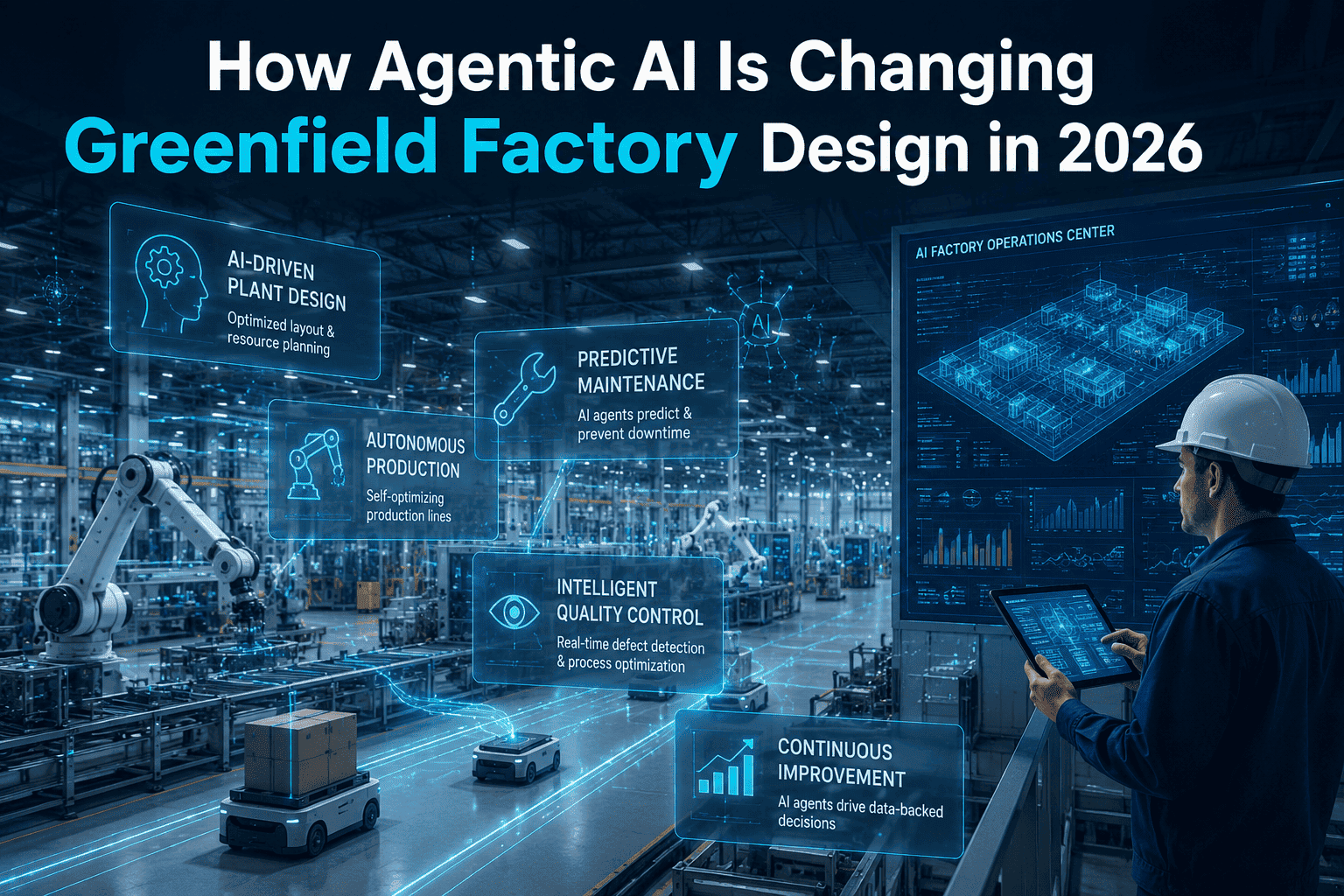
Most factories calling themselves "AI-powered" in 2026 are still running dashboards and alert systems. An anomaly fires, a notification lands in someone's inbox, a human investigates, a human decides, a human acts. That's not AI-driven manufacturing—that's expensive data collection with a human bottleneck at the end. Agentic AI breaks the bottleneck entirely. A temperature spike on Line 3 is detected, correlated with vibration data, diagnosed as bearing degradation, patched via parameter adjustment, and a work order is generated—all in 90 seconds, with zero human touch. For greenfield factory designers in 2026, the question isn't whether to build for agentic AI. It's whether you're designing the infrastructure that makes it possible from day one.
The 2026 Manufacturing Inflection Point
Agentic AI Is Redesigning
the Greenfield Factory
From passive dashboards to factories that detect, decide, and act — autonomously.
4×
Increase in agentic AI
adoption by 2026
Deloitte
90s
Detect → Diagnose → Act
closed-loop response
vs. 4–8 hrs manual
80%
Operational issues resolved
without human intervention
Gartner 2026
50%
Unplanned downtime reduction
with autonomous agents
McKinsey
The Shift: From Copilot to Agent
Generative AI was the manufacturing buzzword of 2024–2025. Agentic AI is the operational reality of 2026. The distinction matters enormously for greenfield design: a copilot answers when asked; an agent proactively pursues outcomes. Every architectural decision in your new facility — network topology, PLC selection, data infrastructure, edge compute placement — either enables or blocks autonomous agent operation.
Yesterday's Factory AI
Scenario: Temperature spike on Line 3
SCADA alert fires → email sent
T+0
Operator checks dashboard, calls maintenance
T+45 min
Technician diagnoses: bearing degradation
T+3 hrs
Work order created, parts ordered
T+5 hrs
Line down, schedule disrupted
T+8 hrs
Outcome: Line stoppage + emergency repair cost
Agentic AI Factory
Same Scenario — Agentic Response
Agent detects anomaly + correlates vibration data
T+0
Bearing degradation identified across sensor fusion
T+12s
Parameters adjusted, failure prevented in-line
T+40s
Work order generated, parts auto-reserved in CMMS
T+70s
Maintenance window slotted, schedule preserved
T+90s
Outcome: Zero downtime. Zero human initiation required.
Designing a greenfield factory and want this capability at commissioning? Book a Greenfield Consultation — iFactory designs your complete agentic architecture before a shovel breaks ground.
The Five Levels of Factory AI — Where Does Your Design Land?
Not all "AI factories" are equal. Most plants claiming AI capability in 2026 are still at Level 1 or 2 — dashboards and alert emails. Greenfield factories designed with agentic intent start at Level 4 on day one. Here's the full maturity spectrum and what each level actually means on the production floor.
L1
Monitor
Dashboards & OEE reports. Humans read and decide.
Most plants 2020–2022
L2
Detect
Anomaly alerts fire. Humans investigate and act.
Most plants today
L3
Predict
AI forecasts failures, suggests actions. Humans approve.
Emerging standard
L4
Act
Agents execute across MES, CMMS, ERP within guardrails.
Greenfield target 2026
L5
Orchestrate
Multi-agent coordination across production, quality, supply chain, energy — continuously self-optimizing.
2026 frontier
iFactory Greenfield Design: L4 at commissioning
The Four Agents Powering the Autonomous Factory
Agentic factories don't run on one AI system — they run on specialized agents, each owning a defined domain, each capable of handing off to other agents when a decision spans multiple systems. These four agent types deliver the clearest, fastest ROI and are the design foundation for every iFactory greenfield project.
Predictive Maintenance Agent
From failure prediction to failure prevention
Vibration
Temperature
Acoustic
Current Draw
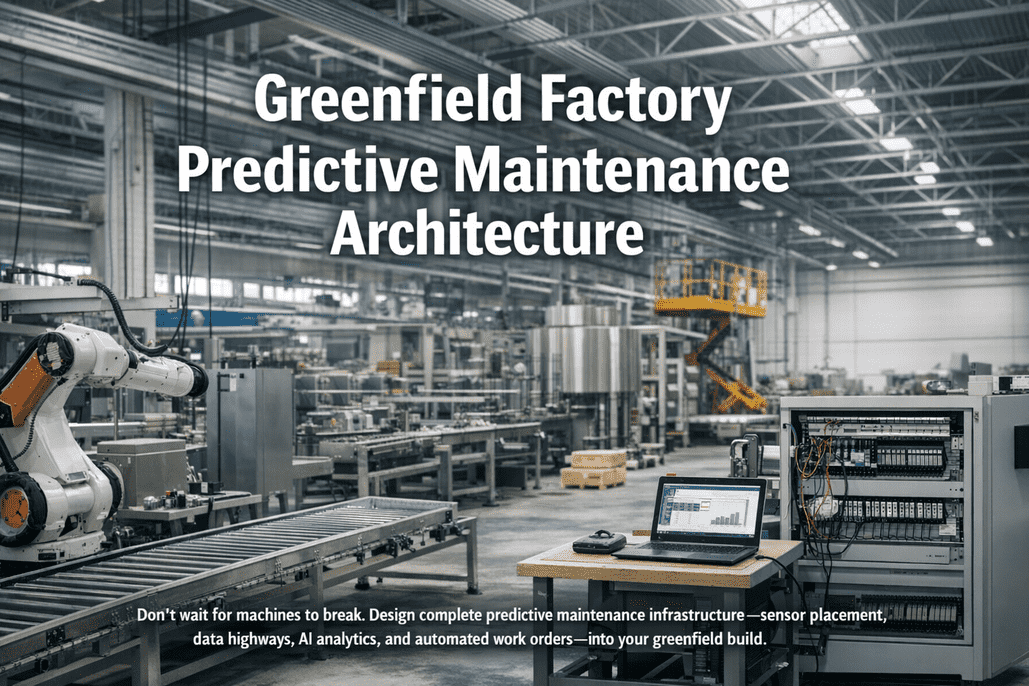
Monitors every rotating asset continuously. When degradation patterns emerge, the agent doesn't alert — it schedules the repair, reserves the part, and carves a maintenance window from the production schedule. The work order exists before the failure does.
50%
Reduction in unplanned downtime
Connects to: CMMS · MES · ERP · Sensor Network
Autonomous Quality Agent
Defect detection is old news — root cause elimination is the goal
AI Vision
Process Params
Material Lots
Line Speed
When defect rates drift, the agent correlates with upstream variables — machine setpoints, humidity, material batch — identifies the root cause, and adjusts parameters in real time. It traces problems across the full process chain before rejects accumulate.
37%
Reduction in manufacturing defects
Connects to: MES · Vision AI · SCADA · PLCs
Production Scheduling Agent
Schedules that are always current, not just accurate at 6am
Demand Signals
Capacity Status
Maintenance Windows
WIP
Production schedules go stale the moment they're published. This agent recalculates the optimal sequence continuously, rebalancing work centers in real time as conditions change — material delays, tooling changes, expedited orders, maintenance constraints.
95%
Reduction in scheduling query time
Connects to: ERP · MES · APS · WMS
Supply Chain Orchestration Agent
Material shortages resolved in minutes, not the next S&OP cycle
Inventory Signals
Supplier Data
Lead Times
Demand Forecast
When a material shortage is flagged, this agent evaluates alternative suppliers, compares cost and lead time, initiates procurement, and updates the production schedule — all before a line stops. One packaging manufacturer responded to material shortages in under five minutes using this architecture.
<5min
Shortage response vs. hours in manual workflows
Connects to: ERP · Supplier Portal · WMS · MES
Want to see how these four agents are designed into a real greenfield facility? Talk to iFactory's greenfield team for a no-cost agentic architecture review.
Building the Foundation: What Agentic AI Actually Needs
Agents are only as capable as the infrastructure they operate on. The six architectural requirements below are what separate greenfield factories that deliver autonomous operations at commissioning from those that spend 18–36 months retrofitting the prerequisites. Design them in now or pay for them later.
01
Unified Namespace (UNS)
Every PLC, sensor, MES, ERP, and historian publishes to one structured real-time data layer. Agents subscribe to what they need. Without UNS, agents can't see across domains. Design-in from day one — retrofitting takes 12–24 months.
02
Edge Compute Layer
Agents controlling production equipment respond in milliseconds — not cloud round-trips. Dedicated hardened edge servers co-located on the plant floor host latency-critical agents. Rule: inference at the edge, learning in the cloud.
03
Bidirectional OT/IT Integration
Most factories read OT data for reporting. Agents need write access: adjust PLC setpoints, trigger CMMS work orders, update ERP purchase orders. This requires explicit governance: which actions are autonomous vs. human-approved.
04
Digital Twin Foundation
Before acting, agents simulate consequences. A live digital twin synchronized from production systems serves as the reasoning environment. Built at design phase — 100% accurate at commissioning. Built post-hoc in brownfield — often 50% incomplete.
05
Human-Agent Governance Layer
Every agent needs a collaboration interface: dashboards showing what agents are doing and why, approval workflows for high-stakes decisions, override controls, and audit logs. Operators become orchestrators of agents, not doers of tasks.
06
Industrial DataOps Platform
Agents reason only as well as their data. A DataOps platform provides context, normalization, and quality management for every stream agents consume. Without it, agents hallucinate — prescribing wrong fixes. DataOps is the reliability layer between data and action.
Design the Complete Agentic Architecture Before Ground Breaks
iFactory designs your Unified Namespace, digital twin, edge compute layer, bidirectional OT/IT integration, and agent governance framework — validated in a digital twin before your facility is built. L4 autonomy at commissioning, not three years later.
Greenfield vs. Brownfield: The Agentic Advantage
Every prerequisite for agentic AI — Unified Namespace, bidirectional OT access, edge compute, live digital twin — is a multi-year retrofit project in an operating brownfield facility. In a greenfield project, they're design-phase line items. The cost difference is not incremental. It's structural.
Brownfield Retrofit
Greenfield AI-Native
PLC / Controller Access
Legacy adapters, partial write access, high risk
Modern PLCs with native OPC-UA, full bidirectional API from day one
Data Infrastructure
Siloed historians, no UNS, data wrangling projects required
UNS designed as the foundational layer — all systems publish to it
Digital Twin
Built post-hoc, often 30–50% incomplete and expensive to sync
Built during design phase, 100% synchronized from commissioning
Edge Compute
Retrofitted into panels, limited space, cooling is an afterthought
Dedicated edge zones designed into facility layout, power, and cooling
Time to L4 Capability
18–36 months of integration work post-commissioning
L4 at commissioning with AI-native design
Incremental Investment
$2–5M in integration, adaptation, and production disruption
+8–12% of automation budget — payback within 18 months
Planning your greenfield automation budget? Schedule an agentic design session — iFactory models full ROI timelines before your design freeze.
Expert Perspective
"The biggest barrier to agentic AI in manufacturing is often not technology — it's mindset. Delegating decision-making to autonomous systems feels unfamiliar in traditionally conservative industries. But the manufacturers best positioned for the years ahead are those willing to rethink how humans and intelligent systems work together. AI succeeds only when the digital foundations are strong. Manufacturers who invested in integrated platforms are the ones now activating AI capabilities at scale."
— Manufacturing Dive / Infor Industrial AI Report, 2026
24%
of manufacturers deploying agentic AI by end of 2026 (up from 6%)
1.6 yr
Average payback period for agentic predictive maintenance
30%
Factory output increase documented at Intel with agentic AI
Conclusion: The Design Decision Is Already Being Made
Every greenfield factory being designed right now is either being built for agentic AI or against it. The infrastructure choices — which PLCs you spec, whether you design in a Unified Namespace, where you place edge compute, how you architect OT/IT integration — will determine whether your facility reaches Level 4 autonomous operations at commissioning or spends its first three years in an expensive retrofit cycle. The factories that Deloitte predicts will be among the 24% deploying agentic AI by end of 2026? The greenfield ones with AI-native designs are already ahead. iFactory's greenfield consulting team designs your complete agentic architecture — digital twin, UNS, agent governance, edge compute, and bidirectional system access — validated before construction begins. Build the factory that acts, not just monitors.
Build the Factory That Acts — Not Just Monitors
From Unified Namespace to autonomous quality agents — iFactory designs your complete agentic AI architecture into your greenfield facility from day one. Start your design consultation today.
Frequently Asked Questions
What is agentic AI and how is it different from predictive AI in manufacturing?
Predictive AI forecasts outcomes — it tells you a bearing may fail in 72 hours. Agentic AI pursues outcomes autonomously: it detects the degradation, adjusts machine parameters to prevent immediate failure, generates the work order, reserves the part from inventory, and schedules the maintenance window — all without human initiation. The key difference is autonomous goal pursuit and multi-system execution. Predictive AI informs people. Agentic AI acts. In 2026, Gartner predicts agentic AI will autonomously resolve 80% of common operational issues without human intervention.
Why is it easier to design for agentic AI in a greenfield factory than retrofitting an existing plant?
Agentic AI requires bidirectional OT system access (write commands to PLCs, not just read), a Unified Namespace aggregating all data streams, edge compute co-located with production equipment, and a live digital twin. In a brownfield factory, each of these is a separate 6–18 month integration project costing $2–5M in total. In a greenfield project, they're design-phase decisions adding roughly 8–12% to the automation budget and delivering L4 capability at commissioning — not three years later. The greenfield advantage is eliminating integration debt entirely.
What is a Unified Namespace (UNS) and why is it the single most important decision in an AI-ready greenfield design?
A Unified Namespace is a centralized real-time data architecture where every system in a facility — PLCs, sensors, SCADA, MES, ERP, historians — publishes data to one structured, subscribable layer via MQTT Sparkplug B or OPC-UA PubSub. Agents subscribe to the streams they need rather than connecting point-to-point to individual systems. Without UNS, agents are siloed — a maintenance agent can't see production schedule context, a quality agent can't trace to material lot data. UNS is the single architectural decision that most determines whether your factory can support genuine agentic operations or is limited to departmental AI pilots.
How do you ensure human oversight and safety with autonomous agents on the production floor?
Agent governance defines three categories of action: fully autonomous (agents execute within defined limits, e.g., PLC setpoint adjustment within safe bands), approval-required (agents propose and await confirmation, e.g., procurement above a cost threshold), and always-escalate (agents never act autonomously, e.g., anything touching safety systems). Every agent action is logged to a full audit trail. Operator dashboards show what agents are doing and why in plain language. Every autonomous action has an override. This governance architecture is designed alongside the AI capabilities — before the first agent goes live, not after the first incident.
What ROI can a greenfield manufacturer expect from agentic AI in the first two years?
Documented results from production deployments include 50% reduction in unplanned downtime, 37% reduction in manufacturing defects, 30% increase in throughput, and average payback periods of 1.6 years for agentic predictive maintenance. One automotive components manufacturer achieved full ROI on a $4.2M investment within two years — expanding capacity 30% without adding floor space and generating $7.5M in additional annual revenue. For AI-native greenfield facilities, these returns arrive faster because there is no integration debt: the systems agents need to act across are natively accessible from commissioning day one.