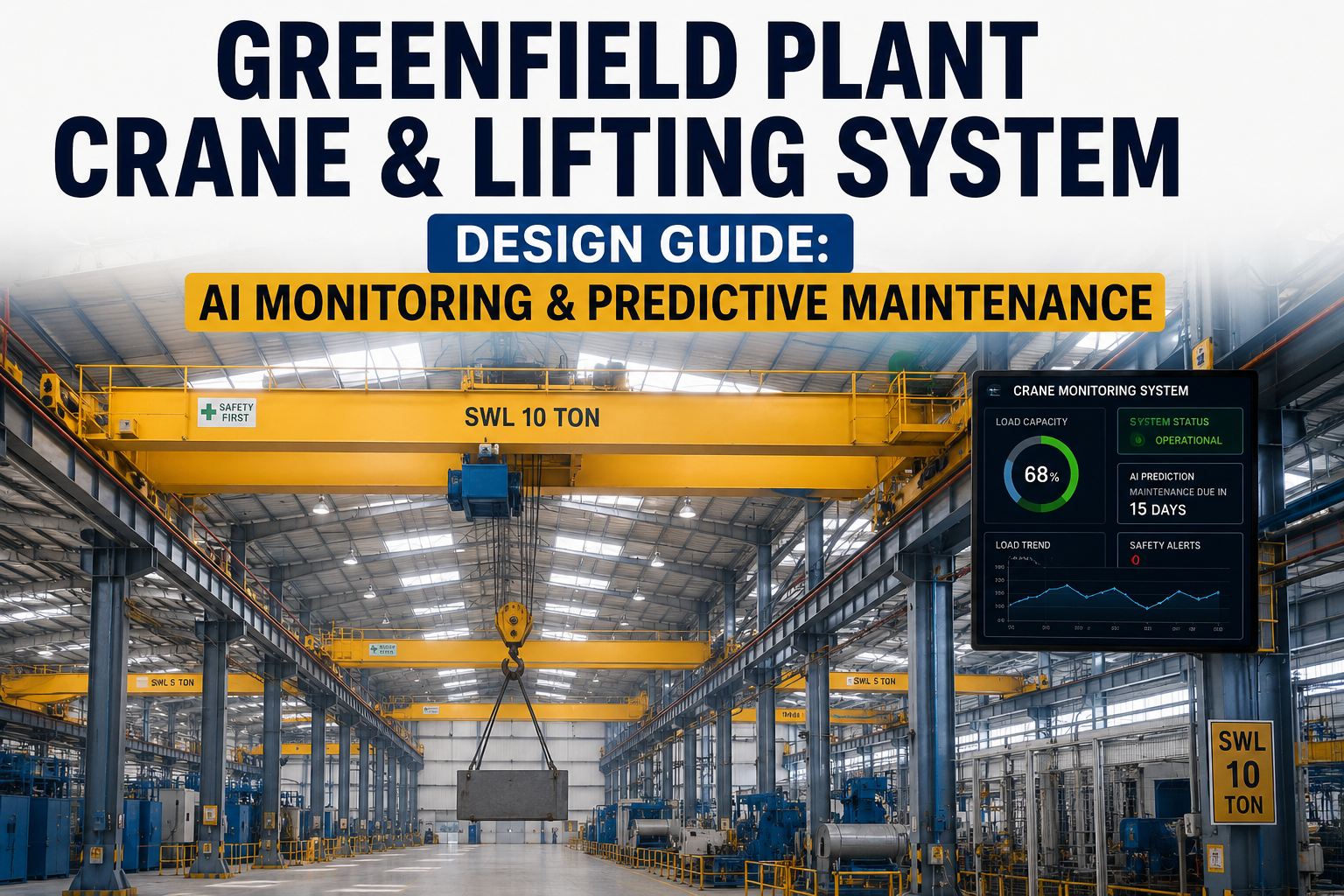
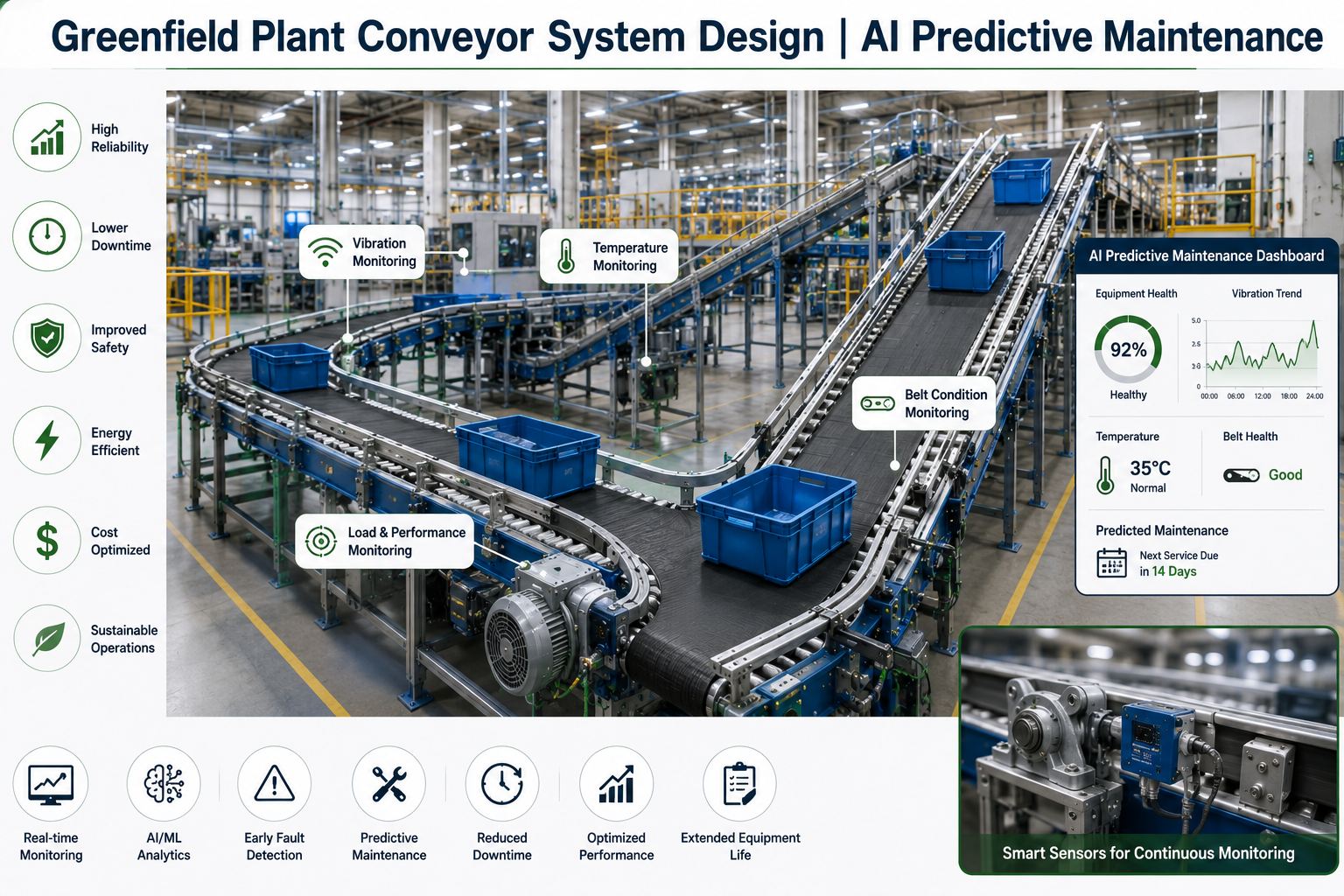
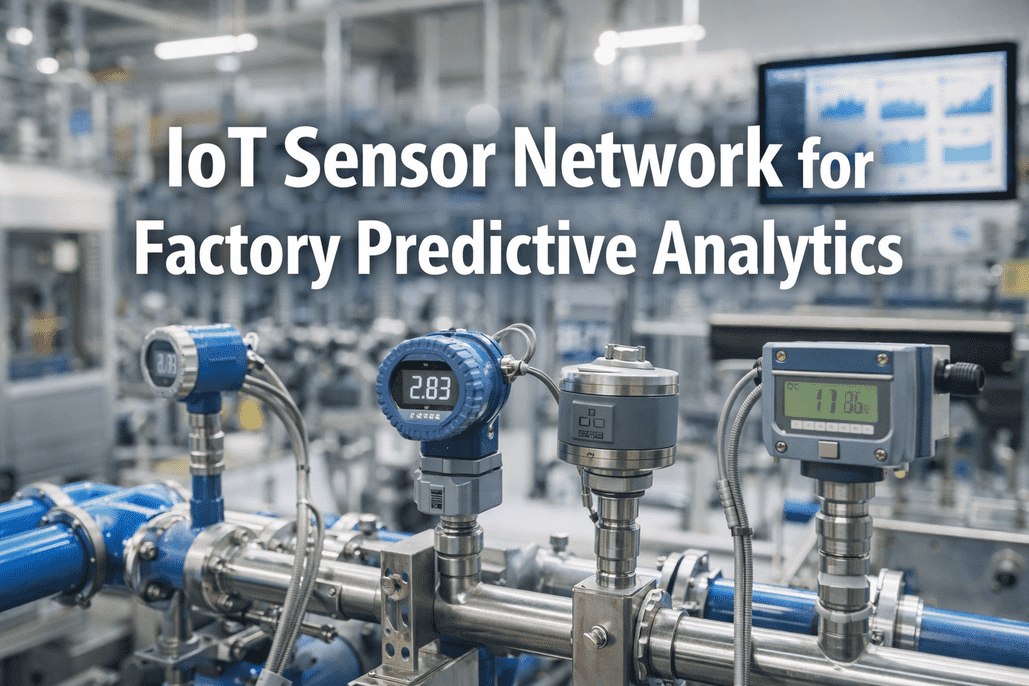
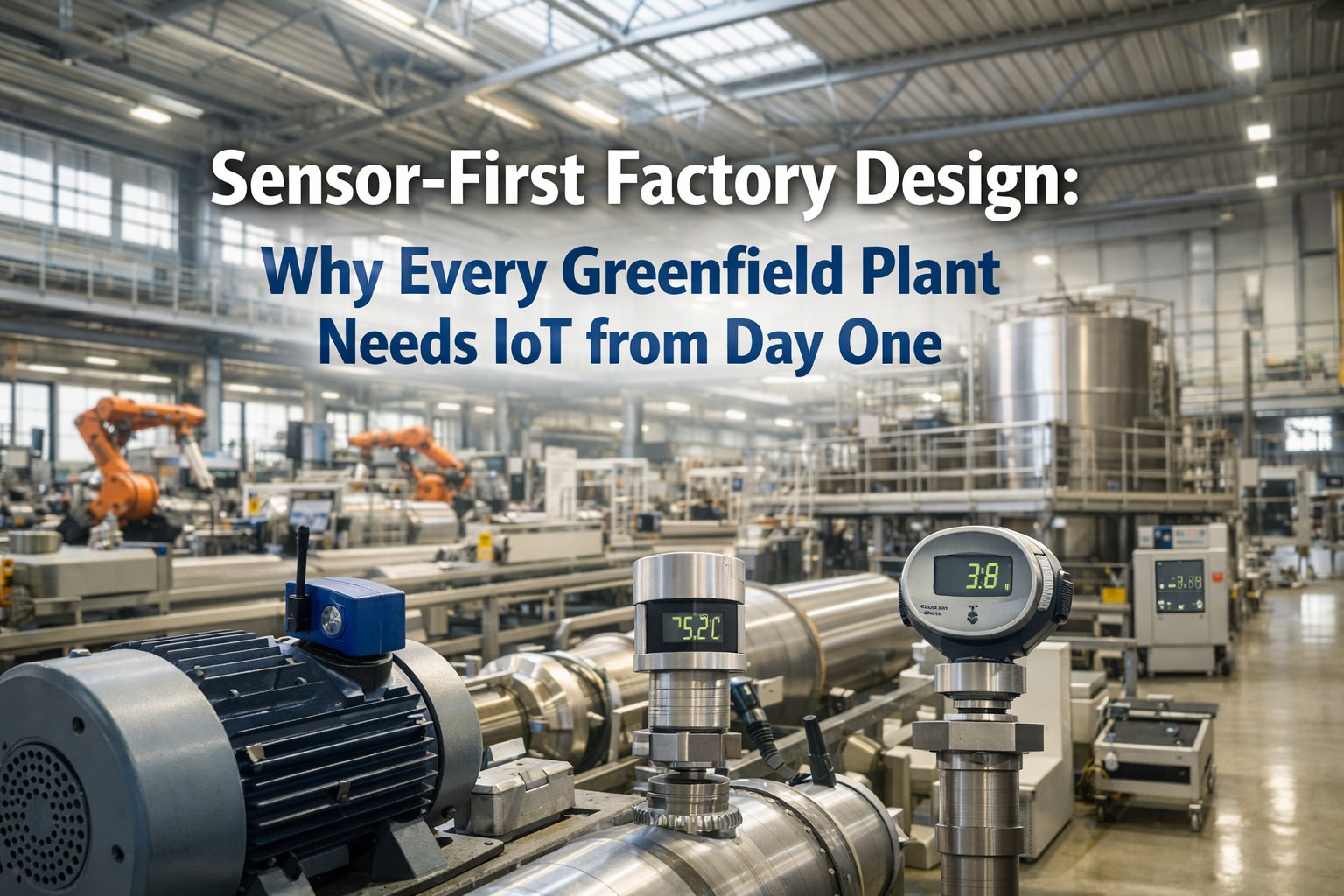
Don't wait for machines to break before you build the system to predict failures. Retrofitting predictive maintenance into an existing factory costs 3x more than designing it into a greenfield build and takes 18+ months — running cables through packed trays, drilling into sealed housings for sensor mounts, and finding server space in facilities never designed for analytics infrastructure. When you design PdM architecture before the first machine is installed, every sensor location is accessible, every cable route is clean, every data pipeline is sized, and the CMMS generates work orders automatically from day one of production. The result: 50% less unplanned downtime, 30% lower maintenance costs, and 25% longer asset life — all without a single retrofit dollar spent. Design Your PdM Architecture — we deliver sensor placement maps, network design, analytics infrastructure, and CMMS integration as construction-ready documentation.
Predictive Maintenance Architecture: 4 Layers
Layer 4
Action
CMMS auto work orders, parts procurement, technician dispatch, dashboard alerts
Layer 3
Analytics & AI
ML models for RUL prediction, anomaly detection, failure classification, digital twins
Layer 2
Data Network
Wired/wireless sensor network, edge gateways, MQTT/OPC UA brokers, time-series database
Layer 1
Sensors & Instruments
Vibration, temperature, current, ultrasonic, oil particle, acoustic emission, thermal imaging
Greenfield design specifies all 4 layers before construction — not one at a time over 18+ months
Retrofit vs. Greenfield: The Cost of Waiting
Retrofit PdM (18-24 months)
Month 1-3: Asset criticality audit and sensor specification — $50K-$100K consulting
Month 4-8: Cable routing through packed trays, conduit drilling, sensor mounting on running equipment — 3x labor cost, production disruption
Month 9-12: Network infrastructure — sharing bandwidth with production, wireless interference from metal structures
Month 13-18: Analytics deployment — collecting baseline data before any predictions are possible
Month 19-24: CMMS integration, dashboard deployment, technician training — first real value delivered
Total: $500K-$2M+ | 18-24 months to value
Greenfield PdM (Designed In)
Design Phase: Sensor locations, cable routing, network backbone, and server room specified in construction documents — $0 incremental if planned with facility
Construction: Sensor mounts, conduit, cable trays, and network drops installed with the building — zero retrofit labor premium
Commissioning: Sensors online during equipment commissioning — baseline data collection starts immediately
Production Day 1: Analytics running, baselines established, anomaly detection active from first shift
Month 3-6: ML models calibrated, CMMS auto-generating work orders, full PdM operational
Total: 60-70% lower cost | 3-6 months to value
Planning a new factory and want PdM from day one? Design Your PdM Architecture — we'll deliver sensor maps, network topology, and CMMS integration specs as construction-ready documents.
Sensor Placement: What to Monitor on Every Critical Asset
| Asset Type | Failure Modes | Sensors Required | Mounting Points | Data Rate | Prediction Horizon |
|---|
| Electric Motors | Bearing wear, winding insulation, misalignment | Vibration (tri-axial), temperature, current signature | Drive end bearing, non-drive end, frame | 25.6 kHz vibration; 1 Hz temp | 6-8 weeks before failure |
| Pumps | Cavitation, seal leak, impeller erosion, bearing | Vibration, pressure (suction/discharge), flow, temperature | Bearing housing, suction/discharge pipes | 25.6 kHz vib; 1 Hz process | 4-8 weeks |
| Gearboxes | Tooth wear, bearing failure, oil degradation | Vibration, oil particle counter, temperature, acoustic emission | Input/output bearings, oil sump, casing | 51.2 kHz vib; continuous oil | 3-12 weeks |
| Compressors | Valve failure, bearing, surge, seal degradation | Vibration, pressure, temperature, current, ultrasonic | Each stage, bearings, discharge | 25.6 kHz vib; 10 Hz process | 2-6 weeks |
| Conveyors | Belt wear, roller bearing, tracking, motor | Vibration (rollers), belt tension, motor current, thermal | Head/tail pulleys, idlers at intervals | 1 kHz vib; 1 Hz tension | 2-4 weeks |
| CNC Machines | Spindle bearing, tool wear, axis backlash | Vibration (spindle), current, acoustic emission, position | Spindle housing, servo drives, axes | 51.2 kHz vib; real-time position | Days to weeks (tool-dependent) |
| HVAC/Utilities | Fan bearing, compressor wear, refrigerant leak | Vibration, temperature, pressure, power | Fan bearings, compressor unit, distribution | 1 kHz vib; 1 Hz process | 4-12 weeks |
Wired vs. Wireless Sensor Networks
Wired (4-20mA / Ethernet / Fieldbus)
Data rate: Continuous high-bandwidth (25-100 kHz sampling)
Reliability: 99.99% — no RF interference, no battery replacement
Latency: Sub-millisecond — suitable for machine protection
Cost per point: $200-$500 installed (higher in retrofit; much lower in greenfield)
Best for: Critical assets requiring continuous high-frequency monitoring (spindles, turbines, large compressors)
Greenfield advantage: Cable trays and conduit designed in; installation cost 60-70% lower than retrofit
Wireless (WirelessHART / ISA100 / BLE / WiFi)
Data rate: Periodic sampling (1 Hz to 1 kHz typical; some up to 25 kHz burst)
Reliability: 99.5-99.9% — RF interference in metal-heavy environments
Latency: 100ms-10s — not suitable for protection, fine for monitoring
Cost per point: $100-$300 installed (lower hardware, higher battery lifecycle cost)
Best for: Non-critical assets, hard-to-reach locations, auxiliary equipment, fleet-wide coverage at scale
Greenfield advantage: Wireless AP locations planned for coverage; metal interference zones mapped and mitigated
Analytics Architecture: Edge to Cloud
Edge
Real-Time Anomaly Detection (0-100ms)
Edge gateways process vibration, temperature, and current data locally. Threshold alerts, spectral analysis, and envelope detection run on-premise with zero cloud dependency. NVIDIA Jetson or L4 GPU for pattern recognition. Triggers immediate machine protection actions (slowdown, alert, shutdown) without waiting for cloud round-trip.
Fog
Plant-Level Correlation (seconds-minutes)
On-premise servers aggregate data across multiple assets. Correlates upstream/downstream equipment behavior (e.g., pump cavitation triggered by upstream valve position change). Runs ML models for failure classification and root cause analysis. Time-series database (InfluxDB, TimescaleDB) stores 30-90 days of high-frequency data locally.
Cloud
Fleet-Wide Learning & Model Training (hours-days)
Cloud receives aggregated features (not raw data — preserving bandwidth and sovereignty). Trains and retrains ML models across multi-site fleet data. Transfer learning applies failure patterns from one plant to another. Digital twin simulations for rare failure scenarios. GPU training on NVIDIA A100/H100 in cloud; optimized models deployed back to edge.
Prescriptive
Automated Action & Continuous Improvement
AI doesn't just predict failure — it prescribes the response. Auto-generates CMMS work orders with failure mode, severity, recommended action, required parts, and estimated time. Schedules maintenance during planned windows to minimize production impact. Generative AI drafts step-by-step repair procedures from equipment manuals and historical technician notes.
Want to see the full analytics stack configured for your asset types? Design Your PdM Architecture — we'll specify edge, fog, and cloud tiers with exact hardware, software, and integration for your greenfield facility.
CMMS Integration: From Prediction to Work Order
1
AI Detects AnomalyML model identifies bearing wear signature on Pump P-101 — confidence 92%, estimated 4 weeks to functional failure.
2
Work Order Auto-GeneratedCMMS creates work order: "Replace drive-end bearing — P-101" with failure mode, evidence (vibration spectra), parts list (SKF 6310-2Z), and estimated labor (2 hours).
3
Scheduling & PartsCMMS checks parts inventory. If in stock: schedules during next planned window. If not: triggers procurement with lead time factored against remaining useful life.
4
Technician ExecutesMobile app delivers work order with AI-generated step-by-step procedure, safety checks, torque specs, and before/after vibration targets. Photos and completion data logged automatically.
5
Model LearnsPost-repair vibration data confirms successful intervention. Predicted vs. actual failure timeline feeds back to improve model accuracy. Every repair makes the next prediction better.
Key Benefits & ROI
50%Less unplanned downtime — failures predicted weeks before they happen
30%Lower maintenance costs — eliminate unnecessary PM tasks and emergency repairs
25%Longer asset life — operate to condition, not arbitrary calendar schedules
6-9 moROI payback — savings from first prevented failure often exceed total sensor cost
$0Retrofit cost — everything designed in before the first wall goes up
The Best Time to Design PdM Is Before Construction Starts
iFactory designs complete predictive maintenance architecture for greenfield factories — sensor placement, network infrastructure, analytics platform, and CMMS integration — delivered as construction-ready documentation that contractors build from directly.
Frequently Asked Questions
How many sensors does each machine need?
It depends on the asset type and criticality. A simple electric motor needs 3-4 sensors (vibration on each bearing, temperature, current). A gearbox needs 5-7 (vibration on input/output bearings, oil particle counter, temperature, acoustic emission). A CNC spindle needs 4-6 (high-frequency vibration, current, acoustic emission, position). A typical greenfield factory with 50-200 critical assets needs 200-1,000 sensor points total. We specify the exact sensor count, type, and mounting location for every critical asset in your facility during the design phase.
Should I use wired or wireless sensors?
Use both — the optimal mix depends on asset criticality and monitoring requirements. Wired sensors (continuous 25-100 kHz sampling) for critical rotating equipment where high-frequency vibration data is needed for early fault detection: main production motors, spindles, compressors, turbines. Wireless sensors (periodic 1 Hz to 1 kHz) for non-critical and auxiliary equipment where fleet-wide coverage at lower cost matters: HVAC fans, small pumps, conveyors, utility systems. In greenfield, the advantage is that cable routes for wired sensors are designed into the building, and wireless access point coverage is planned to avoid dead zones in metal-heavy areas.
What AI/analytics platform should we use?
We design platform-agnostic architecture. The analytics stack typically includes: edge processing (NVIDIA Jetson/L4 with anomaly detection), a time-series database (InfluxDB, TimescaleDB), ML frameworks (TensorFlow, PyTorch), and visualization dashboards (Grafana, Power BI). For cloud model training, AWS IoT, Azure IoT, or Google Cloud IoT all work. The critical design decision is the edge-to-cloud split — what runs locally (real-time protection and anomaly detection) vs. what runs in cloud (model training and fleet-wide analytics). We specify this architecture based on your latency requirements, data sovereignty policies, and IT infrastructure preferences.
How does PdM connect to our CMMS?
Through standard APIs (REST, MQTT, OPC UA) that push AI predictions directly into your CMMS as auto-generated work orders. When a model detects a developing failure, it creates a work order with: asset ID, failure mode, confidence level, estimated time to failure, recommended action, parts list, and evidence (vibration spectra, trend charts). The CMMS then handles scheduling, parts procurement, technician assignment, and completion tracking. iFactory's CMMS supports this natively. For SAP PM, Oracle EAM, Maximo, or other systems, we design the integration layer during greenfield planning.
Book a demo to see the prediction-to-work-order flow.
What does PdM cost per monitored asset?
In greenfield: $500-$2,000 per monitored asset (sensors + installation + network share + analytics license), depending on sensor count and asset complexity. Compare this to $1,500-$6,000 per asset in retrofit (3x more due to cable routing, production disruption, and structural modifications). For a factory with 100 critical assets, greenfield PdM infrastructure costs $50K-$200K total — vs. $150K-$600K for the same coverage as a retrofit. The first prevented failure on a critical asset (avoiding $50K-$100K+ in unplanned downtime) often pays back the entire sensor investment on that machine.
Every Machine Will Eventually Fail — The Question Is Whether You'll Know in Advance
Design the sensor network, data pipeline, AI analytics, and automated work orders into your factory before the first machine is installed. Zero retrofit. Zero surprises.