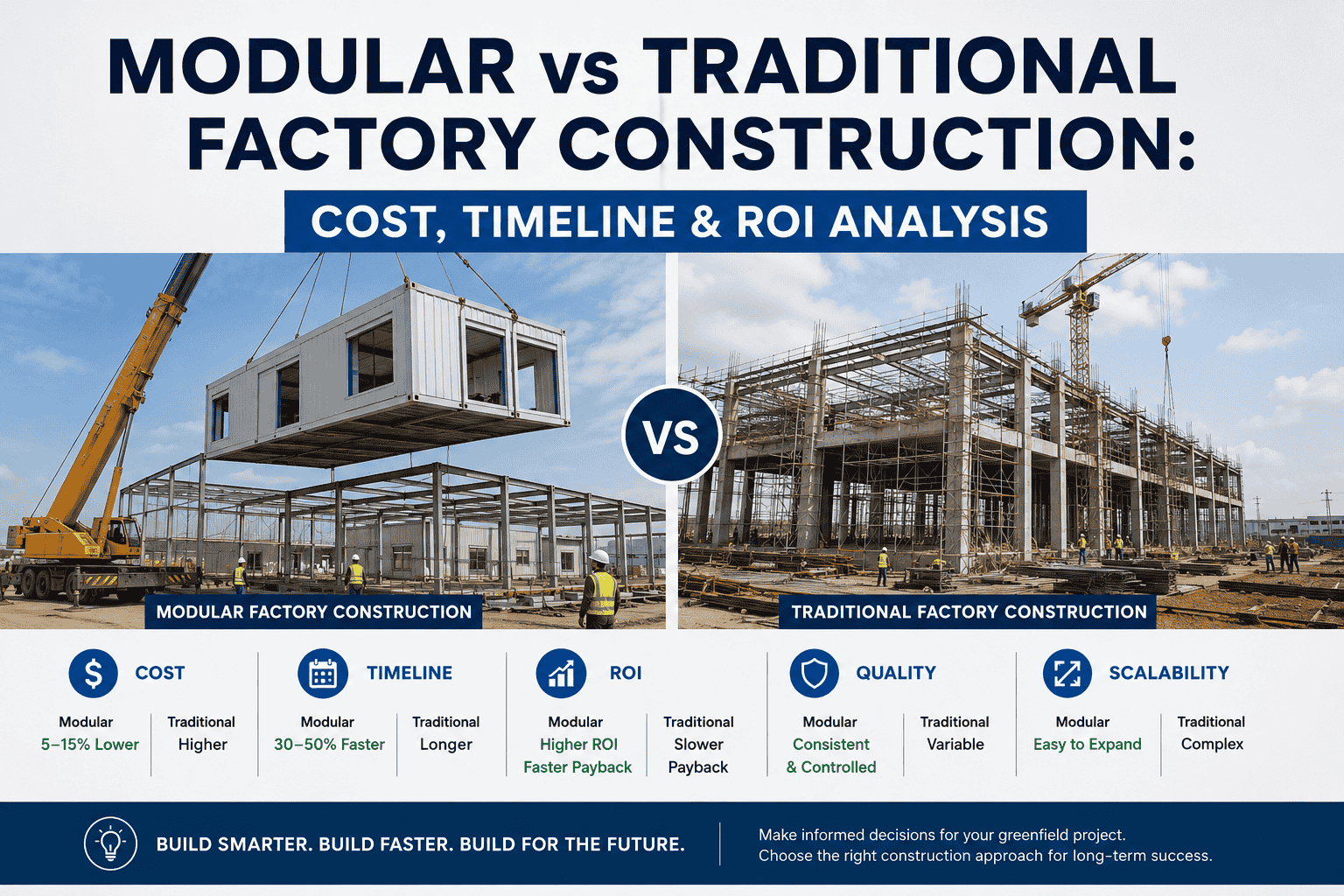
Modular factory construction has shifted from experimental approach to mainstream alternative for greenfield manufacturing projects in 2026. Driven by 30–50% timeline savings, 10–25% cost reductions, and a construction labor shortage that adds 350,000 workers of demand against contracting supply, modular delivery now wins for most manufacturing facilities under 50,000 square feet and increasingly for larger projects too. Traditional construction remains the right answer for highly customized architectural designs, multi-story facilities above four floors, and projects with site-specific complexity that modular logistics cannot handle. This guide compares the two approaches across cost, timeline, quality, scalability, and ROI for industrial manufacturing greenfield projects. Book a greenfield consultation to evaluate which approach fits your specific facility requirements.
TRADITIONAL
Sequential Construction
18–30 months
Land Prep
Foundation
Structure
MEP & Process
Finish & Commission
MODULAR
Parallel Construction
12–18 months
Site Prep + Factory Fab (parallel)
Module Delivery
Assembly & Commission
30–50%timeline reduction with modular
10–25%cost savings on standardized facilities
4–12 moearlier time-to-revenue
The Build Decision: Modular vs Traditional in 2026
The decision between modular and traditional factory construction has shifted meaningfully in 2026. Three forces converged to change the conventional wisdom: a construction labor crisis adding 350,000 worker shortfall to demand, McKinsey research confirming volumetric modular construction can shorten project timelines by up to 50%, and a global modular market projected to grow from $103.55B in 2024 to $162.42B by 2030 at 7.9% annual growth. For manufacturing operations evaluating greenfield construction, the practical question is no longer "is modular viable" but "which approach fits this specific facility." The five factors below drive the decision.
01
Time-to-Revenue Priority
For manufacturing facilities where production capacity directly translates to revenue, getting operational 4–12 months earlier is the most powerful ROI factor. Modular delivers this consistently through parallel workflows. Traditional construction’s sequential phases inherently take longer.
02
Standardization vs Customization
Modular wins for standardized facility designs where modules can be replicated efficiently. Traditional wins for highly customized architectural designs, unusual structural requirements, and facilities where every square foot needs unique configuration. Most manufacturing facilities fall into the standardization-friendly category.
03
Site Logistics & Access
Modular construction requires module transportation infrastructure: highway access, crane staging, assembly clearances. Sites with tight urban footprints, weight-restricted road access, or unusual geographic challenges may favor traditional construction despite the timeline penalty.
04
Facility Size & Complexity
Modular wins for facilities under 50,000 square feet and single-story or low-rise configurations. Multi-story buildings above 4–5 floors, very large monolithic structures, and facilities with complex spatial requirements favor traditional construction. Hybrid approaches combine both methods.
05
Quality & Precision Requirements
Manufacturing facilities requiring contamination control (cleanrooms, food processing, pharmaceutical, semiconductor) benefit from modular factory-controlled construction conditions delivering ±1–2mm precision vs ±3–6mm site-built. ISO 14644 cleanrooms can be manufactured in modular facilities and sealed before transport.
06
Future Expansion Strategy
Modular construction inherently supports phased expansion — adding modules as capacity needs grow. Traditional construction makes future expansion harder, requiring full design and permitting cycles. Manufacturing operations expecting capacity growth over time benefit from modular’s inherent scalability.
How Modular Factory Construction Works
Modular factory construction is a manufacturing-style approach to building manufacturing facilities. Instead of assembling the entire structure on-site from raw materials, modular construction builds factory modules in a controlled off-site facility, transports them to the project site, and assembles them like large-scale building blocks. The off-site work happens in parallel with on-site preparation, compressing the total timeline meaningfully. The six-stage workflow below shows how a typical modular factory construction project unfolds.
01
Design & Engineering (Weeks 1–8)
Facility designed with modular methodology from inception. Module boundaries defined, transportation logistics planned, on-site assembly sequence engineered. Modular design typically requires more upfront planning than traditional but compresses downstream work. Permitting begins in parallel.
02
Parallel Site Prep + Module Fabrication (Weeks 9–28)
This is where modular’s timeline advantage materializes. Site preparation (excavation, foundation, utilities) happens concurrently with module fabrication in the off-site factory. Weather doesn’t affect module fabrication. Labor stability higher in factory environment. Material waste drops to 2–5% (vs 15–25% site-built).
03
Module Transportation (Weeks 28–32)
Completed modules transported from factory to site. Heavy haul logistics required for large modules. Route surveys, permits, traffic coordination. Transportation cost ($3,000–$12,000 per module typically) becomes part of the cost structure. Modules arrive sealed and protected.
04
On-Site Assembly (Weeks 32–40)
Modules craned into position on prepared foundation. Interconnections (utilities, MEP, structural ties) completed. Exterior weatherproofing and architectural finishes applied. Module-to-module assembly typically much faster than equivalent site-built construction because most internal work is already complete.
05
Manufacturing Equipment Installation (Weeks 40–48)
Manufacturing equipment, process piping, automation, and controls installed in modular-built shell. Some equipment can be pre-installed within modules before transport. Production lines configured. Many modular factory projects achieve "ready for equipment" earlier than traditional, allowing equipment installation to compress.
06
Commissioning & Production Start (Weeks 48–52)
Final commissioning, validation, regulatory inspections, production trials. Manufacturing facility operational. Total typical timeline for modular factory construction: 12–18 months from groundbreaking to production start. Traditional equivalent: 18–30 months. The 4–12 month delta is where modular ROI concentrates.
How Traditional Factory Construction Works
Traditional factory construction follows the established sequential workflow that has defined industrial construction for decades. Each phase depends on completion of the prior phase, with limited opportunity for parallelization. The approach offers maximum design flexibility, accommodates complex architectural requirements, and handles site-specific complications well — but at the cost of longer total timeline and greater exposure to weather, labor availability, and supply chain disruptions. The six-phase traditional workflow below contrasts with the modular parallel approach.
01
Design & Permitting (Months 1–6)
Detailed architectural and engineering design. Traditional approach allows extensive customization without modular constraints. Permitting can run in parallel with design refinement. Soil studies, environmental assessments, utility connection planning. Less upfront design constraint than modular but longer cumulative design phase.
02
Site Preparation & Foundation (Months 4–9)
Excavation, grading, utility connections, foundation pour. Cannot begin until permitting complete. Weather-dependent. Concrete cure times govern schedule. Foundation must be 100% complete before structural work begins — no parallelization with above-grade work. Single largest schedule risk in traditional construction.
03
Structural & Envelope Construction (Months 8–18)
Steel structure erection or concrete work, exterior wall systems, roofing. Weather-exposed phase. Labor-intensive. Coordination across multiple trades. Material waste 15–25% typical. Quality variance from weather, labor consistency, on-site conditions. Site-built precision ±3–6mm typical — harder to achieve modular’s ±1–2mm.
04
MEP & Process Systems (Months 14–24)
Mechanical, electrical, plumbing, process piping, automation, and controls. Cleanroom systems where applicable. Major trade coordination challenge. Schedule typically slips here due to dependencies and rework. Industrial MEP complexity often consumes more time than budgeted in traditional construction schedules.
05
Manufacturing Equipment Installation (Months 20–26)
Process equipment installation. Some installation can begin before final MEP completion but ramp-up depends on facility readiness. Equipment installation timeline similar to modular approach — difference is when the facility is "ready for equipment" not how long equipment installation takes.
06
Finish, Commission & Production Start (Months 24–30)
Final architectural finishes, regulatory inspections, commissioning, production trials. Facility operational. Total typical timeline for traditional factory construction: 18–30 months from groundbreaking to production start. Schedule overruns common — over 80% of traditional projects exceed planned timelines.
Want to model both timelines against your specific manufacturing facility requirements? Book a greenfield consultation — we’ll evaluate your facility scope, site characteristics, and time-to-market priorities against both construction approaches.
Cost, Timeline & ROI: The Quantified Comparison
The quantified comparison between modular and traditional factory construction breaks down across six dimensions that drive total project economics. Each dimension has specific numerical evidence from 2024–2026 industrial construction projects. The headline finding is consistent: modular delivers measurable advantages on cost, timeline, quality precision, and waste reduction, while traditional retains advantages on design flexibility and structural longevity. The decision rarely comes down to a single dimension — it comes down to which dimensions matter most for your specific facility.
← Swipe to see comparison →
Modeling the financial impact for your facility? Book a greenfield consultation — we’ll build a quantified comparison for your specific project scope, factoring in time-to-revenue, construction cost, and lifecycle economics.
Decision Framework: When Each Approach Wins
The decision between modular and traditional factory construction depends on facility characteristics more than philosophical preference. The two columns below summarize when each approach delivers the best ROI for industrial manufacturing greenfield projects. Many real-world projects use hybrid approaches — modular for standardized portions (cleanrooms, utilities, repeated production cells), traditional for highly customized elements (executive office, distinctive architectural features, complex multi-story segments).
MODULAR WINS WHEN...
Time-to-revenue is the dominant business priority
Facility design follows standardized patterns
Site has good highway access for module transport
Facility is under 50,000 square feet
Cleanroom precision required (ISO 14644 compliance)
Single-story or low-rise configuration
Future expansion is anticipated (modular scales by addition)
Local construction labor is constrained
Weather conditions threaten traditional schedules
Project economics favor 10–25% cost savings
Quality consistency matters (food, pharma, biotech)
Sustainability/waste reduction is a stated priority
TRADITIONAL WINS WHEN...
Facility design is highly customized architecturally
Multi-story building above 4–5 floors
Site has tight urban footprint or restricted access
Module transportation infeasible (geography, roads)
Facility exceeds 100,000+ square feet monolithic
Heavy industrial process loads require massive foundations
Existing structures require integration (brownfield-adjacent)
Long-term structural lifespan is the dominant priority
Local skilled construction labor is abundant
Schedule pressure is moderate or low
Site-specific requirements drive bespoke design
Capital constraints favor distributed cash flow
Many facilities benefit from hybrid approaches that combine modular and traditional methods. Book a greenfield consultation to determine the right mix of modular standardization and traditional flexibility for your specific facility.
Determine the Right Construction Approach for Your Greenfield Project
A greenfield consultation evaluates your facility scope, site characteristics, time-to-market priorities, capital constraints, and operational requirements against both modular and traditional construction approaches. Output: a documented recommendation with quantified comparison and phased construction plan.
Expert Perspective
"The modular versus traditional factory construction debate has shifted meaningfully between 2022 and 2026. Three forces drove the shift. First, the construction labor shortage became operationally severe — 350,000 additional construction workers needed in 2026 against contracting supply, with 41% of the current workforce retiring by 2031. Second, McKinsey’s research on volumetric modular construction confirmed the timeline reductions of up to 50% in production-scale studies, not just isolated projects. Third, the modular construction market matured to the point where industrial-grade modular facilities — cleanrooms, pharmaceutical, food processing, semiconductor — became routine rather than experimental. The result is that the conventional wisdom of 2022 ('modular is for housing, traditional is for industrial') is operationally wrong in 2026. Modular wins for the majority of manufacturing facilities under 50,000 square feet, particularly those with contamination control requirements where factory-controlled construction conditions deliver precision that site-built construction cannot match. Traditional construction remains the right answer for genuinely complex projects: highly customized architectural designs, multi-story facilities, very large monolithic structures, and projects where site characteristics make module logistics impractical. The decision today is operational, not philosophical — which approach delivers better ROI for this specific facility against this specific business timeline."
— Greenfield Construction Practice, 2026 perspective
$103.55B
global modular construction market 2024
$162.42B
projected 2030 (7.9% CAGR)
350K
additional construction workers needed 2026
Make the Right Construction Method Decision
A greenfield consultation produces a documented construction approach recommendation tailored to your specific facility scope, site characteristics, time-to-market priorities, and capital constraints. We’ll model both approaches quantitatively and recommend the one that fits your project — including hybrid approaches where appropriate.
Frequently Asked Questions
How much faster is modular factory construction really?
Typical timeline reduction for industrial modular construction versus traditional is 30–50%, with McKinsey research confirming up to 50% reduction in volumetric modular projects. The mechanism is parallel workflows: site preparation, foundation work, and module fabrication happen simultaneously rather than sequentially. Traditional construction must complete foundation before structure, structure before MEP, MEP before finishes — each phase depends on the prior. Modular eliminates the sequential dependency for the substantial work that happens in the factory. For a manufacturing facility that takes 18–30 months traditionally, modular typically delivers 12–18 months from groundbreaking to production start. The 4–12 month timeline delta is where modular ROI concentrates — that’s 4–12 months of earlier revenue capture for production-driven economics.
Is modular construction really cheaper than traditional?
Yes, in most industrial applications — typically 10–25% lower on a comparable facility basis. The cost reductions come from four sources: (1) Factory labor rates 20–30% lower than field construction labor due to controlled environment and permanent workforce, (2) Material waste drops from 15–25% (site-built) to 2–5% (factory precision cutting from CAD files), (3) Compressed timeline means less interest carry on construction loans and earlier occupancy, (4) Weather-independent factory environment eliminates schedule delays that compound traditional construction costs. Some costs are higher in modular — transportation logistics typically $3,000–$12,000 per module — but these are outweighed by the savings on labor, materials, and timeline. For highly customized facilities the cost advantage shrinks; for standardized facilities it’s most pronounced.
Schedule a consultation to model the cost comparison for your specific facility.
Can modular construction handle cleanroom and pharmaceutical facilities?
Yes — and in many cases handles them better than traditional construction. Modular cleanrooms are manufactured to ISO 14644 standards in controlled factory conditions and sealed before transport, then connected on-site. The factory-controlled construction environment delivers ±1–2mm precision compared to ±3–6mm typical site-built precision, which is critical for cleanroom integrity. Pharmaceutical, biotechnology, semiconductor, and food processing facilities increasingly favor modular construction for contamination-controlled spaces. The modular approach also allows pre-installation of utilities and basic process equipment within modules before transport, accelerating downstream equipment installation. For industrial cleanroom applications, modular has become the preferred approach for many operators in 2025–2026.
What about facility expansion — can we add to a modular factory later?
Modular construction supports expansion better than traditional construction. The expansion typically follows the same modular methodology: design additional modules, fabricate in factory, transport to site, integrate with existing facility. Permitting often faster because the existing facility provides the precedent and most utility infrastructure exists. Traditional expansion requires full design and permitting cycles, more on-site work, and more disruption to existing operations. For manufacturing operations expecting capacity growth over time — which describes most greenfield projects in growth industries — modular’s inherent scalability is a meaningful long-term advantage that compounds over years of expansion cycles.
What are the situations where modular construction doesn’t work?
Modular construction has practical limitations that traditional construction handles better. (1) Highly customized architectural designs where each section is unique resist the modular standardization benefit. (2) Multi-story buildings above 4–5 floors face engineering challenges with module-on-module structural loading. (3) Very large monolithic structures (single-room spaces over typical module dimensions) cannot be modular. (4) Sites with restricted access — weight-restricted roads, tight urban footprints, limited crane staging — create module transportation problems. (5) Heavy industrial processes with massive foundations or specialized structural loading may require traditional construction. (6) Brownfield-adjacent projects requiring integration with existing structures often favor traditional. The honest answer: modular wins for most manufacturing greenfield projects but not all. The decision should be made facility-by-facility, not philosophically.