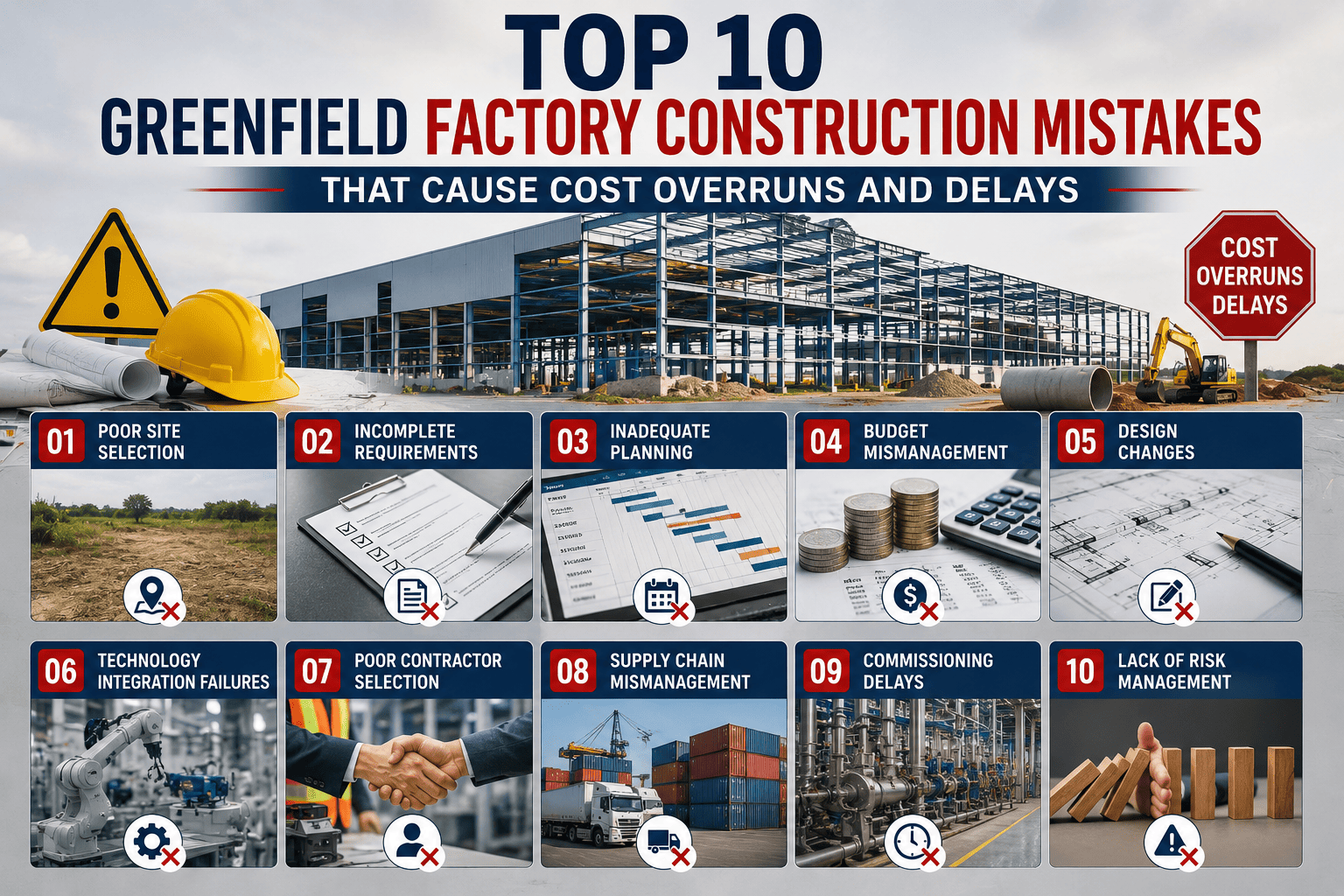
Seventy percent of greenfield manufacturing projects exceed their original budget. The average capital project runs 60% over schedule. Ninety-two percent of large industrial builds miss their original targets. These aren't rare failures — they're the statistical norm. And the most frustrating part for anyone who has lived through a troubled greenfield project is that almost every overrun and delay traces back to a predictable mistake made early in the process. Not contractor errors. Not force majeure. Decisions made in planning, site selection, procurement and design that looked reasonable at the time and became catastrophically expensive later. This is the definitive list of those mistakes — what they look like, what they cost, and what to do instead.
The Greenfield Reality Check
10 Mistakes. Billions in Avoidable Overruns.
Every mistake on this list is predictable. Every one is preventable. Most happen anyway.
70%
of greenfield projects exceed original budget
60%
average schedule overrun on capital projects
$1.3B
average cost overrun on large projects
20 mo
average schedule slippage vs. original plan
The 10 Mistakes That Kill Greenfield Projects
These mistakes don't appear in isolation. The worst project failures combine several of them — a site selected for the wrong reasons, utilities underspecified, procurement started late, and an IT/OT integration left to "Phase 2." By the time commissioning arrives, the project is already carrying 18 months of compounding delays. Understanding the mechanics of each mistake — and its specific cost consequence — is the first step to avoiding it.
01
What goes wrong
Land cost drives the site decision. A parcel looks attractive on price, proximity to leadership, or political incentive packaging — without a full assessment of utility availability, labor market depth, permitting complexity, supply chain proximity, and infrastructure capacity. The cheap land turns out to have a 4-year utility interconnect queue, a 100-year flood plain designation, and no workforce within 50 miles with advanced manufacturing skills.
Cost consequence
$5M–$50M+
Infrastructure remediation, relocation of site selection, extended utility development costs
Schedule impact
12–36 months
Utility queue delays, permitting rework, or full site replacement
The fix
Evaluate 50+ site parameters simultaneously before shortlisting. Lock utility interconnect feasibility, permitting pathway, labor market depth, and supply chain proximity into a weighted scoring model before any land acquisition.
See how iFactory scores sites before you commit →
02
What goes wrong
The electrical substation is sized for Day 1 production loads without headroom for AI edge computing, future automation expansion, or EV charging infrastructure. The compressed air system is sized for current equipment specs, not peak concurrent demand. Water treatment capacity doesn't account for the second production line approved 18 months into construction. Every utility system becomes a bottleneck within 3 years.
Cost consequence
3–5× retrofit cost
Post-commissioning utility expansion costs 3–5× what proper initial sizing would have cost
Schedule impact
6–18 months
Expansion projects in operating facilities require production shutdowns or constraints
03
What goes wrong
Procurement is treated as a construction-phase activity rather than a parallel design-phase workstream. Large transformers, custom switchgear, specialized process equipment, and industrial automation hardware routinely carry 40–80 week lead times. A project that starts equipment procurement at detailed design approval — rather than conceptual design — has already built 12–18 months of delay into the schedule before the first steel goes up. Procurement represents 40–60% of total greenfield project cost; starting it late is the single biggest driver of schedule overruns.
Cost consequence
10–25% project cost
Expediting fees, premium freight, substitution costs, and delay-driven overhead accumulation
Schedule impact
6–18 months
Long-lead items become the critical path when procurement starts after detailed design
The fix
Identify all long-lead items (40+ week delivery) during FEED and issue purchase orders before detailed design is complete. Model lead-time risk in project scheduling software with AI-assisted supply chain monitoring.
Get a procurement risk analysis for your project →
Already deep in a greenfield project and seeing procurement or utility warning signs? Book a Greenfield Risk Assessment — iFactory's team identifies your top delay risks before they become schedule facts.
04
What goes wrong
Every change order looks small in isolation. A mezzanine level added for storage. A second compressed air loop added "while the walls are open." A production line upgrade approved mid-construction because the new model just launched. Change orders on greenfield factory projects average 15–25% of original contract value. Without formal change control — where every modification is evaluated for schedule and cost impact before approval — the project absorbs hundreds of small decisions that collectively blow the budget.
Cost consequence
15–30% budget increase
Uncontrolled change orders on industrial construction projects average 15–25% of original contract value
Schedule impact
3–9 months
Rework, redesign, and trade sequencing disruption from mid-project scope changes
05
What goes wrong
The factory is built, the production lines are installed, and then someone asks: "How does the SCADA talk to the MES? How does the MES talk to the ERP? Where do the AI predictive maintenance agents connect?" These are not post-construction questions — they determine conduit routing, network cabinet placement, server room sizing, UPS capacity, and PLC selection. Discovered after concrete is poured, IT/OT integration failures cost 3–5× what proper design-phase integration would have cost. Protocol mismatches between equipment vendors are invisible during design and catastrophic during commissioning.
Cost consequence
$2M–$8M
Retrofit conduit, additional server hardware, protocol adapters, and integration consultant fees post-commissioning
Schedule impact
3–12 months
Integration debugging delays production start while systems fail to communicate
The fix
Define the full technology stack — SCADA, MES, ERP, IoT, AI platforms — during conceptual design. Validate every protocol handshake in a digital twin before construction starts. IT/OT integration is a design input, not a commissioning activity.
Validate your technology stack before construction starts →
06
What goes wrong
The project schedule shows 3 months for permitting because that's what the last project took — in a different state, with a different facility type, and a different environmental profile. Greenfield manufacturing permits routinely add 3–6 months to project timelines. Environmental impact reviews, stormwater management permits, air quality permits for process emissions, fire marshal approvals, and utility coordination can each run on independent timelines with no dependency on each other. A single permit denial or appeal requires full redesign.
Cost consequence
$500K–$5M
Site holding costs, consultant fees for redesign, and overhead during extended permit delays
Schedule impact
3–18 months
Permitting is the most common source of greenfield schedule additions in the pre-construction phase
The fix
Map every required permit, its jurisdiction, typical timeline, and dependency chain before site selection is finalized. Prioritize sites with pre-permitted industrial parcels or streamlined environmental review programs. Start permit applications as early as FEED stage.
Get your permitting pathway mapped before site commitment →
Catch Every Risk Before It Becomes a Cost
iFactory's greenfield consulting team validates your site selection, utility design, procurement schedule, permitting pathway, and technology integration in a digital twin before construction starts — catching the mistakes on this list while they're still design decisions, not budget line items.
07
What goes wrong
The facility is ready to produce but the workforce isn't. Modern greenfield factories require operators who understand SCADA systems, maintenance technicians who can diagnose PLC faults and sensor failures, and quality engineers who can interpret AI-generated inspection data. Nearly 500,000 advanced manufacturing jobs remain unfilled in the U.S. because current training pipelines haven't caught up to digital factory requirements. A plant that plans to hire 200 skilled operators 6 months before opening in a competitive labor market will miss its production ramp-up targets by 9–18 months.
Cost consequence
$3M–$20M
Delayed production ramp-up, emergency recruiting premiums, temporary staffing, and overtime to compensate for undertrained teams
Schedule impact
6–18 months
Production ramp-up delayed until workforce is recruited, onboarded, and trained to competency
The fix
Begin workforce development planning during site selection — evaluate community college partnerships, apprenticeship programs, and labor market depth as formal site criteria. Build training center requirements into the facility design. Launch recruiting 18–24 months before operations start.
Include workforce planning in your greenfield strategy →
08
What goes wrong
Finance approves a 5–8% contingency because that's what was used on the last project. But large greenfield industrial builds — with complex process equipment, multi-vendor technology integration, and multi-year construction windows — carry materially higher uncertainty than standard construction. Raw material prices rose 5.4% in 2025 alone. Only 25% of industrial projects land within 10% of their original budget. A 5% contingency on a $200M project provides $10M of buffer for a build that statistically faces $40–60M in overruns. When contingency runs out, projects stall, scope gets cut, and the facility opens underequipped.
Cost consequence
Project halt risk
Exhausted contingency forces emergency scope reduction, deferred systems, or project suspension
Schedule impact
3–12 months
Funding re-approval processes while project holds; redesign to reduce scope
The fix
Set contingency at 15–20% for FEED-stage estimates and 10–15% at detailed design. Run Monte Carlo cost simulations across material price, labor rate, and schedule risk scenarios. Build a separate management reserve for black-swan events entirely outside the project contingency.
Run a budget stress-test on your greenfield plan →
09
What goes wrong
The project is already 4 months behind schedule. The production start date is locked — customer commitments, bond covenants, and executive promises all anchor to it. So commissioning gets compressed from 90 days to 30, or staged validation is skipped entirely. A 2023 manufacturing plant explosion caused by uncalibrated pressure relief valves — installed correctly but never verified under operating conditions — injured 15 workers and incurred $75 million in liabilities. Compressing commissioning doesn't save time. It moves the failures from a controlled testing environment to a live production environment, where they're 10× more expensive to fix.
Cost consequence
$10M–$75M+
Production failures, safety incidents, regulatory shutdowns, and emergency repair costs from undiscovered commissioning defects
Schedule impact
3–18 months
Post-startup failures require production halt, root cause investigation, and system remediation
The fix
Use virtual commissioning via digital twin to pre-validate up to 90% of PLC code, protocol handshakes, and control logic before physical commissioning begins. This compresses commissioning timeline without skipping validation — it front-loads testing into a safe digital environment. Never skip interlock verification, safety system validation, or performance baseline testing.
See how virtual commissioning saves 40% of your timeline →
Concerned about your commissioning plan? Talk to iFactory's commissioning specialists — virtual commissioning via digital twin can cut your physical commissioning window by 40% without skipping a single validation step.
10
What goes wrong
The production team designs the facility. The maintenance team inherits it. Equipment is installed without maintenance access lanes. Overhead cranes aren't specified to service the machinery beneath them. Sensor mounting points for predictive maintenance aren't designed in — they're drilled into equipment post-installation with non-standard mounting that produces unreliable vibration data. The CMMS is set up after commissioning from scratch, with no asset hierarchy derived from design drawings. The facility runs on reactive maintenance for its first 2–3 years because the maintenance infrastructure wasn't built into the design.
Cost consequence
$1M–$5M/year
Excess reactive maintenance costs, unplanned downtime, and expensive sensor/access retrofits in years 1–3
Schedule impact
2–3 years
Delayed achievement of target OEE and production reliability due to reactive maintenance mode
The fix
Include maintenance engineering in the design team from FEED. Design sensor mounting points, access routes, spare parts storage, and CMMS asset hierarchy into facility drawings. Commission your predictive maintenance AI platform alongside production systems — not 12 months after startup.
Design predictive maintenance into your facility from day one →
The Pattern Behind Every Mistake: Late Discovery
Read through these ten mistakes and a common thread emerges: every single one is a problem that was knowable early and discovered late. Site selection errors exist in the data before a single dollar of land acquisition money is spent. Utility undersizing is visible in a 10-year demand model run at conceptual design. Long-lead procurement risk appears on any equipment schedule built at FEED. Integration conflicts exist in vendor specification documents available during design. Commissioning failures can be identified in virtual environments months before physical testing. The cost of any mistake scales dramatically with how late it's discovered — and that's the principle that makes AI-powered digital twin validation so transformative for greenfield projects. When every system is modeled before it's built, the discoveries happen in a simulation environment where changes cost hours, not millions.
Cost to Fix an Error — By Project Phase
Source: McKinsey Capital Projects research. Error cost multiplier relative to discovery at conceptual design stage.
Ready to catch these mistakes at the cheapest possible stage? Start your greenfield risk assessment — iFactory models every system in your facility before construction begins.
Expert Perspective
"Cost overruns in manufacturing plant construction rarely stem from contractor mistakes. They originate from incomplete estimates that fail to account for how production facilities actually function. Equipment vendors price machines in isolation. Engineering firms work in siloed scopes. There is no shared specification tying square footage, utilities, equipment, controls, and labor together. By the time these conflicts surface during construction, the project is already committed — and costs increase because reality finally replaces guesswork."
— Industry analysis, greenfield operations management research, 2026
98%
of megaprojects face cost overruns or schedule delays
25%
of industrial projects land within 10% of original budget
40–60%
of total greenfield project cost is procurement — the highest-risk budget category
Before You Break Ground
Your Greenfield
Readiness Checklist
How many can you check off right now?
Site selected with utility, workforce, and permitting assessment complete
All long-lead equipment identified and purchase orders issued at FEED
Utility systems sized to 125–150% of Day 1 load with expansion conduit pre-installed
Full technology stack (SCADA, MES, ERP, AI) defined and protocol-validated in digital twin
Contingency set at 15–20% with separate management reserve
Permitting pathway mapped with all jurisdictions and timelines documented
Workforce recruiting launched 18–24 months before target operations start
Formal change control process locked before detailed design begins
Commissioning plan built — virtual commissioning scheduled, not compressed
Maintenance engineering in design team — sensors, access, CMMS hierarchy in drawings
Frequently Asked Questions
What is the most common cause of greenfield factory construction cost overruns?
The most common root cause is late discovery — problems that existed in design data but were not identified until construction or commissioning, when correction costs are 10–200× higher than at conceptual design. The specific triggers vary: incomplete estimates that fail to tie utilities, equipment, controls, and labor into one integrated specification; long-lead procurement started too late, putting critical equipment on the critical path; and IT/OT integration left to Phase 2 planning, requiring expensive retrofits post-construction. Procurement alone — representing 40–60% of total project cost — accounts for the majority of schedule-driven cost overruns when started too late.
How much contingency should a greenfield manufacturing project budget include?
Industry benchmarks suggest 15–20% contingency at FEED-stage estimates and 10–15% at detailed design completion, plus a separate management reserve (typically 3–5% of project cost) for black-swan risks outside normal project uncertainty. Standard 5–8% contingency — common in less complex construction — is consistently insufficient for greenfield industrial builds with multi-vendor equipment, complex process integration, and multi-year construction windows. Only 25% of large industrial projects land within 10% of their original budget, meaning a 5% contingency will be exhausted on the average project before it reaches mechanical completion.
What are the most important factors to evaluate in greenfield factory site selection?
The six factors that matter most in 2025–2026 greenfield site selection are: energy availability and grid reliability (now the #1 factor for advanced manufacturing); skilled workforce depth for digital and technical roles; incentive package total value across tax abatements, grants, and infrastructure support; supply chain proximity to key input suppliers and customers; permitting speed and regulatory environment in the target jurisdiction; and digital infrastructure quality for AI-driven operations. Selecting a site based primarily on land cost or geographic preference — without modeling all six factors — is the single most expensive mistake in the list, because it's the hardest to fix post-commitment.
Why is commissioning so often compressed or skipped on manufacturing projects?
Schedule pressure is the primary driver — when a project is running behind, commissioning is the last phase, making it the easiest target for compression. Project teams rationalize that equipment was installed correctly and "just needs to be turned on." This logic consistently fails in complex manufacturing environments where interlock sequences, protocol handshakes between multiple systems, safety system interlocks, and process control calibrations all require systematic validation under operating conditions — not just power-on testing. Virtual commissioning via digital twin solves this by front-loading 90% of validation into a simulation environment before physical commissioning begins, compressing physical commissioning timelines without skipping critical validation steps.
How does a digital twin help prevent greenfield factory construction mistakes?
A digital twin provides a complete virtual model of the facility — its layout, production flows, utility systems, equipment specifications, and technology integration — that can be tested and validated before physical construction begins. It enables clash detection between structural, mechanical, and electrical designs before construction; utility capacity modeling under 5- and 10-year growth scenarios; protocol and integration validation between all technology systems; virtual commissioning that pre-validates control logic and interlock sequences; and production ramp-up simulation to identify bottlenecks before first production. The core value is converting late-stage discoveries (expensive) into early-stage discoveries (cheap). iFactory builds and validates this digital twin during the design phase of every greenfield project it manages.