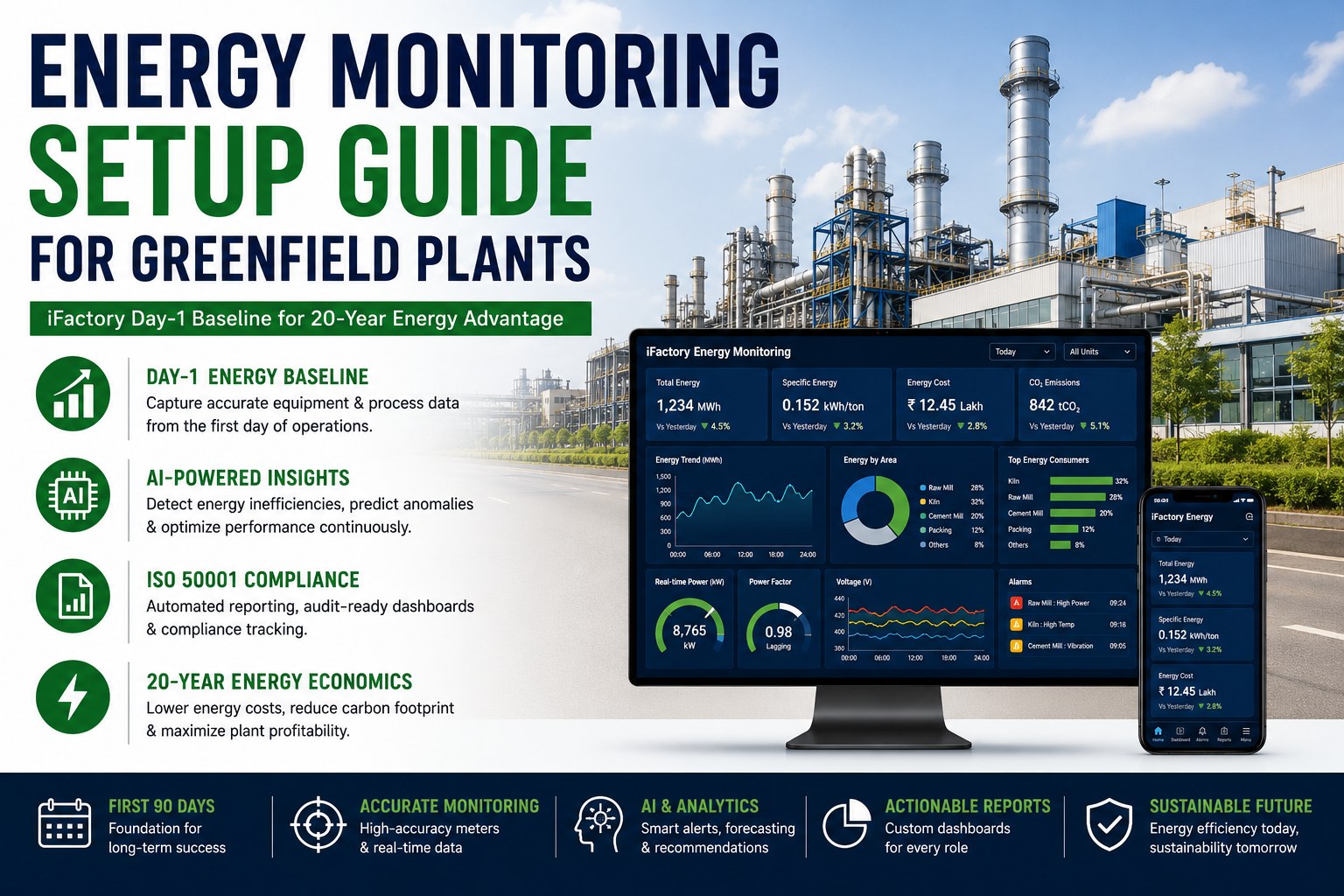
A newly commissioned greenfield steel plant running two EAF lines, a hot strip mill, and a slab reheating furnace complex was consuming energy at 18% above industry benchmarks within its first year of operation. Energy represented 31% of total operating costs — over $42 million annually. Furnace residence times were excessive, rolling mill scheduling was disconnected from furnace discharge, and peak demand charges accounted for 34% of the electricity bill. The plant engaged iFactory to deploy AI-powered energy optimization across the entire production chain. Within 14 months, the facility achieved a 32% reduction in energy costs, an 18% cut in Scope 1 emissions, and reduced specific energy consumption from 418 kWh/ton to 312 kWh/ton on EAF operations. Book a demo to see how this applies to your facility.
The Challenge
Despite being a brand-new facility with modern equipment, the plant's energy performance was significantly below potential. The root causes were systemic — not equipment failures, but operational patterns that compounded into millions in waste:
EAF Operating Above Benchmark
Both EAF lines were consuming 418 kWh/ton against an optimal target of 340-380 kWh/ton. Tap-to-tap times averaged 52 minutes vs. the 45-minute target. Electrode consumption ran at 2.1 kg/ton — well above the 1.8 kg/ton intervention threshold. The energy gap across 750,000 annual tons translated to $5.4M in excess electricity costs alone.
Reheat Furnace Inefficiency
Slab reheating consumed 1.6 GJ/ton against a best-practice target of 1.0-1.2 GJ/ton. Hot charging rates were only 38% — meaning 62% of slabs cooled to ambient temperature in the yard before being reheated from 25°C to 1,200°C. Excess residence time wasted fuel and accelerated scale formation, consuming 0.8% of slab weight as oxide loss.
Rolling Mill-Furnace Disconnect
The hot strip mill operated on a separate schedule from furnace discharge. When the mill slowed for cobble recovery or roll changes, slabs continued discharging into a backup — overheating, wasting fuel, and creating quality defects. No real-time coordination existed between the two systems.
Peak Demand Charges Destroying Margins
EAF power draw during peak grid periods generated $14.5M in annual demand charges — 34% of the total electricity bill. No intelligent load shifting or production scheduling based on time-of-use rates existed. Energy-intensive operations ran regardless of grid pricing.
Facing similar energy challenges in your steel plant? Schedule a free energy assessment call — we'll identify your top optimization opportunities within 30 minutes.
The Solution: iFactory AI Energy Optimization
iFactory deployed a four-layer AI energy optimization system across the entire production chain — from scrap yard to finished coil. The system integrates IoT sensor data, real-time energy pricing, production schedules, and equipment thermal models into a unified optimization engine.
EAF Power Profile Optimization
AI models trained on 12 months of melt data (180,000+ heats) optimize power profiles for each charge composition. The system adjusts electrode positioning, oxygen injection timing, and power ramp curves in real-time based on scrap classification and melt progression. Charge scheduling groups similar scrap mixes to reduce variability and enable tighter power control.
Furnace Sequencing & Hot Charging Optimization
AI scheduling engine connects casting schedules, slab yard inventory, furnace thermal models, and rolling mill order books. Slabs are routed directly from continuous casting to reheating at 600-800°C whenever possible. When hot charging isn't feasible, slabs with similar grades, thicknesses, and target temperatures are batched together to eliminate the "slowest slab" problem.
Mill-Furnace Synchronization
Real-time mill speed data now controls furnace discharge timing. When the rolling mill slows for cobble recovery, roll changes, or schedule gaps, furnaces automatically hold slabs in the soaking zone at minimum fuel instead of discharging into backup. Digital twin simulation validates every scheduling change before execution.
Peak Demand Management & Load Shifting
AI forecasting predicts energy requirements for each production run and aligns energy-intensive EAF operations with off-peak and mid-peak grid periods. The system calculates the optimal production schedule that minimizes energy cost while meeting all delivery deadlines, quality requirements, and equipment constraints.
The Results
Before & After: Key Metrics
| Metric | Before (Year 1) | After (Month 14) | Improvement |
|---|---|---|---|
| EAF Specific Energy | 418 kWh/ton | 312 kWh/ton | -25.4% |
| EAF Tap-to-Tap Time | 52 minutes | 43 minutes | -17.3% |
| Electrode Consumption | 2.1 kg/ton | 1.6 kg/ton | -23.8% |
| Reheat Furnace Energy | 1.6 GJ/ton | 1.05 GJ/ton | -34.4% |
| Hot Charging Rate | 38% | 71% | +33 pts |
| Scale Loss | 0.8% of slab weight | 0.4% of slab weight | -50% |
| Peak Demand Charges | $14.5M/year | $8.6M/year | -41% |
| Total Energy Cost | $42.6M/year | $29.0M/year | -32% |
| Energy as % of OPEX | 31% | 22% | -9 pts |
| Scope 1 CO2 Emissions | Baseline | -18% vs. baseline | -18% |
Want to see what a 25-32% energy reduction looks like for your steel plant? Book a 30-minute demo — we'll model your specific furnace mix, production volume, and energy contract to estimate achievable savings.
Zone-by-Zone Savings Breakdown
| Production Zone | Optimization Applied | Annual Savings | % of Total Savings |
|---|---|---|---|
| EAF Melt Shop | Power profile optimization, charge scheduling, electrode management | $5.4M | 40% |
| Slab Reheating | Hot charging increase, batch optimization, residence time control | $3.1M | 23% |
| Hot Strip Mill | Mill-furnace synchronization, overheating elimination | $1.4M | 10% |
| Peak Demand | Load shifting, time-of-use scheduling, demand forecasting | $2.8M | 21% |
| Utilities & Auxiliaries | Compressed air optimization, cooling system scheduling | $0.9M | 6% |
| Total | $13.6M | 100% |
Implementation Timeline
Discovery & Sensor Deployment
650+ IoT sensors deployed across EAFs, reheat furnaces, rolling mill, and utility systems. 12 months of historical production data ingested. Energy baselines established per zone.
AI Model Training & Validation
ML models trained on 180,000+ historical heats. Digital twin of furnace-mill chain validated against live production. First energy anomalies identified — $1.2M in quick-win savings captured.
Phased Optimization Activation
EAF power optimization live. Hot charging scheduling activated. Peak demand management deployed. Monthly energy reviews show 18% cost reduction achieved at this stage.
Full System Integration & Scale
Mill-furnace synchronization fully operational. Utility optimization added. AI models retrained with 6 months of optimized data. 32% total energy cost reduction achieved and sustained.
Your Steel Plant Has a Hidden Energy Factory
Most steel plants operate 8-15% below optimal thermal efficiency. That gap translates to $3-7M annually for a 500K ton/year facility. See what iFactory AI optimization can recover for you.
What Made This Work
Frequently Asked Questions
Every kWh You Save Goes Straight to Margin
Steel plants operating 8-15% below optimal efficiency are leaving $3-7M on the table annually. Book a free energy assessment to see what AI optimization can recover for your facility.