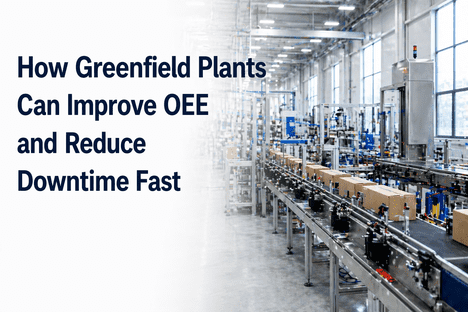
A $180 million greenfield plant in the American Midwest commissioned its first production line in September. By the end of week six, the facility was running at 85% OEE — a number most brownfield plants chase for a decade. The maintenance team started Day One with every asset pre-loaded in a CMMS, every PM schedule already populated from OEM specs and digital twin commissioning data, every spare part registered with reorder thresholds, and every SOP digitized and searchable on mobile. Not a blank slate they would spend six months building. A fully configured system from the moment the first product came off the line. That's the greenfield advantage — and almost nobody takes it. McKinsey reports that 70% of greenfield projects exceed their deadlines and budgets. Deloitte tracks 90% of large industrial projects running over. Most new plants spend 4–6 months clawing their way from 40% OEE to 70% OEE in a painful retrofit of the brownfield playbook — because the maintenance, data, and operational infrastructure was treated as a post-construction afterthought instead of a design decision. The plants that hit 85% OEE in week six aren't lucky. They designed for it. This guide shows you exactly how.
Greenfield Operations Playbook
You Get One Chance to Build a Plant Right From Day One. Don't Copy the Brownfield Playbook.
World-class manufacturing runs at 85%+ OEE. Most plants operate at 55–65%. Greenfield projects can skip the decade-long climb — but only if they design the digital, maintenance, and operational foundation before the first foundation is poured.
85%+
Achievable OEE from week six with proper design
70%
Of greenfield projects exceed deadlines & budgets
50–70%
Faster ramp-up with Day-1 CMMS activation
80%
Of plant lifecycle costs determined before commissioning
Why the Brownfield OEE Playbook Fails in Greenfield Plants
Every OEE improvement guide you've read was written for brownfield plants. Retrofit a CMMS. Layer sensors on old equipment. Eliminate the worst historical failure modes. Fight for every percentage point. That playbook works — slowly, painfully, and expensively — when you're stuck with infrastructure someone else designed. But greenfield plants have an advantage brownfield plants will never have: you get to design the foundation itself. Most greenfield operators throw that advantage away by running the brownfield playbook backwards.
The Greenfield Mistake
Running the brownfield playbook on a new plant
Treat commissioning as the "start" of digital transformation
Build the plant first, then figure out the CMMS and data layer afterward
Procure equipment based on mechanical throughput only, not data signals
Spend 4–6 months populating maintenance records after production begins
Discover data gaps during ramp-up when fixes are expensive and disruptive
Hire operators and maintenance staff after equipment is installed
Accept a typical 6–24 month OEE ramp from 40% to 70%+
Result: Typical 40% to 70% OEE over 6–24 months of expensive firefighting
The Greenfield Advantage
Designing digital-first infrastructure into the plant
Treat digital architecture as a base-build decision alongside utilities
Pre-configure CMMS with every asset, PM schedule, and spare part before Day 1
Specify data signals, protocols, and MES events in equipment procurement
Activate real-time OEE dashboards on commissioning day, not after ramp
Use digital twin virtual commissioning to catch 80%+ of issues before go-live
Hire key roles early and train them inside existing sister plants
Achieve 85%+ OEE by week 6–8 and sustain it through ramp-up
Result: 85% OEE in 6–8 weeks with 50–70% faster ramp-up
Planning a greenfield plant or in early commissioning? Book a 30-minute Day-1 readiness assessment.
The Cost-of-Waiting Curve — Why Every Design Decision Is Amplified
Deloitte tracks that up to 80% of a plant's total lifecycle costs are determined before commissioning even begins. Every decision about layout, equipment specification, data architecture, and maintenance strategy either compounds value or compounds cost for the next 20 years. The later you try to fix a mistake, the more it costs. Here's how the amplification works.
Design Phase
1×
Course-correct a layout or equipment spec while it's still on paper
Procurement Phase
5×
Add a data signal or protocol to a purchase order after initial spec
Construction Phase
20×
Reroute a utility line or add a conduit after concrete is poured
Commissioning Phase
50×
Retrofit missing sensors, reconfigure PLCs, or fix control logic
Production Phase
200×
Rework layout, relocate equipment, or redesign integration after ramp
The 6-Stage Greenfield OEE Design Framework
High-performance greenfield plants follow the same 6-stage framework. Each stage builds the operational and digital infrastructure that makes the next stage possible — and skipping any stage caps the OEE ceiling permanently.
Stage 01
Design the Digital Thread First
Before breaking ground, define the data architecture that will run the plant for 20 years. Specify what sensors go on which assets, what data signals each piece of equipment must expose, what events must reach MES, what PLC-to-CMMS integration looks like, and what OEE dashboards will display. Treat digital architecture as a base-build decision — not a post-construction add-on.
Key deliverable: Digital architecture specification locked before procurement
Stage 02
Write Data Requirements Into Equipment Procurement
This is where most greenfield projects silently lose their Day-1 OEE advantage. Every equipment purchase order must specify data signals, communication protocols (OPC-UA, MQTT, Modbus), recipe confirmation needs, authentication patterns, and the machine states that must be exposed to MES for production control, genealogy, or OEE. When procurement focuses only on mechanical throughput, plants discover during commissioning that critical states are unavailable — and retrofitting costs 20–50× more.
Key deliverable: Data-signal clauses in every equipment PO before sign-off
Stage 03
Run Virtual Commissioning on a Digital Twin
Build a photorealistic digital twin of the entire facility before physical construction. Simulate material flows, test equipment layouts, validate utility routing, rehearse changeover sequences, and debug control logic — all without risk to physical equipment. Virtual commissioning catches 80%+ of control software errors that would otherwise surface during on-site commissioning and delay startup by weeks.
Key deliverable: Digital twin sign-off before site acceptance testing
Stage 04
Pre-Configure the CMMS for Day-1 Activation
The handover from project to operations is the most neglected phase in traditional greenfield approaches. Pre-configure the CMMS with every commissioned asset, complete documentation, PM schedules built from OEM recommendations and digital twin data, full spare parts inventory with reorder thresholds, digital SOPs, and training materials. The maintenance team inherits a fully configured system on Day 1 — not a blank slate they spend six months populating.
Key deliverable: CMMS go-live on commissioning day with 100% asset coverage
Stage 05
Hire and Train Operators Before Equipment Arrives
The Deloitte pattern: hire key maintenance and operations roles during equipment installation and commissioning, not after. Embed them in a similar existing factory to shadow experienced staff, or relocate trained talent to the new site for an extended handover period. Use AR-guided work instructions and digital twin-based simulation for complex tasks. Commissioning day should find a trained, prepared team — not new hires learning on live equipment.
Key deliverable: Phased hiring plan aligned to ramp curve milestones
Stage 06
Activate Real-Time AI Analytics on Day 1
The first 90 days of production are the most critical — and most dangerous — of any greenfield project. Output, quality, and reliability all ramp simultaneously. AI ramp analytics monitor 200+ parameters across every line, flagging drift before it becomes scrap and identifying which machines will constrain throughput. Predictive maintenance prevents early-life failures. Compressed ramp curves deliver 30–40% faster time-to-target-OEE.
Key deliverable: AI ramp analytics live from first production batch
Every Week of Delayed Commissioning Costs $50K–$500K. Every Month of Slow Ramp Costs Millions.
iFactory's greenfield consulting integrates digital architecture, virtual commissioning, CMMS pre-configuration, and AI ramp analytics from concept through stable production — purpose-built to deliver 85%+ OEE from Day 1, not Year 2.
The Greenfield Ramp Curve — What Good Actually Looks Like
Most new plants ramp OEE on a slow, painful curve — starting at 35–45% in the first month and clawing their way to 70% over 6–12 months. High-performance greenfield plants follow a radically different curve. Here's the comparison.
Week 1 (commissioning)
30–40%
65–75%
Digital twin + pre-trained operators
Week 2–4
40–55%
75–80%
Day-1 CMMS activation
Week 5–8
50–65%
80–85%
AI ramp analytics + real-time OEE
Month 3–6
60–70%
85%+ sustained
Predictive maintenance, OEE stability
Month 6–12
65–75%
87–90%
AI retraining on production data
Month 12–24
70–80%
88–92%
Continuous optimization, energy AI
The 5 Greenfield Mistakes That Kill OEE Before Week 1
Every greenfield plant we've analyzed that failed to hit its Year-1 OEE target made at least two of these five mistakes. They're not technology problems — they're sequencing and ownership problems.
M1
Treating the digital layer as post-construction work
Plants that wait until after commissioning to "start digital transformation" hand themselves the brownfield problem they just spent $200M to avoid. Once walls are up and conduit is run, adding data infrastructure costs 20–50× more.
M2
Procurement focused only on mechanical throughput
POs that specify speed, capacity, and energy draw but skip data signals, communication protocols, and MES-exposable events. By commissioning, critical machine states are locked inside vendor black boxes, and custom integrations cost months of delay.
M3
Hiring operators after equipment arrives
The Deloitte pattern: plants that hire and train key roles during installation and commissioning ramp 50%+ faster than plants that hire post-commissioning. Commissioning day should find a trained team ready — not new hires learning on live equipment.
M4
Skipping virtual commissioning on a digital twin
70% of commissioning delays trace to control software errors. Virtual commissioning catches 80%+ of these in a digital environment before equipment is even powered on site. Plants that skip it turn 4-week commissioning timelines into 14-week firefights.
M5
Attempting full product complexity from Day 1
Greenfield plants that try to hit full SKU complexity in the first weeks create confusion that gets blamed on systems when the real issue is operational learning curves. Lower order complexity, buffered changeovers, and limited product families in the first weeks preserve control while teams build confidence.
What Day-1 Readiness Actually Delivers
The business case for greenfield digital readiness isn't theoretical. Every stage pays back in measurable outcomes — from shorter commissioning to faster ramp to lower operating cost.
50–70%
Faster production ramp-up to target OEE
iFactory greenfield data
85% OEE
Achievable by week 6 with Day-1 activation
iFactory case data
80%+
Of commissioning issues caught by virtual commissioning
Deloitte / iFactory commissioning research
30–40%
Ramp curve compression with AI analytics
iFactory ramp analytics data
15–25%
Total timeline compression with digital twin + AI
Deloitte greenfield journey
25%
Reduction in operational issues during commissioning
iFactory 12-step research
30–50%
Downtime reduction from IoT-enabled predictive maintenance
iFactory greenfield benchmark
8–11 mo
Predictive maintenance ROI payback period
iFactory PM ROI data
Frequently Asked Questions
Can a greenfield plant really hit 85% OEE in week six?
Yes — with proper planning. The 85% benchmark was established by Seiichi Nakajima based on real plants achieving it consistently, and greenfield projects have the structural advantage of designing for the target from Day 1 rather than retrofitting toward it. Medical device manufacturers reach 85%+ at nearly 24% of facilities; automotive leaders consistently hit mid-80s with lean practices. The pattern isn't luck — it's Day-1 CMMS activation, digital twin commissioning, pre-trained operators, and AI ramp analytics all working from the first batch forward. Plants that treat digital infrastructure as a base-build decision reach this target routinely; plants that treat it as a post-commissioning add-on rarely do.
How far in advance should digital planning start?
Before site selection is finalized, and no later than the start of detailed equipment specification. Digital architecture decisions shape layout (sensor cable routing, data center location, network infrastructure), procurement (which protocols and data signals to require), and commissioning (what tests are possible on a digital twin). Plants that wait until construction is underway to start digital planning systematically lose the Day-1 OEE advantage — by the time walls are up, critical decisions are already locked. The expert pattern: digital architects participate in the greenfield team from Week 1 of detailed planning, not Week 1 of commissioning.
What's the typical greenfield project timeline to stable production?
Deloitte tracks the full journey as 3–5 years from initial strategy to stable production: 6–12 months of planning, 12–36 months of execution (procurement, construction, installation), 6–12 months of startup (commissioning, qualification), and 6–24 months of ramp-up to target OEE. Digital twin and AI tools can compress the total timeline by 15–25% through virtual validation and faster commissioning. The variance comes from industry (pharma and food plants run longer due to regulatory validation), facility size, and most importantly, whether the digital and operational foundation was designed early or bolted on late.
How do we justify AI and digital infrastructure spend in the greenfield capex?
The CFO-friendly framing: every week of commissioning delay costs $50K–$500K depending on project scale, and every month of slow ramp to target OEE costs millions in unrealized production. Against that baseline, digital twin simulation, CMMS pre-configuration, and AI ramp analytics aren't optional tech spend — they're commissioning-risk insurance with measurable payback in under 12 months. Predictive maintenance alone delivers ROI in 8–11 months. McKinsey and Deloitte both track that 90% of large industrial projects exceed their budgets, and the common root causes (unrealistic commissioning timelines, poor system integration, procurement delays) are exactly what structured digital readiness prevents.
What's the single highest-leverage greenfield decision?
Writing data-signal and protocol requirements into equipment procurement contracts before POs are signed. This one decision determines whether your CMMS, MES, and OEE systems will have the machine-state data they need on Day 1 — or whether they'll operate blind and require expensive custom integrations retrofitted during commissioning. Every other decision (CMMS selection, AI platform, dashboard design) depends on this foundation. Plants that get this right at procurement unlock the entire digital advantage; plants that get it wrong spend the next five years paying for custom adapters, missing signals, and workarounds that a two-page procurement clause would have prevented.
You Only Get One Day One. Make It Count.
iFactory partners with greenfield projects from strategy through stable production — integrating digital architecture, virtual commissioning, CMMS pre-configuration, and AI ramp analytics into every phase. 85%+ OEE by week six. 50–70% faster ramp to target. $2M under budget on $180M projects.