Greenfield Factory Site Selection: Infrastructure Checklist for AI-Powered Plants
By Larry Eilson on February 27, 2026
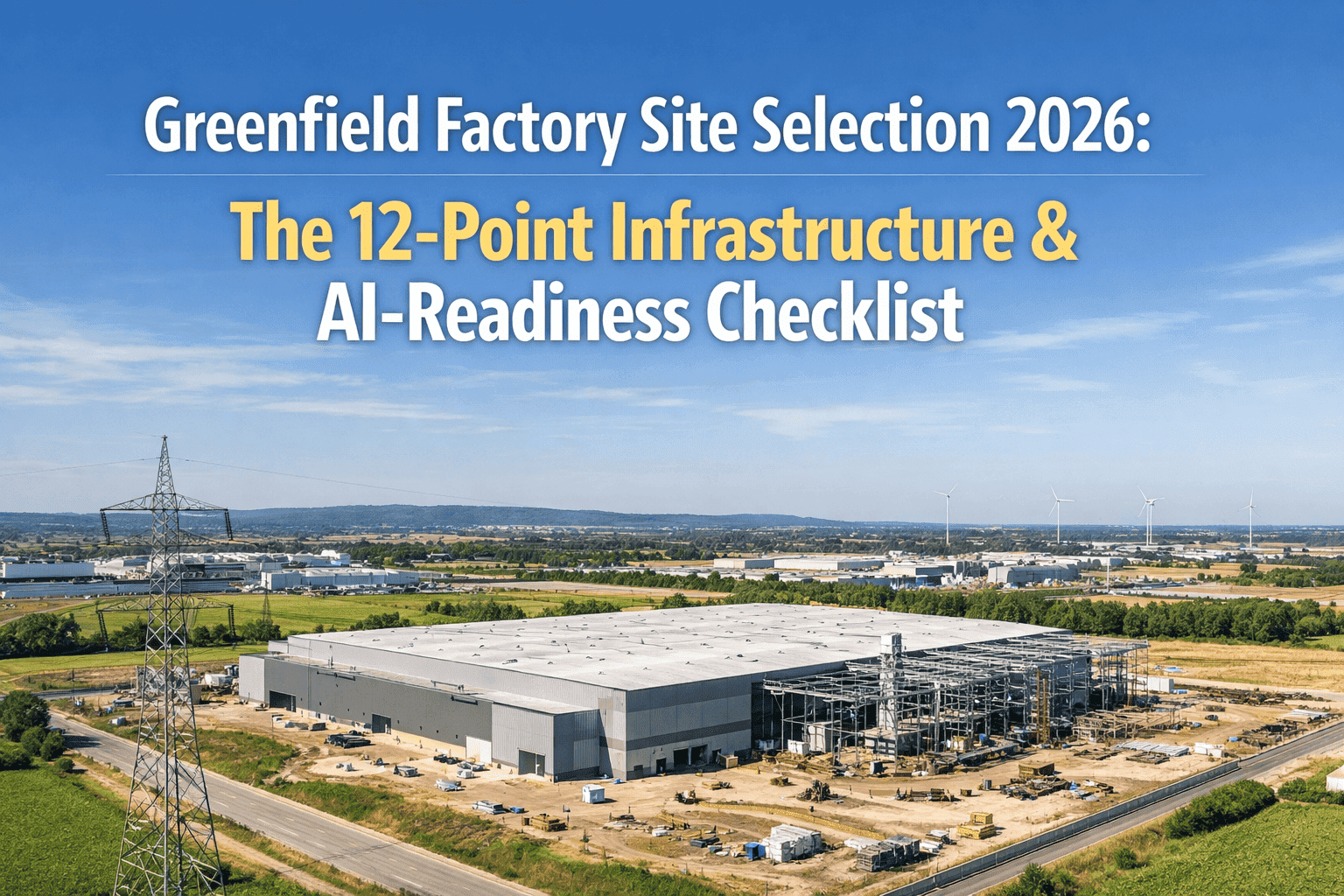
Deloitte's greenfield research confirms it: site selection is the single highest-leverage decision in a 3–5 year factory build. Choose wrong, and you're fighting infrastructure gaps for the life of the plant. Choose right — with AI-readiness baked in — and your smart factory hits full production months ahead of schedule. This checklist covers every infrastructure requirement your site evaluation must include.
AI-READY SITE CHECKLIST
3–5 yrsAverage greenfield timeline from site selection to production
75%Of enterprise data will be processed at the edge by 2025
$13.2TIn global sales enablement predicted from 5G by 2035
How to use this checklist: Score each item as you evaluate potential sites. Any site missing more than 3 items in a single category should be flagged for deeper due diligence — or eliminated. Share this with your site selection committee, engineering leads, and IT architects before signing any land deal.
Category 1: Electrical Power & Energy Infrastructure
AI workloads, edge servers, IIoT sensors, and robotic systems demand clean, uninterrupted power. A smart factory's electrical appetite is 2–3x that of a traditional plant. Power availability is now the number one site selection constraint globally — evaluate capacity, redundancy, and future scalability before anything else.
Confirmed grid capacity meets peak demand + 30% growth headroomVerify MW allocation from the local utility with written commitment letters. AI-powered plants typically require 5–15 MW depending on scale.
Dual-feed or redundant power supply availableA single point of failure on the electrical feed can shut down an entire production line. Require dual substations or independent feeders.
Power quality meets industrial-grade standards (voltage stability, harmonic distortion)Sensitive AI inference hardware and robotic systems require clean power. Evaluate the local grid's historical uptime and voltage fluctuation records.
On-site backup generation plan (UPS + generator sizing)Edge computing nodes and OT control systems need uninterruptible power. Size UPS for at least 15 minutes of full-load runtime.
Renewable energy access or on-site solar/wind feasibility assessedESG mandates and energy costs make renewable integration a competitive advantage. Evaluate rooftop solar potential and local green energy programs.
Why this matters
Power availability and infrastructure delivery timelines are now the most decisive factors in site selection. Utilities are increasingly requiring capital contributions from developers for generation and transmission buildouts — plan for this in your budget.
Category 2: Network Connectivity & 5G Readiness
Modern smart factories generate terabytes of sensor data daily. Without high-bandwidth, low-latency connectivity, your AI models starve and your real-time automation fails. Factory control loops require sub-10ms response times — a threshold that standard cloud architecture simply cannot meet without edge and 5G infrastructure.
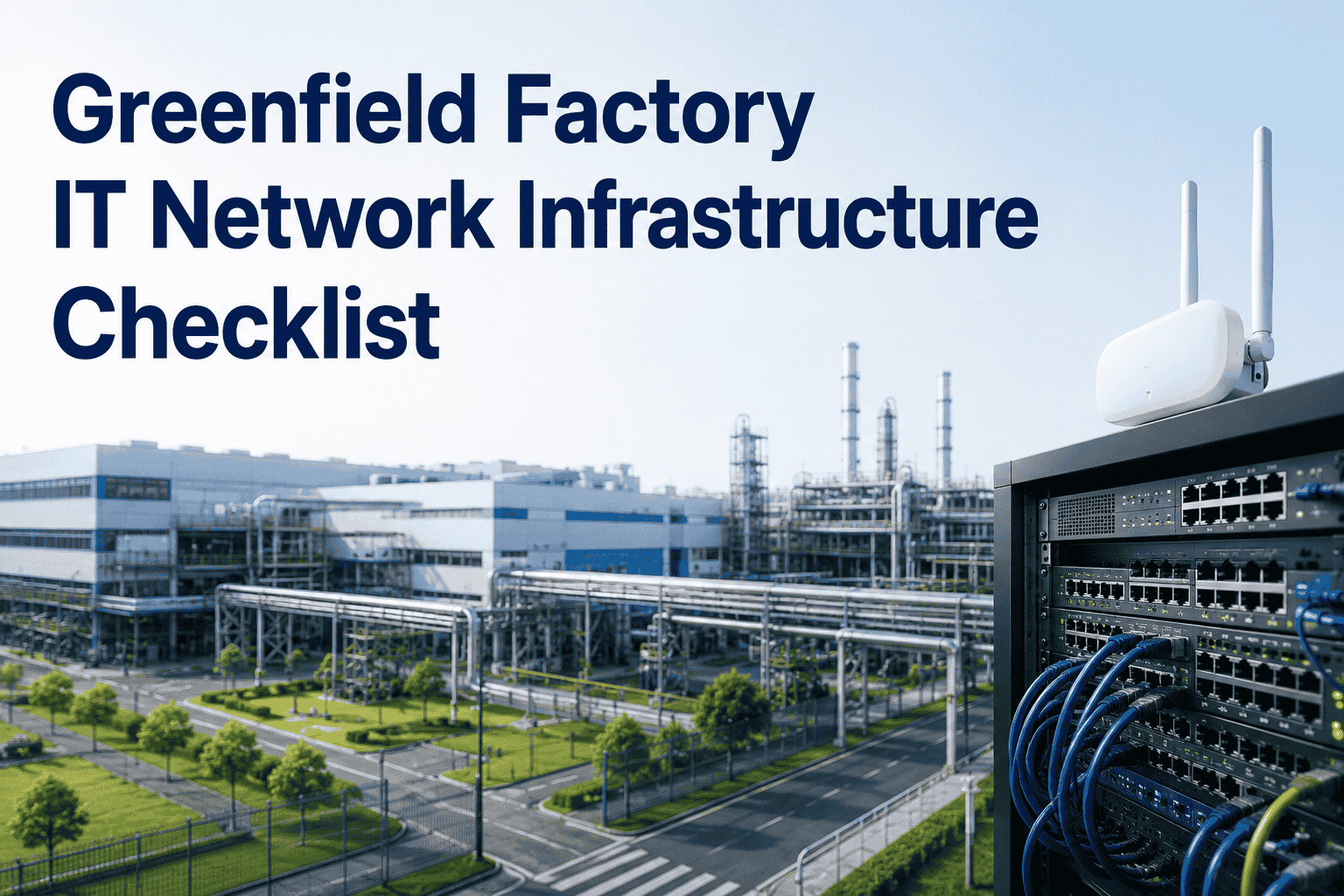
Fiber-optic backbone available at or near the site boundaryMinimum 10 Gbps dedicated fiber from two independent carriers. Verify last-mile distance and installation timelines — rural sites may need 6–12 months lead time.
Private 5G or LTE deployment feasibility confirmedPrivate 5G enables wireless AGVs, mobile robots, and real-time machine vision with sub-10ms latency. Confirm spectrum availability and carrier partnerships.
Network segmentation architecture planned (IT/OT separation)75% of OT attacks originate from IT networks. Design physically or logically separate networks for production control, IoT sensors, and corporate IT from day one.
Carrier redundancy and failover paths documentedCloud-connected AI services need reliable WAN links. Ensure at least two independent ISPs with automatic failover for critical production systems.
Indoor wireless coverage plan for entire facility footprintMap Wi-Fi 6E/7 access points and 5G small cells across the full production floor, warehouse, and outdoor staging areas. Dead zones kill automation.
Category 3: Edge Computing & Data Infrastructure
By 2025, 75% of enterprise data is created and processed outside traditional data centers. Your greenfield factory needs on-site compute power for real-time AI inference, predictive maintenance models, and autonomous quality control — all running at the edge, not in a distant cloud.
Dedicated edge server room or micro data center space allocatedAllocate 200–500 sq ft of climate-controlled space near the production floor for edge racks. Include raised flooring, dedicated cooling, and fire suppression.
Cooling capacity sized for high-density compute loadsGPU-accelerated edge servers generate 2–3x the heat of standard IT racks. Design cooling for 15–30 kW per rack from day one.
Hybrid cloud connectivity strategy defined (edge + cloud)Real-time inference at the edge, model training and analytics in the cloud. Document data flow architecture, latency requirements, and bandwidth allocation.
Data sovereignty and compliance requirements mappedIdentify which production data must remain on-premises vs. cloud. Factor in industry-specific regulations (ITAR, GDPR, CMMC) when planning data architecture.
Cloud-Only Architecture
100ms+ round-trip latency to cloud. Defective parts move downstream before AI detects them. Entire production halts during internet outages. Bandwidth costs spiral as sensor data scales.
Edge + Cloud Hybrid
Sub-10ms local inference for real-time quality control. Production continues during WAN outages. Only aggregated insights sent to cloud. AI models update locally, train centrally.
Category 4: IIoT Sensor & Automation Readiness
Sensors are the nervous system of a smart factory. Retrofitting them after construction costs 3–5x more than pre-wiring during the build. Your site must support the physical infrastructure for thousands of connected endpoints from day one.
Sensor conduit and cable tray routes pre-designed into building plansMap vibration, temperature, pressure, and energy sensors to every critical asset. Pre-install conduits during construction — not after.
CMMS asset hierarchy defined and mapped to sensor endpointsEvery sensor must feed into a structured asset hierarchy inside your CMMS. Define parent-child relationships for equipment, lines, and zones before installation.
OPC-UA and MQTT protocol support confirmed across all systemsAvoid vendor lock-in by requiring open industrial protocols. Ensure every PLC, SCADA, MES, and sensor gateway supports interoperable data exchange.
Predictive maintenance data pipeline architected before equipment arrivesAI models need baseline vibration, temperature, and runtime data from commissioning. Configure data flows so your CMMS starts learning from day one.
Automation expansion zones identified for future robotic cellsReserve floor space, power drops, and network ports for AGVs, cobots, and additional robotic stations. Design for where you'll be in 3 years, not just today.
Don't Evaluate Sites Without This Checklist
iFactory's AI-powered CMMS maps your sensor architecture, asset hierarchies, and maintenance workflows during the planning phase — so your smart factory is production-ready from day one.
2.1 million manufacturing jobs are forecast to go unfilled by 2030. Your site location directly determines your talent pipeline — and Deloitte's research confirms that equipping workers with smart manufacturing skills is the top concern for over a third of manufacturing executives. Proximity to technical talent isn't optional.
Labor market analysis completed for a 60-mile commuter radiusMap available technicians, engineers, electricians, and data scientists within commuting distance. Include competitive wage analysis against nearby employers.
Technical training institutions within recruiting distanceProximity to community colleges, trade schools, or university engineering programs creates a sustainable talent pipeline. Evaluate apprenticeship partnerships.
Connected-worker platform and digital training plan scopedSmart factory operators need guided workflows and intuitive mobile interfaces. Plan your connected-worker rollout alongside construction — not after launch.
Government workforce incentives and subsidies identifiedMany jurisdictions offer tax credits, training grants, and hiring subsidies for new manufacturing facilities. Factor these into your site cost comparison.
Category 6: Physical Site & Environmental Factors
The physical characteristics of your site determine construction cost, timeline, and long-term operational efficiency. Environmental assessments, zoning compliance, and logistics access can add months to your timeline if not evaluated upfront.
Geotechnical survey and soil analysis completedHeavy manufacturing equipment requires stable, load-bearing foundations. Verify soil composition, water table depth, and seismic risk before site acquisition.
Zoning confirms industrial use with no pending restrictionsVerify the site is zoned for heavy industrial use. Check for noise ordinances, emission limits, and any pending zoning challenges from neighboring properties.
Transportation access mapped (highways, rail, ports, airports)Evaluate proximity to major logistics corridors. Easy access reduces raw material and finished goods shipping costs and improves supply chain resilience.
Water supply and wastewater capacity verifiedManufacturing processes and cooling systems require reliable water supply. Confirm municipal or well-water capacity and discharge permit availability.
Expansion land banked or optioned for Phase 2+Secure adjacent land or contractual options for future expansion. Under-sizing now is one of the costliest greenfield mistakes — plan modular growth from the start.
Environmental impact assessment initiatedGreenfield sites may require wildlife, wetland, or air quality assessments. Start early — these can add 3–6 months to your permitting timeline.
Climate risk assessment for natural disasters evaluatedEvaluate flood zones, hurricane paths, earthquake risk, and extreme heat projections. Climate resilience directly impacts insurance costs and operational continuity.
Typical Greenfield Timeline: Site Selection to Production
Phase 1
Site Selection & Planning
6–12 months
Phase 2
Design & Engineering
6–12 months
Phase 3
Construction & Install
12–24 months
Phase 4
Commissioning & Ramp-Up
3–6 months
iFactory deploys during Phase 2 — so your CMMS, asset hierarchies, and predictive models are tested and ready before Phase 4 begins.
Category 7: Financial & Regulatory Readiness
A comprehensive financial model must account for infrastructure buildout costs that are unique to greenfield sites. Government incentives can offset 15–30% of total project costs — but only if you identify them during site evaluation, not after.
Total cost of ownership model built (not just construction costs)Include land, utilities buildout, network infrastructure, ongoing energy costs, maintenance, and future expansion. TCO analysis prevents greenfield budget surprises.
Government incentives, tax breaks, and grants cataloguedFederal, state, and local governments frequently offer subsidies for new manufacturing capacity. Evaluate CHIPS Act provisions, enterprise zones, and workforce training grants.
Permitting timeline and regulatory requirements mappedEnvironmental permits, building codes, and industrial licenses vary dramatically by jurisdiction. Map the full permitting timeline before committing to a site.
7
Categories
32
Checkpoints
0
Should Be Skipped
Frequently Asked Questions
AI-powered factories require infrastructure that traditional plants don't — including high-bandwidth fiber connectivity, private 5G networks for real-time automation, edge computing rooms with dedicated cooling, and 2–3x more electrical power capacity. These requirements must be validated during site evaluation, not discovered during construction.
Private 5G delivers sub-10ms latency required for real-time robotic control, autonomous guided vehicles, and AI-powered quality inspection. Factory control loops that rely on cloud connectivity alone face 100ms+ delays — at production speeds of multiple parts per second, that means defective items move downstream before AI can react.
AI-ready factories typically require 5–15 MW depending on scale, which is 2–3x more than a traditional manufacturing plant of similar size. This accounts for edge computing infrastructure, GPU-accelerated servers, IIoT sensor networks, robotic systems, and high-density cooling. Always plan for 30% headroom above projected peak demand.
CMMS deployment should begin during the design and engineering phase — not after production starts. iFactory integrates during construction to map asset hierarchies, configure sensor data flows, set up predictive maintenance models, and pre-load spare parts inventories. This ensures your maintenance team has full operational visibility from commissioning day one.
iFactory helps greenfield teams plan their sensor architecture, define asset hierarchies, and configure predictive maintenance pipelines during the planning phase. By integrating with your digital twin and IIoT strategy early, iFactory ensures that your CMMS is fully operational and collecting data from the first day of production — eliminating the reactive maintenance gap that plagues most new factories.
Plan Your AI-Ready Factory — From Site Selection
iFactory's AI-powered CMMS integrates into your greenfield project from the planning phase. Define sensor architecture, configure asset hierarchies, and deploy predictive maintenance before production begins.
Ready to evaluate your greenfield site with AI-readiness in mind? Book your free iFactory demo and see how our CMMS maps sensor architecture, asset hierarchies, and maintenance workflows before a single machine is installed.