A $2 billion semiconductor plant in the Southeast passed every evaluation — skilled workforce, generous incentives, prime logistics — until the team discovered the local grid couldn't deliver the 50 MW they needed for another 30 months. That single miss turned a three-year timeline into a five-year crawl. In 2026, site selection isn't about finding a good location. It's about finding a location where power, connectivity, workforce and AI infrastructure converge — because constraints, not incentives, now decide the field before you break ground. This is the 12-point checklist every greenfield team needs before signing a land deal.
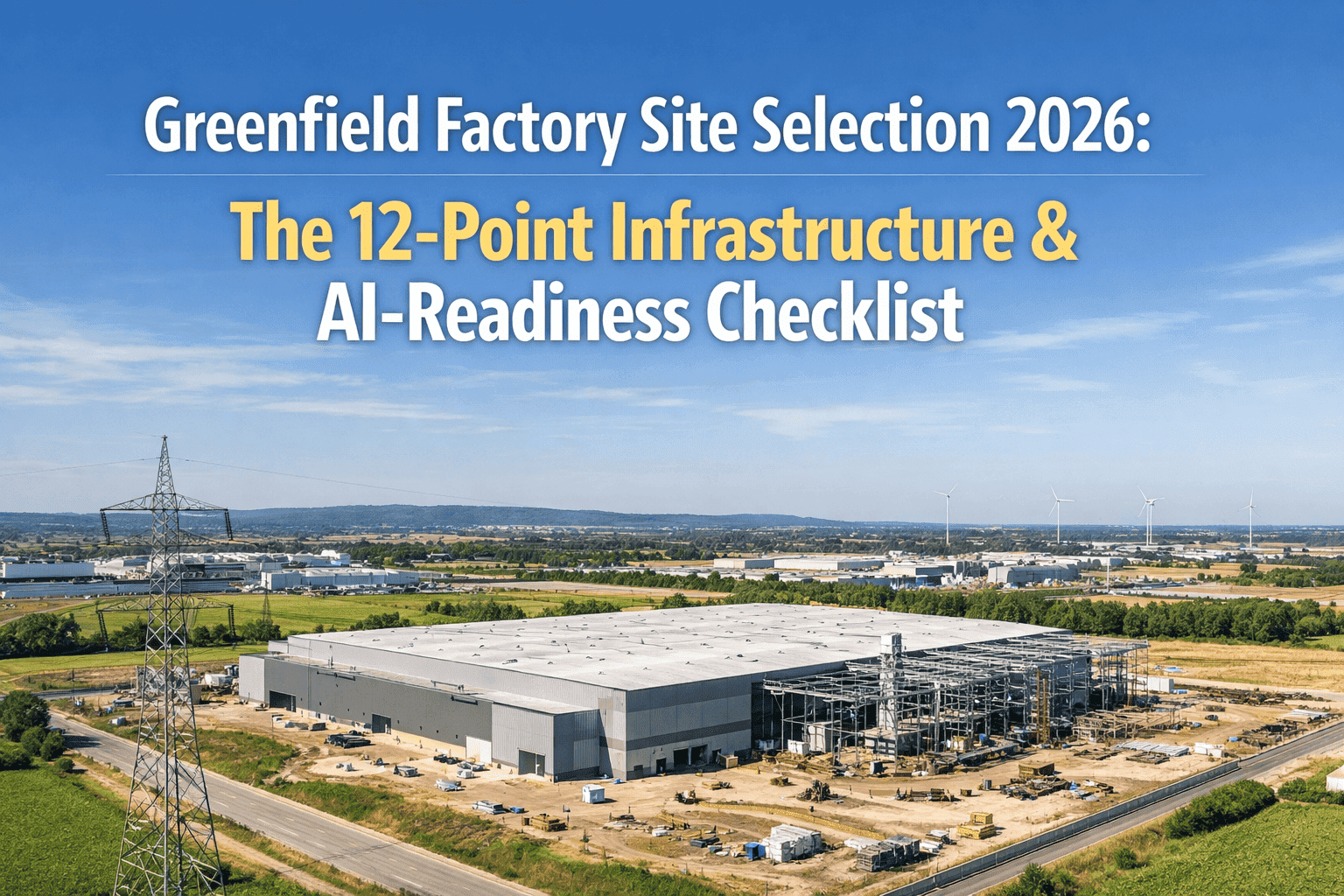
Greenfield Site Selection 2026
The 12-Point Infrastructure & AI-Readiness Checklist
Score every candidate site across the criteria that actually determine whether your plant succeeds — or spends years fighting infrastructure gaps.
Get a Free Site Readiness Assessment
70%+
Of the U.S. grid is 25+ years old and never upgraded
$1.9B
DOE "Speed to Power" funding announced March 2026
1.7M
Annual skilled trades workforce shortfall in the U.S.
3-5 yr
Typical greenfield development timeline from site to production
Sources: Joint Economic Committee · U.S. DOE · Lightcast / Area Development · Deloitte Greenfield Framework
How to Use This Checklist
Score each item as you evaluate candidate sites. Any site missing more than 3 items in a single category should be flagged for deeper due diligence — or eliminated. The 12 criteria are grouped into four categories that reflect how site decisions are actually made in 2026: power first, connectivity second, workforce and logistics third, and financial viability last. Share this with your site selection committee, engineering leads, and IT architects before committing to any location.
01
Grid Capacity & Connection Timeline
Confirm available MW capacity at the substation level — not just the utility's marketing materials. Get a written connection timeline. A large gigafactory can draw 2.4 GWh daily. Grid connection delays are now the #1 cause of greenfield schedule overruns in the U.S. and EU.
Ask: What is the substation's current available capacity? What is the timeline and cost for a new feed?
02
Power Reliability & Redundancy
Evaluate outage history, backup generation options, and dual-feed availability. AI workloads and robotic systems require uninterrupted clean power. One brownout can corrupt hours of production data and halt autonomous operations.
Ask: What is the site's 5-year outage frequency? Are dual utility feeds or on-site generation feasible?
03
Energy Cost & Renewable Access
Compare industrial electricity rates across candidate regions. Evaluate access to renewable energy (solar, wind, PPAs) for sustainability requirements and long-term cost stability. Energy-intensive industries like semiconductors and metals are especially sensitive to rate differences.
Ask: What is the industrial rate per kWh? Are renewable PPAs or on-site generation options available?
04
Fiber & High-Bandwidth Connectivity
Verify fiber-optic backbone availability to the site boundary — not just the nearest town. AI-native factories require low-latency, high-bandwidth connections for cloud model training, remote monitoring, and real-time analytics pipelines.
Ask: What is the distance to the nearest fiber POP? What bandwidth is available? What are lead times?
05
5G / Private Network Readiness
Private 5G enables real-time machine communication, AGV coordination, and wireless sensor density that Wi-Fi can't match. Evaluate whether the site supports private 5G deployment or has carrier coverage plans. 80% of manufacturers plan to invest 20%+ in smart manufacturing initiatives.
Ask: Is CBRS spectrum available? Can the site support private 5G antenna placement and coverage?
06
Edge Computing & Data Center Space
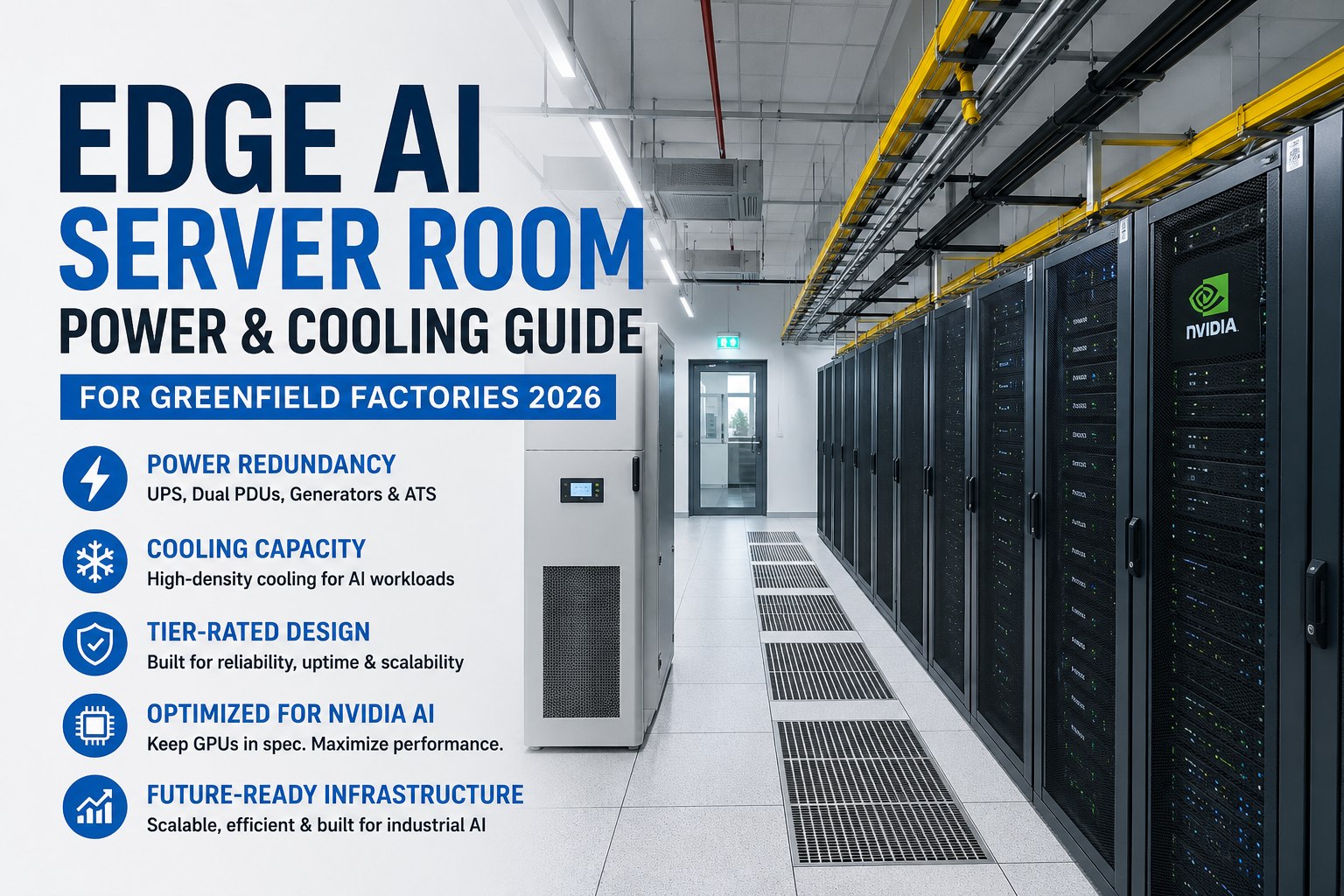
Allocate 200-500 sq ft of climate-controlled space near the production floor for edge server racks. GPU-accelerated edge servers generate 2-3x the heat of standard IT racks. Design cooling for 15-30 kW per rack. Define hybrid cloud/edge data flow architecture before breaking ground.
Ask: Can the site accommodate a micro data center? Is cooling infrastructure planned for high-density compute?
Evaluating sites and need help scoring AI-readiness? Book a free digital infrastructure assessment demo.
07
Skilled Workforce Pipeline
Evaluate local manufacturing employment density, community college and trade school programs, and employer competition for the same talent pool. 1 in 4 manufacturers reports vacancy rates above 5%. Regions with automation training programs outperform those without.
Ask: What is the local manufacturing employment base? Are there technical training partnerships available?
08
Transportation & Supply Chain Access
Assess proximity to interstate highways, rail spurs, ports, and airports. For just-in-time manufacturing, a 30-minute delay in parts delivery can cascade into hours of lost production. Multimodal access provides resilience against supply chain disruptions.
Ask: What is the distance to the nearest interstate, rail spur, and port? Is the road rated for heavy loads?
09
Site Conditions & Expansion Capacity
Evaluate soil conditions, flood zones, seismic risk, and extreme weather exposure. Bank or option adjacent land for Phase 2+ expansion — under-sizing is one of the costliest greenfield mistakes. Environmental impact assessments can add 3-6 months to permitting timelines.
Ask: What are the geotechnical conditions? Is expansion land available? What's the climate risk profile?
10
Government Incentives & Tax Structure
Catalog all federal, state, and local incentives. CHIPS Act funding, IRA manufacturing credits, state enterprise zones, property tax abatements, and workforce training grants can offset 10-25% of project costs. The advanced manufacturing investment credit recently increased from 25% to 35%.
Ask: What federal and state incentives apply? What are the clawback provisions? What is the timeline to access funds?
11
Permitting Speed & Regulatory Environment
Map the complete permitting timeline before committing. Environmental permits, building codes, fire codes, and industrial licenses vary dramatically by jurisdiction. Some states streamline approvals in weeks; others require months or years. Permitting can be a hidden schedule and cost driver.
Ask: What is the realistic permitting timeline? Are there fast-track programs? What environmental reviews are needed?
12
Total Cost of Ownership Model
Build a full TCO model — not just construction costs. Include land, utility buildout, network infrastructure, ongoing energy, maintenance, workforce training, and future expansion. Sites with lower land costs but poor infrastructure often end up more expensive over 10 years than premium locations with everything in place.
Ask: What is the 10-year TCO including all infrastructure buildout? How does it compare to ready-to-build alternatives?
Want to turn this checklist into a scored evaluation for your candidate sites? Schedule a site scoring demo with our greenfield consultants.
Choose the Right Site. Build the Right Intelligence.
iFactory helps greenfield teams evaluate sites for AI-readiness and deploys CMMS, predictive maintenance, and IoT infrastructure during construction — so your plant is production-ready from day one, not year three.
Expert Perspective: What's Changed in Site Selection
Constraints decide the field before incentives do. After a year where "shovel ready" often unraveled under scrutiny, the forward play in 2026 is fewer unknowns and faster paths to operation. Labor metrics are reshaping site selection — companies now weigh workforce availability and training infrastructure as heavily as real estate costs. The future belongs to companies that treat energy not as a cost, but as a competitive differentiator.
— Area Development 2026 Analysis · Cushman & Wakefield Industrial Consulting
80%
Of manufacturers plan to invest 20%+ in smart manufacturing initiatives
$500B+
Private sector commitments to U.S. chipmaking ecosystem as of 2025
$850B+
Manufacturing projects announced since 2021 driven by reshoring
35%
Advanced manufacturing investment credit (up from 25%)
Making a site decision in the next 6 months? Book a free demo — we will score your shortlist against all 12 criteria.
Your Site Decision Shapes the Next Decade
Deloitte calls site selection the single highest-leverage decision in a 3-5 year factory build. iFactory ensures every site you evaluate is scored for AI-readiness, IoT infrastructure, and maintenance system compatibility — so your smart factory hits full production months ahead of schedule.
Frequently Asked Questions
What is the most important factor in greenfield factory site selection in 2026?
Power availability has become the #1 criterion. Over 70% of the U.S. grid is 25+ years old and has never been upgraded, while AI-powered factories demand 2-3x the electrical capacity of traditional plants. Grid connection delays are now the leading cause of greenfield schedule overruns. The DOE launched its "Speed to Power" initiative in 2025 and announced $1.9 billion in funding in March 2026 specifically to accelerate grid infrastructure for manufacturing and AI facilities.
What digital infrastructure does an AI-ready factory site need?
Three essentials: fiber-optic connectivity to the site boundary for cloud integration and remote monitoring; private 5G or CBRS spectrum availability for real-time machine communication and wireless sensor density; and 200-500 sq ft of climate-controlled space near the production floor for edge computing racks. GPU-accelerated edge servers generate 2-3x the heat of standard IT racks, so cooling infrastructure must be designed for 15-30 kW per rack from day one.
How do I evaluate workforce availability for a greenfield manufacturing site?
Look beyond unemployment rates. Evaluate local manufacturing employment density, proximity to community colleges and trade schools with relevant programs, and competition from other manufacturers for the same talent pool. The U.S. faces a 1.7 million annual shortfall in skilled trades workers. One in four manufacturers reports vacancy rates above 5%. Regions with automation training partnerships and AI-skills programs consistently outperform those without, according to Cushman & Wakefield and NAM data.
What government incentives are available for greenfield manufacturing in 2026?
Several major programs: CHIPS Act funding for semiconductor facilities, IRA manufacturing credits ($35/kWh for battery cells), and the recently increased advanced manufacturing investment credit (now 35%, up from 25%). State-level incentives include property tax abatements, workforce training grants, infrastructure cost-sharing, and enterprise zone designations. These combined programs can offset 10-25% of total project costs. Map all applicable incentives early — some have deadlines and clawback provisions that require careful planning.
How long does it take to develop a greenfield manufacturing site from selection to production?
Typically 3-5 years from initial site selection to first production. The timeline breaks down roughly as: site evaluation and selection (3-6 months), design and engineering (6-12 months), permitting and approvals (3-12 months depending on jurisdiction), construction (12-36 months depending on complexity), and commissioning (3-6 months). Environmental permits and grid connection timelines are the most common sources of delay. Engaging construction partners early in site selection — not after — prevents the most expensive surprises.