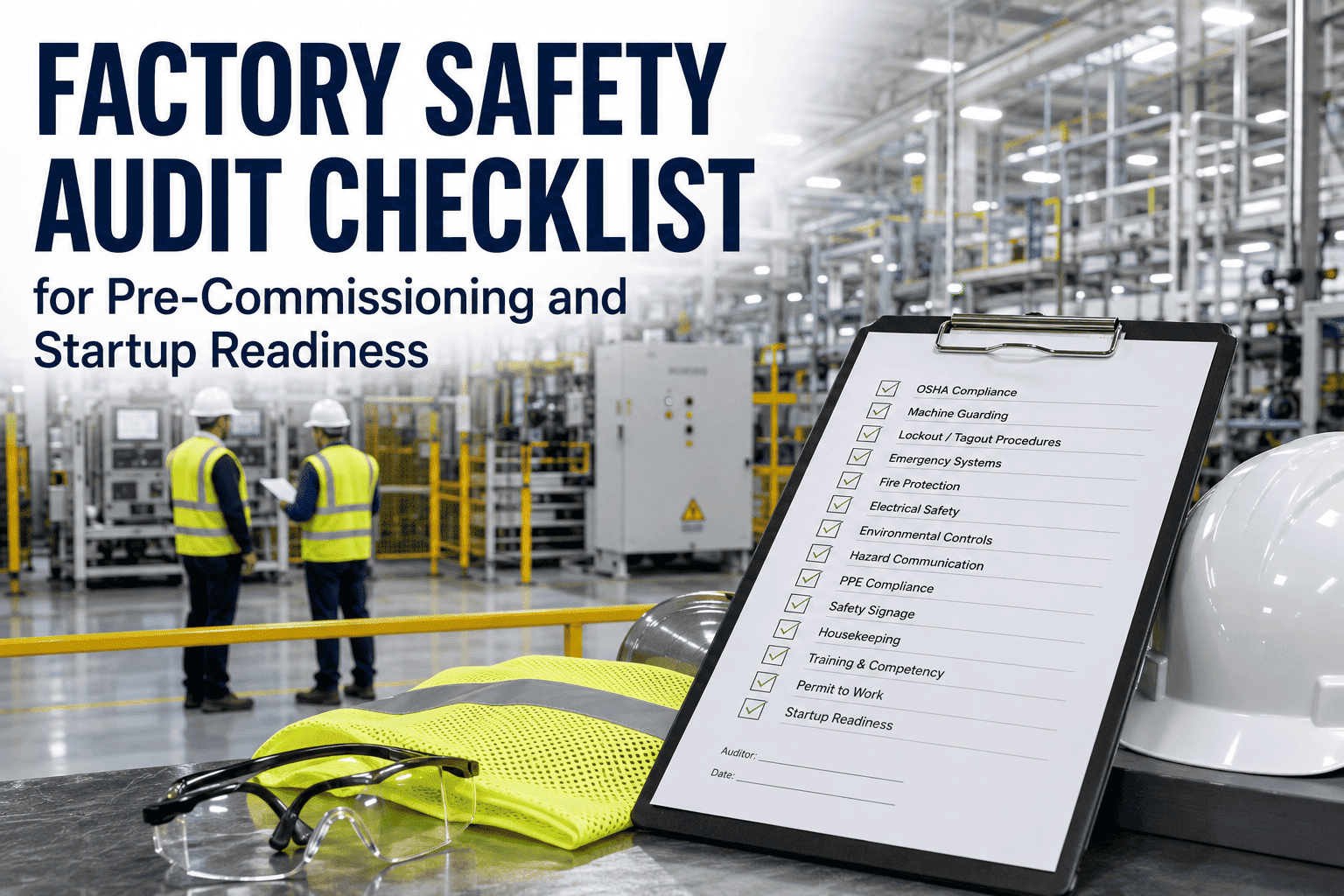
Approximately 60% of safety incidents during factory startups trace back to skipped or incomplete Pre-Startup Safety Reviews. The 2005 BP Texas City refinery explosion that killed 15 workers traced directly to an inadequate PSSR during a restart. This checklist breaks down pre-commissioning safety verification into 5 actionable domains — machine guarding, LOTO, electrical, emergency systems, and HazCom/PPE — covering OSHA 29 CFR 1910 requirements, the PSSR mandate under 1910.119(i), and 2026 OSHA penalty levels. Book a pre-commissioning safety review before your startup date is locked.
01
Machine Guarding
29 CFR 1910.212 · ANSI B11
16 checks
02
Lockout / Tagout
29 CFR 1910.147
14 checks
03
Electrical Safety
29 CFR 1910 Subpart S · NFPA 70E
15 checks
04
Emergency Systems
29 CFR 1910.38 · NFPA 101
18 checks
05
HazCom, PPE & Training
29 CFR 1910.1200 · .132
17 checks
$161K
Max OSHA penalty per willful violation
~60%
of startup incidents tied to skipped PSSR
15
Deaths · 2005 BP Texas City PSSR failure
Why Skipping PSSR Costs You Millions
OSHA enforcement after a startup incident isn't a fine — it's a cascade. A serious citation triggers an inspector. The inspector finds 10 more violations. Willful or repeat findings multiply the fines 10x. And if anyone is injured or killed, criminal referral becomes possible. The 2024 OSHA penalty schedule below shows what's actually at stake when pre-commissioning corners get cut.
Level 1
Other-than-Serious
Violations directly related to job safety with no probable death or serious harm. Inspector may assess penalty or waive entirely.
Up to $16,131 per violation
Level 2
Serious
Substantial probability of death or serious physical harm. Employer knew or should have known. Most common citation level for manufacturing.
Up to $16,131 per violation
Level 3
Failure to Abate
Cited violation not corrected by deadline. Penalties accrue daily until abatement. Adds up fast on multi-week remediation timelines.
Up to $16,131 per day
Level 4
Willful & Repeat
Intentional disregard or plain indifference to OSHA requirements, or substantially similar violation within 5 years. Severe financial and reputational impact.
Up to $161,323 per violation
Level 5
Criminal Referral
Reserved for willful violations resulting in worker death. Company officers can face personal criminal charges. DOJ pursues prosecution.
Up to $500K + prison · per officer
Checklist 1 · Machine Guarding & Equipment Safety
Machine guarding violations are perennially among OSHA's top 10 most-cited standards. Every point of operation, ingoing nip point, rotating part, and pinch point must be guarded before equipment is energized for production. Walk every machine on the floor against this checklist before any startup signoff.
Every point of operation has a guard installed and functionalCritical
Guards cannot be removed without tools or interlock disablingCritical
Light curtains, two-hand controls, and presence sensors validatedCritical
Safe distances calculated per ANSI B11.19 stopping timeMajor
Belts, pulleys, shafts, and couplings fully enclosedCritical
Flywheels < 7 ft from floor have full guardsMajor
Chain and sprocket drives enclosed or location-isolatedCritical
Robot work cells have perimeter guarding + interlocksCritical
E-stops accessible from every operator positionCritical
E-stop stopping time meets safe distance calculationsCritical
Safety PLC interlocks tested per Cat 3/4 per ISO 13849Critical
Reset functions require deliberate two-action sequenceMajor
Checklist 2 · Lockout / Tagout (LOTO)
LOTO consistently ranks in OSHA's top 5 most-cited standards. The pre-commissioning window is the ideal time to lock in (literally) every energy isolation point, develop machine-specific procedures, and train every employee who will operate or service the equipment.
Every machine has lockable disconnects for ALL energy sourcesCritical
Electrical, pneumatic, hydraulic, thermal, kinetic sources mappedCritical
Stored energy (capacitors, springs, gravity) addressed in procedureCritical
Disconnects labeled with permanent equipment ID tagsMajor
Written procedure exists for every machine with hazardous energyCritical
Procedures specify shutdown sequence + energy verificationCritical
Annual procedure inspection scheduled and documentedMajor
Group LOTO procedures defined for multi-worker tasksMajor
Individually-keyed locks issued to every authorized employeeCritical
Lockout hasps, valve covers, plug covers available at every machineMajor
Authorized vs Affected vs Other employee training completedCritical
Contractor LOTO coordination process documentedCritical
Run a Pre-Commissioning Safety Review Before Startup
iFactory's EHS practice runs full pre-commissioning safety audits — machine guarding, LOTO, electrical, emergency, HazCom — and produces an OSHA-defensible PSSR package before your first energized equipment goes live. Walk through startup with zero open critical findings.
Checklist 3 · Electrical Safety
Electrical hazards cause more workplace fatalities per dollar of CAPEX than almost any other category. Pre-commissioning is the only time you can rigorously verify arc flash labels, grounding systems, panel clearances, and NFPA 70E compliance without disrupting production. Don't waste the window.
3-foot working clearance maintained in front of all panelsCritical
Every breaker and disconnect labeled with circuit servedCritical
Panel covers in place, dead-front exposure preventedCritical
GFCI protection installed where required by NECMajor
Grounding electrode system tested and documentedMajor
Arc flash study completed within 5 yearsCritical
Arc flash labels on every panel/MCC/disconnect > 50VCritical
Approach boundaries defined and trained per NFPA 70ECritical
Arc-rated PPE inventory available + sized for affected workersMajor
All flexible cords UL-listed for environment + duty cycleMajor
Conduit, raceway, and cable tray installations per NECCritical
Hazardous location (Class I/II/III) equipment ratings verifiedCritical
Emergency lighting + UPS systems load-testedMajor
Need an arc flash study before energizing? Schedule a NFPA 70E pre-commissioning review with our electrical safety team.
Checklist 4 · Emergency Systems & Fire Protection
Emergency systems get pencil-whipped in 70% of failed PSSRs we audit. The exit lights work, sure — but the fire pump never ran under load, the sprinkler system was never trip-tested, and the assembly point hasn't been walked since the contractor was on site. Verify physically. Don't trust paperwork.
Sprinkler system flow + trip tests completed and documentedCritical
Fire pump load test completed at design dischargeCritical
Smoke + heat detectors functionally testedCritical
Fire extinguishers inspected, located per travel distance limitsMajor
Special-hazard suppression (clean agent, CO₂, foam) commissionedCritical
Exit routes unobstructed and properly illuminatedCritical
Exit signs visible from any point with battery backup testedCritical
Emergency exit doors swing outward, unlocked from insideCritical
Travel distance to exit ≤ 200 ft (250 ft if sprinklered)Major
Written Emergency Action Plan reviewed with all employeesCritical
Evacuation alarm audible/visible throughout facilityCritical
Assembly points posted on evacuation mapsMajor
Full evacuation drill conducted before commissioningCritical
Run a full emergency systems verification before go-live. Connect with our commissioning safety team for a fire + egress walkdown.
Checklist 5 · HazCom, PPE & Training
The final checklist domain covers the human side of safety — what workers wear, what they know, and what hazards they're walking into. HazCom is OSHA's #1 most-cited standard year after year. Pre-commissioning is when you build the program correctly; once startup happens, fixing it competes with production.
Written HazCom program current and accessibleCritical
SDS available for every hazardous chemical on siteCritical
Chemical inventory list maintained and currentMajor
GHS-compliant labels on every containerCritical
HazCom training delivered to all affected workersCritical
Written PPE hazard assessment completed by taskCritical
PPE supplied at no cost to employeesCritical
Respiratory protection program where exposures > PELCritical
Hearing conservation program if 8-hr TWA ≥ 85 dBAMajor
New-hire safety orientation completed for all employeesCritical
Job-specific training documented per task hazardsCritical
Forklift operator certification current per 1910.178Critical
OSHA 300/300A logs initiated for the new facilityMajor
Building a training matrix for your new facility? Book a training program review with our EHS team.
Top 10 OSHA Citations to Avoid
The same handful of standards drive most OSHA citations in manufacturing year after year. Knowing which ones inspectors look at first lets you self-audit against them before your first inspection. The list below covers the 2025 OSHA top-cited manufacturing standards with the regulatory reference for each.
01
Hazard Communication. SDS gaps, missing labels, untrained employees, no written program.
1910.1200
02
Lockout/Tagout. Missing machine-specific procedures, no annual inspections, inadequate training.
1910.147
03
Respiratory Protection. No written program, fit testing skipped, medical evaluations missing.
1910.134
04
Machine Guarding. Points of operation unguarded, interlocks bypassed, two-hand controls modified.
1910.212
05
Powered Industrial Trucks. Operator certification expired, daily inspections skipped, modifications uncertified.
1910.178
06
Walking-Working Surfaces. Slip/trip hazards, missing guardrails on platforms ≥ 4 ft, ladder violations.
1910.22-30
07
Electrical Wiring Methods. Open junction boxes, missing covers, improper conduit, GFCI gaps.
1910.305
08
General Electrical Requirements. Working clearances obstructed, panels mislabeled, dead-fronts removed.
1910.303
09
Permit-Required Confined Spaces. No written program, atmospheric testing skipped, attendant absent.
1910.146
10
Personal Protective Equipment. No hazard assessment, employees paying for PPE, gear mismatched to task.
1910.132
Hierarchy of Controls · The Framework Behind Every Decision
NIOSH's Hierarchy of Controls is the framework underneath every PSSR finding and every OSHA standard. The pyramid below shows the order in which hazards should be addressed — most effective at the top, least effective at the bottom. PPE is the LAST resort, not the first. Most safety failures we audit ignore the top of the pyramid and over-rely on the bottom.
Most Effective
Elimination
Physically remove the hazard from the workplace entirely. Redesign the process so the hazard doesn't exist.
Substitution
Replace the hazard with a less hazardous alternative. Water-based solvents replace flammables.
Engineering Controls
Isolate workers from the hazard. Guards, ventilation, interlocks, automation, sound enclosures.
Administrative Controls
Change the way people work. Procedures, training, signage, job rotation, restricted access.
Least Effective
Personal Protective Equipment
Last line of defense. Protects the individual worker if everything else fails. Never the only control.
Expert Perspective
The PSSRs that prevent incidents have one thing in common: they include a physical walk-down, not just a document review. Every BP Texas City-style failure I've investigated had a paper PSSR that checked all the boxes. The drawings said the relief valve was installed. The procedure existed. The training was logged. Nobody walked the line. The valve was reversed. The procedure didn't match the as-built. The training was an hour of slides. A real PSSR puts engineering, maintenance, ops, and safety in the plant — together — touching equipment, opening panels, simulating emergencies. If your PSSR can be completed sitting at a desk, it's not a PSSR.
— Pre-Startup Safety Review Best Practice
~60%
of startup incidents tied to skipped PSSRs
14
PSM elements · PSSR is one of them
$161K
Max OSHA penalty · willful violation
4
PSSR core verification categories
Bottom Line · No PSSR, No Startup
Pre-commissioning is the only window where safety problems are cheap to fix and easy to find. Once startup happens, fixing safety competes with production — and production almost always wins. Walk every machine. Test every emergency system. Train every worker. Walk every contractor through LOTO. Run a full evacuation drill. Sign off the PSSR with engineering, maintenance, operations, and EHS all in the room. Get this right and your factory's first OSHA inspection is routine. Skip it and your first OSHA inspection becomes the start of a multi-year regulatory burden — or worse.
Walk Into Startup With Zero Open Critical Findings
iFactory's EHS practice combines former OSHA-trained safety engineers with manufacturing commissioning expertise to run physical, defensible PSSRs for greenfield and brownfield startups. Built to find what inspectors will find — before equipment is energized.
Frequently Asked Questions
What is a Pre-Startup Safety Review (PSSR)?
A Pre-Startup Safety Review (PSSR) is a formal, documented verification process required by OSHA under 29 CFR 1910.119(i) before commissioning or restarting new or significantly modified industrial processes, equipment, or facilities. It's one of the 14 elements of OSHA's Process Safety Management (PSM) standard. A PSSR verifies four core categories: equipment and construction meet design specifications, safety and relief systems are installed and operational, written operating procedures are current and accessible, and personnel training is complete. While formally mandated only for facilities handling highly hazardous chemicals above PSM thresholds, the PSSR concept is best practice for all manufacturing facilities — approximately 60% of safety incidents during factory startups trace to skipped or incomplete PSSRs.
What are the most common OSHA citations in manufacturing?
OSHA's top-cited manufacturing standards have remained remarkably consistent: Hazard Communication (29 CFR 1910.1200) typically ranks #1 due to SDS gaps, missing labels, and inadequate training. Lockout/Tagout (1910.147) ranks high from missing machine-specific procedures and skipped annual inspections. Respiratory Protection (1910.134) sees citations for missing fit tests and medical evaluations. Machine Guarding (1910.212) fails when points of operation are unguarded or interlocks bypassed. Powered Industrial Trucks (1910.178) trips on expired forklift certifications. Walking-Working Surfaces (1910.22-30), Electrical (1910.303-305), Permit-Required Confined Spaces (1910.146), and PPE (1910.132) round out the manufacturing top 10. The good news: all of these can be prevented during pre-commissioning if PSSR is done physically rather than as a paperwork exercise.
What are OSHA penalty amounts in 2026?
OSHA penalty levels are adjusted annually for inflation. Current maximum penalties: Serious and Other-than-Serious violations carry up to $16,131 per violation. Failure to Abate previously-cited violations accrues at up to $16,131 per day until correction. Willful or Repeat violations — where an employer intentionally disregarded OSHA requirements or committed substantially similar violations within 5 years — can reach up to $161,323 per violation. Criminal referrals to the Department of Justice apply when willful violations result in worker death, with company officers facing personal criminal charges, fines up to $500,000, and potential prison time. Multi-violation inspections in manufacturing routinely produce 10-30 citations, meaning total penalty exposure on a single inspection can exceed $1-5M for facilities with significant compliance gaps.
What is the Hierarchy of Controls and how does it apply to factory safety?
The Hierarchy of Controls is NIOSH's framework that prioritizes hazard mitigation strategies by effectiveness. From most to least effective: Elimination physically removes the hazard from the workplace by redesigning the process so the hazard doesn't exist. Substitution replaces the hazard with a less dangerous alternative — water-based solvents replacing flammables. Engineering Controls isolate workers from the hazard through guards, ventilation, interlocks, or automation. Administrative Controls change how people work via procedures, training, signage, and job rotation. Personal Protective Equipment (PPE) is the last line of defense, protecting individual workers when other controls fail. The framework matters because most safety failures we audit over-rely on the bottom of the pyramid (PPE and procedures) while ignoring the top (elimination and engineering). A pre-commissioning PSSR should explicitly evaluate whether higher-tier controls could replace lower-tier ones before the facility starts up.
How long does a PSSR take and who should be involved?
PSSR duration varies with facility complexity. Small modifications might take 1-2 days; major greenfield commissioning typically requires 1-3 weeks of structured review including physical walk-downs, system testing, and documentation review. A successful PSSR requires multi-disciplinary participation: engineering (verifies construction matches design), operations (validates procedures work in practice), maintenance (confirms equipment serviceability and access), EHS/safety (assesses hazard controls), and management (authorizes startup). External facilitation often brings objectivity and lessons learned from other facilities. PSSR is not a desk exercise — every finding requires physical verification: walking equipment, opening panels, testing interlocks, simulating emergencies. Every finding must have an owner, due date, and closure verification. Critical findings must be resolved before introducing hazardous materials or energizing equipment; non-critical findings can be tracked for post-startup resolution if properly risk-assessed.
Book a PSSR scoping session to plan team composition and timeline for your specific project.