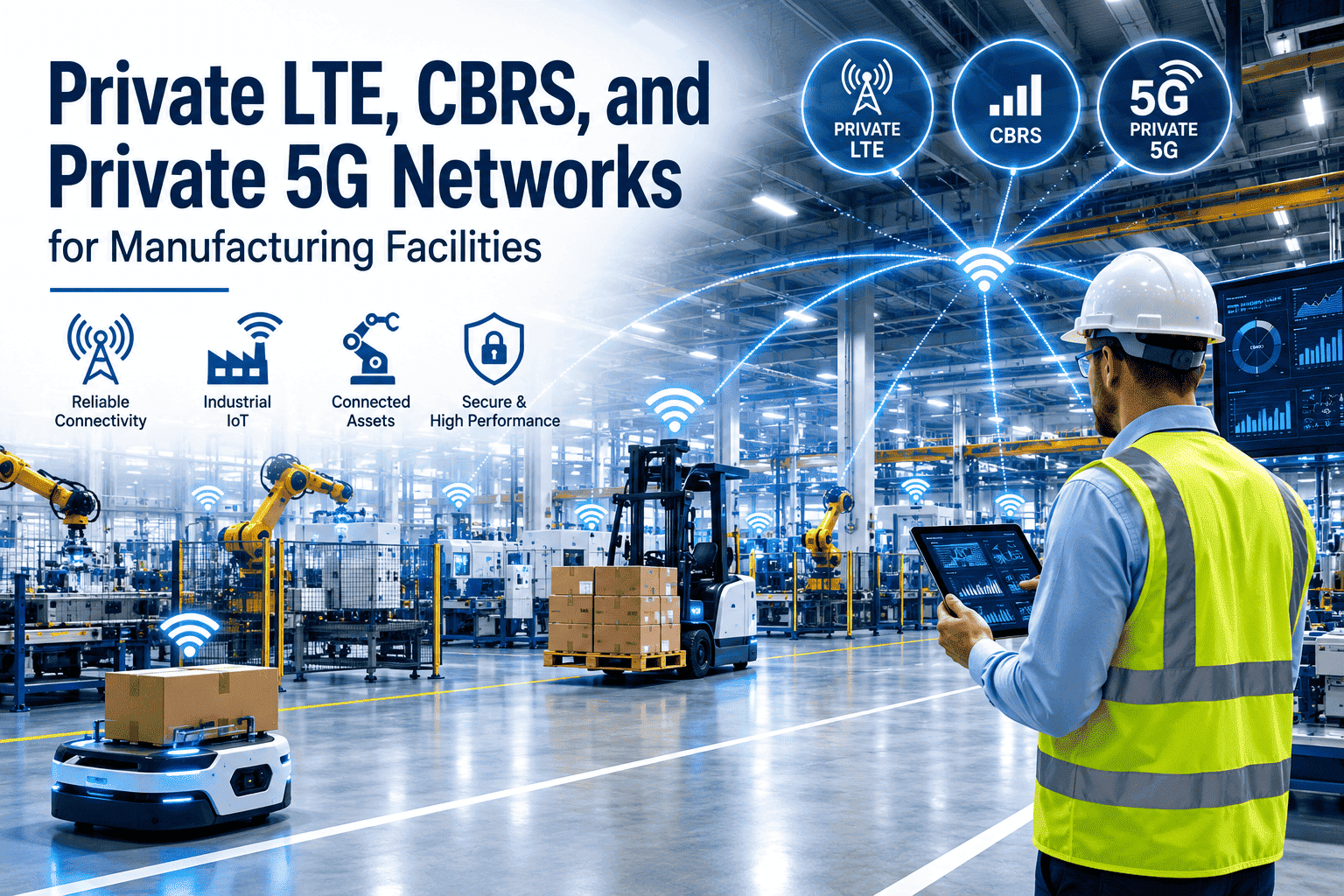
Private LTE, CBRS, and Private 5G Networks for Manufacturing Facilities
By Riley Quinn on June 12, 2026
Wi-Fi was built for offices, not factory floors with 200 AMRs crossing roaming domains every minute. Private cellular — LTE and 5G running on CBRS shared spectrum — gives manufacturers the deterministic latency, device density, and seamless mobility that AGVs, computer vision, and connected workers actually need. This buyer's guide compares Wi-Fi vs Private LTE vs Private 5G, decodes the 3-tier CBRS spectrum model, and walks through deployment options and selection criteria. Book a factory connectivity assessment to scope yours.
The Industrial Wireless Spectrum That Changed Everything
3550358036503700 MHz
Tier 1
Incumbent
Naval radar & FSS
Tier 2 · PAL
Priority Access
Licensed · 70 MHz · 10-yr auctions
Tier 3 · GAA
General Access
Unlicensed · 80 MHz · free
Coordination via Spectrum Access System (SAS) · 3GPP Band 48 (LTE) · n48 (5G NR)
4,700+
Private LTE/5G networks worldwide (end 2024)
2,500
Manufacturing private 5G networks by 2032
28.5%
Mfg share of global private LTE market
↓ 30%
Unplanned downtime reduction (typical)
Why Wi-Fi Falls Short for Modern Factory Operations
Wi-Fi 6/6E is excellent for offices and even good for some industrial applications. But factories aren't offices. They're high-mobility, RF-hostile, latency-critical environments where 200+ autonomous devices need to roam seamlessly across 500,000 sq ft of steel-and-concrete obstacles. Five specific Wi-Fi limitations push manufacturers toward private cellular — and none of them go away by adding more access points.
01
Handoff Disruption
AMRs lose connectivity for 200-500ms when crossing AP boundaries — long enough to stop the vehicle. Cellular handoffs complete in < 10ms.
02
Co-channel Interference
2.4/5 GHz bands are crowded with consumer devices, forklift scanners, and microwaves. CBRS gives you dedicated mid-band spectrum.
03
Coverage Gaps
A factory needs 5-10x more Wi-Fi APs than cellular cells for equivalent coverage in steel structures. CBRS cells reach 200-500m indoors.
04
Latency Variance
Wi-Fi latency varies 5-100ms+ depending on contention. Private 5G delivers deterministic sub-10ms latency for control loops.
05
Security Posture
Wi-Fi is broadcast-by-default. Private cellular uses SIM-based authentication, encrypted air interface, and isolated core — closer to OT-grade.
Wi-Fi 6 vs Private LTE vs Private 5G · Head-to-Head
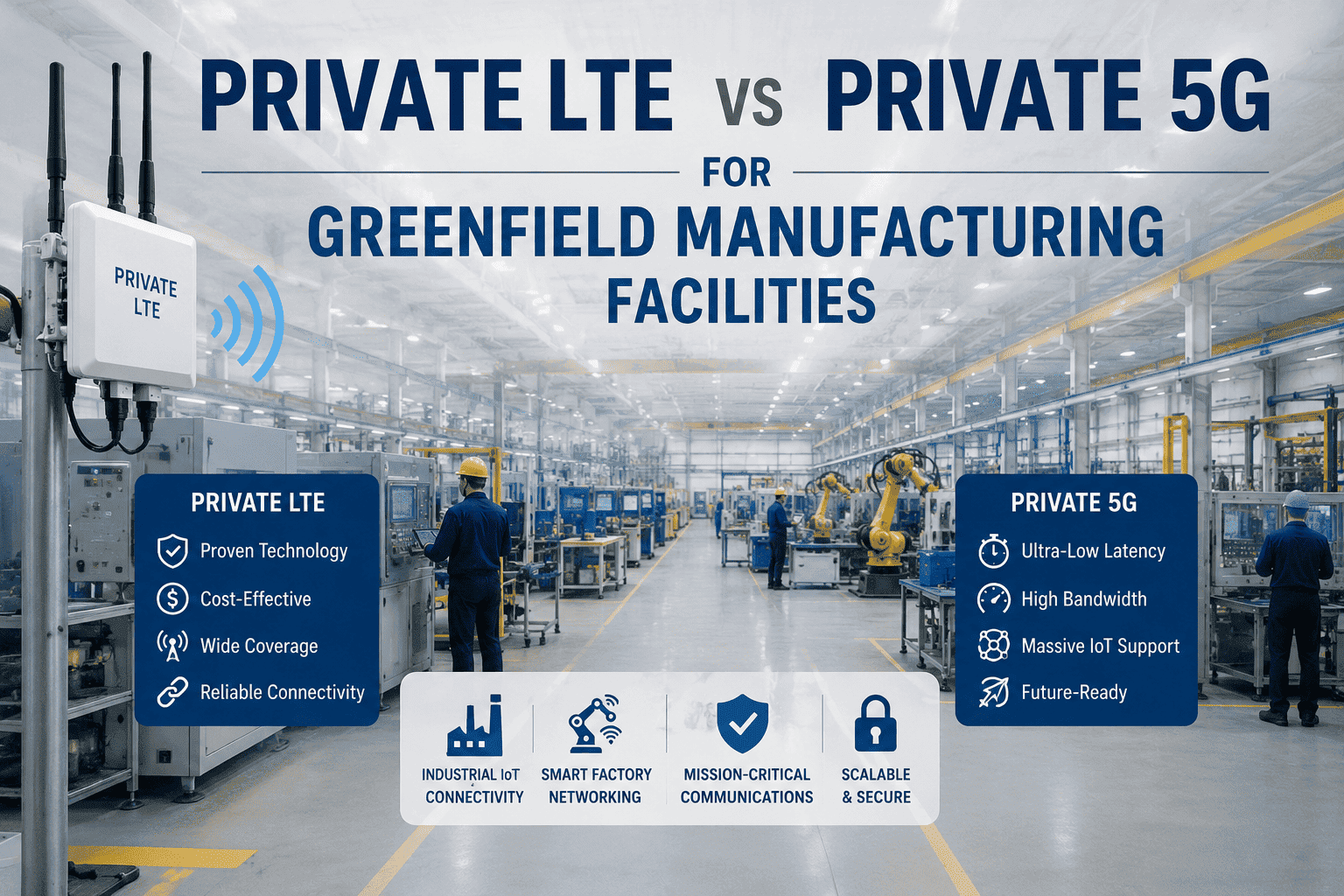
The three wireless options serve different production realities. Wi-Fi 6 still wins on cost and simplicity for low-mobility data tasks. Private LTE handles the bulk of industrial mobility today. Private 5G unlocks the demanding edge AI and ultra-low-latency control workloads that private LTE can't deliver. Use the matrix below to map your specific workload to the right technology.
Capability
Wi-Fi 6/6E
Private LTE
Private 5G
Spectrum
2.4/5/6 GHz unlicensed
CBRS Band 48
CBRS n48 + mmWave
Typical latency
5-100ms (variable)
20-50ms
< 10ms (URLLC)
Mobility / handoff
200-500ms gaps
< 10ms seamless
< 10ms seamless
Device density
~250 per AP
~1,000 per cell
~1M per km²
Coverage radius
30-50m indoor
200-500m indoor
200-300m indoor
Security model
WPA3 / Enterprise
SIM-based + 4G core
SIM + zero-trust slicing
Network slicing
—
Limited
Native (per-workload)
Typical CAPEX
$50K-$200K
$300K-$1.5M
$500K-$3M
Best for
Office IT, scanners, low-mobility data
AMRs, sensors, voice, asset tracking
Edge AI, vision QC, AR, robotic control
CBRS Explained · The 3-Tier Spectrum Model
CBRS is the regulatory innovation that made private cellular economically viable for manufacturers. Instead of expensive carrier-licensed spectrum, the FCC carved out 150 MHz at 3.5 GHz into a shared three-tier model coordinated by a Spectrum Access System (SAS). Understanding the tiers determines whether you pay $0 or millions to operate — and how robust your interference protection is.
Highest Priority
Tier 1 · Incumbent Access
US Navy radar systems and Fixed Satellite Service earth stations. SAS automatically protects these incumbents — when they're active, lower tiers must vacate. Coastal locations face higher activity zones.
Always winsCoastal sensitiveNo fee
Mid Priority
Tier 2 · Priority Access Licenses (PAL)
Up to 70 MHz auctioned in 10-year licenses by county. Protected from GAA interference but must yield to Tier 1. The right answer for facilities running mission-critical workloads where determinism matters more than CAPEX.
70 MHz maxCounty-licensedAuction fees
Best-Effort
Tier 3 · General Authorized Access (GAA)
Free, unlicensed access to the remaining ~80 MHz. Coordinated by SAS to minimize interference between GAA users. The default starting point for most greenfield manufacturers — upgrade to PAL if interference becomes an issue.
~80 MHzUnlicensedFree
Scope the Right Wireless Architecture for Your Factory
iFactory's connectivity team designs Wi-Fi, private LTE, and private 5G architectures matched to your specific production model — AMRs, computer vision, AR/VR, predictive maintenance — without overbuying spectrum or under-engineering coverage.
The reason private cellular adoption is accelerating isn't the technology — it's the workloads it unlocks. These six manufacturing use cases drive the strongest ROI cases for CBRS-based private LTE/5G, with measurable returns typically materializing within 3-6 months of go-live.
01
AGV / AMR Fleet Connectivity
Seamless handoff between cells keeps autonomous vehicles operational across the entire facility. Deterministic latency prevents safety stops.
< 10ms latencySeamless mobility
02
AI Computer Vision QC
High-resolution cameras stream to edge AI for real-time defect detection. Bandwidth + latency requirements exceed Wi-Fi reliability thresholds.
High bandwidthEdge AI
03
Connected Worker AR/VR
AR glasses for assembly guidance, remote expert assist, and digital work instructions. Demands deterministic latency that Wi-Fi can't guarantee.
Low jitterWide coverage
04
Predictive Maintenance IoT
Thousands of vibration, temperature, and acoustic sensors stream continuously. Massive device density exceeds Wi-Fi AP capacity.
Massive scaleLow power
05
Real-Time Asset Tracking
Forklift telemetry, WIP location, tooling tracking. Cellular range covers entire facility plus yard from a handful of cells.
Outdoor + indoorLong range
06
Robot & PLC Control
Wireless connection to mobile robots and untethered control panels. Network slicing isolates this traffic from data workloads.
How you deploy a private cellular network matters as much as which technology you pick. Most manufacturers underestimate the RF planning, integration, and ongoing optimization burden of DIY deployments — and overpay for inflexible turnkey vendor solutions. Three models dominate the market today, each with distinct trade-offs across cost, control, and time-to-value.
Option A
DIY · Self-Deployed
Maximum control · highest complexity
Manufacturer owns all infrastructure: radios, core, SAS subscription, SIMs. Internal team handles RF planning, site surveys, integration, and ongoing operations. Best for organizations with strong existing OT/IT capabilities.
CAPEX$500K – $3M+
Time6-12 months
TeamIn-house RF + network
Option B
Managed Private Network
Balanced cost + speed (most common)
Specialist MSP handles deployment, optimization, and 24/7 ops. Manufacturer pays subscription. Network equipment owned by either party. Strongest fit for mid-to-large factories scaling beyond pilot.
CAPEX$200K – $1.5M
Time3-6 months
OPEX$5K-$30K/mo
Option C
Network-as-a-Service (NaaS)
Fastest deployment · subscription model
Vendor delivers complete turnkey solution as monthly service. Zero CAPEX. Equipment, SAS, SIMs, ops all bundled. Best for proof-of-concept, single-site, or organizations averse to infrastructure ownership.
The advertised CBRS network cost rarely matches the real CAPEX you end up writing checks for. Three line items consistently surprise manufacturers during procurement — and missing them in the business case is why pilots stall and full deployments slip. Plan for these from day one and your project lands on budget.
RAN Infrastructure
Small cells, radios, antennas (5-15 cells per 500K sq ft)
$200K-$800K
Mobile Core (4G/5G)
On-prem or cloud-native packet core, EPC/5GC
$80K-$400K
SAS & Spectrum
Annual SAS subscription · optional PAL auction fees
$20K-$200K/yr
SIMs & End Devices
eSIMs + LTE/5G modules in AMRs, sensors, cameras
$50K-$500K
Integration & Ops
RF design, site survey, integration, training, year-1 ops
$150K-$600K
The hidden line item: end-device integration. Every AMR, scanner, camera, or PLC needs a CBRS-compatible module + eSIM provisioning. Plan $200-$2,000 per device — and discover which existing assets can't be retrofit at all.
Need a defensible CBRS CAPEX model before approving the project? Book a TCO modeling session with our industrial connectivity team.
Selection Decision Framework
Faced with three wireless options and a pile of vendor pitches? Walk this decision tree. Each branch reflects the operational trade-off that actually differentiates the technologies — not the marketing claims they all share.
Q1
Do you need deterministic sub-10ms latency (URLLC) for control loops or safety?
If yes → Private 5G (URLLC slice required)
Q2
Do you have 50+ mobile devices (AMRs, AGVs, scanners) crossing large coverage areas?
If yes → Private LTE or 5G (Wi-Fi handoffs will fail)
Q3
Streaming high-resolution video for AI computer vision or AR/VR?
If yes → Private 5G (bandwidth + latency required)
Q4
Mostly low-bandwidth IoT sensors with low mobility?
If yes → Wi-Fi 6 or Private LTE depending on scale
Q5
Have RF expertise + capital + 6-12 months for full DIY deployment?
If no → Choose Managed Private Network or NaaS
Expert Perspective
Every manufacturer asking us "Wi-Fi or 5G?" is asking the wrong question. The right answer is almost always "both." Wi-Fi handles handhelds, scanners, and office IT just fine. Private cellular handles the workloads where Wi-Fi physically can't — high-mobility AMRs, latency-sensitive control, massive sensor density. The factories getting this right run Wi-Fi for their data plane and private LTE or 5G as a parallel deterministic plane for OT-grade workloads. Pick the technology that matches the workload — not the technology that matches your last conference talk.
— Industrial Wireless Architecture Best Practice
3-6 mo
Typical ROI for CBRS private 5G in manufacturing
5-10x
More cells needed for Wi-Fi vs CBRS coverage
$6.4B
Global private cellular spend by 2026
2020
Year CBRS opened for commercial use
Bottom Line · Match Wireless to Workload, Not Hype
Private LTE and 5G aren't replacements for Wi-Fi — they're complements. Use Wi-Fi for handhelds, scanners, and general office IT. Use private LTE for high-mobility AMRs, asset tracking, and IoT density that Wi-Fi can't handle. Use private 5G for ultra-low-latency edge AI, robotic control, and AR/VR. Start with CBRS GAA for free spectrum, deploy as managed service if you lack in-house RF expertise, and plan for end-device integration as the hidden cost line item. Get this right and your factory's wireless backbone outperforms your ERP for the next decade.
Build the Wireless Backbone Your Factory Actually Needs
iFactory's industrial connectivity practice designs Wi-Fi, private LTE, and private 5G architectures matched to specific manufacturing workloads — AMRs, computer vision, AR, predictive maintenance. Vendor-neutral. Architecture-first. Built to scale.
What is the difference between private LTE and private 5G for manufacturing?
Private LTE (4G) and private 5G are sequential generations of cellular technology, both deployable on CBRS shared spectrum. Private LTE operates on 3GPP Band 48 and delivers 20-50ms latency, ~1,000 devices per cell, and seamless mobility with sub-10ms handoffs — sufficient for most current manufacturing workloads like AMR/AGV connectivity, asset tracking, predictive maintenance IoT, and connected worker voice. Private 5G operates on 3GPP n48 (plus optional mmWave bands) and adds ultra-reliable low-latency communication (URLLC) below 10ms, massive device density up to ~1 million per km², and native network slicing that isolates control traffic from data traffic. Private 5G is required when you need deterministic latency for robotic control, edge AI computer vision, AR/VR for connected workers, or wireless PLC integration. Most manufacturers deploy private LTE today and upgrade to private 5G for specific high-demand workloads — the same CBRS spectrum supports both.
What is CBRS and how does it enable private cellular networks?
CBRS (Citizens Broadband Radio Service) is 150 MHz of mid-band spectrum at 3.55-3.70 GHz that the FCC opened for commercial use in 2020. It uses a three-tier shared-access model coordinated by a Spectrum Access System (SAS): Tier 1 (Incumbent Access) protects US Navy radar and Fixed Satellite Service stations; Tier 2 (Priority Access Licenses or PAL) provides up to 70 MHz of licensed spectrum auctioned in 10-year county-level licenses with interference protection from GAA; Tier 3 (General Authorized Access or GAA) gives free unlicensed access to the remaining ~80 MHz with SAS-coordinated interference avoidance. CBRS enabled private LTE deployments starting 2020 and private 5G deployments starting 2023 by giving enterprises mid-band spectrum without carrier intervention. Approximately 370,000 CBRS devices and 4,700+ private LTE/5G networks worldwide were operational by end-2024, with North America leading at 37.5% of the private LTE market.
How much does a private LTE or private 5G network cost for a factory?
Private cellular network CAPEX varies significantly with facility size, technology choice, and deployment model. Private LTE deployments typically cost $300K-$1.5M for a mid-sized manufacturing facility (500K sq ft). Private 5G deployments range from $500K-$3M+ depending on URLLC requirements and edge compute integration. Five main cost categories: RAN infrastructure (small cells, radios) at $200K-$800K, mobile core (EPC/5GC) at $80K-$400K, SAS subscription and optional PAL spectrum at $20K-$200K annually, end-device SIMs and CBRS modules at $50K-$500K (often the hidden surprise), and integration plus year-1 operations at $150K-$600K. Network-as-a-Service (NaaS) models eliminate CAPEX with $10K-$60K monthly subscriptions. Managed private network models typically have $200K-$1.5M CAPEX plus $5K-$30K monthly. Most manufacturers see ROI within 3-6 months through downtime reduction (typically 30%) and automation enablement.
Can private cellular replace Wi-Fi in a factory?
Private cellular complements Wi-Fi rather than replacing it in most manufacturing deployments. Wi-Fi 6/6E remains the right choice for handheld devices, scanners, office IT, and general low-mobility data workloads — it's cheaper and simpler for those use cases. Private LTE and 5G become essential when factories need seamless mobility for autonomous vehicles (Wi-Fi handoffs cause 200-500ms gaps versus <10ms cellular handoffs), deterministic low latency for control loops, massive device density beyond 250 devices per Wi-Fi AP, or wide-area coverage where CBRS cells reach 200-500m indoors versus 30-50m for Wi-Fi. The winning architecture for modern factories is dual-plane: Wi-Fi for the data plane (handhelds, office, scanners) and private cellular as a parallel deterministic plane for OT-grade workloads (AMRs, vision QC, robot control, AR/VR). The two networks coexist with different SLAs matched to different workloads.
How long does it take to deploy a private LTE/5G network in manufacturing?
Deployment timelines vary significantly with deployment model and facility complexity. Network-as-a-Service (NaaS) deployments — where a vendor delivers complete turnkey infrastructure as a managed service — typically go live in 4-12 weeks for standardized configurations. Managed private network deployments via specialist MSPs run 3-6 months including RF design, site survey, equipment installation, integration with existing OT systems, and 30-day stabilization. DIY self-deployed networks where the manufacturer owns all infrastructure and operations typically require 6-12 months due to in-house RF planning, vendor selection, equipment lead times (especially radios and cores), site work, and team buildout. Timelines extend for multi-plant rollouts, complex existing automation integration, regulated industries requiring extensive validation, or deployments requiring PAL spectrum auction participation. Book a connectivity assessment to scope timeline and deployment model for your specific facility.