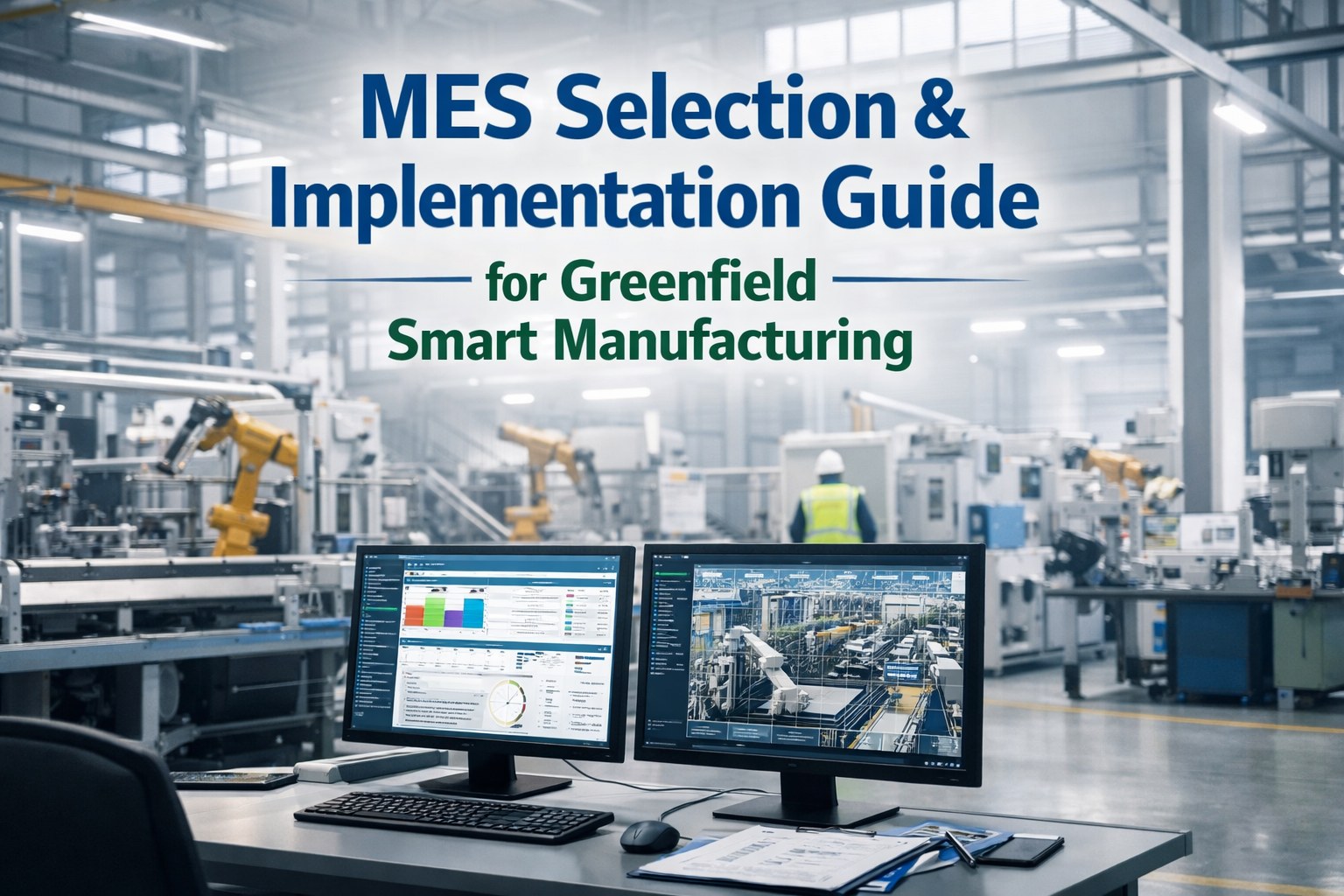
MES is the brain between your ERP planning system and your shop floor reality — and picking the wrong one means watching your digital transformation stall for years. Siemens, SAP, Rockwell, and AVEVA each lead in specific manufacturing contexts, but no platform wins everywhere. This independent comparison breaks down the four MES leaders across cost, capability, fit, and implementation risk so your factory picks right the first time. Book an MES strategy session to scope the right platform for your operation.
#1
Siemens Opcenter
Discrete & Pharma Leader
Best for complex discrete & pharmaceutical
#2
SAP Digital Manufacturing
ERP-Native Integrator
Best for SAP-native global enterprises
#3
Rockwell Plex / FactoryTalk
Cloud-Native Discrete
Best for Rockwell-stack mid-large manufacturers
#4
AVEVA MES
Process Industry Specialist
Best for process & PI System integrators
What MES Does & Where Each Vendor Differs
Before comparing vendors, lock in what MES actually does. The MESA standard defines 11 core functions, but in practice five drive 90% of value. Each vendor invests differently across these functions — which is why "best MES" is always a question of best for what. Here are the five functions, followed by a positioning quadrant showing where each leader actually sits.
01
Production Execution
Order dispatch, work instructions, operator guidance, machine commands
02
Quality Management
In-process checks, SPC, deviations, CAPA, audit-ready records
03
Traceability & Genealogy
Material, batch, work-step linking · regulatory compliance · recall response
04
Performance Analysis
Real-time OEE, downtime classification, throughput, scrap analytics
05
Integration Layer
ERP, SCADA/PLC, LIMS, WMS, quality systems, IoT & AI platforms
Vendor Positioning · Cloud-Native vs On-Prem × Discrete vs Process
Positioning reflects each vendor's dominant deployment pattern — all 4 support hybrid use cases via configuration
Vendor Profiles · Strengths, Weaknesses, Best Fit
Each MES leader earned its market position through different trade-offs. Here's what each gets right, what it gets wrong, and which manufacturing profile it actually serves best.
The most comprehensive MES suite on the market. Strong in complex discrete (aerospace, automotive, semiconductor) and pharmaceutical batch execution. Deep digital twin integration via Tecnomatix and tight handshake with Siemens automation hardware. Modular Opcenter Execution Discrete, Process, Foundation, Pharma, and Semiconductor variants address specific industry needs.
Strengths
Deepest functional coverage
Pharma-grade compliance & validation
Digital twin / Tecnomatix integration
Strongest discrete MES globally
Weaknesses
Steep learning curve
Longer implementation timelines
Premium pricing
Heavy Siemens ecosystem lock-in
Best for
Complex discrete and pharmaceutical manufacturers needing deep traceability, validated compliance, and digital twin integration — typically 500+ user enterprises
Cloud-based MES (formerly SAP ME and DM Cloud) that ties production execution directly to S/4HANA financials, planning, and procurement. The clear winner for global manufacturers already standardized on SAP. Quarterly cloud updates, embedded AI, and out-of-the-box ERP integration eliminate the integration project that plagues other MES rollouts.
Strengths
Native S/4HANA integration
Cloud-only — no infra overhead
Embedded AI/ML capabilities
Global multi-site standardization
Weaknesses
Shop-floor depth below Siemens
Limited value without SAP ERP
Customization more constrained
Heavy reliance on master data quality
Best for
Large global manufacturers already standardized on SAP S/4HANA seeking unified ERP-MES execution with minimal integration effort
Two platforms under one roof. Plex Smart Manufacturing is the cloud-native ERP+MES platform Rockwell acquired in 2021 — ideal for mid-market discrete manufacturers wanting integrated end-to-end software. FactoryTalk ProductionCentre is the traditional on-prem MES for facilities deeply invested in Rockwell Automation PLCs and FactoryTalk applications.
Strengths
Cloud-native option (Plex)
Tight Rockwell PLC integration
Strong mid-market positioning
Combined ERP+MES via Plex
Weaknesses
Two-platform strategy confusing
Best with Rockwell automation stack
Smaller global partner network
Less depth in regulated industries
Best for
Mid-market discrete manufacturers (100-2,500 users) using Rockwell PLCs, wanting cloud-native deployment or integrated ERP+MES
The standard for process industries — chemicals, oil & gas, pulp & paper, food & beverage. Deep integration with the AVEVA (formerly OSIsoft) PI System data historian makes it the natural choice for facilities already running PI for time-series operational data. Strong OEE, genealogy, and predictive maintenance modules.
Strengths
PI System / data historian native
Strongest in process industries
Multi-site enterprise scalability
Deep OEE & genealogy modules
Weaknesses
Steep learning curve
Specialist consultant dependency
Discrete fit weaker than Siemens
Complex initial setup
Best for
Process and hybrid manufacturers (chemicals, F&B, pharma APIs) with existing PI System investments and continuous-process operations
Get an Independent MES Recommendation in 2 Weeks
iFactory's MES advisory team reviews your manufacturing processes, automation stack, and ERP strategy — then recommends the right platform with a defensible TCO model. Vendor-neutral. Implementation-focused. No commissions, no kickbacks.
Head-to-Head · Cost & Implementation Timeline
MES total cost of ownership spans 4-6x between vendors for comparable mid-market deployments. Implementation timelines vary 2-3x. Use the visualizations below to ground budget expectations in reality before vendor demos start adding scope creep.
Siemens Opcenter
$1.5M – $4M+
SAP Digital Manufacturing
$1M – $3M
Rockwell Plex / FactoryTalk
$500K – $2M
$0$1M$2.5M$4M+
Typical Implementation Timeline · From Kickoff to Go-Live
Rockwell Plex (cloud)
4-8 mo
SAP Digital Manufacturing
6-12 mo
Rockwell FactoryTalk (on-prem)
8-14 mo
Siemens Opcenter
12-18 mo
Need a defensible MES TCO model before you commit budget? Schedule a TCO modeling session with our advisory team.
Head-to-Head · MES Capability Matrix
The pricing tells half the story. The capability matrix tells the other half — and for greenfield manufacturers, this is where the real selection battle gets fought. Each MES scores across the 8 capabilities that drive shop-floor execution outcomes.
Capability
Siemens
SAP DM
Rockwell
AVEVA
Production execution & dispatch
OEE & performance analytics
Regulated industry compliance
Need help mapping these capabilities to your specific manufacturing requirements? Connect with our MES architects for a tailored capability assessment.
Industry Fit · Which MES Wins for Your Manufacturing Type
MES selection isn't just about features — it's about manufacturing model fit. A platform optimized for discrete automotive assembly will fight you in batch pharmaceutical operations, and vice versa. Use this matrix to see where each vendor delivers its best value across the major manufacturing models.
Manufacturing Type
Siemens
SAP DM
Rockwell
AVEVA
Aerospace / Defense
Best
OK
OK
N/A
Automotive Assembly
Best
OK
Best
N/A
Pharmaceutical
Best
OK
N/A
OK
Semiconductor
Best
OK
N/A
N/A
Food & Beverage
OK
Best
OK
Best
Chemicals / Petrochem
OK
OK
N/A
Best
Discrete Mid-Market
OK
OK
Best
N/A
Multi-product factory with mixed manufacturing models? Schedule a fit assessment to map MES against your specific production mix.
Selection Decision Framework
Faced with four credible options and a procurement deadline? Walk this decision tree. Each branch reflects the trade-off that actually differentiates the four MES platforms in real selection processes — not the ones vendors highlight on their feature lists.
Q1
Are you running SAP S/4HANA as your enterprise ERP?
If yes → SAP Digital Manufacturing wins on ERP-native integration
Q2
Process industry (chemicals, oil & gas, F&B) with PI System data historian?
If yes → AVEVA MES wins on process depth + PI integration
Q3
Mid-market discrete manufacturer using Rockwell PLCs?
If yes → Rockwell Plex or FactoryTalk wins on automation ecosystem fit
Q4
Complex discrete, pharma, or semiconductor needing deepest MES functionality?
If yes → Siemens Opcenter wins on functional depth & compliance
Q5
None of the above clearly fits your profile?
Consider niche specialists: Tulip, Critical Manufacturing, Werum PAS-X, MPDV Hydra
Expert Perspective
The biggest MES selection mistake we see isn't picking the wrong platform — it's picking before defining what you'll actually use it for. Most factories deploy 15% of their MES capabilities and pay for 100%. Define the 3-4 operational outcomes you need (faster changeovers, lower scrap, audit-ready traceability, real-time OEE) and select against those. The platform that wins on those outcomes — not the one with the deepest feature list — is the right MES for your factory.
— Manufacturing Execution Strategy Best Practice
150+
MES vendors worldwide tracked by analysts
65%
of MES projects exceed planned timeline
10-15 yr
Expected MES lifecycle once committed
15%
Avg capability utilization vs licensed
Bottom Line · Pick the MES Your Factory Actually Needs
Siemens wins on functional depth and complex discrete or pharma. SAP wins on ERP-native integration when you're already on S/4HANA. Rockwell wins on Rockwell-PLC factories and mid-market cloud-native deployment. AVEVA wins on process industries and PI System integrations. None of them is universally best — and the consultant who says otherwise has a commission to collect. Spend three weeks getting MES selection right; you'll save three years of regret.
Get the Right MES Picked, Scoped, and Stood Up
iFactory's MES advisory practice combines vendor-neutral selection with implementation-ready scoping. Walk away with a recommended platform, defensible TCO, integration architecture, and risk mitigation plan — in weeks, not months.
Frequently Asked Questions
What is the best MES software for manufacturing in 2026?
There is no single best MES — the right choice depends on manufacturing type, ERP environment, and automation stack. For complex discrete manufacturing, pharmaceuticals, and semiconductor operations needing the deepest functional coverage and validated compliance, Siemens Opcenter Execution leads. For large global enterprises already standardized on SAP S/4HANA, SAP Digital Manufacturing wins on ERP-native integration. For mid-market discrete manufacturers using Rockwell automation, Rockwell Plex (cloud-native) or FactoryTalk ProductionCentre (on-prem) deliver the strongest ecosystem fit. For process industries (chemicals, oil & gas, food & beverage, pulp & paper) and facilities already running the AVEVA PI System historian, AVEVA MES is the natural choice. Other strong specialists include Tulip for connected worker apps, Critical Manufacturing for semiconductor, and Werum PAS-X for pharmaceutical batch execution.
How much does manufacturing execution system software cost?
MES software costs vary 4-6x between vendors for comparable mid-market deployments. Three-year total cost of ownership typically ranges from $500K-$2M for Rockwell Plex/FactoryTalk, $1M-$3M for SAP Digital Manufacturing and AVEVA MES, and $1.5M-$4M+ for Siemens Opcenter. Costs include licensing (perpetual or subscription, often starting at $100K+ annually for enterprise tiers), implementation services (typically 1.5-2.5x license cost), data migration, ERP/SCADA integration, training, change management, and ongoing maintenance. Cloud-native platforms (Rockwell Plex, SAP DM) eliminate on-premise infrastructure costs but lock you into subscription pricing. On-premise platforms (Siemens, AVEVA, FactoryTalk) have higher upfront costs but lower long-term operating costs for stable deployments.
How long does MES implementation take?
MES implementation timelines vary significantly with platform, scope, and integration complexity. Cloud-native Rockwell Plex deployments go live in 4-8 months for standardized mid-market manufacturers. SAP Digital Manufacturing typically takes 6-12 months. AVEVA MES runs 9-15 months given its process industry depth. Rockwell FactoryTalk on-premise averages 8-14 months. Siemens Opcenter — particularly for complex discrete or pharmaceutical operations — typically runs 12-18 months. Implementation timelines extend significantly with custom integrations (multiple SCADA systems, legacy ERP), regulated industry validation (pharma 21 CFR Part 11), multi-plant rollouts, and weak internal change management. The fastest projects have strong executive sponsorship, dedicated cross-functional teams, and accept platform best practices instead of customizing to legacy workflows.
What is the difference between MES and ERP?
ERP (Enterprise Resource Planning) plans production at the business level — managing orders, financials, inventory, procurement, customer relationships, and human resources across the enterprise. MES (Manufacturing Execution System) executes production at the shop floor level — translating ERP plans into specific work instructions, capturing real-time machine and operator data, managing quality checks, tracking material genealogy, and feeding actual performance back to ERP. ERP answers "what should we make and when"; MES answers "did we actually make it correctly". They complement rather than compete — most large manufacturers run both. Modern platforms like SAP Digital Manufacturing increasingly blur the line by embedding MES capabilities directly into the ERP cloud platform, while others (Siemens, Rockwell, AVEVA) keep MES as a separate but tightly integrated layer.
Should we select MES before or after greenfield factory design?
Select MES in parallel with greenfield factory design — never after construction begins. The MES platform you choose determines integration architecture with ERP, SCADA, PLCs, LIMS, and shop-floor data infrastructure. Choosing the building's network architecture, edge compute capacity, and data layer before knowing your MES creates expensive retrofits when integration requirements emerge. Best practice: complete MES platform selection during factory design, validate API and integration capabilities with shortlisted automation vendors, then design the network and compute infrastructure to support the chosen stack. This sequencing also unlocks better licensing terms — most MES vendors offer significant greenfield deployment discounts when committed early in the project lifecycle.
Book a greenfield MES planning session to align your selection with your factory build timeline.