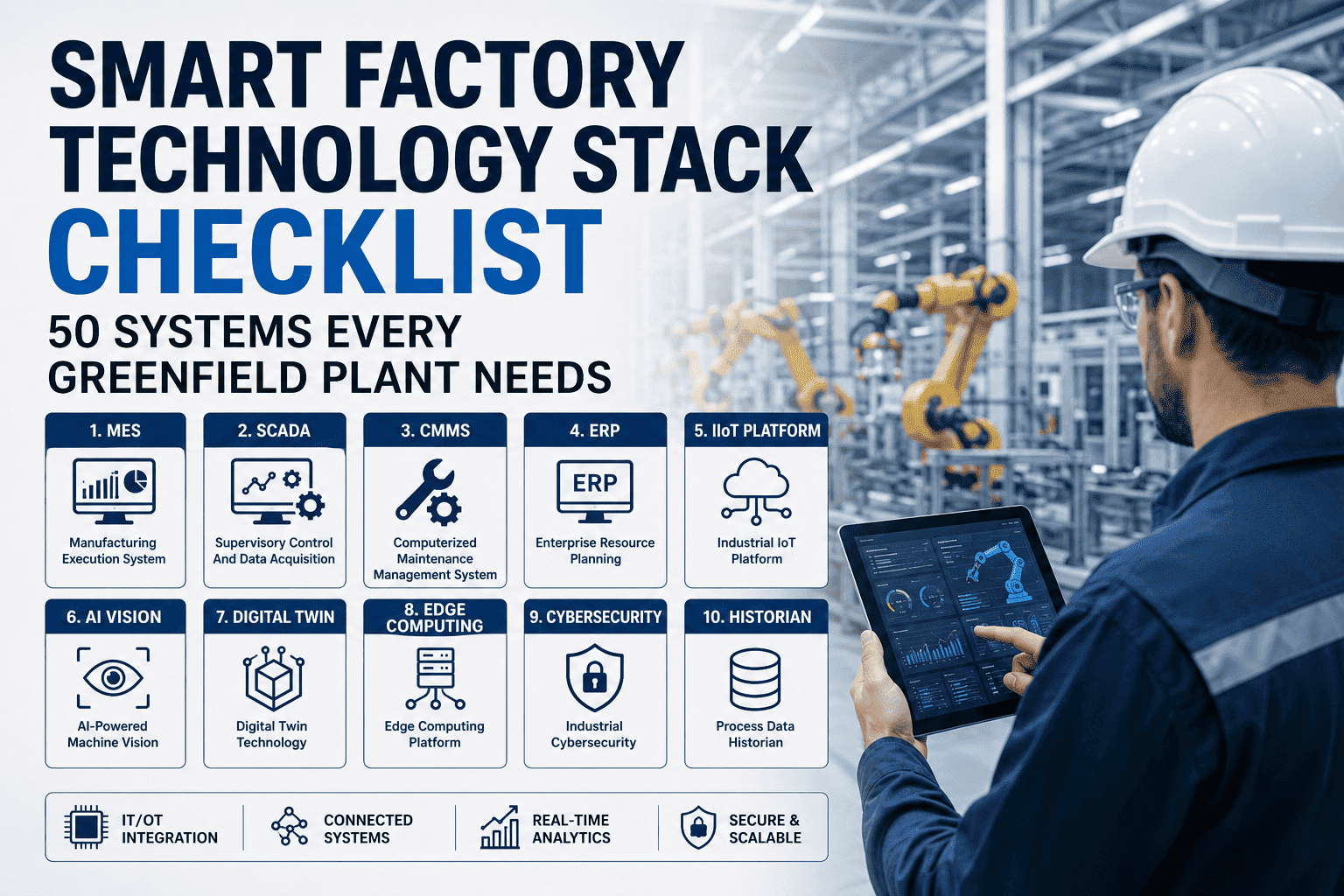
Greenfield factory technology stacks span 50+ distinct systems across 11 architectural layers — from PLCs at the equipment level to AI quality vision at the intelligence layer. Selecting systems independently, and expecting them to integrate at commissioning is the number one cause of greenfield delays. This checklist documents the 50 systems every modern greenfield plant needs in 2026, organized by ISA-95 stack layer with selection notes. Schedule a greenfield architecture consultation to walk through your stack against this reference.
Greenfield Reference Checklist · 2026
50 Systems Every Greenfield Plant Needs
The complete ISA-95 aligned smart factory technology stack. PLCs through AI quality vision, organized by 11 architectural layers with selection criteria and integration dependencies. Use during design phase to specify the full stack before procurement locks in incompatible architectures.
50systems across 11 layers
ISA-95reference architecture aligned
$155BAI manufacturing market by 2030
Stack Layers
10
AI & Advanced Intelligence
4
08
Maintenance Management
3
07
Quality & Compliance
5
06
Manufacturing Execution
8
03
Connectivity & Network
5
02
Control & Automation
5
How to Use This Checklist
This is a design-phase reference, not a procurement spec. Use it during greenfield design (typically 12–18 months before construction starts) to specify the complete technology stack and identify integration dependencies before vendor selection. Walk through each layer, mark systems as required/optional/not applicable, and document the integration protocols that connect adjacent layers.
01
Walk Through Each Layer
Read each of the 11 layer sections in sequence. For each system listed, decide required, optional, or not applicable. Document the rationale for future reference.
02
Identify Integration Points
For each required system, identify which adjacent-layer systems it must integrate with. Document the protocol (OPC-UA, MQTT, REST API) and direction.
03
Validate the Unified Namespace
Modern stacks use a Unified Namespace (UNS) with MQTT/Sparkplug B as the central data bus connecting every layer. Specify the UNS design before selecting individual systems.
04
Specify Before Procurement
Convert layer-by-layer decisions into a unified procurement specification with integration requirements documented per system. Vendors bid against the integrated stack spec.
Designing the stack for your specific industry? Book a greenfield architecture session to walk through layer-by-layer decisions tailored to your plant.
The 50-System Checklist — By Layer
Each layer below is collapsible. Open the layers relevant to your greenfield to see the systems within, brief descriptions of their purpose, and selection notes for 2026. The layers progress from physical sensing at the equipment level to cross-cutting cybersecurity, following ISA-95 conventions with modern AI and security additions.
Layer 01
Physical & Sensing
6 systems
+
The bottom of the stack — physical sensors and equipment-level data acquisition. Data not captured here isn’t available to any system above, so modern greenfield plants deploy dense sensor networks.
01
Process Sensors (Temperature, Pressure, Flow, Level)
Continuous measurement of process variables across critical equipment. Wireless HART, 4–20mA, or OPC-UA enabled options. Specify per CCP and per quality requirement during P&ID development.
02
Vibration & Acoustic Monitoring
Predictive maintenance signal source for rotating equipment (motors, pumps, compressors, gearboxes). ISO 10816 compliant for severity assessment. Critical for AI-driven failure prediction.
03
Machine Vision Cameras
Industrial cameras for quality inspection, defect detection, and process verification. GigE Vision, USB3 Vision, or CoaXPress depending on speed and resolution requirements.
04
RFID & Barcode Readers
Asset tracking, batch traceability, lot genealogy. Critical for FSMA 204, automotive traceability, pharmaceutical serialization. Specify reader density per work cell during layout planning.
05
Weighing & Dimensional Measurement
In-line scales, checkweighers, dimensional measurement systems. Required for fill weight verification, package validation, and yield measurement. Class III certification for legal-for-trade applications.
06
Environmental Monitoring
Temperature, humidity, particulate, air pressure monitoring for cleanroom, cold chain, and HVAC verification. Continuous data feed to compliance documentation and environmental optimization.
Layer 02
Control & Automation
5 systems
+
The machine-level control layer that translates supervisory commands into physical action. Millisecond execution speed required. Standard ISA-95 Level 1.
07
Programmable Logic Controllers (PLCs)
Allen-Bradley, Siemens, Schneider, Mitsubishi, Omron. Specify per equipment vendor compatibility. OPC-UA server capability required for modern stack integration. Cycle time per application requirement.
08
Safety PLCs & Safety Instrumented Systems
SIL-rated safety controllers for emergency shutdown, machine guarding, fire/gas protection. Separate from process PLCs per IEC 61511. Required for any hazardous process.
09
Distributed Control Systems (DCS)
Process control platforms for continuous manufacturing (chemical, oil & gas, food & beverage, pharma). Emerson DeltaV, Honeywell Experion, ABB 800xA, Yokogawa CENTUM.
10
Motion Controllers
Servo and stepper motion control for precision applications (robotics, CNC, packaging). Coordinated multi-axis motion. EtherCAT, PROFINET IRT, or Sercos III for deterministic communication.
11
Variable Frequency Drives (VFDs)
Motor control with speed/torque regulation. Energy efficiency, soft start, regenerative braking. Modbus TCP, EtherNet/IP, PROFINET connectivity for monitoring and setpoint adjustment.
Layer 03
Connectivity & Network
5 systems
+
The data plumbing that connects OT to IT. Industrial protocols, network infrastructure, and the Unified Namespace that 2026 best practice mandates for greenfield stacks.
12
OPC-UA Servers & Aggregators
The gold standard for PLC-to-SCADA-to-MES communication. Platform-agnostic data modeling with security certificates and semantic context. Specify OPC-UA capability at every PLC during procurement.
13
MQTT Brokers (Sparkplug B)
The Unified Namespace backbone. Lightweight pub-sub messaging connecting thousands of sensors to enterprise systems. Sparkplug B for industrial semantic context. HiveMQ, EMQX, Mosquitto.
14
Industrial Network Switches & Routers
Managed switches with VLAN segmentation, redundancy (PRP, HSR, ring), and PoE for sensors. ISA-95 DMZ architecture isolates OT from IT. Cisco IE, Hirschmann, Moxa.
15
Industrial Wireless (Wi-Fi 6, 5G, LoRa)
Wireless infrastructure for mobile assets, sensors in inaccessible locations, and AGV/AMR communication. Private 5G increasingly viable for greenfield. Coverage planning during layout phase.
16
Edge Gateways & Protocol Converters
Modbus-to-OPC-UA, legacy serial-to-Ethernet, proprietary-to-standard protocol translation. Critical for integrating legacy equipment alongside modern stack. Moxa, Red Lion, Advantech.
Layer 04
Edge Computing
3 systems
+
The 2026 differentiator. By 2026, 75% of enterprise data is created and processed outside traditional data centers — meaning edge compute is no longer optional for greenfield plants serious about AI workloads.
17
Edge AI Servers (NVIDIA Appliances)
On-prem GPU compute for AI inference on streaming process data. NVIDIA Jetson, IGX, or DGX class depending on workload. Critical for sub-second AI decisions (quality vision, predictive maintenance, adaptive SPC).
18
Edge Analytics & Stream Processing
Real-time event processing on streaming sensor data. Apache Kafka, Apache Flink, AWS Greengrass, Azure IoT Edge. Filtering and aggregation at the edge reduces cloud bandwidth by 60–80%.
19
Edge Historian / Time-Series Database
Local high-frequency data storage for process variables. InfluxDB, TimescaleDB, OSIsoft PI, AVEVA Historian. Specify retention period and resolution per regulatory and analytical requirement.
Layer 05
SCADA & HMI
4 systems
+
The supervisory layer. Operators interact with the plant through SCADA and HMI. Modern greenfield deploys SCADA as the visualization and alarm layer with MES handling production execution above it.
20
SCADA Platform
Plant-wide supervisory control and data acquisition. FactoryTalk (Rockwell), WinCC (Siemens), Wonderware/AVEVA, Ignition, iFIX. Specify based on PLC ecosystem and integration requirements.
21
HMI Runtime & Operator Stations
Local operator interfaces at each work cell. Industrial PCs, touch panels, or thin clients. Specify quantity, ruggedness rating, and display size per workstation during layout design.
22
Alarm Management Software
ANSI/ISA-18.2 compliant alarm rationalization, prioritization, and shelving. Critical for operator effectiveness — poorly managed alarms cause 60–80% of operator overload incidents.
23
Enterprise Historian
Long-term high-resolution time-series data storage spanning all production. OSIsoft PI, AVEVA Historian, Canary. Feeds analytics, audit trails, and compliance reporting.
Layer 06
Manufacturing Execution
8 systems
+
The heart of the smart factory stack. ISA-95 Level 3. MES sits at the center, coordinating production execution with adjacent quality, inventory, scheduling, and recipe systems.
24
Manufacturing Execution System (MES)
The core production execution platform. SAP DMC, Rockwell Plex, AVEVA, Siemens Opcenter, GE Proficy, Tulip. Selection should anchor the entire stack — specify before adjacent systems.
25
Manufacturing Operations Management (MOM)
Broader scope than MES, covering production, quality, maintenance, and inventory operations under unified governance. Often delivered as MES suite with additional modules.
26
Laboratory Information Management System (LIMS)
Sample tracking, test result recording, lab workflow management. Critical for regulated industries (pharma, food, semiconductors). LabWare, STARLIMS, LabVantage.
27
Warehouse Management System (WMS)
Inventory tracking, putaway/picking optimization, replenishment. Manhattan, Blue Yonder, SAP EWM, Oracle. Integration with MES for material consumption and ERP for inventory valuation.
28
Batch Management (S88)
ISA-S88 compliant batch execution for process industries. Recipe execution, equipment allocation, batch record creation. Required for pharma, biotech, specialty chemicals, F&B.
29
Recipe Management
Master recipe authoring, versioning, and deployment to MES/DCS. Critical for multi-product lines with frequent changeovers. ISA-S88 alignment for process industries.
30
OEE Monitoring Software
Overall Equipment Effectiveness measurement across availability, performance, quality. Real-time line-level OEE dashboards. MachineMetrics, SensrTrx, or MES module.
31
Production Scheduling & APS
Advanced Planning & Scheduling. Finite capacity scheduling, sequencing optimization. Siemens Opcenter APS, Aspen Plant Scheduler, Asprova. Critical for complex changeover constraints.
Layer 07
Quality & Compliance
5 systems
+
Quality control, regulatory documentation, and audit readiness. Regulated industries (pharma, food, automotive, aerospace) require these systems for compliance.
32
Quality Management System (QMS)
Document control, CAPA workflows, audits, training, supplier quality. ETQ, MasterControl, SAP QM, Rockwell PharmaSuite. Required for ISO 9001, FDA-regulated, AS9100 environments.
33
Statistical Process Control (SPC) Software
Real-time process monitoring with control charts, capability analysis (Cpk, Ppk), Western Electric/Nelson rules. iFactory AI (adaptive SPC), InfinityQS, SafetyChain.
34
Electronic Batch Record (eBR) / eDHR
Electronic batch records (pharma) or Device History Records (medical device). 21 CFR Part 11 compliant. Required for FDA-regulated production.
35
Traceability & Genealogy
Lot-level forward and backward traceability. FSMA 204 compliance (effective Jan 2026), automotive recall, pharma serialization. Often integrated within MES.
36
Audit Management Platform
Internal audit, supplier audit, regulatory inspection management. Document tracking, finding closure, CAPA linkage. Required for SQF, BRC, FSSC 22000, AS9100.
Layer 08
Maintenance Management
3 systems
+
Asset reliability and maintenance execution. Greenfield plants deploy CMMS for work order execution and add predictive maintenance AI for failure prediction on critical equipment.
37
Computerized Maintenance Management System (CMMS)
Work order management, preventive maintenance scheduling, parts inventory, technician dispatch. eMaint, MaintainX, Limble, UpKeep, Aptean.
38
Enterprise Asset Management (EAM)
Broader scope than CMMS, including asset lifecycle, capital planning, regulatory compliance. IBM Maximo, SAP EAM, Infor EAM. Specify for multi-plant operations.
39
Predictive Maintenance AI Platform
AI-driven failure prediction from vibration, current, temperature signals. iFactory AI, Senseye, SparkCognition, Augury. 25–40% maintenance cost reduction documented.
Layer 09
Enterprise Systems
4 systems
+
ISA-95 Level 4. Business systems that interface with manufacturing operations. Greenfield decisions here set the integration patterns for the next decade of operations.
40
Enterprise Resource Planning (ERP)
Financial, procurement, inventory, HR backbone. SAP S/4HANA, Oracle Cloud, Microsoft Dynamics 365, Infor, NetSuite. Integration with MES via standard APIs.
41
Product Lifecycle Management (PLM)
Engineering BOM, design data, change management, specification control. Siemens Teamcenter, PTC Windchill, Dassault Enovia.
42
Supply Chain Management (SCM)
Demand planning, supplier collaboration, logistics optimization. SAP IBP, Oracle SCM, Blue Yonder, Kinaxis. Critical for complex multi-tier supply chains.
43
Business Intelligence & Analytics
Executive dashboards, KPI reporting, cross-functional analytics. Power BI, Tableau, Qlik. Connected to MES, ERP, and historian for unified visibility.
Layer 10
AI & Advanced Intelligence
4 systems
+
The intelligence layer above traditional ISA-95 levels. 2026 best practice deploys AI-native platforms that learn from manufacturing data and generate recommendations across quality, maintenance, scheduling, and energy.
44
AI Quality Vision Platform
Computer vision AI for defect detection, surface inspection, assembly verification. Trained on plant-specific defect libraries. iFactory AI, Cognex Deep Learning, Landing AI.
45
Digital Twin Platform
Real-time virtual replica of physical plant. Process simulation, what-if analysis, virtual commissioning. Siemens Xcelerator, Bentley iTwin, NVIDIA Omniverse.
46
Adaptive AI SPC & Process Optimization
AI-native statistical process control with adaptive limits, automated pattern detection, and process optimization recommendations. iFactory AI, on-prem NVIDIA appliance.
47
Energy Management & Optimization AI
Real-time energy consumption monitoring, optimization, demand response participation. Schneider EcoStruxure, Siemens Energy IP. Critical for sustainability reporting.
Layer 11
Cybersecurity
3 systems
+
Cross-cutting governance layer. OT cybersecurity protects the entire stack from network-borne threats. IEC 62443 compliance increasingly required for greenfield design.
48
OT Cybersecurity Platform
Network monitoring, anomaly detection, threat response specifically for industrial protocols. Claroty, Nozomi, Dragos, Tenable OT. IEC 62443 aligned.
49
Identity & Access Management (IAM)
User authentication, role-based access control, privileged access management for OT systems. Okta, CyberArk, BeyondTrust.
50
Vulnerability Management & Patching
Asset inventory, vulnerability scanning, patch deployment for OT environment. Different cadence and risk profile than IT. Critical for IEC 62443 compliance.
Want this 50-system checklist mapped to your specific greenfield project? Schedule a consultation — we’ll work through each layer against your operational requirements and produce a documented evaluation.
Walk Through This Checklist Against Your Greenfield
A greenfield architecture session walks through your specific plant requirements against the 50-system checklist, identifies the systems required for your operation, documents the integration dependencies, and produces a unified procurement specification before vendor selection begins.
Common Greenfield Stack Mistakes
Reviewing dozens of greenfield projects shows the same mistakes appear repeatedly. Each of the five below adds 3–12 months to commissioning timelines and substantially increases retrofit costs. Most are avoidable with disciplined design-phase architecture work.
Mistake 01
Selecting Systems Independently
SCADA, MES, ERP, CMMS, IoT, and AI systems selected by different teams and expected to integrate at commissioning. Number one cause of greenfield delays.
Mistake 02
Skipping Edge Compute Specification
Greenfield designs treat edge AI as future enhancement. By 2026, 75% of enterprise data is processed outside data centers — edge compute is foundational.
Mistake 03
Ignoring the Unified Namespace
Point-to-point integrations between systems create technical debt that compounds. UNS with MQTT/Sparkplug B is 2026 best practice.
Mistake 04
Cybersecurity as Afterthought
OT security bolted on after commissioning requires retrofitting network segmentation. Specify IEC 62443 compliance during architecture phase.
Mistake 05
Underspecifying Sensor Density
Data not captured at the sensor level isn’t available to any system above. Specify density to support planned 5-year intelligence buildout.
Reviewing these mistakes against your current greenfield plan? Book an architecture review to identify which of the five risks are present in your project and how to mitigate them before construction starts.
Expert Perspective
"The 50-system checklist isn’t a procurement spec — it’s an architecture discipline. The greenfield plants we see succeed are the ones that walked through every layer consciously during design phase, made deliberate decisions about which systems to deploy and which to defer, and documented integration requirements before any vendor was selected. ISA-95 is forty years old and remains the right framework. What’s changed in 2026 is the addition of the edge AI layer (where on-prem NVIDIA appliances deliver real-time intelligence) and the cross-cutting cybersecurity layer (where IEC 62443 compliance is increasingly a hard requirement). Greenfield plants that build the AI-ready and security-ready architecture into design phase capture full value. Plants that retrofit later spend 5–10x more to reach the same capability."
— Greenfield Architecture Practice, 2026 industry perspective
50 systems
across 11 architectural layers
75%
data processed outside data centers
5–10x
retrofit vs design-phase cost
Build Your Greenfield Stack Specification
An architecture session walks through your plant against this 50-system checklist, designs your Unified Namespace, identifies edge AI infrastructure, and produces a unified procurement specification before vendor contracts are signed.
Frequently Asked Questions
Does every greenfield plant need all 50 systems?
No — the 50-system checklist is comprehensive for advanced manufacturing, but not every plant needs every system. The checklist is designed as a deliberate evaluation framework: walk through each layer, decide required/optional/not applicable, document the rationale. Smaller plants may skip systems like APS scheduling, MOM, EAM, or PLM. The 50-system count is the typical scope for a modern advanced manufacturing greenfield — it’s the upper bound for most plants, but every plant should consciously evaluate each one rather than skip by omission.
What is the Unified Namespace (UNS) and why does it matter?
The Unified Namespace is a 2026 best practice for industrial data architecture. Instead of point-to-point integrations between each pair of systems, the UNS provides a single event-driven data bus — typically MQTT with Sparkplug B — where every system publishes data and subscribes to data it needs. For a greenfield plant with 50 systems, point-to-point integration could require 1,225 connections; UNS requires 50. Specify the UNS architecture before selecting individual systems — this is the most important architectural decision in modern greenfield design.
How does ISA-95 relate to this checklist?
ISA-95 defines a 5-level reference architecture: Level 0 (physical processes), Level 1 (sensing), Level 2 (supervising), Level 3 (manufacturing operations), Level 4 (business planning). This checklist follows ISA-95 conventions but adds modern layers: edge computing (between Level 2 and 3), AI & advanced intelligence (above Level 4), and cybersecurity as cross-cutting governance.
When should we start specifying the stack during greenfield design?
Stack specification should begin during basic engineering (typically 12–18 months before construction starts) and complete before detailed engineering locks in equipment selections. The architecture phase should produce: layer-by-layer system selection with rationale, integration dependency documentation, UNS architecture design, and a unified procurement specification that vendors bid against.
How much does the full 50-system stack typically cost?
Stack cost varies dramatically by plant scale, industry, and vendor selection — ranging from approximately $5M for a small specialty manufacturer to $50M+ for a large advanced manufacturing facility. Largest components are typically MES ($1–5M), ERP ($2–15M), SCADA ($500K–3M), and digital twin platforms ($500K–5M). Greenfield plants that defer AI infrastructure typically pay 5–10x more to add equivalent capability after commissioning.
Schedule a stack cost review to model your specific plant economics.
What integration protocols should we standardize on?
The 2026 recommended baseline: OPC-UA for PLC-to-SCADA-to-MES communication, MQTT with Sparkplug B for IIoT and Unified Namespace, REST APIs for MES-to-ERP integration, and Modbus TCP only for legacy equipment integration through edge gateways. Standardizing on these four protocols simplifies integration complexity and matches the protocols modern vendor products support natively.