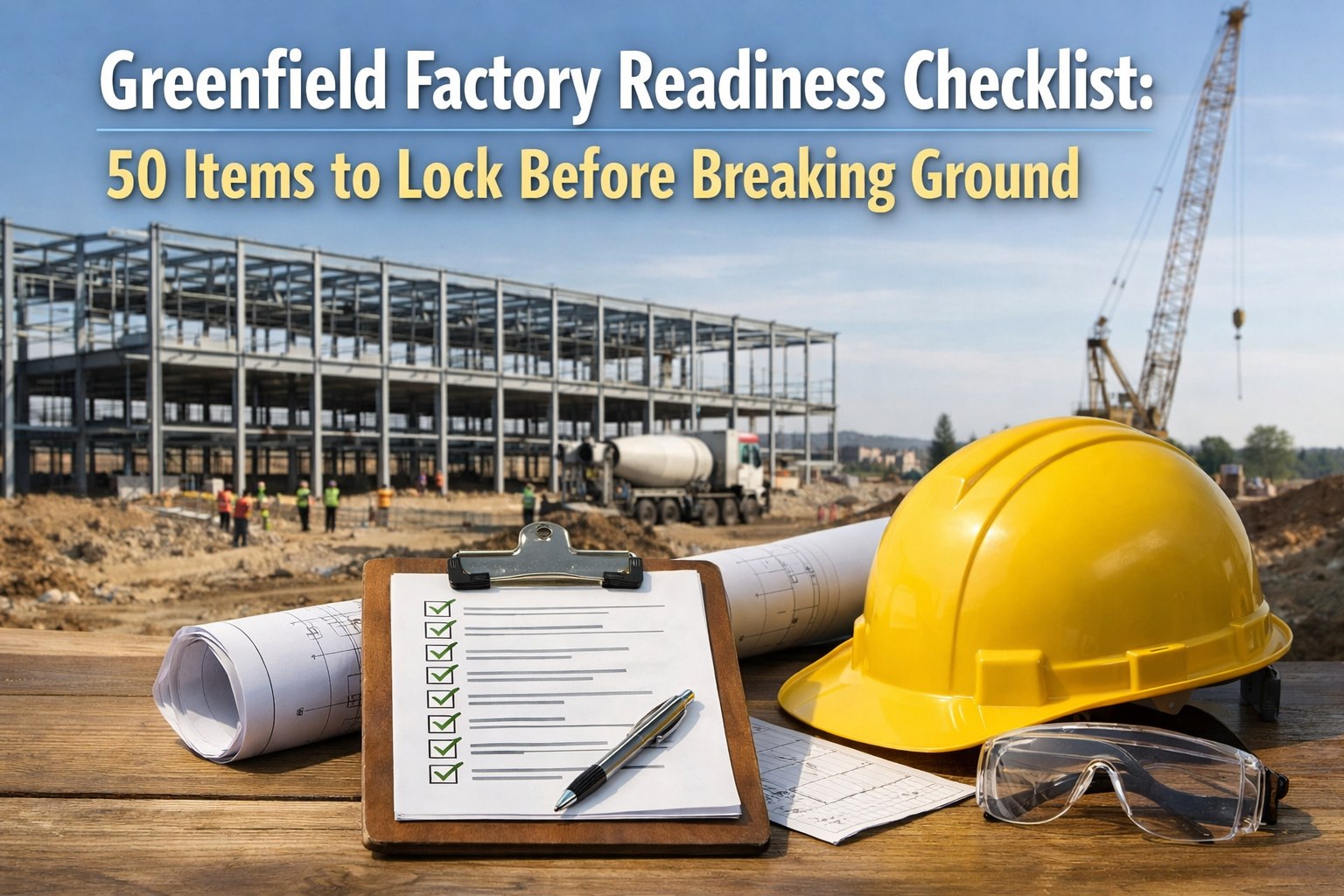
McKinsey reports 70% of greenfield projects exceed their deadlines and budgets. Deloitte's 12-step greenfield framework confirms that the planning phase is where it's least expensive to change course — and the most expensive to skip. This 50-point readiness checklist covers everything that must be locked, validated, and signed off before breaking ground. Miss even a handful, and you're building risk into the foundation of a facility designed to last decades.
8
Critical categories spanning strategy to workforce readiness
70%
Of greenfield projects exceed deadlines and budgets
3–5 yrs
Typical greenfield timeline — planning is the cheapest phase to change course
How to use this checklist: Work through each of the 8 categories with your cross-functional project team. Every item must be reviewed, assigned an owner, and marked as locked before ground is broken. Items not fully locked should be flagged with a risk mitigation plan and escalation timeline. Share this with your engineering, IT/OT, procurement, operations, and compliance leads.
Category 1: Strategy & Scope Definition 7 items
Every greenfield failure traces back to ambiguous scope. Lock your manufacturing strategy, capacity targets, and success criteria before a single design drawing is produced.
01
Manufacturing strategy document finalized — Product lines, volumes, quality targets, and competitive positioning defined and approved by executive leadership.
02
Capacity model validated for current + future demand — Right-size production capacity using AI-driven demand modeling. Include Phase 2 expansion assumptions with documented trigger criteria.
03
Business case and ROI model signed off — Total cost of ownership, payback period, and IRR approved by finance. Include infrastructure buildout costs that are unique to greenfield sites.
04
Ramp-up timeline and milestones defined — Month-by-month production targets from first article to full output. KPI dashboards configured to track ramp-up velocity.
05
Risk register created with mitigation plans — Supply chain, labor, regulatory, environmental, and technology risks identified with owners assigned and escalation paths documented.
06
Project governance structure established — Steering committee, project manager, and workstream leads appointed. Decision rights, meeting cadence, and reporting lines documented.
07
Digital twin strategy and scope defined — Determine scope of virtual simulation before physical construction. Layout testing, workflow validation, and utility routing to be completed digitally.
Category 2: Facility Design & Infrastructure 8 items
Facility design decisions made today are locked into concrete and steel for 30+ years. Design changes during construction cost 10x more than changes during planning.
08
Factory layout validated through digital twin simulation — Equipment placement, material flow, utility routing, and personnel movement tested across thousands of scenarios.
09
Power capacity confirmed with utility provider — Written MW allocation with 30% growth headroom. Dual-feed or redundant supply verified. UPS and generator sizing completed.
10
Water supply, wastewater, and cooling systems designed — Process water, cooling tower, fire suppression, and wastewater treatment capacity validated against production requirements.
11
HVAC and environmental control specifications locked — Clean room classifications, temperature/humidity zones, and air handling requirements matched to production process needs.
12
Modular expansion zones documented in master plan — Future production bays, utility laterals, network drops, and structural provisions for Phase 2+ designed into the base build.
13
Edge computing room and server space allocated — 200–500 sq ft climate-controlled space near production floor. Dedicated cooling (15–30 kW/rack), fire suppression, and redundant power included.
14
Loading docks, logistics staging, and material flow mapped — Dock count, truck turning radius, staging areas, and internal material transport paths validated against throughput targets.
15
Sustainability features integrated into design — Solar readiness, LED lighting, energy recovery systems, rainwater harvesting, and LEED/WELL certification targets locked.
Category 3: Automation & Equipment 7 items
Equipment procurement has some of the longest lead times in the project. Specifications must be locked early to avoid cascading delays across construction and commissioning schedules.
16
Equipment list finalized with technical specifications — Every production machine, robot, AGV, and support system specified. Power, compressed air, water, and data requirements documented per asset.
17
Automation level and robotic cell designs approved — Manual vs. automated vs. hybrid decisions locked per production stage. Cobot and robotic cell layouts validated in digital twin.
18
Equipment move-in sequence and rigging plan created — Heavy equipment move-in paths, dock scheduling, rigging requirements, and foundation readiness dependencies mapped.
19
PLC, SCADA, and MES architecture specified — Control system hierarchy, communication protocols (OPC-UA, MQTT), and data collection points defined for every production line.
20
Quality inspection systems and sensors selected — Machine vision, coordinate measuring machines, inline inspection points, and statistical process control (SPC) requirements finalized.
21
Equipment lead times mapped to construction schedule — Long-lead items ordered. Delivery dates cross-referenced with building readiness and utility lateral completion milestones.
22
FAT (Factory Acceptance Testing) schedule confirmed — On-site or vendor-site testing windows booked. Test protocols, acceptance criteria, and punch list resolution timelines agreed.
Don't Break Ground Without Locking These Items
iFactory's AI-powered CMMS integrates into your greenfield timeline from the planning phase — configuring asset hierarchies, sensor architecture, and maintenance workflows before construction begins.
Category 4: OT/IT & Digital Infrastructure 7 items
75% of OT cyberattacks start as IT breaches. Network architecture, cybersecurity, and data infrastructure must be designed — not bolted on — from the start.
23
IT/OT network architecture designed with segmentation — Physically or logically separate networks for production control, IIoT sensors, corporate IT, and guest access. Zero-trust principles applied.
24
Fiber-optic backbone and redundant WAN links specified — Minimum 10 Gbps dedicated fiber from two independent carriers. Automatic failover paths documented and tested.
25
Private 5G / Wi-Fi 6E wireless coverage plan completed — Indoor coverage mapped across production floor, warehouse, outdoor staging. Dead zone analysis completed. Spectrum availability confirmed.
26
OT cybersecurity framework selected and implemented — IEC 62443, NIST CSF, or equivalent framework applied. Anomaly detection, incident response plans, and monitoring tools specified.
27
Hybrid cloud + edge computing strategy documented — Real-time inference at the edge, model training and analytics in the cloud. Data flow architecture, latency requirements, and bandwidth allocation defined.
28
IIoT sensor architecture mapped to every critical asset — Vibration, temperature, pressure, energy, and flow sensors assigned. Conduit routes and cable trays pre-designed into building plans.
29
Data sovereignty and compliance requirements locked — Which data stays on-premises vs. cloud. Industry regulations (ITAR, GDPR, CMMC, HIPAA) factored into data architecture decisions.
Category 5: Maintenance & CMMS Readiness 6 items
Ignoring maintenance strategy until after launch is one of the costliest greenfield mistakes. Reactive firefighting from day one adds 20–30% to maintenance costs and delays the ramp-up timeline by months.
30
CMMS selected, configured, and deployed during construction — Asset hierarchies, equipment records, and sensor integrations configured before production starts. Not after.
31
Preventive maintenance schedules pre-loaded for all assets — OEM-recommended PM intervals, task lists, and checklists configured in CMMS. Compliance-critical maintenance flagged with automated alerts.
32
Spare parts strategy defined and inventory staged — Critical spares identified per equipment, reorder points set, storage locations assigned. First 90 days of consumables pre-stocked.
33
Predictive maintenance data pipeline configured — Sensor data flowing into CMMS from commissioning. AI models begin learning equipment baselines during pre-production testing.
34
KPI dashboard configured for OEE, MTBF, MTTR, FPY — Executive dashboards auto-calculating key metrics from connected equipment. Targets and thresholds set for real-time alerting.
35
Work order workflows and escalation paths tested — Mobile-first work order creation, assignment, and completion workflows tested end-to-end. Escalation rules validated for critical equipment failures.
The iFactory difference: iFactory deploys alongside your construction timeline — not after launch. Asset registers, maintenance workflows, sensor integrations, and predictive models are configured and tested before the first machine powers on. This eliminates the reactive maintenance gap that plagues most new factories and gives your AI models a head start on learning equipment behavior.
Category 6: Vendor & Supply Chain 5 items
Deloitte's greenfield research emphasizes that sourcing strategy must address long lead-time materials early and pursue multiple sources to de-risk supply delivery. Vendor decisions made during planning have 30-year consequences.
36
Critical vendor contracts signed with SLAs — Equipment OEMs, automation integrators, and software vendors under contract. Delivery timelines, warranty terms, and performance guarantees documented.
37
Integration architecture verified before vendor selection — Open API requirements (OPC-UA, MQTT, REST) confirmed across all systems. No proprietary lock-in that blocks future data interoperability.
38
Dual-source strategy for critical components confirmed — Single-source dependencies identified and mitigated. Backup suppliers qualified for long-lead and high-risk items.
39
Local service vendor network established — Electricians, HVAC technicians, calibration services, and rigging companies identified within response radius. Emergency service agreements signed.
40
Raw material supply chain mapped and tested — Primary and secondary suppliers for production materials identified. Logistics routes, lead times, and buffer stock levels validated.
Category 7: Regulatory & Compliance 5 items
Environmental permits, building codes, and industrial licenses vary dramatically by jurisdiction. Regulatory surprises during construction are among the most expensive and time-consuming problems to resolve.
41
All building, environmental, and industrial permits secured — Zoning confirmation, environmental impact assessment, air quality permits, and construction permits finalized before ground-breaking.
42
Industry-specific compliance requirements mapped — FDA, OSHA, EPA, ISO, cGMP, ITAR, or sector-specific standards identified. Facility design reviewed against compliance requirements.
43
Safety systems and emergency response plans designed — Fire suppression, emergency exits, spill containment, hazmat storage, and evacuation routes integrated into facility design.
44
Government incentives and tax credits secured — Federal, state, and local subsidies, enterprise zone benefits, CHIPS Act provisions, and workforce training grants applied for and confirmed.
45
Insurance coverage reviewed and bound — Builder's risk, general liability, equipment, business interruption, and environmental liability policies in place before construction begins.
Category 8: Workforce & Organizational Readiness 5 items
2.1 million manufacturing jobs are forecast to go unfilled by 2030. A smart factory is only as smart as the people operating it — and workforce readiness is the most commonly underestimated dimension of greenfield planning.
46
Organizational structure and key roles defined — Plant manager, maintenance lead, production supervisors, quality engineers, and IT/OT staff positions created with clear reporting lines.
47
Hiring plan aligned to commissioning timeline — Recruitment pipeline starts 6–9 months before production. Critical roles filled in time for virtual commissioning participation and vendor training.
48
Training program developed for all technology systems — CMMS, MES, SCADA, quality systems, and connected-worker platforms. Operators trained during virtual commissioning, not on-the-job after launch.
49
Standard operating procedures (SOPs) drafted and reviewed — Production, quality, maintenance, safety, and emergency SOPs written. Accessible via mobile-first digital platforms from day one.
50
Connected-worker platform rollout planned — Guided workflows, visual dashboards, and AI-driven alerts configured. Intuitive interfaces selected to minimize learning curves for operators of all skill levels.
Readiness Scorecard
50
Total items — every one must be locked before breaking ground
Frequently Asked Questions
Lock Every Item Before Breaking Ground
iFactory's AI-powered CMMS covers items 28–35 of this checklist — sensor architecture, asset hierarchies, predictive maintenance, and KPI dashboards — configured during construction, not after launch.
Ready to lock your greenfield readiness checklist? Book your free iFactory demo and see how AI-powered CMMS eliminates planning gaps before they become million-dollar construction changes.