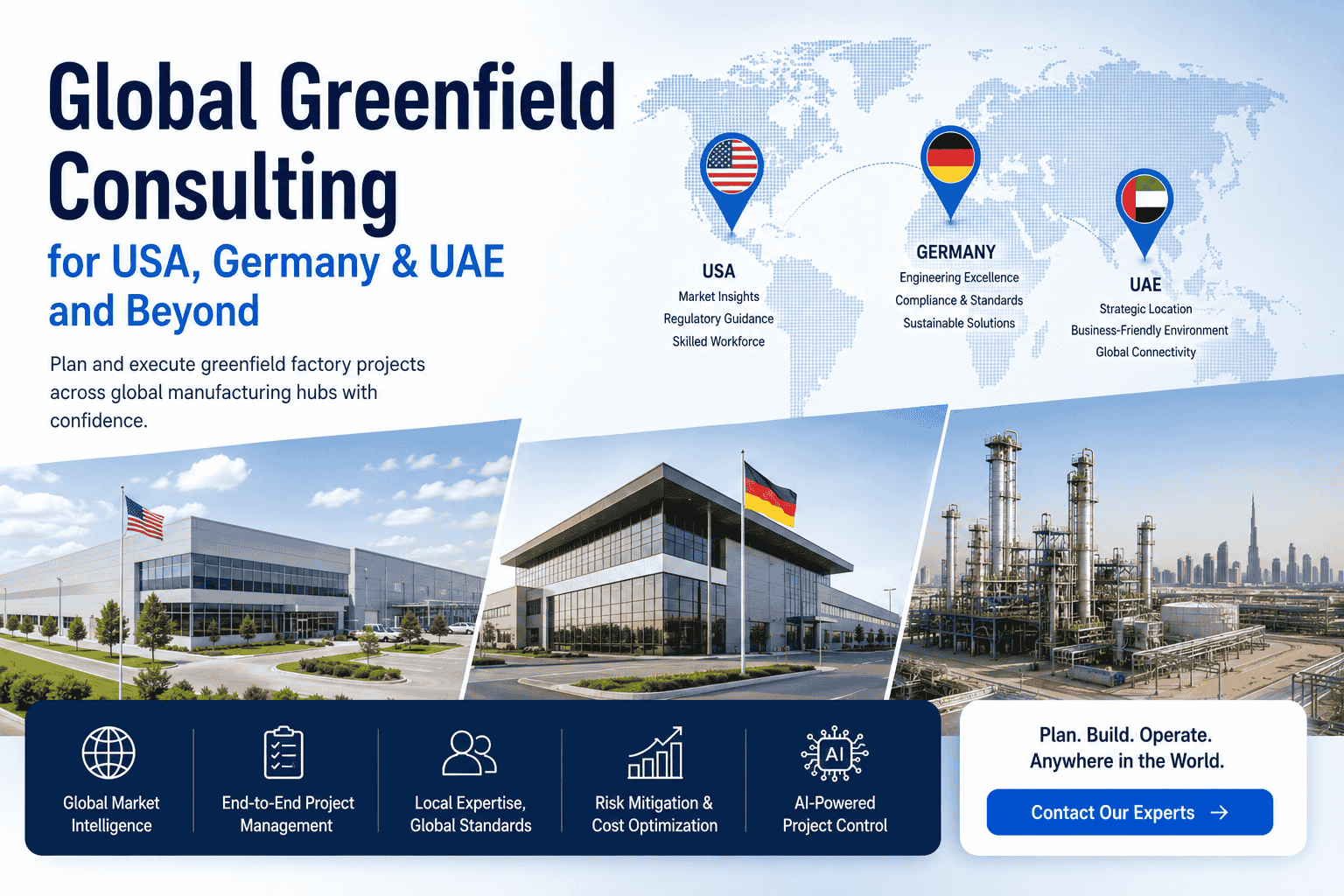
Greenfield manufacturing is increasingly cross-border. Manufacturers are placing factories where the incentives, labor pools, and regulatory pathways favor their sector — semiconductors in the USA under CHIPS Act, industrial AI and power grids in Germany’s European corridor, automotive and sovereign-capital-backed ecosystems in the UAE. The right country choice can swing project economics by 30–50%, while the wrong regulatory pathway can add 6–12 months to schedule. iFactory’s global greenfield consulting practice combines country-specific regulatory expertise, labor market intelligence, and AI-powered project management to plan and execute factories across the USA, Germany, UAE, and global manufacturing hubs. Book a global greenfield strategy session to evaluate your country shortlist against current incentive and timeline reality.
International Factory Planning & Execution
Greenfield Projects Across USA, Germany & UAE
Country-specific regulatory navigation, labor market intelligence, incentive negotiation support, and AI-powered project management. From site selection through ramp-up — in any of the three markets or coordinated across all of them.
$560B+US manufacturing megaproject investment committed
AED 40BUAE Ministry of Industry financing available
$270BAsia-Middle East corridor projected flows
Three Markets, Three Realities
USA
United States
CHIPS Act + IRA incentives
Texas semiconductor hub
12–24 mo standard timeline
DEU
Germany
European industrial corridor
Semiconductors & power grids
Sector collective agreements
UAE
United Arab Emirates
Made in Emirates incentives
Sovereign capital available
Dubai #1 greenfield city
Why Country Choice Drives 30–50% of Project Economics
Country selection isn’t a logistics decision — it’s a financial decision that compounds across the 3–5 year build and the 20-year operating life. Capital incentives shift by 10–30% of project value depending on jurisdiction. Labor costs and availability shift by 50–200% across regions. Regulatory timelines shift by 6–18 months. Tariff exposure shifts by 0–25% on imported components. The countries that look comparable on a spreadsheet diverge sharply once incentives, labor market reality, and regulatory pathways are mapped to your specific sector and product.
10–30%
Project value swing from capital incentives by jurisdiction
50–200%
Labor cost variance across regional manufacturing markets
6–18 mo
Regulatory timeline variance by country & sector
0–25%
Tariff exposure delta on imported components
2–4×
Energy cost variance across global manufacturing markets
$1.3B
Average overrun on megaprojects without country expertise
USA — Greenfield in the CHIPS & IRA Era
The United States has committed over $560 billion in manufacturing megaproject investment, anchored by the CHIPS and Science Act, the Inflation Reduction Act, and state-level incentives that can exceed $1.5 billion for individual projects (Rivian Georgia, Tesla Nevada, Samsung). Texas has emerged as the leading semiconductor and EV construction hub. The FDA’s PreCheck program (launched 2025) streamlines pharma approvals. But execution complexity is rising: skilled construction labor is constrained, project leadership talent is scarce, and federal incentives carry compliance requirements that compound the documentation burden.
Capital Incentives
CHIPS Act, IRA & State-Level Programs
CHIPS Act: billions in semiconductor build funding (Samsung received $4.7B)
IRA: $35/kWh production credits for battery cells
Rivian Georgia: $1.5B incentive package with job-creation thresholds
Tesla Nevada: $330M tied to semi-trucks & batteries facility
State-level workforce training grants stackable with federal incentives
Regulatory Pathway
EPA, OSHA, FDA & State Permitting
EPA permitting: 6–18 months depending on air, water, hazmat scope
FDA PreCheck (2025): streamlined pharma plant approvals
OSHA process safety management for chemical/petrochemical sites
State environmental review (CEQA in CA, similar elsewhere)
Local building & zoning approvals vary by jurisdiction
Labor Market
Construction & Operations Talent
Skilled construction labor: severe shortage in 2026 megaproject regions
Semiconductor project managers: aggressive cross-recruiting among firms
Texas leading hub: lower costs, business-friendly environment, scale
Sign-on bonuses, retention packages, relocation now standard
Right-to-work states preferred for compressed delivery timelines
Sector Focus
Where US Greenfield Is Concentrating
Semiconductors: Micron (Clay NY), Samsung, Intel expansion projects
EV & battery: Rivian Georgia, gigafactory wave nationwide
Pharmaceuticals: domestic API capacity, FDA PreCheck enabled
Advanced manufacturing: defense electronics, aerospace components
Data centers: AI infrastructure driving power-led site selection
Planning a US greenfield in semiconductors, EV, or pharma? Book a strategy session — we map CHIPS/IRA eligibility, state incentive stacking, and Texas vs. coastal state economics for your specific scope.
Germany — The European Industrial Corridor Anchor
Germany anchors a new European industrial corridor with France and the Nordics, attracting greentech, semiconductor, and industrial AI investment at scale. The country’s strategic refocus on semiconductors, power grids, and industrial AI creates opportunity for foreign manufacturers entering the European market through German production. The challenge isn’t capital or technology — it’s talent: Germany’s workforce transition from traditional manufacturing roles to high-tech specialists (systemic integrators who bridge physical machines and digital simulation) is the binding constraint on most 2026 projects.
Strategic Position
European Industrial Corridor Anchor
Anchors corridor with France (regulatory navigation) and Nordics (deep tech)
Refocus on semiconductors, power grids, industrial AI in 2026
Largest EU economy with mature supplier ecosystem
Direct access to EU single market without import tariffs
Strong existing greentech and advanced manufacturing base
Regulatory Pathway
German & EU Compliance Framework
Federal Immission Control Act (BImSchG) for industrial permits
EU Carbon Border Adjustment Mechanism (CBAM) compliance
Länder-level (state) variation in approval timelines
Environmental Impact Assessment (UVP) for major projects
EU machinery directive compliance for installed equipment
Labor Reality
Workforce Transition Challenge
Workforce shifting from traditional mfg to high-tech roles
Systemic integrators (machines + simulation) in highest demand
Sector-level collective agreements (IG Metall) must be navigated
Works councils (Betriebsrat) require structured engagement
Skilled trades pipeline strong but competing with EV transition
Sector Focus
Where German Greenfield Is Concentrating
Semiconductors: Intel Magdeburg, ESMC (TSMC) Dresden announcements
Battery & EV: gigafactory cluster across northern & eastern regions
Industrial AI: integration into existing automotive supplier base
Power grid components: anchoring European energy transition
Pharma & biotech: established mid-tier production capacity
Map Your Country Shortlist Against 2026 Reality
A strategy session evaluates 2–3 country candidates against your specific sector, capital plan, and timeline constraints. You leave with a documented country comparison covering incentives, regulatory timelines, labor availability, and key 2026 risk factors.
UAE — Sovereign Capital & the Made in Emirates Era
The United Arab Emirates has positioned itself as a global manufacturing destination with sovereign capital availability, energy cost advantages, and the Made in Emirates campaign. Dubai ranks #1 globally for greenfield city attractiveness. The Ministry of Industry and Advanced Technology signed agreements providing AED 40 billion (USD 10.9B) in competitive financing over five years. Abu Dhabi Investment Office targets AED 8 billion (USD 2.2B) in FDI for the automotive value chain. The Asia-Middle East corridor is projected at $270 billion in flows. The UAE plays differently than USA or Germany — it requires localization strategy and regional HQ positioning, not just factory siting.
Capital Access
Sovereign Capital & Industry Financing
AED 40B (USD 10.9B) Ministry of Industry competitive financing
Abu Dhabi Investment Office automotive ecosystem FDI program
Mubadala, ADQ, ADIA sovereign wealth fund partnerships available
Made in Emirates campaign procurement opportunities
Free zone vs mainland entity structure decisions affect capital flow
Strategic Position
Global Manufacturing Hub
Dubai #1 globally for greenfield city attractiveness
Asia-Middle East corridor with $270B projected flows
Energy cost advantages vs Western markets
Free zones (JAFZA, KIZAD, RAKEZ) with 0% corporate tax structures
AI partnerships multiplying (Microsoft-G42 anchor)
Regulatory Pathway
UAE Compliance Framework
Federal industrial licensing through Ministry of Industry
Emirate-level approvals (Dubai DET, Abu Dhabi DED, etc.)
Free zone authority structure differs from mainland
Localization (Emiratization) requirements scaling annually
Environmental approvals through emirate-level agencies
Sector Focus
Where UAE Greenfield Is Concentrating
Automotive ecosystem: Abu Dhabi $2.2B FDI target
AI infrastructure: G42 partnerships, data center buildout
Pharmaceuticals: regional manufacturing for GCC distribution
Petrochemicals: integration with existing energy infrastructure
Aerospace & defense: Strata, EDGE Group expanding
How iFactory’s Global Practice Works
iFactory’s global greenfield practice combines four capabilities that conventional management consultancies and EPC firms handle separately. The integrated approach means country selection feeds directly into regulatory pathway planning, which feeds labor market analysis, which feeds AI-powered project management — all under a single accountable team rather than three or four firms exchanging documents.
01
Country Strategy & Site Selection
Multi-country evaluation against your specific sector, capital plan, and timeline. Incentive stacking analysis (federal + state + local). Labor market depth modeling. Energy and infrastructure capacity verification. Sovereign capital pathway mapping (UAE) and federal program eligibility (USA/Germany).
02
Regulatory Pathway Navigation
Country-specific regulatory expertise: EPA/OSHA/FDA in USA, BImSchG/CBAM/UVP in Germany, Ministry of Industry/free zone authority in UAE. Permit pathway prediction, environmental approval timelines, and stakeholder engagement strategy. Compliance gating integrated into project schedule.
03
Labor Market Intelligence
Construction labor availability in target regions (severe US shortage, transitioning German workforce, expat-heavy UAE pool). Operations labor planning. Compensation benchmarking. Sector collective agreement navigation (Germany IG Metall, US union vs right-to-work). Emiratization compliance planning (UAE).
04
AI-Powered Project Management
iFactory’s risk intelligence platform layers above your EPC partner and PM software. AI monitoring across procurement, design, regulatory, and execution risks. Probability-weighted alerts when variance crosses threshold. Country-aware models tuned to USA, German, and UAE regulatory and supply chain patterns.
Country Comparison at a Glance
The three markets favor different sectors, different capital structures, and different operational models. Use this comparison as a starting point — full strategy sessions tune the analysis to your specific sector, capital availability, and timeline constraints.
← Swipe to see all columns →
Need a country comparison tuned to your specific sector and capital plan? Book a strategy session — the comparison gets customized to your real project economics, not generic averages.
Deployment Timelines by Sector
Build timelines vary by sector more than by country. Food processing facilities go up in months; semiconductor fabs take years. Plan your country shortlist with realistic sector timelines, not generic averages — the difference between an 18-month battery plant and a 5-year pharmaceutical facility changes which incentive programs apply and which regulatory pathways gate the schedule.
Food Processing
3–7 months
Metal-building construction, equipment install, validation. Fastest greenfield category.
Standard Manufacturing
12–24 months
Discrete and process manufacturing. Most common build profile across sectors.
Automotive Assembly
2–4 years
Paint shop, body shop, assembly, supplier park. Complex robotic commissioning.
Pharmaceutical/Biotech
3–5 years
Includes GMP qualification, FDA/EMA approval cycles, cleanroom commissioning.
Semiconductor Fab
3–5 years
Cleanroom buildout, 24–36 mo equipment lead times, utility capacity buildout.
Battery Gigafactory
2–3 years
Process scale-up, supplier ecosystem, IRA $35/kWh production credits gating.
Industries iFactory Serves Globally
iFactory’s global greenfield practice covers six manufacturing sectors with sector-specific regulatory and operational expertise. The country-by-country specifics adapt to where your project lands — FDA PreCheck in USA, EMA in Europe, MOH UAE in the Emirates — but the sector framework stays consistent so your team isn’t reorienting for each country shortlist evaluation.
Food & Beverage
FSMA 204 (USA), EFSA (EU), MOH (UAE) compliance. CIP cycle validation, allergen controls, hygienic equipment specification. Fastest country-to-country deployment patterns.
Pharmaceuticals
FDA PreCheck (USA), EMA (EU), MOH UAE regulatory pathways. GMP qualification, cleanroom commissioning, validated workflow gating. 3–5 year build profiles.
Automotive & EV
Gigafactory wave (USA), European corridor (Germany), Abu Dhabi automotive ecosystem (UAE). IRA $35/kWh credits, supplier qualification, paint shop environmental approvals.
Semiconductors
CHIPS Act (USA), Intel/TSMC corridor (Germany), G42 partnerships (UAE). Cleanroom buildout, 24–36 mo equipment lead times, utility capacity verification.
Chemicals & Petrochem
EPA Title V (USA), BImSchG (Germany), MOIAT (UAE). Process hazard analysis, hazmat storage compliance, environmental remediation, sovereign energy integration (UAE).
Industrial AI & Data Centers
Power-led site selection, fiber connectivity, edge computing infrastructure. Microsoft-G42 partnership template in UAE, hyperscaler patterns in USA, European corridor industrial AI.
Plan Your Greenfield Across USA, Germany & UAE
A 60-minute strategy session evaluates your country shortlist against current 2026 incentive reality, regulatory timelines, and labor market constraints. You leave with documented country recommendations tuned to your sector, capital plan, and target go-live date. No engagement commitment required to participate.
Frequently Asked Questions
We’re early in country selection — can iFactory help us shortlist before we commit?
Yes — country shortlisting is the most common entry point for iFactory’s global greenfield practice. The strategy session evaluates 2–3 candidate countries against your specific sector, capital plan, target product mix, and timeline. We map current 2026 incentive eligibility (CHIPS/IRA in USA, EU/Länder programs in Germany, AED 40B Ministry of Industry financing in UAE), regulatory timelines, labor market constraints, and energy/infrastructure capacity. Output is a documented country comparison your executive team can use to make the commit decision. Many engagements stop here — clients select a country and execute internally — and that’s a fine outcome.
Do you work outside USA, Germany, and UAE?
Yes. The three named markets are our deepest-coverage regions, but the practice extends to global manufacturing hubs including India, Mexico, Vietnam, Malaysia, Saudi Arabia, France, Poland, and Brazil. Sector regulatory frameworks (FDA, EMA, FSSAI, ANVISA, etc.) and labor market patterns vary, but the underlying greenfield methodology stays consistent. If you’re evaluating a market not listed, the strategy session still applies — we’ll be transparent about coverage depth in your specific country candidates and whether local partners need to augment the engagement.
How does this differ from a Big Four management consulting engagement?
Three differences. First, integration: iFactory combines country strategy, regulatory pathway, labor intelligence, and AI-powered project management under one accountable team. Big Four engagements typically separate these into different practice areas with different leads. Second, technology: iFactory’s AI risk intelligence platform monitors project execution continuously, not just produces reports at milestones. Third, specialization: iFactory focuses exclusively on greenfield manufacturing, so the methodology, country relationships, and sector benchmarks are deeper than at generalist firms. The trade-off: Big Four firms may have broader brand recognition for board presentations. Some clients use both — iFactory for execution depth, Big Four for board-level validation.
Can you coordinate a project that spans multiple countries simultaneously?
Yes — multi-country greenfield coordination is increasingly common as manufacturers build regional production networks. A typical example: a battery manufacturer building one US gigafactory under IRA, one German facility for European market access, and one UAE plant for Asia-Middle East corridor distribution. iFactory coordinates the three projects with shared methodology, consistent AI risk monitoring, and country-specific regulatory leads. Schedule alignment, capital allocation phasing, and supplier coordination across the three projects gets managed centrally. This pattern is harder for firms with single-country focus and easier for global EPCs (Fluor, Bechtel, Jacobs) — iFactory complements those EPCs with the country strategy and AI risk monitoring layers they don’t typically provide.
What kind of capital are typical greenfield projects in these markets?
Range varies dramatically by sector and country. Food processing facilities typically run $20–100M. Standard manufacturing $50–300M. Automotive assembly $1–5B (Rivian Georgia is $5B). Pharmaceutical plants $200M–2B (including validation). Semiconductor fabs $5–20B (Samsung, TSMC scale). Battery gigafactories $2–5B (Tesla Nevada $3.6B). iFactory’s practice covers the full range — the methodology scales because the underlying greenfield framework stays consistent even as the capital and timeline grow. For mega-projects ($1B+), the working session typically expands to a 2–3 day workshop with executive sponsors, EPC candidates, and country incentive negotiators in the room together.
Is the strategy session a sales pitch or actual analysis?
Actual analysis. The 60-minute strategy session walks through your specific country shortlist with iFactory’s methodology applied live — not a generic capability pitch. Sessions typically include your project sponsor, CFO or finance lead, and operations or supply chain leadership. iFactory’s global greenfield lead facilitates. You leave with documented country recommendations, identified critical decisions, and a clear path forward whether that involves engaging iFactory or executing internally. No engagement commitment required to participate; we recover session value through subsequent engagements when there’s good fit, not by gating insight behind sales calls.