Most plant managers don't lose sleep over software categories—they lose sleep over unplanned downtime costing $260,000 per hour on average. Yet 53% of manufacturers still run maintenance on spreadsheets. The real question isn't "MES or CMMS or EAM?"—it's "What combination keeps my plant running?" Book a free consultation to find the right stack for your plant.
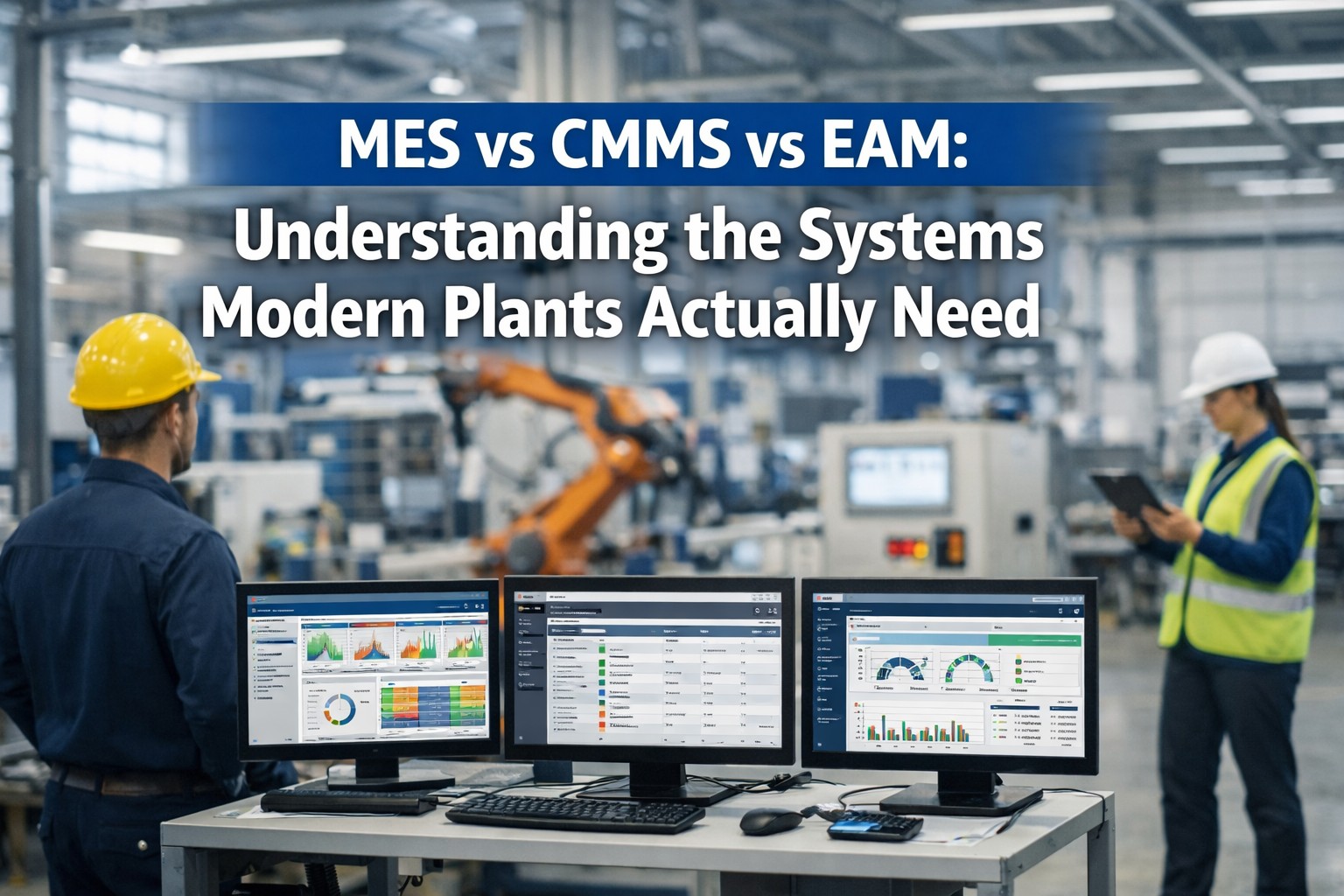
MES vs CMMS vs EAM: Understanding the Systems Modern Plants Actually Need
Production tracking. Maintenance management. Asset lifecycle strategy. Three systems, three goals—one connected factory. Here's how they differ, where they overlap, and what your plant actually needs.
Three Systems, Three Jobs—One Factory Floor
Before diving into comparisons, let's understand what each system actually does and why it exists.
Sits between your ERP and the shop floor. Tracks real-time production—what's being made, how fast, by whom, and at what quality level. It's the system that turns business plans into finished goods.
Manages day-to-day maintenance tasks—work orders, preventive schedules, spare parts inventory, and technician assignments. It keeps machines running and fixes them when they break.
Takes the broadest view—managing physical assets from procurement to retirement. Covers capital planning, depreciation tracking, risk analysis, and multi-site asset strategy across the enterprise.
MES vs CMMS vs EAM at a Glance
A clear comparison across the dimensions that matter most to plant operations teams.
| Dimension | MES | CMMS | EAM |
|---|---|---|---|
| Primary Focus | Production execution and quality | Maintenance task management | Full asset lifecycle strategy |
| Core Users | Production managers, operators | Maintenance techs, supervisors | Asset managers, finance, C-suite |
| Time Horizon | Real-time (seconds to shifts) | Short-term (days to weeks) | Long-term (years to decades) |
| Data Focus | OEE, cycle time, yield, scrap | Work orders, PM schedules, parts | TCO, depreciation, risk scores |
| Scope | Single production line or plant | Maintenance department | Enterprise-wide, multi-site |
| ROI Driver | Throughput and quality gains | Reduced downtime and labor costs | Extended asset life, capital savings |
| Implementation | 3–9 months | 2–8 weeks | 6–18 months |
| Complexity | High | Low to Medium | High |
MES vs CMMS: Production Control vs Maintenance Efficiency
The most common comparison—and the most misunderstood. These systems solve fundamentally different problems.
Answers the Question:
"Are we making the right product, at the right speed, at the right quality?"
MES tracks every unit from raw material to finished goods. It enforces process routing, captures real-time OEE, flags quality deviations mid-production, and ensures traceability for regulatory compliance.
When a pharma manufacturer needs to prove every batch was made exactly to specification—that's MES doing its job.
Answers the Question:
"Is our equipment ready to run when production needs it?"
CMMS schedules preventive maintenance, dispatches technicians, tracks spare parts inventory, and logs every repair. It reduces unplanned downtime by shifting from reactive "fix it when it breaks" to proactive maintenance strategies.
When a packaging plant cuts downtime by 44% through automated PM scheduling—that's CMMS delivering value.
CMMS vs EAM: Maintenance Tool vs Enterprise Asset Strategy
CMMS is Your Maintenance Workhorse
CMMS focuses on what happens during an asset's operational life—scheduling PMs, tracking work orders, managing spare parts, and keeping technicians productive. It starts tracking after an asset is installed and stops when it's decommissioned.
Best for single-site operations, maintenance teams transitioning from paper or spreadsheets, and organizations that need quick deployment with minimal IT complexity.
EAM is Your Asset Strategist
EAM manages assets from procurement through retirement—including capital planning, depreciation, risk scoring, vendor management, and disposal. It often encompasses CMMS functionality but adds enterprise-wide visibility across multiple sites and departments.
Best for multi-site enterprises with complex asset portfolios, organizations needing capital planning and financial integration, and industries with strict regulatory lifecycle requirements.
Where MES, CMMS, and EAM Converge
These systems aren't isolated silos anymore. Modern platforms increasingly share capabilities.
Equipment Downtime Tracking
All three systems track equipment availability. MES records it as lost production time (OEE), CMMS logs it as maintenance events, and EAM uses it for reliability scoring and replacement decisions.
Compliance and Documentation
Regulatory industries need audit trails across production (MES), maintenance (CMMS), and asset history (EAM). Integration creates a single compliance thread from shop floor to boardroom.
IoT and Sensor Data
Connected sensors feed data to all three systems—MES uses it for quality; CMMS triggers maintenance alerts; EAM builds long-term performance baselines for capital decisions.
Reporting and Analytics
Production efficiency, maintenance KPIs, and asset TCO all require overlapping datasets. Unified analytics across systems eliminates data silos and conflicting metrics.
Not Sure Which System Fits Your Plant?
Most manufacturers don't need all three as separate tools. See how a unified platform bridges production, maintenance, and asset management.
Get a Personalized Assessment →Do Modern Plants Need All Three Systems?
The honest answer depends on your size, complexity, and where you are in your digital journey.
Start with a CMMS that includes basic production monitoring. A standalone MES is typically overkill. EAM features aren't needed until your asset portfolio grows significantly.
You need both production visibility and maintenance control. Look for unified platforms that combine CMMS + OEE tracking, with EAM capabilities you can activate as you scale.
Enterprise operations need all three capabilities—but not necessarily three separate tools. The trend is toward consolidated platforms where MES, CMMS, and EAM share a common data layer.
Connecting Production and Maintenance Data
The real power isn't in any single system—it's in how they talk to each other.
ERP Sends the Order
"Make 10,000 units of Product X by Friday"
MES Executes Production
Tracks real-time output, quality, and OEE. Detects a machine slowing down.
CMMS Triggers Maintenance
Auto-generates a work order. Dispatches technician. Parts are pre-staged.
EAM Updates Asset Intelligence
Logs the event into asset history. Updates reliability score. Informs replacement planning.
Data Flows Back to ERP
"Delivered 10,000 units. Used $450 in maintenance. Asset health: 87%"
This closed-loop integration eliminates the data silos that cost manufacturers an estimated 20–30% in operational efficiency. When production data triggers maintenance and maintenance history informs asset decisions, your entire operation becomes predictive instead of reactive.
How to Choose the Right System for Your Plant
Answer these five questions to identify where to start.
What's your biggest pain point right now?
If it's unplanned downtime and reactive maintenance, start with CMMS. If it's production visibility and quality control, you need MES capabilities. If it's capital spending decisions and asset replacement timing, EAM is your priority.
How many sites do you operate?
Single-site operations can usually start with CMMS. Multi-site operations with shared asset pools benefit from EAM's enterprise-wide visibility and capital planning features.
What's your regulatory burden?
Heavily regulated industries (pharma, food, aerospace) typically need MES for batch genealogy and production compliance. CMMS handles maintenance compliance. EAM covers lifecycle documentation.
What are you using today?
Moving from spreadsheets? Start with cloud CMMS—fastest ROI. Already have CMMS? Add MES for production intelligence. Have both? Consider EAM to unify lifecycle strategy.
Can you integrate or do you need one platform?
Best-of-breed means buying separate tools and integrating via APIs. Modern unified platforms combine CMMS + MES + EAM capabilities—reducing IT complexity and eliminating data silos.
Why This Decision Matters Now
Frequently Asked Questions
Can a CMMS replace an MES?
No. A CMMS manages maintenance workflows—work orders, PM schedules, and spare parts. An MES manages production execution—scheduling, quality, traceability, and OEE. Some modern platforms combine both capabilities, but they solve fundamentally different problems. You can run a CMMS without an MES, but you'll lack production visibility.
Is EAM just a bigger version of CMMS?
Not exactly. EAM encompasses CMMS functionality but adds asset lifecycle management, capital planning, depreciation tracking, risk analysis, and multi-site coordination. Think of CMMS as the maintenance chapter and EAM as the entire asset management book. Many EAM systems include a CMMS module, but the reverse isn't true.
What's the typical implementation cost?
Cloud CMMS solutions can start at $50–150/user/month with deployment in weeks. MES implementations range from $100K–$500K+ depending on complexity. Enterprise EAM rollouts can exceed $1M and take 12–18 months. The trend is toward unified SaaS platforms that reduce all three cost profiles significantly.
Which industries need all three systems?
Automotive, aerospace, pharmaceuticals, and large-scale food manufacturing typically need capabilities from all three. However, they don't necessarily need three separate products—unified platforms that combine production monitoring, maintenance management, and asset lifecycle tracking are becoming the industry standard.
How does IoT change this decision?
IoT sensors generate data that all three systems consume. Real-time vibration data feeds MES (production quality), CMMS (predictive maintenance triggers), and EAM (asset degradation curves). IoT makes integration between these systems more valuable—and makes the case for unified platforms even stronger.
Find the Right Manufacturing Software Stack for Your Plant
Whether you need production control, maintenance management, or enterprise asset strategy—iFactory helps you build a connected factory without the complexity of managing three separate systems.