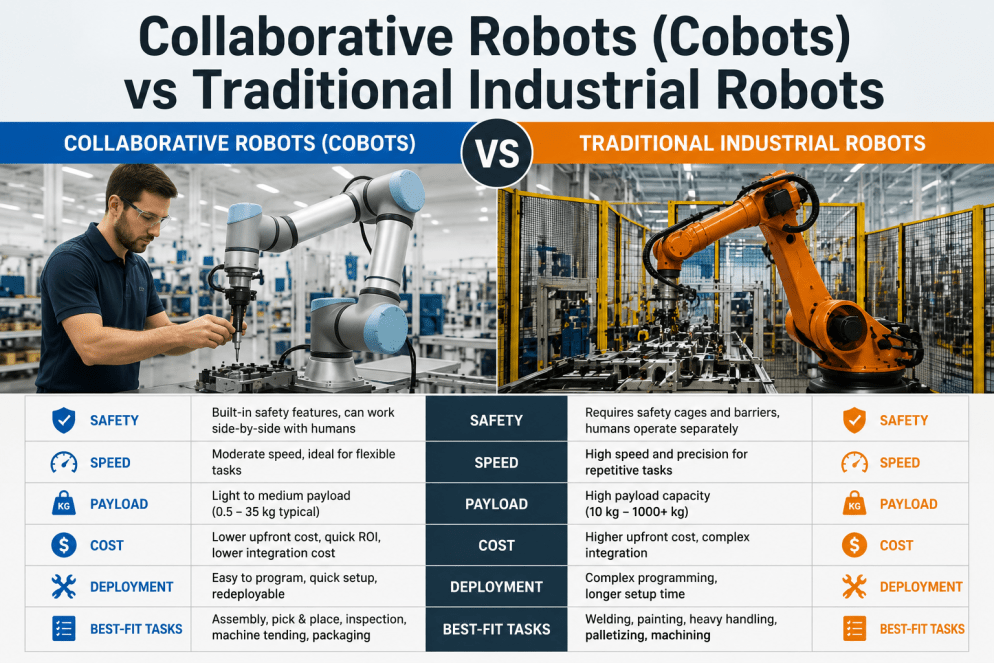
The factory floor is no longer one-size-fits-all. As U.S. manufacturers face rising labor costs, shrinking talent pipelines, and pressure to automate smarter—not just faster—the choice between collaborative robots (cobots) and traditional industrial robots has become a defining strategic decision. This guide breaks down the real differences, helps you build a business case and shows where iFactory AI's Robotics AI platform fits in.
Cobots vs Traditional Industrial Robots
Safety · Speed · Payload · Cost · Best-Fit Tasks — A Decision Matrix for Automation Leaders
What Sets Cobots Apart From Traditional Robots?
Traditional industrial robots — the kind you see in automotive stamping plants and high-volume electronics lines — are engineered for raw throughput. They operate inside caged cells, move at speeds unsafe for humans nearby, and require significant integration work. Cobots, by contrast, are designed with ISO/TS 15066-compliant force-torque sensing so they can slow or stop when a person enters their workspace.
Collaborative Robot (Cobot)
- Works alongside humans without caging
- Payload: typically 3 – 35 kg
- Avg deployment: 1–3 days
- Entry cost: $25,000 – $75,000
- Ideal for: SMEs, mixed-model lines
Traditional Industrial Robot
- Requires safety fencing / light curtains
- Payload: 5 kg – 2,300 kg+
- Avg deployment: weeks to months
- Entry cost: $80,000 – $400,000+
- Ideal for: high-volume, single-task lines
Head-to-Head Comparison: 8 Critical Dimensions
Use this comparison matrix to evaluate which automation technology aligns with your production environment, workforce, and capital budget.
| Dimension | Cobot | Traditional Robot | Winner For |
|---|---|---|---|
| Safety | Built-in force sensing, ISO/TS 15066 compliant | Hard guarding required, E-stop systems | Cobot |
| Speed | 250 – 1,000 mm/s (limited near humans) | Up to 3,000 mm/s uncaged | Traditional |
| Payload | 3 – 35 kg (some up to 65 kg) | 5 kg – 2,300 kg | Traditional |
| Upfront Cost | $25K – $75K (incl. integration) | $80K – $400K+ | Cobot |
| Floor Space | Compact, no cage needed | Large cell footprint with guarding | Cobot |
| Reprogramming | Hand-guiding + tablet UI; hours | Specialist programmer; days to weeks | Cobot |
| Repeatability | ±0.02 – ±0.1 mm | ±0.02 – ±0.05 mm | Traditional |
| ROI Timeline | 12 – 24 months | 24 – 48 months | Cobot |
Best-Fit Use Cases by Task Type
Neither technology is universally superior. The right choice depends on task variability, volume, and whether human collaboration adds value on the line.
Loading/unloading CNC machines, presses, and injection molders alongside operators
Mixed-model final assembly with frequent changeovers and operator hand-off points
Camera-guided surface checks in combination with AI vision systems
End-of-line tasks under 20 kg where line layout changes frequently
Automotive MIG/TIG welding at sustained duty cycles with zero human proximity
Parts over 50 kg requiring high-force, fast-cycle handling in sealed cells
Paint booths and hazardous coating environments where human exclusion is mandatory
Single-SKU lines running 24/7 at maximum throughput with minimal changeover
Not sure which automation path fits your facility? Book a Demo and let iFactory AI's Robotics experts map your floor.
Total Cost of Ownership: The Real Numbers
Sticker price rarely tells the full story. When you factor in installation, integration, safety infrastructure, and reprogramming costs over a 5-year horizon, the TCO gap between cobots and traditional robots often surprises procurement teams.
How iFactory AI Robotics AI Works With Both
iFactory AI's Robotics AI module is hardware-agnostic — it connects to cobots and traditional robots alike through standard OPC-UA, MQTT, and MODBUS protocols. Once integrated, the platform delivers real-time health monitoring, predictive maintenance alerts, production cycle analytics, and AI-guided quality inspection directly from the robot's sensor data.
Real-Time OEE Monitoring
Track availability, performance, and quality metrics per robot cell — cobot or caged — with automated shift reports.
Predictive Maintenance
AI models flag joint wear, torque anomalies, and cycle-time drift before they cause unplanned downtime.
AI Vision Quality Control
Camera feeds from cobot end-effectors feed iFactory's vision AI for defect detection without manual inspection steps.
Digital Twin Simulation
Model new cobot deployments or reconfigured robot cells virtually before any physical changeover — eliminating costly trial-and-error.
Expert Review
"The frame I use with every plant manager: if your cycle time is under 10 seconds and the task never changes, buy a traditional robot. If your SKU mix changes quarterly or your operators need to stay in the cell, go cobot. The mistake I see most often is buying a traditional robot for a high-mix line and then spending six figures in reprogramming every product launch. Cobots—paired with a platform like iFactory AI—let you retask in an afternoon and track the ROI in real time. That combination is what closes the business case."
Conclusion
Cobots and traditional industrial robots are not competitors — they are complements within a well-designed automation strategy. Cobots win on flexibility, floor space, deployment speed, and total cost in mixed-model environments. Traditional robots win on payload, speed, and repeatability in high-volume, single-task cells. For most U.S. mid-market manufacturers today, a hybrid fleet monitored through a unified platform like iFactory AI's Robotics AI delivers the best return across the entire operation — not just at the individual robot level.
Thinking about your first cobot deployment or upgrading a traditional robot cell? Book a Demo with iFactory AI to see the Robotics AI platform in action.
Frequently Asked Questions
Deploy Smarter Robotics — Backed by AI
From cobot integration to full-plant digital twin simulations, iFactory AI helps automation leaders maximize robot ROI across every cell on the floor.