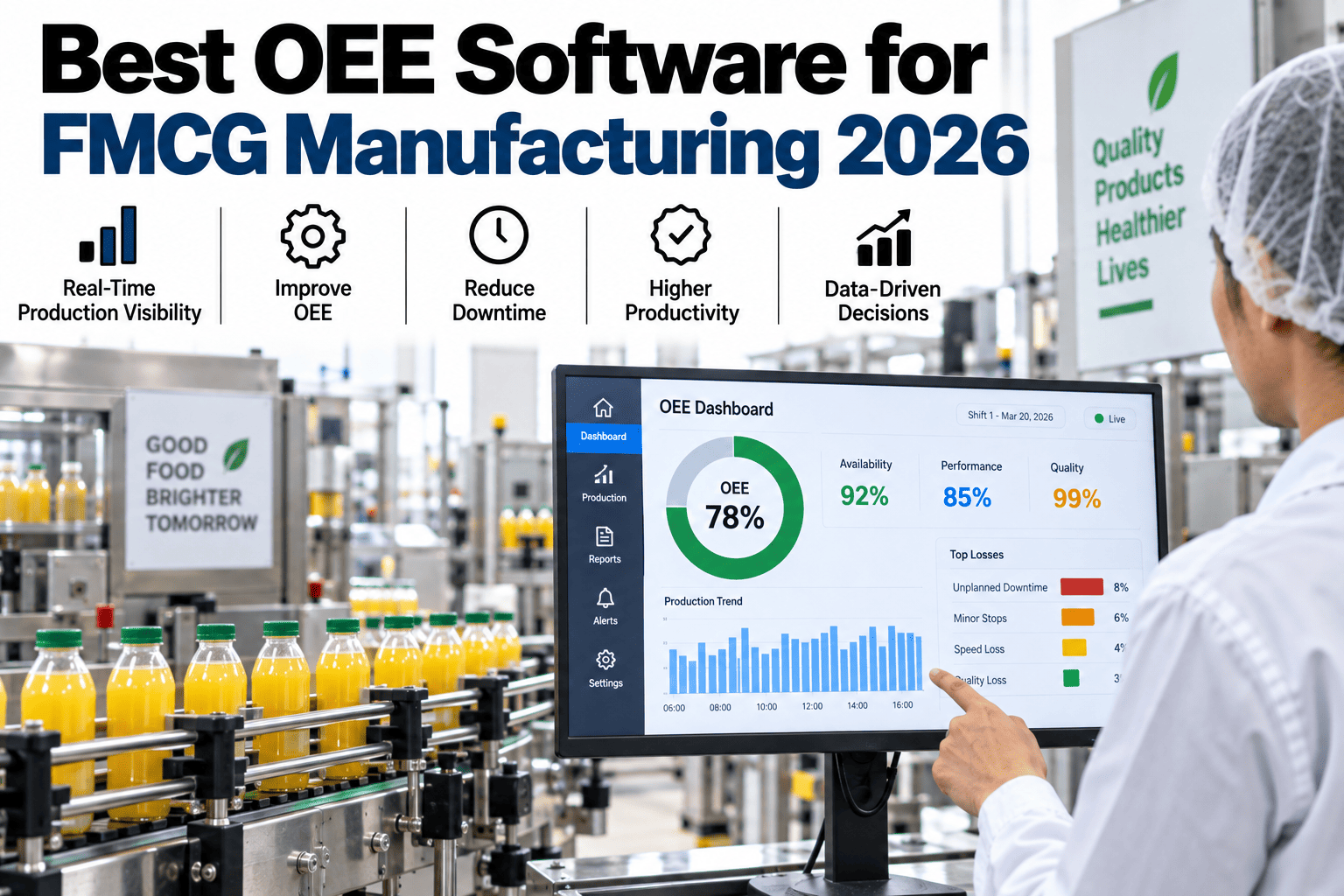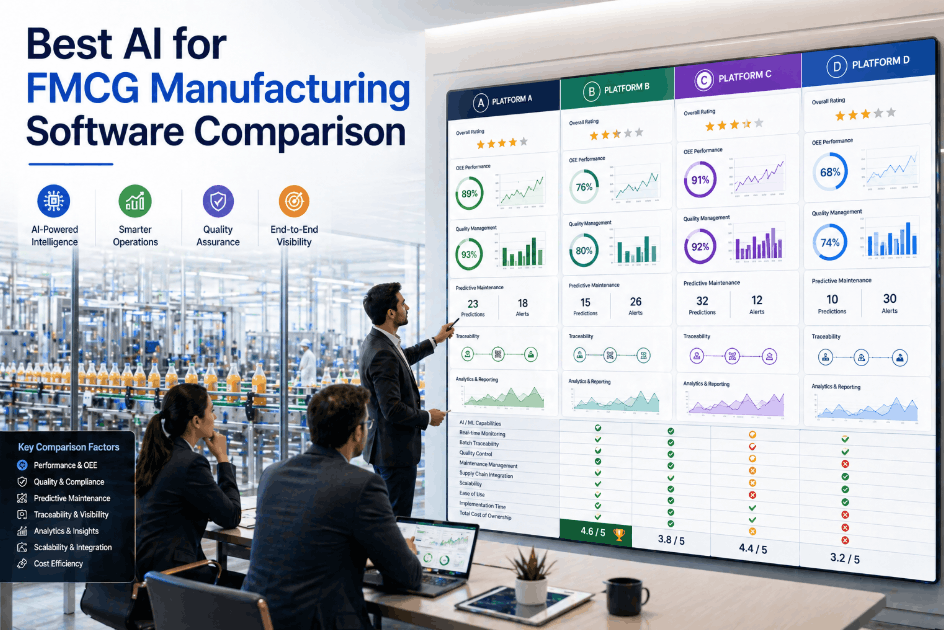
Choosing the right AI software for FMCG manufacturing is no longer an innovation budget question — it is a margin-defining operational decision. Fast-moving consumer goods plants run at speeds, complexity levels, and compliance burdens that generic enterprise software was never engineered to handle. From AI manufacturing software for predictive maintenance to industrial IoT platforms tracking line speed in real time, the FMCG manufacturing software landscape has expanded into a layered ecosystem where the differences between platforms now translate directly into OEE points, downtime hours, and recall risk exposure. This food manufacturing software comparison evaluates the categories, capabilities, and selection criteria that operations leaders need to make a confident platform decision in 2026.
See How iFactory Compares Against Every Major FMCG AI Platform
iFactory is the AI-powered manufacturing intelligence platform purpose-built for FMCG plants — combining MES, predictive maintenance, real-time analytics, and compliance reporting in one unified system.
Why FMCG Manufacturing Demands Purpose-Built AI Manufacturing Software
FMCG plants are not heavy industry. They run high-speed packaging lines at 500 units per minute, manage hundreds of SKUs across home care, food, beverage, and personal care, and operate under strict GMP, FSMA, GFSI, and SQF compliance pressure. Generic ERP and conventional manufacturing software architectures simply cannot capture the operational reality of fast-moving production: micro-stops that erode OEE without registering as breakdowns, allergen washdown protocols that block line restarts until verified, cold-chain integrity that compounds spoilage risk every minute it drifts. AI manufacturing software for FMCG must be engineered specifically for these conditions — and the platforms that succeed are the ones that fuse manufacturing execution, predictive maintenance, quality automation, and compliance documentation into a single intelligence layer. Operations leaders evaluating this transition can book a demo with iFactory's engineering team to map their existing software stack.
Six Core Categories of AI Manufacturing Software for FMCG Plants
Before comparing specific vendors, FMCG operations leaders need a clean mental model of the software categories at play. The market has consolidated around six distinct platform types, each solving a different layer of the manufacturing problem. The most effective FMCG software stacks combine two to three of these categories — not all six — into a unified data architecture. Understanding which categories your plant actually needs is the first step in any rigorous AI manufacturing software comparison.
Manufacturing Execution System (MES)
Real-time production management software that controls work orders, batch records, line speeds, and shop floor execution. Modern AI MES platforms add yield prediction, automated scheduling adjustments, and OEE optimization. Critical for FMCG plants running multiple SKUs across high-speed lines.
Computerized Maintenance Management System (CMMS)
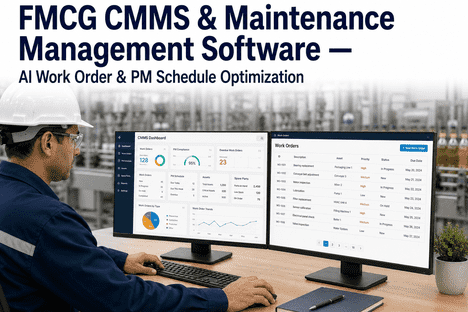
Work order management, asset registry, spare parts tracking, and preventive maintenance scheduling. AI-enhanced CMMS platforms add condition-based triggers and failure pattern recognition. The foundational layer for any FMCG maintenance digitalization initiative.
Enterprise Asset Management (EAM)
Strategic asset lifecycle management across multiple sites — capital planning, depreciation, reliability engineering, and risk-based maintenance prioritization. EAM platforms extend CMMS capability with financial and strategic decision support for VP-level operations leaders.
Predictive Maintenance Software
AI-powered condition monitoring that ingests vibration, temperature, current, and acoustic signals to forecast equipment failures days or weeks before they happen. Modern platforms predict mixer and motor failures up to 12 days in advance using vibration signature analysis, eliminating unplanned downtime.
Industrial IoT Platform
The data infrastructure layer that connects PLCs, sensors, edge devices, and historians into a single ingestion pipeline. IIoT platforms feed every other software category — without a robust IIoT foundation, AI models starve. Sensor-agnostic architectures work across legacy and greenfield assets equally.
Quality Management Software (QMS)
Document control, deviation management, CAPA workflows, and audit-ready compliance reporting for FSMA, GFSI, and SQF. AI-enabled QMS platforms add computer vision defect detection and automated root-cause analysis. Vision systems now inspect products at over 600 units per minute with up to 99.99% defect detection accuracy.
Most FMCG plants benefit from a layered architecture that combines an MES core with a predictive maintenance overlay and a unified industrial analytics platform sitting on top. Operations leaders weighing this architecture decision can book a demo to walk through how iFactory consolidates four of these six categories into a single deployment.
AI Manufacturing Software Comparison Across FMCG-Critical Dimensions
The table below benchmarks the six core software categories against the operational dimensions that matter most in FMCG manufacturing. Use this comparison as a structured filter when evaluating vendors — a platform can be excellent in its category while still being the wrong fit for an FMCG operating environment if it lacks compliance reporting depth or cold-chain monitoring capability. The most common procurement mistake in FMCG software selection is buying for category labels rather than evaluating against vertical-specific operational requirements.
| Software Category | Primary Use Case | Key AI Capabilities | Best Fit Plant Size | Typical Deployment |
|---|---|---|---|---|
| Manufacturing Execution System | Real-time production tracking, batch genealogy, OEE | Yield prediction, scheduling AI, anomaly detection | Mid to large multi-SKU | 4–9 months |
| Computerized Maintenance Management | Work orders, PMs, spare parts, technician dispatch | Condition triggers, mobile AI assistants | All sizes | 2–6 weeks |
| Enterprise Asset Management | Multi-site reliability strategy, capital planning | Risk-based prioritization, lifecycle modeling | Large enterprise | 6–12 months |
| Predictive Maintenance Software | Failure forecasting, condition monitoring | Vibration ML, thermal pattern recognition | Mid to large | 2–8 weeks |
| Industrial IoT Platform | Sensor data ingestion, historian, edge computing | Real-time stream analytics, edge AI inference | All sizes | 4–12 weeks |
| Quality Management Software | Document control, deviations, audit trails | Vision inspection, automated CAPA, NLP audit prep | All sizes (regulated) | 3–6 months |
FMCG Capability Coverage Heatmap by Software Category
The heatmap below scores each software category against the six capabilities that matter most in FMCG manufacturing operations. A "Strong" rating indicates native, mature capability shipped as core product functionality. "Moderate" indicates partial coverage, often through integrations or add-on modules. "Limited" indicates capability gaps that typically require a complementary platform to fill. This visualization is the fastest way to see which platform combinations actually deliver complete FMCG coverage versus which combinations leave critical operational gaps.
The pattern visible in the heatmap is the structural reason FMCG plants increasingly select unified manufacturing intelligence platforms over single-category point solutions: stitching together three or four point solutions creates integration debt, data silos, and audit complexity that erode the very efficiency the software was meant to deliver. Operations leaders evaluating this trade-off can book a demo to see how a unified architecture eliminates these integration costs entirely.
AI FMCG Manufacturing Software KPI Benchmarks
The performance gains delivered by AI manufacturing software vary widely by deployment scope, baseline maturity, and platform fit. The benchmarks below reflect average KPI improvements observed across FMCG plants within 12 months of full platform deployment, drawn from industry reports and iFactory customer data spanning beverage, dairy, packaged food, home care, and personal care manufacturing environments.
Four-Phase Selection Framework for FMCG Manufacturing Software
The most expensive mistake in AI manufacturing software procurement is selecting a platform before clearly defining the operational problems it must solve. The four-phase framework below structures the selection process so that vendor evaluation happens against documented requirements rather than feature demos. Plants that follow this sequence consistently achieve 2–3x faster time-to-value than plants that compress it.
Define Use Cases & Pain Points
Week 1–3Document the top 5–7 operational pain points and quantify each in dollars. This becomes the requirements filter for vendor evaluation.
Pain point P&L mapMap Capability Requirements
Week 3–6Translate pain points into specific software capabilities. Use the heatmap above to identify which categories address each requirement.
Capability requirements docPilot & Vendor Evaluation
Week 6–14Shortlist 3 vendors maximum. Run 4–8 week pilots on a single line. Score against capability fit, usability, and TCO using live data.
Pilot scorecardScale & Continuous Improvement
Month 4+Roll out across additional lines in 90-day waves. Measure realized savings against Phase 1 dollar targets quarterly.
Quarterly value reviewQuantifying the ROI of AI Manufacturing Software in FMCG Plants
The performance gains delivered by AI manufacturing software in FMCG plants can be quantified across four core ROI dimensions. Combined, these dimensions consistently produce platform payback under 12 months for plants with mature operational baselines and under 6 months for plants carrying high reactive maintenance or quality cost burden. Plants weighing this investment can book a demo to model their specific cost structure against expected platform impact.
FMCG packaging lines lose $4k–$12k per hour of unplanned downtime. Eliminating 50% of unplanned downtime through AI-powered predictive maintenance typically returns $400k–$1.2M annually per plant.
Payback: 9–14 monthsComputer vision quality automation eliminates manual end-of-line inspection labor while catching defects human inspectors miss at 600+ units per minute, plus a substantial reduction in customer complaint and recall risk exposure.
99.99% detection accuracyAI-enabled supply chains reduce forecasting errors by up to 50% in some FMCG categories, with stockout rates dropping by up to 65% and inventory holding costs falling around 20% — translating directly into freed working capital.
–20% inventory holding costFSMA, GFSI, and SQF audit prep consumes 80–200 hours per cycle. Automated digital compliance logging eliminates the majority of this work — generating continuously audit-ready documentation as a byproduct of normal operation.
Days to hoursAI Manufacturing Software for FMCG — Frequently Asked Questions
What is the best AI software category to start with for an FMCG plant?
Most FMCG plants should start with predictive maintenance plus a CMMS foundation, then layer in MES capability once maintenance data flows reliably. This sequence delivers the fastest measurable ROI because downtime elimination is the most directly quantifiable financial benefit. Plants with significant quality cost or recall exposure should prioritize a quality automation deployment in parallel.
How is AI manufacturing software different from a generic ERP system?
ERP systems manage transactional and financial workflows — purchasing, accounting, order management, basic production planning. AI manufacturing software operates at the shop floor data layer, ingesting real-time sensor and PLC signals to drive operational decisions in seconds rather than days. The two are complementary; ERP and AI manufacturing platforms exchange data through APIs but solve fundamentally different problems.
Do FMCG plants really need both an MES and a CMMS, or can one platform replace both?
Modern unified manufacturing intelligence platforms increasingly consolidate MES and CMMS functionality into a single deployment. For mid-size FMCG operations, a unified platform typically delivers better total cost of ownership, eliminates integration costs, and provides a single source of truth across production execution and maintenance. Large multi-site enterprises may still benefit from best-of-breed combinations.
How long does AI manufacturing software take to deploy in an FMCG plant?
Deployment timelines range from 14 days for sensor-agnostic predictive maintenance overlays to 9 months for full multi-site MES rollouts. Most modern cloud-native AI manufacturing platforms reach initial production deployment in 6–12 weeks. Plants with existing IoT infrastructure and historian data move fastest; plants requiring greenfield sensor deployment require additional time for instrumentation.
What is the typical ROI payback period for FMCG AI manufacturing software?
Most FMCG plants achieve full platform payback in 9–14 months. Plants with high reactive maintenance burden, significant quality cost, or substantial unplanned downtime exposure frequently achieve payback under 6 months. ROI accelerates after the first year as machine learning models mature against plant-specific operational patterns.
How does AI manufacturing software support FSMA and GFSI compliance?
AI manufacturing platforms generate continuous, time-stamped digital records of every temperature condition, equipment state, deviation, and corrective action — satisfying FSMA preventive controls documentation requirements automatically. Audit preparation time typically drops from days to hours, and inspectors gain verified evidence of hazard control at every production step rather than reconstructed paper records.
See How iFactory Outperforms Every Major FMCG AI Manufacturing Platform
iFactory consolidates MES, predictive maintenance, real-time analytics, and compliance reporting into one unified intelligence platform — purpose-built for high-speed FMCG manufacturing environments.