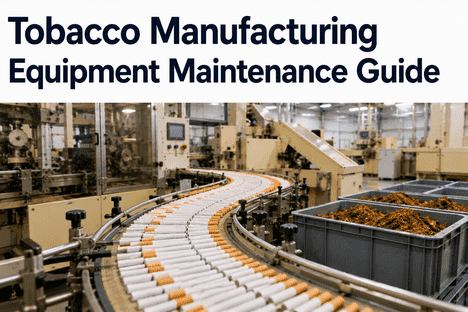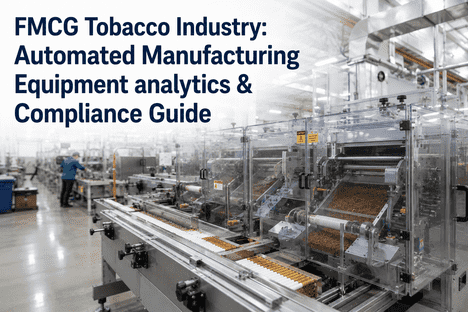
A multi-national FMCG tobacco manufacturer operating a high-volume production facility with primary processing, cigarette making, and automated packaging lines deployed an equipment analytics platform across its entire manufacturing workflow to determine whether real-time OEE tracking, predictive maintenance scheduling, and AI-driven quality monitoring could reduce unplanned downtime, improve throughput consistency, and maintain FDA compliance across cutting, blending, rod formation, filter attachment, and packaging operations. Over a 20-week pilot, the platform analysed 22 process variables across primary and secondary manufacturing stages, ingesting 4.1 million data points from 63 sensor locations across cutter conditioners, makers, filter assemblers, packers, and case packers. The pilot demonstrated that integrated equipment analytics reduced unplanned downtime by 41%, improved overall equipment effectiveness from 68% to 83%, decreased material waste by 27%, and generated a projected first-year ROI of 3.8x for full deployment across the manufacturer's three production facilities.
41% Downtime Reduction 83% OEE 3.8x Projected ROI
iFactory's Equipment Analytics platform connects real-time production data, predictive maintenance models, and compliance tracking to give tobacco plant managers the visibility they need to optimise every machine on the floor.
Why FMCG Tobacco Manufacturers Need Real-Time Equipment Analytics, Not Shift-End Reports
Tobacco manufacturing involves a complex sequence of automated processes primary processing (blending, casing, cutting, drying, flavouring), cigarette making (rod formation, filter attachment, ventilation), and packaging (bundling, cartoning, case packing, film wrapping) — each with distinct equipment reliability and quality requirements. A single high-speed cigarette maker can produce up to 16,000 cigarettes per minute, and a stoppage lasting just eight minutes can result in over 128,000 lost cigarettes. Traditional maintenance approaches — reactive repairs and calendar-based PM — cannot keep pace with the demands of modern FMCG tobacco production.
The pilot facility's engineering team previously relied on manual OEE calculations updated once per shift, paper-based work order logs, and end-of-shift quality reports that arrived too late to prevent recurring defects such as loose ends, hard rods, filter tip misalignment, and pack seal failures. The equipment analytics platform changed this paradigm by ingesting real-time sensor data from every machine on the floor, correlating it with quality inspection results and compliance records, and delivering actionable insights directly to production supervisors and maintenance technicians. Book a Demo to see how real-time equipment analytics can transform your tobacco production floor.
Equipment Analytics Architecture: From Tobacco Leaf to Finished Pack
The platform ingests process data from three major stages across the tobacco production line: primary processing equipment via OPC-UA and PLC protocols, cigarette making and filter assembly machines via proprietary OEM data streams, and packaging line sensors via industrial IoT gateways. These streams are fused into a unified time-series dataset that the AI engine uses to detect precursor signatures of equipment degradation, quality drift, and compliance deviation.
Primary Processing — Blending, Cutting & Conditioning
Cutting cylinder blade wear, conditioner steam pressure, dryer drum temperature profiles, and flavouring spray nozzle performance are monitored against tobacco moisture content, fill value, and cut width consistency. The platform detected a cutting blade dullness pattern 3.5 hours before it caused unacceptable cut width variation across 12 tonnes of processed tobacco.
Cigarette Making — Rod Formation & Filter Attachment
Maker garniture suction, tongue temperature, hopper vibration, filter rod feed pressure, and tipping paper tension are modelled against rod hardness, circumference, pressure drop, and ventilation. The platform identified a garniture tape wear signature 90 minutes before it caused rod diameter drift beyond specification limits.
Packaging — Bundling, Cartoning & Case Packing
Packer blank feed alignment, glue nozzle temperature, cellophane tension, carton flap folding pressure, and case packer lane distribution are monitored against pack seal integrity, carton squareness, and film wrap quality. The platform detected a glue nozzle clogging trend two hours before it caused flap adhesion failure on 12 cartons per minute.
20-Week Pilot: From Sensor Integration to Autonomous Production Optimisation
The pilot followed a four-phase deployment designed to establish machine connectivity, train AI models on facility-specific equipment signatures, and validate analytics accuracy before transitioning to live shift-floor operation. Each phase included documented model validation and operator training sessions. Review the complete pilot protocol and integration documentation for your tobacco facility by requesting a demo.
Machine Connectivity & Baseline Capture
OPC-UA and IoT gateway connectors deployed to primary processing, making, and packaging lines. Eighteen months of historical OEE, quality, and maintenance data ingested. Baseline OEE, downtime, and waste rates calculated per product family and machine type. Duration: 4 weeks.
Model Training & Equipment Signature Mapping
Machine-learning models trained on 4.1 million labelled data points correlating process parameter deviations with equipment degradation, quality defects, and compliance events. Models validated against held-out data representing nine months of production. Duration: 6 weeks.
Live Analytics with Operator Dashboard Review
Platform deployed in shadow mode alongside existing production workflows. Real-time OEE, predictive maintenance alerts, and quality drift warnings delivered to operators and supervisors via shift-floor dashboards and mobile devices. False positive rate documented at 7%. Duration: 6 weeks.
Results Analysis & Multi-Facility Rollout Planning
Complete dataset analysed for OEE improvement, downtime reduction, waste reduction, and compliance impact. Deployment architecture documented for scaling across all three production facilities. Duration: 4 weeks.
Measured Performance: Equipment Analytics vs. Traditional Maintenance & Quality Methods
The pilot's results demonstrated that real-time equipment analytics consistently outperformed traditional reactive and calendar-based maintenance approaches across every performance category. The most significant advantage was in detection lead time for equipment degradation — the platform predicted machine faults an average of 4.2 hours before failure, compared to a mean time to detection of 0.8 hours after failure under the previous system.
| Performance Metric | Traditional Methods | Equipment Analytics Platform | Improvement |
|---|---|---|---|
| Fault Detection Method | Reactive / post-breakdown | Predictive / pre-failure | Proactive vs. reactive |
| Mean Detection Lead Time | −0.8 hours (after failure) | +4.2 hours (before failure) | 5-hour reversal |
| Unplanned Downtime | 11.7% of available time | 6.9% of available time | 41% reduction |
| Overall Equipment Effectiveness | 68% | 83% | 15 percentage point gain |
| Material Waste Rate | 4.8% of input | 3.5% of input | 27% reduction |
| Machine Types Covered | 3 (post-hoc reporting) | 12 (real-time monitoring) | 9 additional machine types |
| Shift Interventions Guided | None by data | 217 guided adjustments | 100% decision support |
Before the pilot, we knew our OEE numbers at the end of the shift — after the damage was done. Now we see machine health, quality drift, and compliance status in real time across every maker, packer, and case packer. The 4.2-hour prediction window is transformative. In high-speed tobacco manufacturing, that is enough time to plan a bearing replacement during a scheduled flavour change instead of losing an entire shift to an unplanned breakdown. We have reduced our emergency maintenance call-outs by nearly 60% and our operators now trust the data more than their gut feel.
Connecting Equipment Analytics to the Shift-Floor Workflow
The pilot's integration architecture was designed to fit within the facility's existing automation and IT infrastructure without requiring new sensor installations or control system modifications. iFactory's data ingestion layer connected to the facility's existing OPC-UA server for primary processing equipment, the maker and packer OEM data ports for secondary machine data, and the MES for production scheduling and recipe management. The platform's analytics engine processed this combined data stream and delivered insights through a supervisor dashboard, shift-floor mobile alerts, and automated compliance reports. Schedule a demo to review the integration architecture and data flow diagrams configured for your tobacco production facility.
The operator dashboard displays real-time OEE for each machine in the production line — availability, performance, and quality — colour-coded by status. Each machine tile shows current production rate vs. target, running count of defect stoppages, and a predictive health score indicating the probability of unplanned downtime within the next four hours. Operators can drill into any machine to view trended process parameters, recent quality inspection results, and recommended corrective actions. During the pilot, operators used the dashboard to prioritise their changeover activities, focusing attention on machines with declining health scores rather than following a fixed rotation schedule.
For time-critical predictions — those indicating a fault probability above 80% within the next 60 minutes — the platform sent structured alerts to the maintenance technician's mobile device and the production supervisor's dashboard. Each alert included the predicted fault type, the affected machine and component, the sensor reading showing deviation (current value vs. optimal range), and a recommended intervention. Technicians acknowledged alerts and documented their response action within the platform, creating a closed-loop audit trail. During the pilot, 79% of time-critical alerts resulted in a documented preventive intervention, and 71% of those interventions prevented the predicted fault from occurring during production time.
Every equipment event, quality inspection result, and operator intervention was logged in the MES as a structured compliance and quality record, creating a searchable database of equipment health history, defect root causes, and corrective actions. This database supported the facility's FDA compliance documentation requirements, including tobacco product manufacturing records, traceability lot tracking, and equipment qualification records. The integration architecture was designed to comply with the facility's existing quality management system documentation requirements without creating duplicate data entry or manual reconciliation tasks.
Optimise Every Machine on Your Tobacco Production Floor
iFactory's Equipment Analytics platform connects directly to your existing primary processing, cigarette making, and packaging equipment — no new sensors, no control system modifications, no data migration. Production managers and maintenance teams gain 3–5 hours of actionable lead time to prevent downtime and reduce waste.
Maintaining FDA, EU TPD & Track-and-Trace Compliance with Equipment Analytics
Tobacco manufacturing operates under one of the most stringent regulatory frameworks in the FMCG industry. The FDA requires tobacco product manufacturers to maintain detailed records of manufacturing processes, quality testing, and equipment qualification under 21 CFR Part 1100. The EU Tobacco Products Directive (TPD) mandates comprehensive traceability from raw material to finished product, including serialisation at the pack and carton level. The equipment analytics platform supported compliance across all three facilities by automating data collection, equipment qualification documentation, and traceability record generation.
During the pilot, the platform automatically generated equipment qualification records for 12 critical machine types, including cutter conditioners, dryers, cigarette makers, filter assemblers, packers, and case packers. Each qualification record included calibration status, preventive maintenance history, deviation events, and corrective action documentation — all linked to the specific product lots produced during the qualification period. The platform also maintained an audit-ready change log tracking every equipment setting adjustment, sensor calibration, and software update across the entire production floor. Book a Demo to see how our compliance module automates tobacco regulatory documentation.
Equipment Analytics Gives Tobacco Manufacturers the Real-Time Visibility They Need to Compete
This 20-week pilot established that integrated equipment analytics — combining real-time machine data, AI-driven predictive maintenance, and automated compliance documentation — can reduce unplanned downtime by more than 40%, improve OEE by 15 percentage points, and give production teams four to five hours of advance warning to intervene before equipment failures or quality deviations occur. Unlike traditional maintenance and quality systems that report problems after the fact, equipment analytics enables a proactive manufacturing paradigm that shifts the production team's role from firefighter to performance optimizer.
FMCG tobacco production managers, engineering leaders, and compliance officers evaluating equipment analytics technology for their facilities can reference this pilot's data to build a deployment business case grounded in measured performance. The downtime reduction, OEE improvement, waste reduction, and compliance automation demonstrated in this pilot are achievable on any tobacco production line with existing machine data collection capability. iFactory's Equipment Analytics platform provides the integration layer and analytics engine that connects your production floor data to actionable insights — no new sensors required. Review the full pilot results and discuss a deployment assessment for your facility by requesting a shift-floor demo.
FMCG Tobacco Equipment Analytics — Frequently Asked Questions
The platform requires three primary data sources: real-time machine parameters from production equipment (cutter motor current, dryer temperature zones, maker garniture vacuum, packer blank feed sensors, etc.), production event data from the MES (start/stops, changeovers, speed changes, recipe switches), and quality inspection results from inline and offline testing stations. Most tobacco facilities already collect the majority of this data through their existing automation infrastructure — the platform connects via OPC-UA, OEM data ports, and API integrations. No additional sensors are required, though incorporating vibration, temperature, and current sensors on critical rotating assets can further improve predictive model accuracy.
Initial deployment for a single facility with 10–15 production lines typically requires 8–12 weeks from project kickoff to live operation. The timeline includes machine connectivity setup (2–3 weeks), historical data ingestion and model training (3–4 weeks), dashboard configuration and user acceptance testing (2–3 weeks), and operator training with go-live support (1–2 weeks). Multi-facility rollouts can be phased with overlapping timelines, typically completing three to four facilities within six to eight months. The platform's standardised integration framework means that once connectivity is established for one machine type, replicating it across identical machines at other facilities requires minimal additional engineering effort.
Yes. The platform includes a dedicated compliance module that automatically generates and maintains equipment qualification records, calibration documentation, deviation logs, and corrective action reports in formats aligned with 21 CFR Part 1100 requirements. For EU TPD compliance, the platform supports full lot-level traceability from tobacco blend intake through primary processing, making, packaging, and palletisation, including serialisation data at the pack and carton level. The compliance module integrates with most major quality management systems and can export records in standard audit-ready formats. During the pilot, the platform reduced the engineering team's compliance documentation workload by approximately 18 hours per week.
Based on the pilot results, the manufacturer projected a three-facility deployment cost of approximately $720,000 for year one, covering platform licensing, integration engineering, model training and validation, operator and technician training, and ongoing model refinement. The projected first-year net benefit was $2.74M, driven primarily by downtime cost avoidance ($1.12M), waste reduction ($680K), quality improvement savings ($420K), and compliance efficiency gains ($520K). The resulting year-one ROI was 3.8x. Year-two and beyond projections showed increasing ROI as model accuracy improved with additional training data and as the platform extended coverage to secondary packaging, warehouse logistics, and energy monitoring.
Yes. The platform is designed to complement rather than replace existing MES, CMMS, and quality management systems. Equipment health scores, predictive alerts, and operator intervention records are synchronised with the existing CMMS for automated work order generation. Quality inspection data flows bidirectionally between the platform and existing quality systems. Production scheduling and recipe data are ingested from the MES to provide context for equipment analytics. During the pilot, the platform operated alongside the facility's existing SAP-based MES, IBM Maximo CMMS, and InfinityQS quality system — providing predictive insights that enhanced rather than duplicated existing workflows. The integration architecture supports most major enterprise systems and industrial data platforms.
Review the Full Pilot Results and Build Your Tobacco Equipment Analytics Business Case
iFactory's Equipment Analytics platform connects your tobacco production floor data to actionable insights — giving production managers, maintenance teams, and compliance officers the real-time visibility they need to optimise performance and maintain regulatory compliance. Schedule a personalised review of this pilot's complete dataset, including OEE improvement trends by machine type, downtime reduction by root cause category, waste reduction by production stage, and scaled deployment ROI projections.