As the FMCG industry pivots to biodegradable, recycled, and compostable packaging materials, conventional packaging lines — designed for uniform petroleum-based films and rigid plastics — face a cascade of mechanical, thermal, and handling challenges. Without intelligent changeover management and predictive equipment care, sustainable materials cause jams, tearing, sealing failures, and costly unplanned downtime.
Sustainable Packaging Analytics
AI-Driven Equipment & Robot Care for Eco-Friendly FMCG Materials
Intelligent changeover, real-time material adaptation, and predictive maintenance for packaging lines handling biodegradable, recycled, and compostable substrates — powered by iFactory AI vision and IIoT.
◉
Material Adapt
AI vision detects material type and adjusts gripper force, heat, and sealing dwell in real time
◉
Changeover OEE
Automated recipe switching cuts changeover time by up to 62% for mixed-material runs
◉
Predictive Care
Vibration and temperature sensors predict end-effector wear before brittle materials cause damage
◉
Zero-Waste QA
Inline defect detection reduces material waste by 41% across compostable film lines
The Sustainable Packaging Shift
Biodegradable films, recycled-content paperboards, and compostable polymers behave fundamentally differently than conventional plastics. They exhibit higher coefficient-of-friction variability, lower tear resistance, narrower heat-seal windows, and greater sensitivity to ambient humidity. Standard packaging equipment — designed for the narrow spec of petro-plastics — lacks the sensor fusion and adaptive control required to handle these materials at line speed, forcing operators into manual babysitting or frequent jam-clearing cycles that destroy OEE. Book a Demo to see iFactory's adaptive control in action.
SUSTAINABLE MATERIAL CHALLENGES
1
Friction Variability — recycled papers and bio-PET films show 3× wider COF range than virgin plastics, causing feed roller slip and register errors
2
Narrow Seal Windows — PLA and PBAT films seal only within 8–12 °C bands vs 30+ °C for LDPE; missed temps produce cold seals or burn-through
3
Moisture Sensitivity — cellulose and starch-based materials absorb atmospheric water, changing dimensional stability and modulus in hours
4
Brittleness at Speed — recycled HDPE and compostable polyesters become micro-cracked at high forming-plug speeds, leading to pinhole leaks
Why Standard Equipment Fails on Sustainable Materials
01
Rigid Gripper & End-Effector Geometry
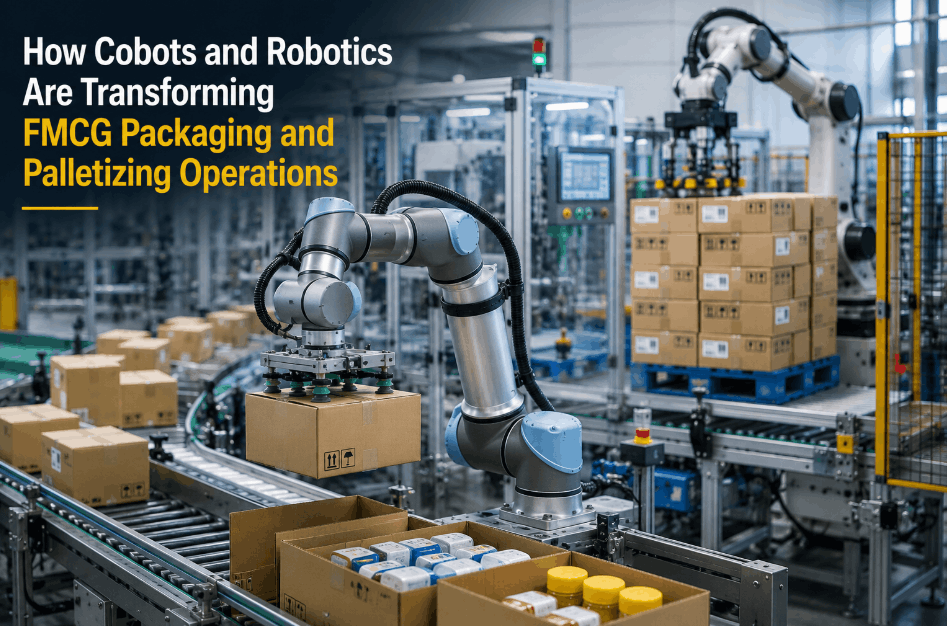
Conventional vacuum cups and parallel grippers apply uniform force profiles optimized for stiff, low-friction films. When processing recycled cardboard or flexible bio-pouches, the same geometry causes edge crushing, surface delamination, or insufficient hold. iFactory's robot vision layer — powered by edge-AI cameras — detects material deformation in real time and adjusts gripper closing force, vacuum pressure, and approach angle on-the-fly.
Book a Demo to see adaptive end-effector control in action.
Robot CareEnd-EffectorForce Control
02
Thermal Mismatch in Sealing and Forming
Compostable films such as PLA and PBAT have melting points 30–50 °C lower than conventional polyolefins. Heated seal bars tuned for LDPE overheat these materials, causing sticking, burn-through, and toxic off-gassing. iFactory's IIoT thermal sensing network provides closed-loop temperature control with ±1.5 °C accuracy per zone, while the PM engine predicts heater element degradation before it drifts out of spec — eliminating scrap events during material changeovers.
Thermal ControlPredictive MaintenanceSealing
03
Changeover Complexity Without Digital Twin
Switching a vertical form-fill-seal line from recycled kraft paper to compostable poly-film requires 20+ parameters to be adjusted: film tension, jaw timing, seal pressure, cooling air volume, cut-off knife speed, and registration sensor thresholds. Most facilities rely on tribal knowledge and paper checklists, resulting in 45–90 minutes of changeover downtime and 15–25 units of scrap. iFactory's digital changeover manager stores and validates recipes, auto-sets machine parameters via OPC-UA, and guides operators with AR overlays.
Talk to an ExpertChangeoverDigital TwinOEE
Traditional vs. Sustainable Packaging Equipment Setup
Film COF Range
0.20–0.35
0.15–0.65
Real-time tension trim via vision-based web guide
Seal Temperature Window
130–170 °C
90–115 °C
Adaptive PID per zone + heater health prediction
Gripper Force Range
40–60 N
15–45 N
Force-sensing end-effector with auto-calibration
Changeover Duration
20–35 min
45–90 min
Automated recipe switch in under 12 min
Equipment Care & Predictive Maintenance for Eco-Friendly Materials
Sustainable materials impose unique wear patterns on packaging equipment. Recycled paper fibers are abrasive on forming shoulders and cutting knives; compostable films leave corrosive residues on heated seal bars; moisture variability accelerates bearing corrosion in feed sections. iFactory's predictive maintenance platform fuses vibration, temperature, current-draw, and vision data to forecast equipment degradation specific to each material class — triggering work orders, spare-part reservations, and robot care routines before failure occurs. Book a Demo to see predictive care for your packaging line.
Abrasive recycled paper fibers accelerate cutting-knife blunting and forming-shoulder scoring. iFactory's vibration signature analysis detects the high-frequency harmonics of dull knives and surface roughness changes on formers, enabling replacement before burrs create tear-offs.
Knife Life Increase+73%
Scrap Reduction-38%
Talk to an Expert
PLA and PBAT decomposition byproducts deposit acidic residues on heated seal jaws, causing micro-pitting and localized hot spots. iFactory's thermal imaging array maps jaw surface temperature gradients across every cycle, flagging deviations that predict sealing failures. The PM scheduler auto-generates cleaning work orders based on cumulative material-contact hours.
Seal Defect Rate-64%
Cleaning IntervalOptimal
Talk to an Expert
Bio-polyester films exhibit unpredictable slip-stick behavior at pick-and-place speeds. iFactory's vision-guided robot controller measures actual displacement at each pick event and adjusts vacuum-on timing, gripper closing velocity, and dwell pressure cycle-by-cycle — eliminating dropped packages and surface marring without human tuning.
Pick Reliability99.97%
Surface Defects-91%
Talk to an Expert
Measurable Impact on Sustainable Packaging Lines
62%
Faster Changeovers
Between recycled and compostable materials
41%
Waste Reduction
Inline QA catches defects before scrap accumulation
73%
Extended Tool Life
Predictive care for knives, seal bars, and grippers
99.9%
Robot Pick Reliability
Adaptive end-effector control for variable materials
Frequently Asked Questions
Future-Proof Your Packaging Line for Sustainable Materials
Stop fighting with brittle films, abrasive papers, and endless changeover adjustments. iFactory equips your packaging equipment and robots with the intelligence to handle any eco-friendly material at full OEE — with predictive care that keeps your line running.
Sustainable Packaging
Robot Care
Predictive Maintenance
Changeover Management
FMCG Analytics