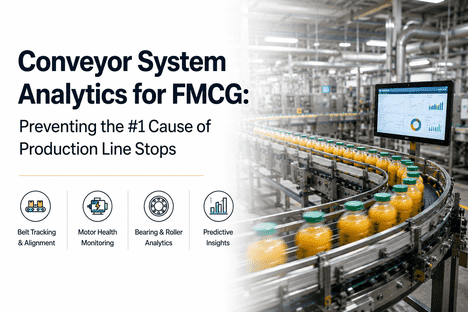
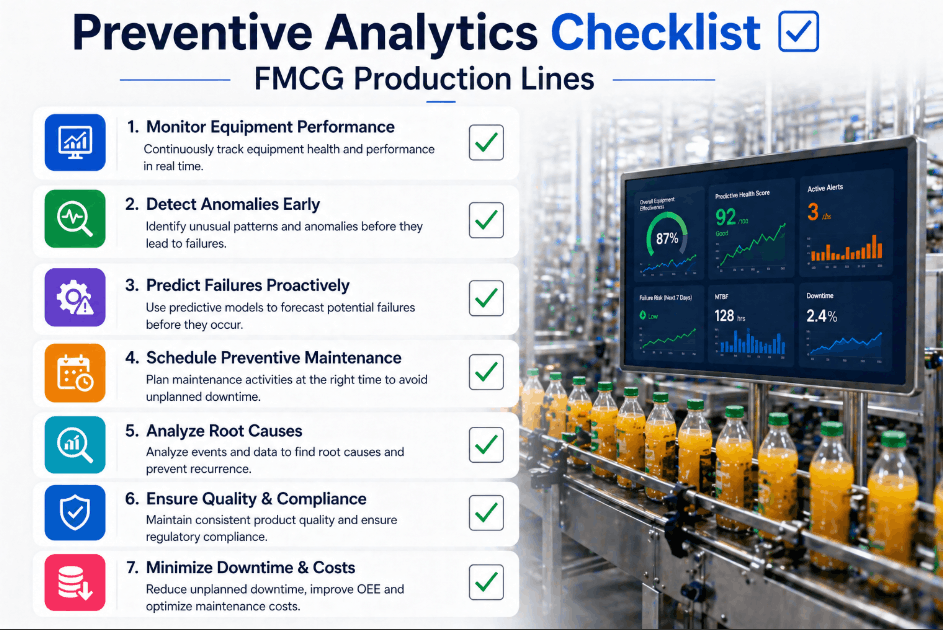
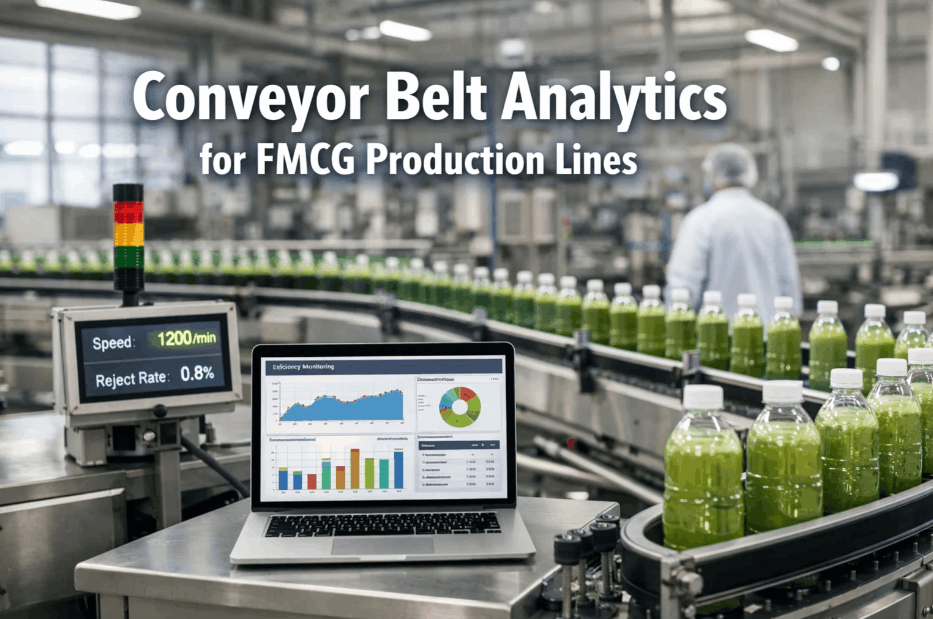
In FMCG production, conveyor belts and robotic palletizers form the mechanical backbone of every packaging and distribution line. A single misaligned belt on a 300-ppm beverage line can halt an entire filler operation within 90 seconds, creating a cascade of backed-up product, idle downstream equipment, and perishable inventory at risk of spoilage. A robotic palletizer whose end-effector gripper has drifted 2 mm out of calibration will drop cases intermittently, requiring operator intervention every 8–12 minutes and reducing effective throughput by 15–25%. Despite their criticality, these assets are often maintained on fixed-interval schedules that bear no relationship to actual operating conditions — belt tension is checked every 30 days regardless of whether the line ran 400 hours or 40 hours in that period. This analytics guide covers the specific inspection points, sensor integration strategies, predictive failure patterns, and preventive scheduling approaches for conveyor systems and robotic palletizers in FMCG production environments, with iFactory's Asset Management and PM Scheduling platform automating the entire workflow. Book a Demo to see how iFactory digitises conveyor and robotic palletizer analytics in live FMCG plants.
Conveyor Belt Analytics: Inspection Points and Predictive Indicators
Conveyor systems in FMCG plants range from simple flat-belt conveyors moving packaged cases to complex multi-strand accumulating systems, spiral conveyors for cooling tunnels, and modular belt systems for inclined product transport. Each type presents distinct failure modes that analytics can detect before they cause line stoppages.
Belt tracking deviation is the most common conveyor failure mode in FMCG production. A belt that drifts 5–10 mm off-centre causes edge fraying on the belt, accelerated wear on the pulley lagging, and product spillage at transfer points. Tracking problems account for 30–40% of all conveyor-related downtime. Analytics approaches include: monitoring belt edge position via photo-eye or laser sensors at 100 mm intervals, tracking snub pulley angle adjustment frequency, and analysing motor current draw variation — a belt that begins oscillating laterally produces a ±5–10% fluctuation in drive motor amperage. iFactory's platform ingests these data streams and predicts tracking-related belt replacement 2–4 weeks in advance.
Belt tension degrades as the belt material elongates under load, particularly on long-centre conveyors over 30 metres and on inclined conveyors where gravity adds continuous tension. Under-tensioned belts slip on drive pulleys, reducing line speed and causing product accumulation; over-tensioned belts accelerate bearing wear on idler rollers and increase motor load by 10–20%. Analytics approach: measure take-up position drift over time via linear position sensor on the gravity or screw take-up assembly. A take-up position change of 50 mm on a fabric belt typically signals 8–12% elongation, indicating the belt is approaching end-of-life. iFactory's PM Scheduling module triggers belt replacement orders when take-up position reaches the OEM-recommended limit, typically 2–3% of belt centre distance.
Idler roller seizure is the leading cause of belt bottom-cover wear and tracking instability in FMCG conveyors. A seized roller on a 50-metre conveyor with 200 rollers can go undetected for weeks while it wears a groove in the belt underside. Analytics approach: deploy wireless vibration sensors on 8–12 strategically located idler stations per 50 metres of conveyor. Measure velocity in mm/s at the roller bearing housing. A reading above 4.5 mm/s indicates bearing degradation; consistent readings above 7 mm/s suggest roller seizure within 1–2 weeks. For modular belt conveyors, sprocket tooth wear is measured by monitoring chain pitch elongation via encoder-based position tracking. iFactory's Asset Management module maintains individual roller and sprocket inventories with service life counters.
In food and beverage FMCG plants, conveyor cleaning is both a food safety requirement and a maintenance activity that consumes 2–4 hours per line per sanitation cycle. Dry cleaning (vacuum, scraping) versus wet cleaning (foam, rinse, sanitise) decisions must balance microbial control against bearing washout and motor ingress risks. Analytics approach: track cumulative production volume per cleaning cycle, monitor bearing vibration trends before and after wet cleaning to detect water ingress, and measure belt surface ATP swab results in iFactory's Shift Logbook. Plants using analytics-driven cleaning intervals report 25–35% reduction in cleaning chemical costs and 40% fewer bearing replacements attributed to washdown damage. Clean-in-place (CIP) cycles logged in iFactory automatically adjust PM scheduling for conveyor bearings and motors.
Robotic Palletizer Analytics: Arm Calibration, End-Effector and Predictive Care
Robotic palletizers in FMCG plants operate at 15–25 cycles per minute, 18–22 hours per day, performing the same pick-and-place sequence up to 25,000 times per day. At this duty cycle, calibration drift, end-effector wear, and joint fatigue accumulate rapidly. Analytics-driven maintenance extends palletizer uptime and reduces the risk of dropped loads, damaged product, and costly robot arm repairs.
Six-axis palletizing robots drift out of calibration over time due to gearbox wear, joint bearing degradation, and thermal expansion during extended production runs. A TCP (tool centre point) deviation of 2–3 mm causes pick-and-place misalignment — the gripper misses the case centre by enough to drop cases or damage carton flaps. Analytics approach: run automated TCP calibration routines every 500 operating hours using a calibrated touch-off fixture. Track TCP deviation trend over time in iFactory's Asset Management module. A deviation trend that increases by 0.1 mm per 1,000 cycles signals gearbox wear requiring inspection. Most FMCG palletizers require full recalibration every 2,000–4,000 operating hours depending on payload and speed. iFactory's PM Scheduling auto-generates calibration work orders based on actual operating hours rather than calendar intervals.
End-effector wear is the most frequent cause of palletizer-related downtime in FMCG plants. Vacuum cup grippers lose suction efficiency as cups harden, crack, or pick up debris from case surfaces. Mechanical gripper pads wear down, reducing friction and causing cases to slip during high-speed. Analytics approach: monitor vacuum pressure at the gripper manifold — a 15–20% drop in vacuum level from baseline signals cup wear or vacuum line blockage. For mechanical grippers, measure grip force via strain gauge on the gripper mount and compare against the calibrated set point. Track end-effector cycle count in iFactory and auto-generate gripper pad replacement orders every 50,000–100,000 cycles depending on case weight and material. Plants using iFactory's cycle-count-based end-effector scheduling report 50–70% fewer dropped-case events and 3x longer gripper component life.
Palletizer robot joints J1–J6 experience different wear profiles depending on the palletising pattern. J1 and J2 (base and shoulder) bear the highest loads and are most susceptible to gearbox wear. Analytics approach: monitor servo motor current draw per axis during each movement segment. A 10–15% increase in axis current for the same movement trajectory signals gearbox efficiency loss or bearing drag. Vibration sensors on the J1 and J2 gearbox housings at 500 Hz–10 kHz detect gear tooth pitting and bearing race defects 3–6 weeks before failure. iFactory's ML models train on axis current signatures across different pallet patterns and payload weights, learning normal operating envelopes. When an axis deviates outside the normal envelope, iFactory generates a predictive work order with the specific joint and component requiring attention.
Each pallet pattern change in FMCG production — switching from a 12-pack case format to a 24-pack case format — requires programme validation to ensure pick points, placement coordinates, and layer stacking sequences are correct. An incorrect programme causes collision events, dropped loads, and potential robot arm damage. Analytics approach: log each pattern changeover in iFactory's Shift Logbook with pass-fail validation results, cycle time consistency check, and operator sign-off. Track cycle time per pattern over time — a pattern whose cycle time increases by 5–10% over several months may indicate the robot is compensating for calibration drift or mechanical drag. iFactory's Asset Management module maintains a pattern changeover history with average cycle time, error rate, and last validation date for each pattern.
Conveyor and Palletizer Analytics Schedule by Frequency
The table below consolidates the recommended analytics and inspection schedule for conveyor systems and robotic palletizers in FMCG production. Frequencies should be adjusted based on actual operating hours, production intensity, and environment.
| Asset Type | Daily / Per Shift | Weekly (40 hrs) | Monthly (160 hrs) | Quarterly (500 hrs) |
|---|---|---|---|---|
| Flat belt conveyor | Visual belt tracking check, e-stop test | Belt tension measurement, roller sound check | Idler bearing vibration, drive motor current | Belt thickness measurement, pulley lagging inspection |
| Modular belt conveyor | Sprocket alignment visual, belt wander check | Chain tension check, flight condition | Sprocket tooth wear measurement, drive chain elongation | Full belt width measurement, sprocket replacement assessment |
| Spiral / accumulating conveyor | Product gap consistency, drive chain noise | Track alignment, wear strip condition | Drive motor current trending, chain lubrication | Track thickness measurement, drive sprocket inspection |
| Six-axis robotic palletizer | Gripper function test, dropped-case check | TCP calibration verification, vacuum pressure | Axis current trending, gearbox temperature | Joint backlash measurement, full calibration |
| End-effector / gripper | Visual cup or pad condition, vacuum check | Grip force measurement, cup hardness test | Vacuum line integrity, manifold pressure drop | Full gripper rebuild or replacement decision |
IoT Sensor Integration for Conveyor and Palletizer Predictive Monitoring
iFactory's IoT Integration layer connects to the specific sensor types and data protocols used in conveyor and robotic palletizer systems, enabling real-time condition monitoring and predictive failure detection without requiring a full control system upgrade.
Wireless tri-axial vibration sensors with magnetic mount install on drive pulley bearing housings, take-up pulley bearings, and 8–12 idler stations per 50-metre conveyor section. Temperature sensors monitor drive motor winding and bearing temperatures. Encoder-based speed sensors measure belt speed at the drive pulley and compare against the PLC set point — a speed difference of more than 3–5% indicates belt slip. iFactory ingests these data streams via LoRaWAN or Bluetooth 5.0 gateways and trends them on the Real-Time Monitoring dashboard. Vibration velocity trending above 4.5 mm/s on idler bearings triggers an inspection work order; above 7 mm/s triggers a replacement work order.
iFactory integrates with robot controller data via OPC UA and Modbus TCP from major robot brands including FANUC, ABB, KUKA, Yaskawa, and Epson. The platform ingests axis servo current, joint temperature, TCP position, cycle time, and fault code data at 100 ms intervals. ML models trained on axis current signatures detect gearbox wear, bearing degradation, and axis misalignment 3–6 weeks before failure. The Shift Logbook captures operator-reported anomalies — unusual sounds, dropped cases, pick failures — alongside controller data, creating a unified reliability record per robot asset. Every predictive alert includes the specific axis, component, and recommended intervention window.
Industry Perspective on Conveyor and Palletizer Analytics
Top Predictive Failure Patterns for Conveyors and Palletizers
Detectable via: belt edge photo-eye tracking that shows increasing lateral position deviation over time, visual inspection of belt edges at weekly frequency. Predictive window: 3–6 weeks before functional failure. Typical root causes: misaligned snub pulley, seized idler roller on one side, worn belt scraper forcing debris under belt edge. iFactory automates belt edge wear trend tracking with photo-eye data inputs and triggers belt replacement work orders when edge position deviation exceeds 10 mm from centre.
Detectable via: drive motor current trending up by 8–15% over baseline for same load condition, visible lagging surface wear pattern at monthly inspection. Predictive window: 4–8 weeks before functional failure. Lagging wear reduces friction between pulley and belt, causing slip that accelerates belt wear. iFactory trends drive motor current as a percentage of baseline at constant throughput and triggers pulley inspection when current increases more than 10% without a corresponding load change.
Detectable via: axis servo current signature analysis showing increased ripple at gear mesh frequency, joint position error increasing by 0.05–0.1 mm per week in TCP calibration checks. Predictive window: 4–6 weeks before functional failure. Gearbox backlash that exceeds 0.5 mm at the TCP requires gearbox rebuild or replacement. iFactory's ML models detect the signature change in axis current ripple and generate predictive work orders with the specific joint and gearbox assembly requiring attention.
Detectable via: vacuum pressure at gripper manifold dropping 15–25% below baseline for the same case type and weight, visual inspection showing surface cracking or hardening of cup material. Predictive window: 2–3 weeks before functional failure. iFactory tracks vacuum pressure per gripper cup zone and triggers replacement orders when pressure falls below the product-specific threshold. Cycle count-based PM scheduling auto-generates cup replacement at 50,000–100,000 cycle intervals depending on case material (cardboard, plastic film, shrink-wrapped).
How iFactory Automates Conveyor and Palletizer PM Scheduling
iFactory's PM Scheduling module replaces fixed-interval maintenance with condition-based and usage-based scheduling for conveyors and robotic palletizers. The platform calculates PM due dates based on actual operating hours, cycle counts, and sensor-indicated condition rather than elapsed calendar time.
For conveyor systems, the PM engine receives operating hour data from the line PLC via OPC UA. When a conveyor reaches 160 operating hours (approximately one month at 20 hrs/day), iFactory auto-generates a bearing vibration and drive motor current inspection work order. When the take-up position sensor indicates 50 mm of belt elongation, the platform generates a belt tension adjustment work order regardless of calendar date. For robotic palletizers, the PM engine tracks TCP calibration interval by actual operating hours — a palletizer running 22 hours per day reaches its 500-hour calibration interval every 23 days, while an identical robot on a line running 12 hours per day reaches the same interval every 42 days. iFactory's PM Scheduling adjusts each robot's calibration PM date independently based on its actual duty cycle. Book a Demo to see iFactory's PM Scheduling engine in action with conveyor and palletizer work order automation.
Deploy Conveyor and Palletizer Analytics in Your FMCG Plant
iFactory's Asset Management and PM Scheduling platform digitises conveyor belt analytics, robotic palletizer calibration tracking, end-effector maintenance scheduling, and predictive failure detection in a single dashboard. Share your conveyor and robot asset list — we will build your digital analytics programme in a single session.