FMCG Conveyor System analytics Stop Production Losses
By Seren on June 5, 2026
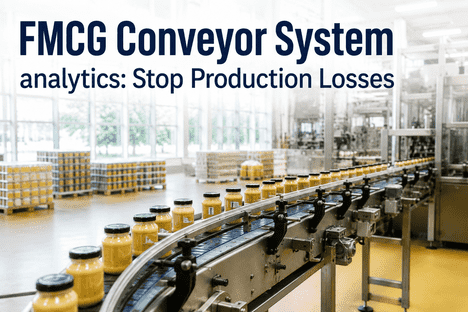
FMCG conveyor systems are the circulatory network of every food, beverage, and consumer goods production plant moving raw ingredients, work-in-progress, packaged goods, and empty containers across filling, capping, labeling, cartoning, and palletizing stations in a continuous synchronized flow. When any section of that network stops, the entire line starves or backs up within seconds. A single belt mistrack on a primary infeed conveyor halts the filler, backs up the depalletizer, idles the capper, labeler, and cartoner downstream, and puts 15 to 25 operators on unproductive standby within 90 seconds. Across FMCG facilities, conveyor failures account for 28 to 35 percent of all unplanned production line stoppages more than fillers, cappers, and labelers combined. Belt mistracking is the most common failure mode, causing accelerated edge wear, belt instability, product spillage, and belt-off-track events that stop the entire line and damage structural components. Splice failures rank second and carry the highest food safety risk: mechanical splice components that shed into product zones create recall-level contamination events that cost 50,000 to 500,000 dollars per incident in recalls and production holds. The food processing conveyor belt market reached 4.2 billion dollars in 2024, reflecting how central this equipment category is to global food manufacturing. Foreign material contamination from belt failures was the number one cause of USDA food recalls in 2025, responsible for 13 out of 42 total recalls affecting over 71 million pounds of product. Despite the stakes, most facilities still manage conveyor maintenance reactively discovering belt tracking problems, worn splices, and seized rollers by the sound they make or the product they contaminate, not by scheduled inspection. iFactory AI converts every conveyor in your facility from a reactive liability into a managed asset with real-time analytics, automated PM scheduling, and predictive failure detection. Book a Demo to see how iFactory's AI monitoring platform predicts conveyor equipment failures weeks before they occur, or to discuss your specific FMCG conveyor maintenance challenges.
Three factors are driving the urgency to adopt conveyor system analytics in FMCG. First, production line speeds continue to increase, with modern high-speed lines running 800 to 1,200 containers per minute, leaving zero tolerance for unscheduled stops. Second, food safety regulations under FSMA, BRC Clause 4.6, and SQF Module 11 now require documented evidence that equipment maintenance is performed according to a written program with corrective actions tracked when findings indicate a risk to food safety. Third, margin pressure in FMCG means every hour of unplanned downtime directly erodes profitability, with costs ranging from 5,000 to 50,000 dollars per hour depending on line speed and product value. The facilities that invested early in conveyor analytics, AI-driven predictive monitoring, and structured PM programs report line availability of up to 98 percent versus the 87 percent industry baseline, with documented conveyor downtime reductions of 35 to 55 percent within the first year alone.
Every Belt, Roller, Drive, and Bearing in Your Conveyor Network Is a Predictable Asset. Track Them All with iFactory AI.
iFactory registers every conveyor as a managed asset with automated PM scheduling, belt tension and tracking analytics, roller health monitoring, drive system diagnostics, splice wear trending, and full compliance audit trails built for FSMA, BRC, SQF, and GMP regulatory frameworks. Real-time AI sensor monitoring delivers predictive failure alerts weeks before the line stops.
Of all unplanned production line stoppages in FMCG facilities are caused by conveyor system failures — more than fillers, cappers, and labelers combined.
$50K
Per hour is the cost of unplanned downtime on a high-speed FMCG production line — driving the business case for predictive conveyor analytics and condition-based maintenance.
98%
Line availability achieved by FMCG facilities with systematic conveyor PM and modular belt management, versus the 87 percent industry baseline.
The Four Pillars of Conveyor System Analytics in FMCG
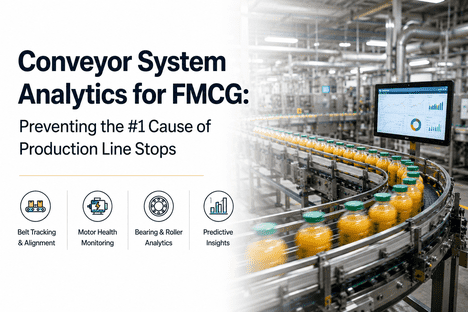
Effective conveyor analytics rests on four integrated monitoring domains. Belt tension and tracking analytics detect lateral drift and tension imbalance before they cause edge damage or belt-off events. Roller alignment and bearing health monitoring identifies failing idlers before they seize and scuff the belt underside. Drive system analytics track motor current, vibration, and thermal signatures that precede gearbox and drive pulley failures. Sanitary conveyor analytics ensure that cleaning cycles, chemical exposure, and belt surface condition remain within food-grade compliance parameters. These four layers function as a single system, and the FMCG plants achieving the highest throughput gains are those that integrate them into a unified analytics platform.
Pillar One
Belt Tension and Tracking Analytics
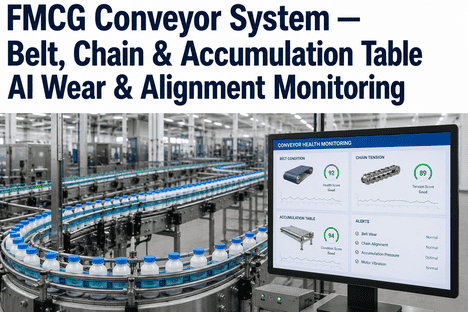
Belt mistracking is the most common conveyor failure in FMCG — and it is entirely preventable with continuous AI optical monitoring. A belt that drifts 5mm from center today will drift 15mm by next week and 30mm the week after, at which point it contacts the frame, shreds the edge, and stops the line. iFactory's AI-driven vision sensors detect lateral drift trends across hundreds of cycles before they breach framing constraints, triggering preventive tensioner recalibration. Belt tension is measured at defined intervals using tensioning tools and adjusted against belt type specifications. Both over-tensioning and under-tensioning compound over time — over-tensioning accelerates bearing and splice wear, while under-tensioning causes slippage that overheats the drive pulley and scorches the belt underside. iFactory correlates tension data with drive motor load readings to maintain optimal tension across all production speeds and load conditions.
Continuous AI optical belt tracking detection
Pillar Two
Roller Alignment and Bearing Health
Misaligned idler rollers cause 60 to 70 percent of belt tracking issues. When an idler is even one to two degrees off-parallel with the head and tail pulleys, it steers the belt toward the high side. One seized roller increases motor load by 8 to 12 percent and creates observable belt wear within weeks. iFactory's acoustic and thermal sensors assign an independent AI health score to every critical idler and roller in the conveyor network. Bearing fatigue inside rollers creates acoustic anomalies long before the roller seizes and strips the belt — localized acoustics identify failing rollers down to the individual bearing, enabling targeted replacement instead of full roller bank changeouts. Roller spin checks, bearing lubrication, and alignment verification are scheduled as PM tasks with documented results stored against each asset record for compliance auditing.
Individual roller bearing health scoring with AI
Pillar Three
Drive System and Motor Diagnostics
Rotary drives — motors, gearboxes, and sprockets — develop vibration and thermal signatures weeks before mechanical failure. iFactory monitors drive torque and current draw continuously across every conveyor motor. FFT vibration analysis on motors and gearboxes detects bearing wear and gear mesh faults weeks ahead. Thermal sensors confirm degradation before failure occurs. Unexplained load spikes are flagged before mechanical failure boundaries are breached. Motor current trending catches mechanical load increases that vibration alone may miss, such as belt tension buildup, product accumulation on return strands, and gearbox drag from lubricant breakdown. When any parameter crosses the learned baseline threshold, iFactory auto-generates a work order with component details, failure type, and estimated time to failure.
Vibration + thermal + current multi-signature monitoring
Pillar Four
Sanitary Conveyor Cleaning Analytics
Food-grade conveyors require H1 food-grade lubricants on all bearings and chains — never standard industrial grease. Belt cleaning must use approved sanitizers compatible with the belt material, as modular plastic belts degrade with certain chlorinated cleaners. iFactory integrates directly with CIP control systems and chemical dosing records to calculate a cumulative chemical exposure index for each belt section. This index is combined with mechanical load hours and operating temperature data to generate a composite belt health score that drives dynamic PM interval adjustment. Post-maintenance sanitation sign-off is captured digitally before production resumes. Cleaning validation tasks are logged with chemical concentration, temperature, contact time, and visual or ATP verification results — satisfying FSMA, SQF, and BRC hygiene monitoring requirements per conveyor, per date, and per shift.
CIP-integrated chemical exposure tracking per belt
The Four-Tier Conveyor PM Schedule
An effective conveyor PM program has four inspection tiers — shift, daily, weekly, and monthly — each targeting different failure modes at different stages of development. The total PM time investment per conveyor is approximately 3.5 hours per month across all four tiers. For a plant with 20 conveyors, that is 70 hours of PM monthly, preventing an average of 15 to 25 unplanned stoppages per month that would otherwise consume 80 to 160 hours of production downtime plus emergency repair labor. The PM-to-downtime ratio is consistently one-to-two or better — every hour of structured PM prevents at least two hours of unplanned downtime. iFactory automates this entire schedule, adjusting intervals based on actual belt hours and production cycles rather than calendar dates, so maintenance tracks real wear instead of elapsed time.
Shift
Belt tracking visual check, drive motor temperature scan, spillage and debris inspection under return strand
Daily
Belt surface and edge condition scan, splice visual inspection, photoeye sensor cleanliness check, guard position verification
Weekly
Roller spin check on all idlers, belt tension measurement, skirt seal inspection, drive belt and chain tension check
Monthly
Bearing lubrication all rollers, splice condition measurement, drive alignment check, motor current trending review
Every Conveyor in Your FMCG Plant Needs a Structured PM Program. iFactory AI Automates It.
iFactory registers every belt, roller, drive, and bearing as a managed asset with manufacturer PM scheduling, real-time sensor monitoring, AI-based failure prediction, and a complete compliance audit trail built for FSMA, BRC, SQF, and GMP environments. Shift, daily, weekly, and monthly inspections are auto-scheduled based on actual belt hours.
Predictive Monitoring: The Three Signals That Predict Conveyor Failure
Beyond structured PM inspections, three data-driven monitoring techniques convert conveyor maintenance from calendar-based to condition-based, intervening based on actual equipment health rather than arbitrary time intervals. Vibration monitoring catches bearing defects earliest — a bearing gives two to six weeks of vibration warning before seizure. Motor current trending catches mechanical load increases that vibration may miss, such as belt tension drift and gearbox drag from lubricant breakdown. Thermal monitoring catches electrical faults and lubrication failures that manifest as heat before they manifest as vibration or current change. A conveyor monitored on all three parameters has virtually zero probability of an undetected catastrophic failure. AI builds equipment-specific baselines across all SKUs, speeds, and loads over two to four weeks, separating real degradation from normal process variation. When a failure threshold is crossed, iFactory auto-generates a work order with component details, failure type, and estimated time to failure. Book a Demo to see how iFactory's AI sensor platform translates conveyor vibration, load, tracking, and thermal data into predicted failure dates.
Deployment Spotlight
FMCG Plant Achieves 98% Line Availability After Conveyor Analytics Implementation
A major FMCG beverage plant operating 24 conveyors across three high-speed filling lines deployed iFactory's AI-powered conveyor analytics platform in 2026. Before implementation, conveyor failures accounted for 31 percent of all unplanned line stoppages — the single largest contributor to the plant's 87 percent OEE. Belt mistracking events on the primary infeed conveyor alone caused an average of 4.2 hours of unplanned downtime per month. Within 90 days of deployment, iFactory's AI sensors detected 17 bearing defects across 11 different conveyors, 4 developing belt splice failures, and 3 drive motor temperature anomalies that would have progressed to catastrophic failure within two to four weeks. The plant's maintenance team replaced the affected bearings and splices during scheduled sanitation windows instead of emergency stoppages. After six months, unplanned conveyor downtime was reduced by 52 percent, line availability increased to 96 percent, and the plant is tracking toward the 98 percent target within 12 months. The conveyor analytics platform achieved full payback in 8 months based on downtime cost avoidance alone.
52%
Conveyor downtime reduction in 6 months
17
Bearing defects detected by AI before failure
8 mo
Full payback on analytics platform investment
Frequently Asked Questions
Traditional time-based preventive maintenance schedules are designed around worst-case assumptions — replacing rollers and belts far earlier than necessary or missing component-specific degradation patterns that do not align with generic PM intervals. AI-powered conveyor analytics eliminates both failure modes by continuously reading actual equipment health through vibration, temperature, current, and acoustic sensors rather than relying on calendar-based guesswork. The system builds equipment-specific baselines across all SKUs, speeds, and loads over two to four weeks, separating real degradation from normal process variation. When a failure threshold is crossed, a work order is auto-generated with component details and estimated time to failure. FMCG plants implementing AI conveyor analytics report 35 to 55 percent fewer unplanned stoppages and 18 to 27 percent reduction in belt replacement costs versus calendar-based PM programs. Book a Demo to see how iFactory's AI monitoring platform predicts conveyor failures weeks before they occur.
iFactory's sensor platform monitors all major conveyor components across belt, roller, drive, and structural categories. Belt sensors track lateral position drift, surface wear, edge fraying, splice integrity, and tension variation using optical sensors and AI vision. Roller and idler monitors use acoustic emission sensors to detect bearing fatigue, vibration accelerometers to identify misalignment, and thermal sensors to flag overheating. Drive system sensors include FFT vibration analysis on motors and gearboxes, current transducers on motor power cables for torque trending, and infrared temperature sensors on drive pulley surfaces. Structural monitoring tracks frame alignment, guide rail positioning, and skirt seal condition. All sensor data is correlated against learned baselines to generate AI health scores per component, with automatic work order generation when thresholds are breached. Talk to an Expert to discuss which sensor configuration fits your conveyor network.
FSMA Preventive Controls, BRC Clause 4.6, and SQF Module 11 all require documented evidence that equipment maintenance is performed according to a written program — with corrective actions taken when maintenance findings indicate a risk to food safety. A conveyor with a worn belt generating debris in a food zone is a physical contamination hazard. iFactory captures every inspection result, every corrective work order, and every technician sign-off with timestamps — creating an audit-ready maintenance record for every conveyor without manual report compilation. For food-contact belts in wet environments, cleaning validation tasks are logged with chemical concentration, temperature, contact time, and visual or ATP verification results. Splice inspection measurements — fastener thickness for mechanical splices, lap opening measurements for vulcanized splices — are captured as custom fields within recurring work orders, building degradation trends that trigger corrective work orders automatically when replacement thresholds are approached. Book a Demo to see how iFactory builds your conveyor compliance audit trail.
Yes — retrofit IoT monitoring for conveyors is now cost-effective and non-invasive. Clip-on vibration sensors attach to roller housings and motor mounts without modification. Infrared temperature sensors monitor motor and gearbox surfaces remotely. Current transducers clip onto motor power cables in the panel. Optical belt tracking sensors mount on existing frame members. Most retrofit installations on a standard FMCG conveyor take two to four hours and require no production stoppage. The sensors connect via wireless gateway to iFactory's cloud platform, which ingests those signals to generate automated work orders when thresholds are breached. iFactory connects via OPC-UA, Modbus, and MQTT protocols — no PLC replacement needed. The result is condition-based maintenance without replacing a functioning conveyor system. Talk to an Expert to discuss your conveyor retrofit requirements.
FMCG manufacturers typically achieve full payback within 6 to 14 months of deploying iFactory conveyor analytics, scaling faster on primary line bottlenecks where downtime costs are highest. The ROI calculation is straightforward: unplanned downtime on a high-speed production line costs 5,000 to 50,000 dollars per hour, and conveyor systems account for up to 35 percent of all unplanned stoppages. Every hour of structured PM prevents at least two hours of unplanned downtime. Plants implementing CMMS-driven PM programs for conveyor assets reduce unplanned stoppages by up to 62 percent in the first year. Beyond downtime reduction, facilities report 18 to 27 percent reduction in belt replacement costs through condition-based versus calendar-based replacement, and 20 to 35 percent reduction in spare parts inventory through optimized stock levels based on predictive failure data. Book a Demo to see the ROI calculation modeled for your conveyor network.
Conclusion
The FMCG conveyor system of 2026 is monitored, measured, and maintained through data — not through reactive firefighting triggered by the sound of a seized bearing or the sight of a shredded belt edge. Belt tension and tracking analytics detect lateral drift before it becomes edge damage. Roller alignment and bearing health monitoring identifies failing idlers before they seize and scuff the belt underside. Drive system diagnostics track motor current, vibration, and thermal signatures that precede gearbox and pulley failure. Sanitary conveyor analytics ensure that cleaning cycles, chemical exposure, and belt surface condition remain within food-grade compliance parameters. And structured four-tier PM programs — shift, daily, weekly, monthly — operating on actual belt hours instead of calendar dates, prevent the 15 to 25 stoppages per month that plague facilities running calendar-based or reactive programs.
The asset management infrastructure that keeps these conveyor systems tracked, maintained, and audit-ready is not optional. iFactory AI provides that infrastructure: asset registration for every belt, roller, drive, and bearing; PM scheduling aligned with manufacturer specifications and regulatory requirements; real-time AI sensor monitoring with predictive failure alerts; splice wear trending with automatic replacement work orders; sanitation and chemical exposure tracking for food-grade compliance; and documented audit trails built for FSMA, BRC, SQF, and GMP environments. Book a Demo to see how iFactory manages FMCG conveyor assets, or Talk to an Expert to begin registering your conveyor network.
Every Product That Moves Through Your FMCG Plant Moves on a Conveyor. Every Conveyor Should Be Tracked Too.
iFactory AI registers every belt, roller, drive, and bearing as a managed asset with real-time sensor monitoring, AI-based failure prediction, PM scheduling, sanitation tracking, and compliance audit trails for FSMA, BRC, SQF, and GMP frameworks. Start preventing production losses before the line stops.