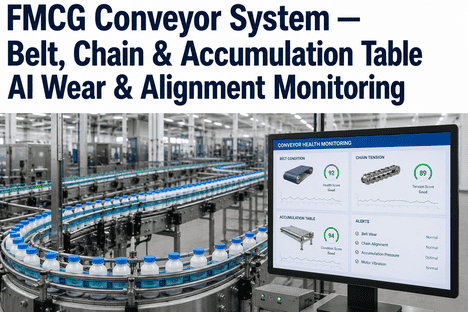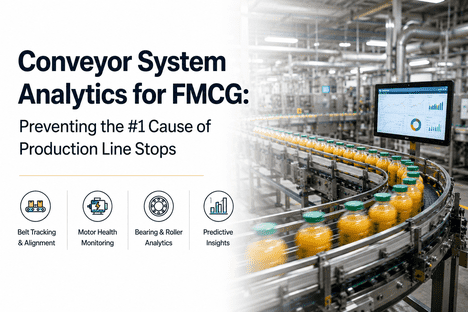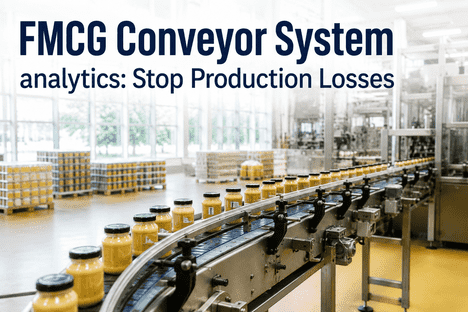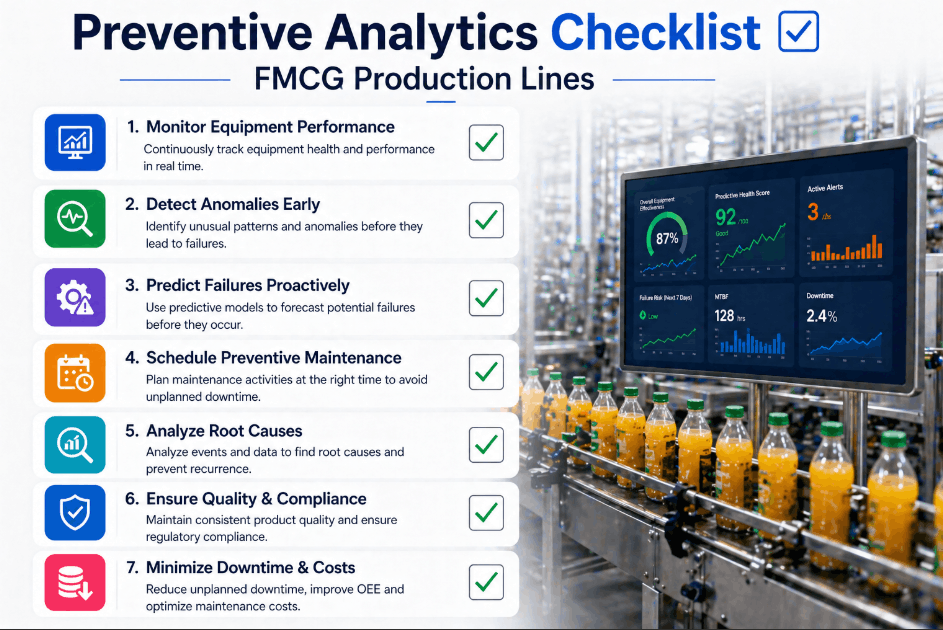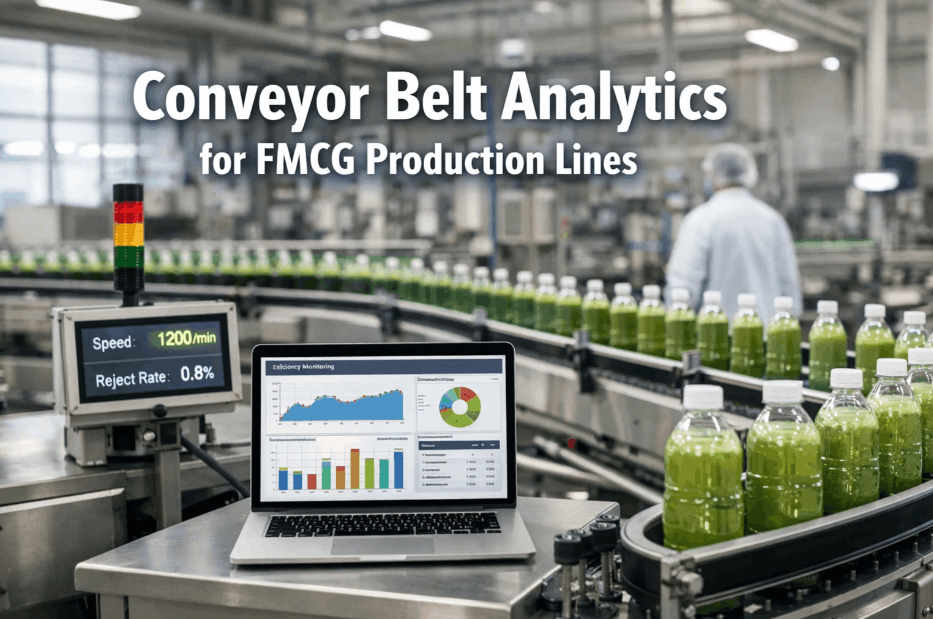
Conveyor belt failures don't announce themselves — they cascade. A worn bearing causes belt drift, an erratic drive motor creates micro-stops, and a seized roller halts the entire material flow before your maintenance team even opens a ticket. For FMCG manufacturers, material handling stoppages directly translate to missed production targets, downstream starvation, and backed-up upstream processes that force machine shutdowns. Conveyor belt analytics powered by AI-driven sensor monitoring changes this equation entirely — shifting your maintenance strategy from reactive firefighting to precision-timed intervention before the line ever goes down. Book a demo to see how iFactory's AI monitoring platform predicts conveyor equipment failures weeks before they occur.
Predict Conveyor Failures Before They Stop Your Production Line
iFactory's AI sensor platform monitors belt tracking, roller health, drive analytics, and motor performance in real time — delivering predictive alerts that prevent costly FMCG material handling stoppages.
Why Conveyor Downtime Is a Compounding Problem in FMCG Manufacturing
Unplanned downtime on a high-speed production line costs FMCG manufacturers between $5,000 and $50,000 per hour — and conveyor systems account for up to 35% of all unplanned stoppages in continuous manufacturing environments. The economic case for conveyor belt analytics FMCG is not theoretical; it is the difference between seamless material flow and chronic margin erosion driven by reactive maintenance cycles.
Traditional time-based preventive maintenance schedules for conveyor machines are designed around worst-case assumptions — replacing rollers and belts far earlier than necessary, or missing component-specific degradation patterns that don't align with generic PM intervals. AI-powered conveyor failure prediction eliminates both failure modes by continuously reading actual equipment health rather than relying on calendar-based guesswork.
The 5 Conveyor Failure Modes AI Sensors Detect First
Conveyor Analytics FMCG works by correlating multi-sensor data streams against learned baseline signatures for each failure mode. These are the five most common — and most costly — failure patterns iFactory's AI monitors across FMCG production lines.
How AI-Powered Conveyor Belt Sensor Monitoring Works in Practice
Implementing conveyor machine predictive analytics requires more than installing sensors. The intelligence layer — AI models trained on physics, failure libraries, and your specific line's operational signature — is what separates actionable predictions from raw data noise.
Multi-Sensor Data Acquisition
IIoT sensors capture data from drives, rollers, and belts at high frequency. iFactory connects via OPC-UA, Modbus, and MQTT — no PLC replacement needed.
AI Baseline Learning
Over 2–4 weeks, AI builds equipment-specific baselines across all SKUs, speeds, and loads. The system separates real degradation from normal process variation.
Predictive Alert & Work Order
When a failure threshold is crossed, iFactory auto-generates a work order with component details, failure type, and estimated time-to-failure.
Continuous Model Improvement
Every confirmed failure and false-positive feeds back into the AI model. Prediction accuracy improves over time, compounding ROI quarter over quarter. Book a demo to see the modeling engine.
Reactive vs. Preventive vs. Predictive Maintenance for Conveyors
Understanding the performance and cost difference between maintenance strategies is essential for building the business case for material handling AI investment. Book a demo to receive a detailed ROI calculation.
| Metric | Reactive Maintenance | Time-Based PM | AI Predictive (iFactory) |
|---|---|---|---|
| Average Downtime per Failure Event | 4–12 hours | 1–3 hours (planned) | Near-zero (intervene before failure) |
| Belt Tracking FMCG Tracking | Visible frame damage | Periodic visual alignment | Continuous AI optical tracking |
| Roller & Belt Replacement Timing | After seizure/tear | Fixed calendar interval | Condition-triggered at optimal point |
| Spare Parts Inventory Requirement | High (emergency buffer) | Moderate | Optimized — 20–35% reduction |
| Drive System Health Visibility | None until failure | Lubrication/inspection only | Continuous vibration + thermal monitoring |
| ROI Payback Period | Negative (costs accumulate) | 12–24 months | 6–14 months typical |
Which FMCG Conveyor Lines Benefit Most from Predictive Analytics
Conveyor failure prediction delivers measurable ROI across all material handling equipment types in FMCG. The highest-value applications share one characteristic: high throughput combined with high downtime cost per hour.
Primary Food & Beverage Lines
High-speed accumulation tables and modular incline belts face the highest downtime cost in continuous processing. iFactory monitors drive overload and tracking drift in real time.
Packaging Feeders & Diverters
High-speed sortation and pop-up diverters experience severe mechanical shock. AI monitoring tuned to pneumatic and servo actuation prevents jamming events before they halt case packers.
Secondary Pallet Handling
Heavy-duty chain conveyors and roller tables dealing with finished pallets operate under immense load. iFactory monitors chain elongation and sprocket wear to ensure outbound logistics never stop.
Raw Material Intake
Bulk material bucket elevators and troughing belts handle massive continuous flow. iFactory gives these systems absolute visibility. Book a demo to secure your bulk handling.
iFactory Conveyor System PM: Platform Capabilities
iFactory's FMCG conveyor monitoring platform integrates sensor intelligence, AI anomaly detection, and maintenance workflow automation into a single operational system — replacing disconnected data sources with actionable predictive insight.
FFT vibration analysis on motors and gearboxes detects bearing wear and gear mesh faults weeks ahead. Thermal sensors confirm degradation before failure occurs.
Acoustic and thermal sensors assign an independent AI health score to critical idlers and rollers. Replace one seized bearing instead of scorching a belt.
AI builds wear progression curves for splice integrity. Drift alerts are triggered to realign tensioners over time, completely avoiding costly edge damage.
AI continuously tracks torque and current draw across the drive belt. Unexplained load spikes are flagged before mechanical failure boundaries are breached.
Availability, throughput, and line starvation data are auto-calculated dynamically instead of utilizing tedious manual spreadsheets.
Predictive alerts auto-generate work orders in SAP PM, Maximo, or iFactory's native CMMS — prepopulated with component, parts, and labor details.
Your Conveyor Line Is Generating Failure Signals Right Now. Are You Reading Them?
iFactory's AI sensor platform translates conveyor belt vibration, load, tracking, and thermal data into predicted failure dates and actionable maintenance work orders — before downtime happens.
How to Implement FMCG Conveyor Monitoring Without Disrupting Flow
The most common barrier to conveyor Analytics FMCG adoption is operational disruption risk during installation. iFactory's phased implementation methodology is designed specifically for 24/7 continuous process environments where stopping the line is rarely an option.
Assessment & Node Mapping
Engineers assess the conveyor flow and identify sensor placement points for each high-torque drive and critical transfer node.
Sensor Installation & Integration
Conveyor belt sensors are installed during scheduled sanitation. Wireless nodes seamlessly integrate with existing PLC architectures locally.
AI Baseline Tuning
AI builds belt-specific baselines across varying weights and speeds. Anomaly detection goes live and is automatically refined through mechanic feedback.
Full PdM Operations
Auto work orders, tracking reports, and spare parts optimization go live permanently. Monthly reviews drive continuous algorithm improvement steadily.
Conveyor Belt Analytics: Frequently Asked Questions
Stop Letting Material Flow Failures Define Your Production Output.
iFactory's AI-powered conveyor system PM monitors every roller, drive, bearing, and belt track in real time — delivering predicted failure dates and auto-generated work orders that keep your FMCG material handling running smoothly.