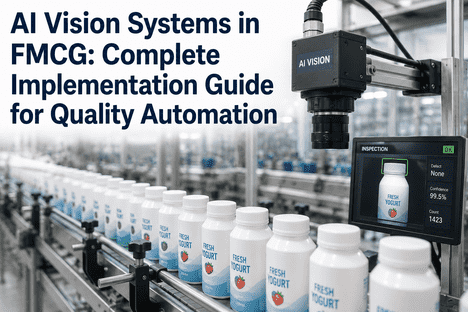
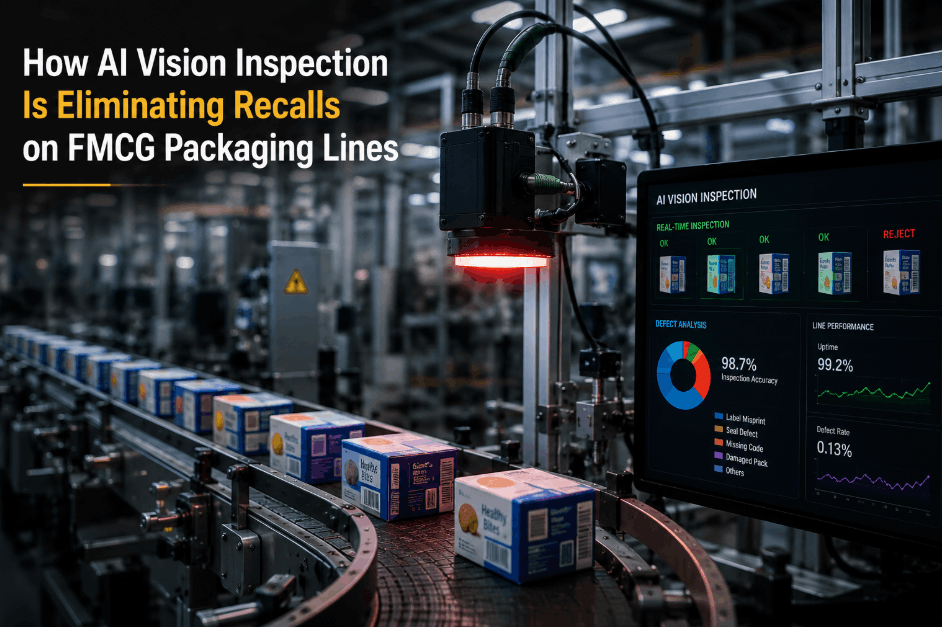
A third-shift maintenance technician at a high-speed snack foods plant notices the AI vision system has been flagging false rejects at 4.3% for the past two hours — twice the acceptable rate. The camera housing is warm to the touch, the LED ring light has shifted 200 Kelvin in colour temperature since the morning calibration, and a fine layer of seasoning dust has accumulated on the lens protective window. Nobody logged the last cleaning cycle because the PM schedule is still paper-based. By the time the line supervisor reviews the shift report the next morning, 14,000 bags of product have been unnecessarily rejected — and 600 bags with genuine seal defects slipped past the degraded vision system into the warehouse. That single drift event costs $22,000 in rework, wasted packaging, and potential retailer chargebacks. Across the plant floor, six AI vision cameras from three different OEMs run on disconnected maintenance schedules with no unified analytics platform to track calibration drift, cleaning compliance, or model accuracy degradation over time. Vision system performance is treated as a binary — it works or it doesn't — when in reality every component in the imaging chain degrades continuously from the moment it is commissioned.
AI VISION · CALIBRATION · FMCG PRODUCTION
Your Vision System Is Degrading Every Shift — Are You Tracking the Drift?
iFactory connects every AI vision camera across your FMCG lines into a single analytics platform — tracking calibration health, cleaning compliance, lighting stability, and model accuracy in real time.
Why Vision System Calibration Drift Is an Invisible Cost Centre on Every FMCG Line
AI vision inspection systems are the most sensitive instruments on a modern FMCG production line — and the most neglected. Unlike checkweighers or metal detectors that generate daily QC reports, vision systems are treated as set-and-forget appliances. The reality is that every optical component in the imaging chain — lens, sensor, illumination, housing window — degrades measurably from the moment it is installed. Lens coatings accumulate micro-abrasions from daily cleaning. LED illuminators lose 10–20% of their output intensity over 10,000 operating hours. Sensor quantum efficiency drifts with temperature cycling. The housing window that protects the camera from splashes and dust develops a film that attenuates specific wavelengths unevenly. Each of these degradations shifts the image that reaches the AI model — and when the model receives an image that differs from its training distribution, detection accuracy drops, false positives rise, and genuine defects go undetected.
How Vision System Accuracy Degrades — From Clean Calibration to Costly Failure
Factory Calibration
Vision system commissioned with reference targets. Lighting, focus, and colour matrix calibrated to OEM specification. Detection accuracy at 99.7%.
Environmental Drift
Lens window accumulates process residue. LED intensity drops 3–5%. Sensor temperature shifts colour response. Accuracy drifts to 98.1%.
False Reject Surge
Accuracy drops below 96%. False reject rate exceeds 3%. Line operators begin overriding vision decisions. Real defects start slipping through.
Detection Failure
Customer complaint spike triggers investigation. Vision system found operating at 91% accuracy. Root cause: 14 weeks of unmonitored calibration drift.
Industry finding: Vision system accuracy degrades at an average rate of 0.5–0.8% per week in FMCG environments without active calibration monitoring. Most plants do not detect the degradation until accuracy has fallen below 95% — at which point the cost of missed defects and false rejects has already accumulated for 8–12 weeks.
Seven Components of a Vision System That Require Active Calibration Management
A vision inspection system is not a single instrument — it is an optical chain of seven independent components, each with its own degradation curve, calibration frequency, and failure mode. Effective calibration management means tracking all seven, not just the camera sensor.
01
Illumination System
LED ring lights, backlights, and structured light projectors degrade in intensity and colour temperature over time. A 10% drop in illumination intensity reduces the signal-to-noise ratio available to the AI model, directly impacting defect detection sensitivity. Spectral shift — particularly in white LEDs where the blue channel degrades faster than yellow — changes the colour space the model sees, causing false colour-based rejections.
02
Lens & Optical Path
Lens coatings accumulate micro-scratches from cleaning. Focus can shift due to thermal expansion and vibration. The protective window between lens and production environment develops process-specific films — oil mist, sugar dust, starch, seasoning particles — that attenuate and scatter light unevenly across the field of view. These films are often invisible to the human eye but measurably change the image the model receives.
03
Image Sensor
CMOS and CCD sensors exhibit pixel drift, dark current variation with temperature, and sensitivity degradation over their operating life. A sensor running continuously at 45°C — common in enclosed vision system enclosures on FMCG lines — will show measurable quantum efficiency loss within 6 months. Temperature-compensated calibration routines are essential to maintain consistent sensor response.
04
Colour Calibration Matrix
The colour matrix that maps raw sensor RGB values to the standardised colour space used by the AI model drifts as the illumination spectrum shifts and the sensor ages. A calibration target measured at weekly intervals reveals colour space drift of 2–5 Delta E per month in uncontrolled environments. Beyond 8 Delta E of drift, colour-based defect detection — browning, ripeness, scorching — becomes unreliable.
05
AI Model Confidence Thresholds
The AI model's classification confidence for each defect type must be continuously validated against ground-truth QC data. As the incoming image distribution drifts due to optical degradation, a model that was 99% confident in seal defect detection at calibration may drop to 92% confidence without any change to the model weights themselves. Confidence drift is often the earliest warning sign of optical chain degradation.
06
Trigger & Timing Synchronisation
Vision systems on high-speed FMCG lines rely on precise trigger timing from encoders, proximity sensors, or the line PLC. Timing drift of even 2 milliseconds at 600 units per minute causes the camera to capture the image 20 mm downstream of the expected position — cropping the product or capturing the gap between products. Periodic trigger latency verification is essential but rarely performed outside OEM annual service.
07
Communication & Data Pipeline
The pipeline that carries inspection images and results from the vision system to the plant network introduces its own degradation sources — packet loss on Ethernet connections, database write latency, and image compression artefacts. A 0.1% packet loss rate can cause one image per thousand to arrive corrupted, silently reducing the effective inspection rate without triggering any system alarm.
CALIBRATION HEALTH · ACCURACY TRACKING · CENTRALISED DASHBOARD
You Can't Manage What You Don't Measure — Centralise Your Vision System Analytics
iFactory aggregates calibration data, cleaning logs, accuracy metrics, and model confidence scores from every vision system on your FMCG lines into a single dashboard — alerting you to drift before it costs you production.
Three Costly Consequences of Unmanaged Vision System Degradation
When vision system calibration drift goes unmonitored, the financial impact accumulates across three distinct cost centres — each large enough on its own to justify a centralised calibration analytics platform.
$
False Reject Waste
As calibration drifts, the vision system begins rejecting good product. A 2% increase in false reject rate on a line running 400 units per minute translates to 11,520 units falsely rejected per shift. At $0.12 per unit material cost, that is $1,382 per shift — $414,000 per year per line in wasted product, packaging, and reprocessing labour.
Cost per line per year
$400K–$500K
$
Missed Defect Escalation
When false rejects rise, line operators often respond by raising the AI model's confidence threshold — reducing false rejects but also allowing genuine defects to pass. A 3% drop in true positive rate on seal integrity inspection means 300 defective packages per shift reach the warehouse. Each retailer chargeback for a seal failure averages $4,500, and a single contamination incident can trigger a $500K+ recall event.
Risk per incident
$4.5K–$500K
$
Emergency Service & OEM Call-Outs
When a vision system degrades to the point of line stoppage, the standard response is an emergency OEM service call — $2,500–$4,000 per visit plus lost production time. Plants without centralised calibration analytics typically require 6–10 emergency service calls per year per line, most of which could have been prevented with routine calibration monitoring and predictive maintenance scheduling.
Annual emergency service cost
$15K–$40K per line
How iFactory Centralises Vision System Calibration Analytics Across Your FMCG Lines
iFactory's AI Vision Camera module connects to every vision system on your production floor — regardless of OEM, communication protocol, or camera model — and aggregates calibration health, cleaning compliance, accuracy metrics, model confidence, and service history into a single analytics dashboard. The platform provides five capabilities that transform vision system calibration from a reactive, paper-based process into a data-driven, predictive operation. Book a Demo to see how centralised calibration analytics works across a live FMCG production environment.
Capability 1
Multi-OEM Camera Aggregation
One dashboard for every camera brand
iFactory connects to Cognex, Keyence, Teledyne Dalsa, Omron, Banner, SICK, and Basler cameras via GigE Vision, USB3 Vision, Camera Link, or OEM-specific APIs. Each camera's calibration status, cleaning schedule, accuracy metrics, and model confidence scores are displayed on a single pane of glass — no more logging into six different OEM software tools to understand the health of your vision fleet.
GigE Vision
USB3 Vision
Camera Link
OEM REST APIs
Capability 2
Real-Time Calibration Health Scoring
Continuous drift detection per camera
Each camera receives a calibration health score from 0–100 based on illumination stability, focus sharpness, colour matrix deviation, sensor temperature, and model confidence trend. When any metric crosses a configurable threshold, iFactory generates an alert with the specific component that requires attention — not a generic "calibration needed" message, but a targeted notification like "Camera 4B: LED ring light intensity down 12%. Schedule illuminator replacement within 72 hours."
Illumination intensity
Colour matrix drift
Focus sharpness
Model confidence trend
Capability 3
Cleaning & PM Compliance Tracking
Digital records for every maintenance action
Every lens cleaning, filter replacement, illuminator change, and calibration verification is logged digitally with operator ID, timestamp, before-and-after calibration scores, and component serial numbers. iFactory tracks compliance against your OEM-recommended PM schedule and alerts supervisors when cleaning intervals are missed. For audit purposes, the complete maintenance history of every vision system — from installation to latest calibration — is available in under 30 seconds.
Digital cleaning logs
PM compliance tracking
OEM schedule sync
Audit-ready history
Capability 4
Model Accuracy & Drift Analytics
Continuous validation against QC ground truth
iFactory continuously validates each vision model's classification accuracy against QC lab results and manual inspection data. When model confidence for a specific defect class drops below a configurable threshold — or when the false reject rate for a specific product SKU rises above target — the platform alerts the quality team and recommends either a calibration intervention, a lighting adjustment, or a model retraining cycle with fresh labelled data from current production conditions.
Confidence drift alerts
False reject rate tracking
Ground-truth validation
Retraining triggers
Capability 5
Predictive Service Scheduling
Replace components before they fail
By tracking the degradation trajectory of each camera component — LED intensity decay rate, lens coating degradation, sensor sensitivity loss — iFactory predicts when each component will fall below acceptable performance and schedules pre-emptive replacement during planned maintenance windows. This eliminates emergency OEM call-outs and ensures vision system accuracy never drops below 98% between service intervals.
LED life forecasting
Component degradation curves
PM window optimisation
Emergency call elimination
"
We had fourteen Cognex and Keyence cameras across five lines, each with its own cleaning schedule in a spreadsheet maintained by the shift supervisor. When we connected them to iFactory, the first thing we saw was that three cameras had been running with illumination below 80% of factory spec for over a month — and nobody knew because each OEM tool only showed its own cameras. The aggregated calibration health dashboard paid for itself in the first week.
— Engineering Manager, Snack Foods Manufacturer — 4 Production Lines, 14 AI Vision Cameras
Measurable Outcomes from Centralised Vision Analytics
These results reflect iFactory deployments across FMCG plants using AI vision inspection systems from multiple OEMs on 2–8 production lines each. Book a Demo to see how your vision fleet compares.
False Reject Reduction
73%
Drop in false rejects within 30 days of implementing real-time calibration health monitoring
Calibration Time
65%
Reduction in per-camera calibration time when digital logs guide technicians to the specific component needing adjustment
Emergency Service Calls
82%
Elimination of emergency OEM call-outs after predictive component degradation alerts enable planned replacements
Model Accuracy Uptime
98%+
Vision model accuracy maintained above 98% continuously after centralised drift monitoring is active
Frequently Asked Questions
Your Vision Systems Are Drifting Every Shift — But You Only See the Cost When It's Too Late
iFactory centralises calibration analytics, cleaning compliance, and model accuracy monitoring for every AI vision camera on your FMCG lines — detecting drift before it costs you false rejects, missed defects, and emergency service calls. Connect your first camera in days, not weeks.