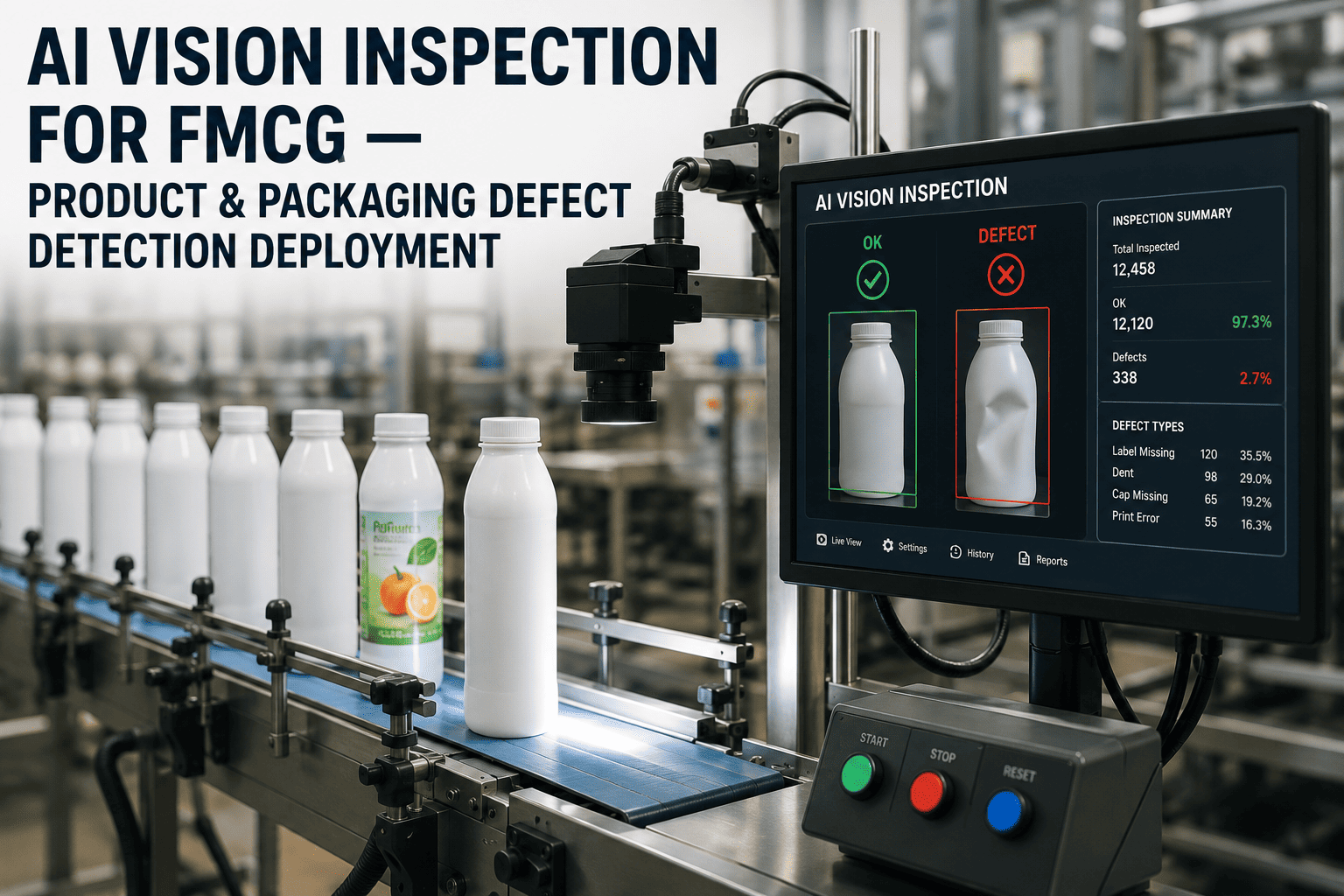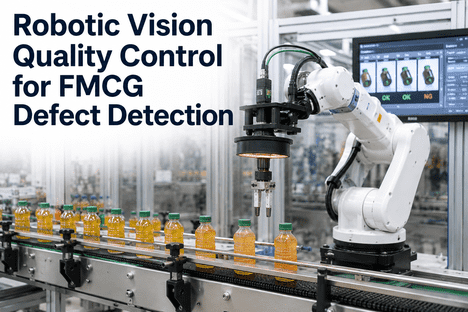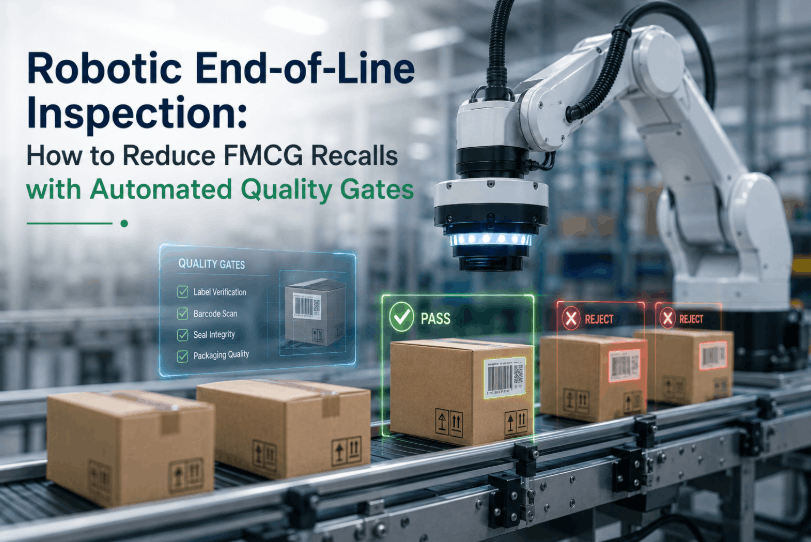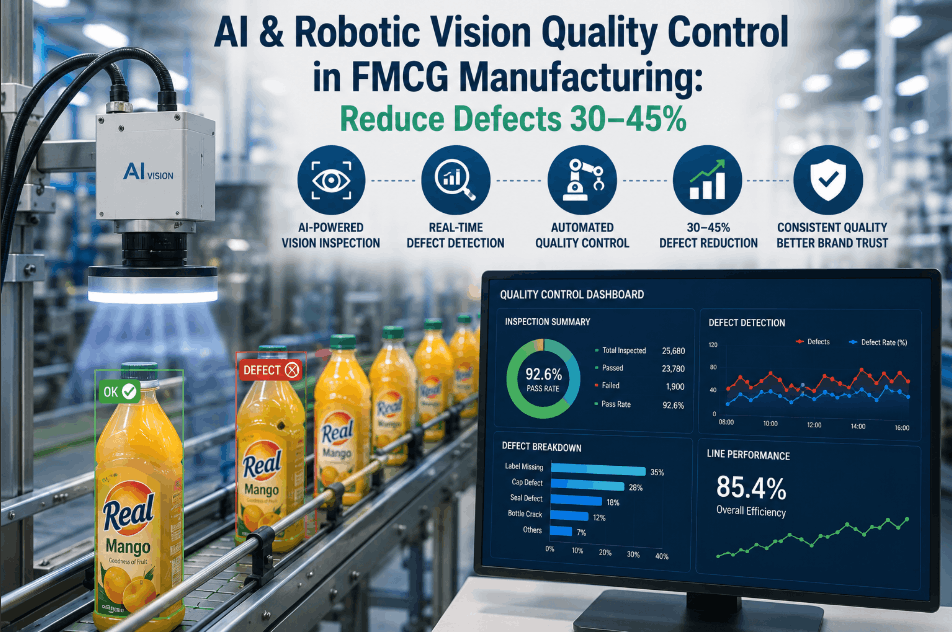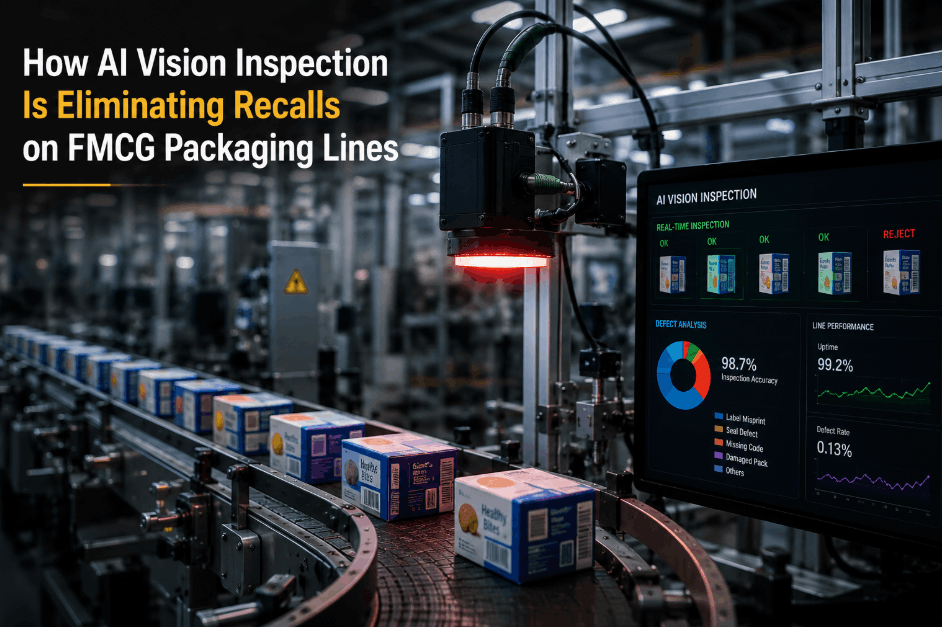
AI vision inspection is rapidly becoming the single most decisive technology for eliminating product recalls on FMCG packaging lines. With consumer goods plants operating at line speeds of 800–1,200 units per minute, even a 0.2% defect escape rate translates to thousands of compromised packs reaching retail shelves every shift. Modern AI-powered vision inspection systems — driven by deep learning, high-frame-rate cameras, and edge analytics — now detect packaging defects with 99.8% accuracy, virtually eliminating the most common causes of consumer-facing recalls. Manufacturing teams that book a demo with iFactory consistently see a 70–80% reduction in recall events within the first six months of deployment.
Eliminate Packaging Recalls With Real-Time AI Vision Inspection
iFactory's AI vision integration captures every pack at full line speed — detecting label, seal, fill, and date code defects before product leaves the line.
Why FMCG Packaging Recalls Are a Vision-Solvable Problem
More than 60% of FMCG recalls trace back to packaging defects rather than core product quality failures — missing or unreadable date codes, incorrect labels, compromised seal integrity, foreign object contamination, and under-fill or over-fill conditions. These are precisely the defect categories where AI vision inspection systems outperform human operators, traditional rule-based machine vision, and statistical sampling programs. A modern packaging defect detection platform inspects every single unit at full line speed, generating an immutable visual record that satisfies retailer compliance audits and regulatory traceability requirements simultaneously. Plants that book a demo with iFactory typically discover that their existing quality inspection AI gaps are concentrated in three or four high-impact defect categories — making the return on AI vision deployment unusually fast to realize.
Label Inspection
Misaligned, missing, wrong-SKU, or smudged labels are the single largest cause of mass-market FMCG recalls. AI vision validates every label against the master image, character-by-character.
Seal Integrity
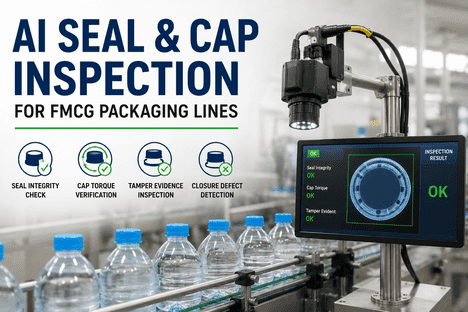
Compromised seals on flexible packaging, blister packs, and beverage closures trigger costly consumer-safety recalls. Vision AI detects wrinkles, leaks, and incomplete heat seals in real time.
Date Code Verification
Illegible, missing, or incorrect best-before codes are a top regulatory citation. OCR-driven vision systems verify every printed code with sub-millimeter accuracy at line speeds above 1,000 ppm.
Fill Level Validation
Under-fill triggers consumer complaints and weight-and-measures violations; over-fill destroys margin. AI vision validates fill height to ±0.5 mm without slowing the filler.
How AI Vision Inspection Works on a High-Speed FMCG Line
Modern machine vision FMCG deployments combine four layers of technology working together at production speed: optical capture, edge inference, defect classification, and reject actuation. Unlike rule-based vision systems of the past — which required hand-tuned thresholds for every SKU and broke whenever lighting, label artwork, or substrate changed — deep-learning vision models generalize across variants, learn from edge cases, and continuously improve as more inspected images flow into the model retraining pipeline. Engineers who book a demo with iFactory walk through a live inspection pipeline that processes 1,200 units per minute on a single inspection station.
Capture
High-speed line-scan and area cameras with strobed LED illumination freeze every pack at line speed, generating up to 1,200 inspection-grade images per minute per station.
Edge Inference
On-device neural networks classify each pack within 8–15 ms — far faster than the pack interval — eliminating dependence on cloud latency for reject decisions.
Classification
Detected anomalies are tagged by defect category, severity, and root cause hint — feeding both the immediate reject action and the longer-horizon analytics dashboard.
Reject + Learn
Defective packs are diverted within milliseconds; the labeled image is logged to the training dataset, continuously improving model accuracy on edge cases.
The Five Highest-Impact Packaging Defect Categories AI Vision Catches
Not every packaging defect carries equal recall risk. Quality teams deploying computer vision manufacturing systems on FMCG lines see the greatest ROI when inspection priority is sequenced against defect severity, frequency, and downstream consumer impact. The following defect categories represent the five highest-impact targets where AI vision inspection consistently delivers measurable recall reduction within the first deployment quarter.
Wrong-SKU Label Application
A label intended for one product applied to a different SKU is the single most expensive packaging recall scenario — particularly when allergen declarations are mismatched. AI vision validates each label against the active production order, blocking wrong-SKU events at the source rather than discovering them at retail.
Missing or Unreadable Date Codes
Inkjet coder failures, ribbon exhaustion on thermal transfer printers, and substrate misalignment all produce date codes that fail retailer scanning at goods-in. Vision OCR catches every illegible code in real time, triggering both reject and an alert to the coder operator.
Seal Integrity Failures
Flexible packaging seal failures account for a disproportionate share of consumer complaints. Multi-angle vision inspection identifies wrinkles, channel leaks, and incomplete heat seals at line speed — without the throughput penalty of leak testers.
Foreign Object Detection
Plastic fragments, label backing, and stray packaging waste inside primary packaging are catastrophic recall triggers. Vision systems trained on contamination datasets flag anomalies invisible to operators on a fast-moving line.
Fill Level and Weight Anomalies
Vision-based fill validation works in parallel with checkweighers — catching see-through bottle under-fills, cap height variations, and meniscus anomalies that mass-only inspection misses entirely.
Traditional Machine Vision vs AI-Driven Vision Inspection
The performance gap between legacy rule-based machine vision and modern AI vision inspection is large enough to redefine what is achievable on a high-speed packaging line. Plants that have run traditional vision systems for a decade or more often assume the technology has plateaued — until they see a deep-learning inspection model handle artwork variants, lighting changes, and edge-case defects that previously triggered constant operator intervention. Teams that book a demo with iFactory walk through the comparison below using their own line conditions and defect history.
| Capability | Traditional Rule-Based Vision | AI-Driven Vision Inspection |
|---|---|---|
| Defect Detection Accuracy | 85–92% on trained defects; drops sharply on variants | 99.5–99.8% across trained and novel defect classes |
| Line Speed Handling | 400–700 ppm reliable; degrades with SKU complexity | 1,200+ ppm sustained with multi-SKU artwork sets |
| SKU Changeover Time | 30–90 minutes per SKU; manual threshold tuning required | Under 5 minutes; model recognizes SKU from artwork |
| False Reject Rate | 2–5%; high giveaway and operator alarm fatigue | Under 0.3%; minimal good-product rejection |
| Adaptation to New Defects | Requires reprogramming and revalidation | Continuous learning from labeled production images |
| Recall Prevention Impact | Catches obvious defects; misses subtle anomalies | 70–80% reduction in packaging-driven recall events |
See AI Vision Inspection Running on a Live FMCG Packaging Line
Walk through real defect captures, classification accuracy, and reject analytics across label, seal, date code, and fill inspection stations.
How AI Vision Inspection Integrates With Existing FMCG Line Architecture
A common concern from packaging engineers is that AI vision inspection requires line replacement or major control system upgrades. In practice, modern vision platforms integrate as an overlay on existing infrastructure — communicating with PLCs over standard industrial protocols, triggering existing reject mechanisms, and feeding inspection data into the plant analytics layer without disrupting the underlying control architecture. Plants that book a demo with iFactory get an integration map specific to their line OEM combinations and existing reject station hardware.
AI Vision Inspection for FMCG Packaging: Frequently Asked Questions
What is the typical accuracy of AI vision inspection on FMCG packaging lines?
Production-grade AI vision systems consistently achieve 99.5–99.8% defect detection accuracy across label, seal, date code, and fill validation tasks — significantly outperforming both human visual inspection and legacy rule-based machine vision systems.
Can AI vision keep up with line speeds above 1,000 units per minute?
Yes. Edge-inference vision platforms process individual pack images in 8–15 milliseconds, comfortably handling 1,200+ units per minute on a single inspection station — without compromising defect detection accuracy or reject timing.
How long does it take to deploy AI vision inspection on an existing packaging line?
A standard deployment on an existing line typically takes 4–8 weeks from site survey to full production validation. Integration uses standard PLC communication protocols and existing reject mechanisms, avoiding any need to replace upstream packaging equipment.
Does AI vision inspection require labeled defect images to train the model?
Initial deployment uses pre-trained models for standard defect categories. Site-specific edge cases are then captured during live production and added to the training set — continuously improving accuracy without requiring large labeled image collections upfront.
What is the typical ROI timeline for AI vision inspection on FMCG lines?
Most FMCG plants reach full ROI within 6–12 months — driven by recall prevention, reduced retailer chargebacks, lower scrap from earlier defect detection, and elimination of dedicated end-of-line manual inspection roles.
Ready to Eliminate Packaging Recalls With AI Vision Inspection?
iFactory's AI vision platform delivers end-to-end packaging defect detection across label, seal, date code, fill, and foreign object inspection — at full FMCG line speeds with 99.8% accuracy.