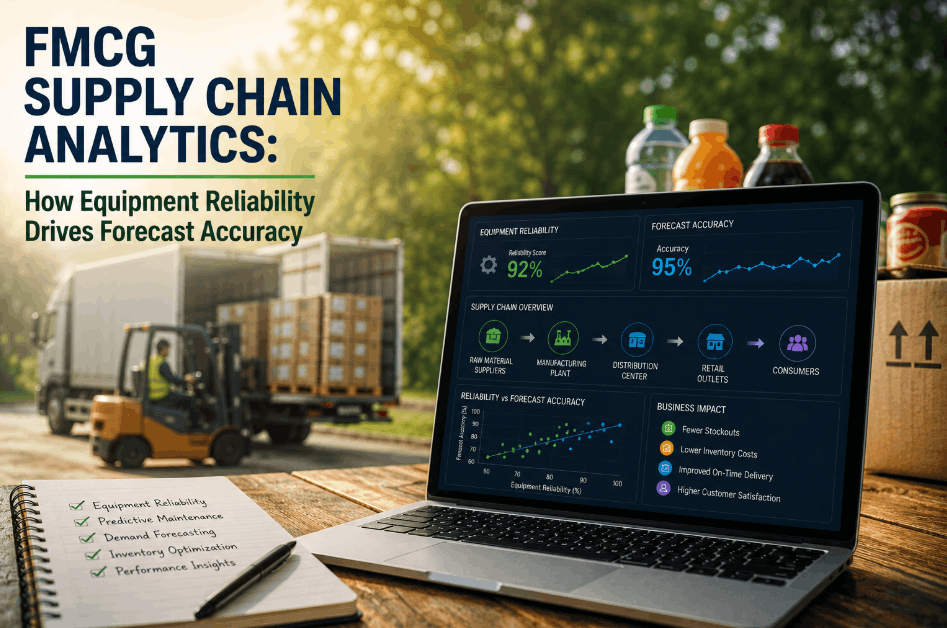
In today's hyper-competitive FMCG landscape, supply chain analytics is no longer a back-office function — it is the operational backbone of profitable growth. Yet most FMCG manufacturers overlook the single most powerful input to accurate demand forecasting: equipment reliability data. When production lines run unpredictably, every downstream plan — inventory replenishment, distribution scheduling, retailer commitments — is built on an unstable foundation. The facilities that achieve 20–50% improvements in forecast accuracy are not simply running better analytics software; they are feeding their planning systems with real-time production capacity data derived from reliable, well-monitored assets. If your supply chain visibility still excludes plant-floor reliability signals, Book a Demo to see how iFactory closes the gap between production reliability and supply chain performance.
Why FMCG Supply Chain Analytics Fails Without Equipment Reliability Data
Most FMCG supply chain analytics platforms are designed to consume demand signals — retailer POS data, promotional calendars, seasonal indices — and translate them into production and inventory plans. What they rarely consume is the one variable that determines whether those plans are executable: the actual, real-time capacity of the production assets that will fulfill them.
When a high-speed filling line, a mixing vessel, or a packaging unit operates unpredictably — experiencing unplanned stoppages, speed losses, or quality deviations — the supply chain plan built around its assumed capacity instantly becomes fiction. Safety stock buffers widen to absorb unpredictability. Replenishment cycles lengthen. Customer service levels decline. The cost compounds silently across every layer of the supply chain. The fix is not a larger safety stock policy — it is connecting equipment reliability data directly into the supply chain analytics loop, so that capacity planning reflects what the plant can actually produce rather than what it was theoretically designed to produce. To understand how iFactory enables this connection, Book a Demo with our supply chain integration team.
Unreliable Capacity Inputs
When equipment OEE data is excluded from demand planning systems, capacity inputs default to theoretical nameplate values — often 20–35% higher than actual sustained throughput. Every plan built on inflated capacity is a plan designed to fail under real production conditions.
Root CauseReactive Inventory Buffering
Safety stock levels set without visibility into equipment health trends compensate for unpredictability with excess inventory — tying up working capital, increasing spoilage risk for perishable FMCG categories, and masking the true reliability cost of aging or poorly maintained assets.
Downstream EffectForecast Bias Accumulation
Planning teams that routinely miss production targets begin applying subjective bias adjustments to capacity forecasts — a practice that introduces systematic error into demand planning cycles and reduces the statistical validity of every downstream supply chain model.
Planning FailureCustomer Service Degradation
Unplanned production stoppages that were not predicted — and therefore not buffered — translate directly into stockouts, late shipments, and retailer chargebacks. For FMCG manufacturers operating on thin margins, each service failure carries a disproportionate financial and reputational cost.
Business ImpactHow Equipment Reliability Data Transforms Demand Forecasting Accuracy
The relationship between equipment reliability and supply chain analytics is not theoretical — it is a direct, quantifiable input-output relationship. Real-time OEE data, predictive maintenance alerts, and asset health scores are, fundamentally, capacity confidence metrics. When integrated into demand planning and inventory management systems, they convert supply chain forecasts from probabilistic guesses into data-driven commitments.
FMCG manufacturers who have implemented reliability-integrated supply chain analytics consistently report forecast accuracy improvements of 20–50% within the first two quarters of deployment. The mechanism is straightforward: when planners know that Line 3 is trending toward a bearing failure in the next 14 days and will require a 6-hour maintenance window, they plan around it rather than discovering it as an emergency stoppage. You can explore this integration in your specific production environment by choosing to Book a Demo with our reliability and planning specialists.
Real-Time OEE as a Capacity Signal
Continuous OEE measurement replaces static nameplate capacity assumptions with dynamic, asset-level throughput data. When integrated into supply chain planning systems, live OEE feeds enable planners to adjust production schedules, prioritize SKUs, and re-sequence changeovers based on actual asset performance — not theoretical throughput models that bear no relation to current plant conditions.
Predictive Maintenance Windows in Production Planning
AI-generated failure predictions with 2–6 week lead times allow supply chain teams to pre-build inventory buffers ahead of planned maintenance windows — eliminating the difference between a managed, planned stoppage and an emergency stockout event. Predictive maintenance data converted into scheduled capacity constraints is one of the highest-ROI integrations available in modern FMCG supply chain analytics.
Reliability-Adjusted Safety Stock Optimization
Traditional safety stock calculations use historical demand variability as their primary input. Reliability-adjusted models incorporate asset health trends, seasonal failure patterns, and equipment age profiles to set scientifically defensible stock levels — reducing excess inventory in stable periods and proactively building buffers when reliability data indicates elevated risk. This approach typically reduces total inventory carrying costs by 12–18% while simultaneously improving fill rates.
Supply Chain Analytics Performance: With vs. Without Equipment Reliability Integration
The performance differential between FMCG supply chains that integrate equipment reliability data and those that operate on traditional demand-signal-only planning is measurable across every key supply chain metric. The table below quantifies the impact across the dimensions that matter most to supply chain directors, operations VPs, and CFOs evaluating a reliability-integrated analytics investment.
| Supply Chain Metric | Traditional Analytics (Demand-Only) | Reliability-Integrated Analytics | Performance Gain |
|---|---|---|---|
| Forecast Accuracy | 55–70% (demand signal only) | 75–90% (reliability-adjusted) | +20–50% improvement |
| Unplanned Stockout Events | High frequency (reactive gaps) | Significantly reduced (predicted) | –40% stockout frequency |
| Safety Stock Levels | Inflated (unpredictability buffer) | Optimized (reliability-calibrated) | –12–18% inventory costs |
| Production Plan Adherence | 65–75% (reactive adjustments) | 88–95% (predictive scheduling) | +25% plan adherence |
| Customer Service Level | Variable (equipment-driven gaps) | Consistent (capacity-assured) | +8–12% OTIF improvement |
| Capacity Utilization Visibility | Theoretical (nameplate assumptions) | Live (OEE-based actuals) | Real-time decision accuracy |
Six Supply Chain Analytics Capabilities Powered by Equipment Reliability Data
iFactory's supply chain integration platform is engineered around the six capabilities that most directly close the gap between production floor reliability and supply chain plan accuracy. Each capability is designed to deliver measurable impact on forecast accuracy, inventory optimization, and customer service levels within the first production quarter. To see a live demonstration mapped to your facility's asset mix and SKU complexity, Book a Demo with our supply chain team.
Live Capacity Planning Dashboard
Real-time OEE data feeds directly into production capacity models — replacing static throughput assumptions with live, asset-level output rates that reflect actual plant conditions across every shift and production line.
Predictive Maintenance Scheduling Integration
AI-generated maintenance window predictions integrate with production scheduling tools to plan stoppages during low-demand periods — converting unpredictable downtime into planned capacity constraints visible to the entire supply chain team.
Reliability-Adjusted Demand Forecasting
Supply chain planning models automatically incorporate asset health trends, seasonal failure risk, and equipment age profiles into demand-to-capacity matching — producing forecasts that account for production variability as well as demand variability.
Dynamic Safety Stock Optimization
Safety stock policies recalibrate automatically based on real-time equipment health scores — reducing excess buffer inventory during high-reliability periods and proactively building strategic stock when predictive models flag elevated downtime risk.
Multi-Site Capacity Visibility
Network-level supply chain planning gains full visibility into the real-time production capacity and reliability status of every manufacturing site — enabling intelligent work order allocation, load balancing, and risk-based production routing across multi-plant FMCG networks.
ERP and S&OP Integration
Reliability and OEE data integrates directly with existing ERP and Sales & Operations Planning platforms — ensuring that the monthly S&OP cycle is built on real production capacity data rather than outdated static assumptions that no longer reflect plant performance.
The Financial Return: How Reliability-Integrated Supply Chain Analytics Pays for Itself
The Compounding ROI of Connecting Production Reliability to Supply Chain Planning
The financial return from integrating equipment reliability data into FMCG supply chain analytics compounds across three distinct value layers. Supply chain directors who implement reliability-integrated planning consistently find that the initial investment is recovered within the first avoided major stockout event — after which every subsequent cycle of improved forecast accuracy, reduced safety stock, and higher plan adherence compounds the return. To model the ROI specific to your supply chain network, Book a Demo and receive a network-specific financial projection.
Immediate: Stockout Avoidance & Service Recovery
A single major FMCG stockout event — accounting for lost revenue, retailer chargebacks, emergency production costs, and expedited freight — frequently exceeds the annual cost of a reliability-integrated analytics platform. Preventing even one production-driven service failure delivers a compelling single-event ROI that justifies the full investment in months, not years.
Short-term value driverIntermediate: Inventory Optimization & Working Capital Release
Reliability-adjusted safety stock policies consistently reduce inventory carrying costs by 12–18% while maintaining or improving customer service levels. For FMCG manufacturers carrying significant finished goods inventory, the working capital released by scientifically optimized stock policies represents a medium-term return that compounds with every inventory review cycle.
Medium-term growth driverLong-Term: Structural Forecast Accuracy & Network Efficiency
As the platform accumulates operational history and reliability trend data, forecast accuracy compounds — improving the statistical validity of demand-to-capacity matching across multi-year planning horizons. FMCG manufacturers that achieve 85%+ forecast accuracy through reliability integration gain a structural competitive advantage in retailer relationships, promotional planning, and network capacity investment decisions.
Long-term capital efficiencyMaximum improvement in demand forecast accuracy achieved by integrating real-time equipment reliability data into FMCG supply chain planning models.
Average reduction in safety stock carrying costs through reliability-adjusted inventory optimization policies calibrated to actual asset health trends.
Improvement in production plan adherence when maintenance windows and capacity constraints are driven by predictive reliability data rather than reactive scheduling.
On-time in-full delivery improvement for FMCG manufacturers who connect equipment reliability intelligence directly into their supply chain execution systems.
Who Benefits From Reliability-Integrated FMCG Supply Chain Analytics
Reliability-integrated supply chain analytics resolves the organizational tension between plant operations and supply chain planning that exists in almost every FMCG manufacturer. Operations teams gain the planning certainty to schedule maintenance without disrupting commitments. Supply chain teams gain capacity confidence to build credible customer commitments. Finance gains the data transparency to model the true cost of equipment unreliability on the P&L.
Capacity-Confident Planning
Build demand-to-capacity plans on live OEE data and predictive maintenance schedules — eliminating the gap between planned and actual production capacity that drives safety stock inflation and customer service failures across the FMCG supply chain network.
Tool: Reliability-Adjusted Forecast EnginePlanned Maintenance Coordination
Coordinate predictive maintenance windows with supply chain planning teams in advance — converting reactive emergency stoppages into scheduled capacity events that the supply chain can buffer for, plan around, and communicate to retail customers without service failures.
Tool: Predictive Maintenance SchedulerTrue Cost of Unreliability Modeling
Quantify the total cost of equipment unreliability across the P&L — including lost revenue from stockouts, retailer chargebacks, excess inventory carrying costs, and emergency production premiums — with an audit-ready data record that supports capital investment decisions for asset renewal and automation.
Tool: Supply Chain Cost AnalyticsConnecting Equipment Reliability to Supply Chain Planning: A Three-Phase Roadmap
Integrating equipment reliability data into FMCG supply chain analytics follows a structured, low-disruption pathway that begins delivering capacity planning improvements within weeks of initial deployment — without requiring changes to existing ERP or demand planning infrastructure.
Asset Connectivity & OEE Baseline
Deploy wireless sensors on priority production assets and establish real-time OEE measurement across the lines that drive the highest supply chain risk. Within 2–4 weeks, supply chain planners gain access to live capacity data that replaces theoretical throughput assumptions in production scheduling models.
Timeline: 2–4 Weeks · FoundationPredictive Integration & Planning Alignment
AI failure prediction models reach high-confidence output within 4–8 weeks, enabling the supply chain planning team to incorporate predictive maintenance schedules into S&OP cycles for the first time. Safety stock policies begin recalibrating against reliability-adjusted capacity models — reducing excess buffer inventory while improving service level consistency.
Timeline: 4–8 Weeks · IntelligenceFull Supply Chain Optimization
Reliability data integrates fully with ERP, demand planning, and distribution management systems — creating a closed-loop supply chain optimization engine where every plan is continuously validated against real-time production capacity. Forecast accuracy improvements compound as the platform accumulates reliability history and refines its predictive models.
Timeline: Ongoing · MaturityFMCG Supply Chain Analytics — Planning Director FAQs
How does equipment reliability data actually improve demand forecast accuracy?
Demand forecast accuracy is constrained by both demand variability and supply variability. Most forecasting systems address demand variability but treat production capacity as a fixed, reliable input. When equipment reliability data is integrated, supply variability — unplanned stoppages, speed losses, quality deviations — becomes a predictable, manageable input rather than a random shock. This converts forecast error from a two-variable problem to a one-variable problem, improving accuracy by 20–50%.
Can iFactory integrate with our existing ERP and demand planning systems?
Yes. The platform is designed for deep integration with SAP, Oracle, Kinaxis, and other leading ERP and supply chain planning systems. Real-time OEE data and predictive maintenance schedules are pushed directly into your existing planning workflows — ensuring that capacity inputs reflect actual plant conditions without requiring manual data entry or custom development.
How quickly can we expect improvements in forecast accuracy after deployment?
Most FMCG manufacturers begin seeing measurable improvements in production plan adherence within the first 4–6 weeks of deployment, as live OEE data replaces theoretical capacity assumptions. Meaningful forecast accuracy improvements — driven by predictive maintenance integration into S&OP — typically materialize within the first 2–3 planning cycles, with compounding improvements as the AI models accumulate reliability history.
Does the platform work for multi-site FMCG supply chain networks?
Multi-site supply chain visibility is a core capability of the enterprise platform. Supply chain directors gain a consolidated view of real-time production capacity, asset health scores, and predictive maintenance risk across all manufacturing locations — enabling intelligent network-level production allocation and risk-based capacity planning that single-site tools cannot support.
How does reliability-adjusted safety stock differ from traditional safety stock calculations?
Traditional safety stock formulas use historical demand variability and lead time variability as their only inputs. Reliability-adjusted safety stock incorporates asset health trends, seasonal failure risk profiles, and predictive maintenance schedules — allowing inventory policies to be tightened during high-reliability periods and proactively increased ahead of predicted downtime events, reducing total inventory costs while improving service level consistency.