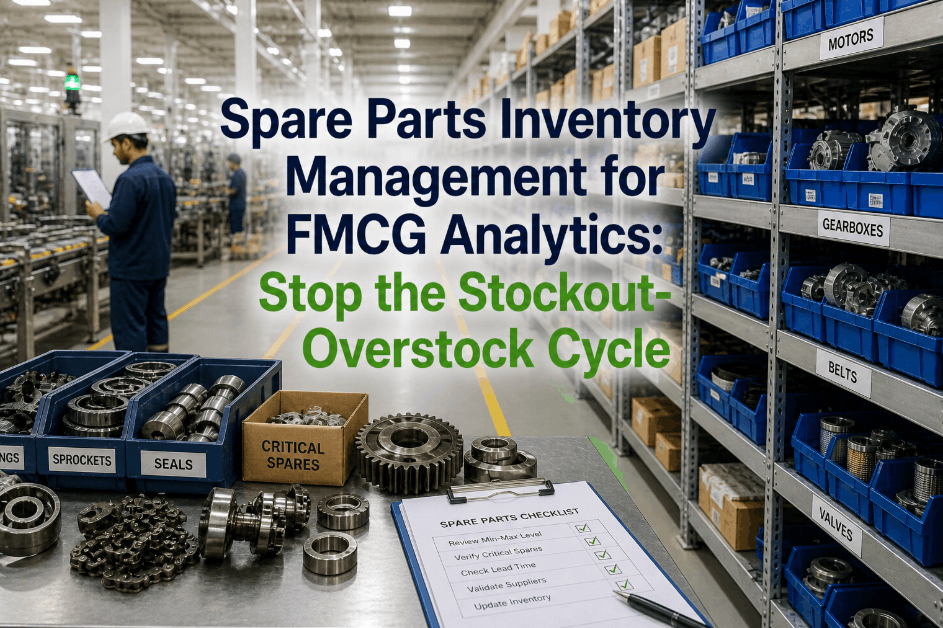
In the high-speed environment of food and beverage manufacturing, the spare parts inventory FMCG balance is notoriously difficult to maintain. Operations teams are constantly caught between the risk of crippling production downtime caused by a missing part and the financial burden of carrying millions in obsolete inventory. Poor MRO inventory management costs FMCG plants an estimated 15-20% more in analytics and carrying costs annually. Analytics spare parts optimization is now the defining capability separating high-performing food manufacturers from those perpetually fighting the stockout-overstock cycle. If your team is still relying on reactive reordering, now is the time to book a demo and see what an AI-driven inventory management system looks like in a live FMCG environment.
Stop the Stockout-Overstock Cycle — Automate Your MRO Inventory
iFactory's Predictive Inventory Engine gives FMCG enterprises real-time spare parts forecasting, automated min-max optimization, and multi-facility parts visibility — eliminating stockouts while recovering trapped capital.
Why Manual FMCG Parts Management Is Failing
The spare parts requirements for FMCG manufacturing have never been more complex. With automated packaging lines, high-shear mixers, and robotic palletizers operating 24/7, facilities must maintain access to thousands of critical components. Relying on spreadsheets or static ERP data to manage a min-max inventory strategy leads to overlapping purchasing, lost parts, and a perpetual state of emergency freight ordering. The result is a maintenance team in reactive mode — hoarding parts to prevent downtime, while millions of dollars sit trapped in dead stock.
AI-driven inventory management fundamentally restructures this workflow. Instead of humans guessing at reorder points based on historical averages, automated systems ingest real-time machine health data, lead times, and failure probabilities to generate dynamic spare parts forecasting. FMCG manufacturers serious about parts stockout prevention should book a demo to map their current MRO workflow against an automated alternative before their next major line failure.
What Analytics Inventory Optimization Actually Does
Understanding exactly which inventory tasks are automatable — and which generate the highest return — requires mapping the MRO workflow against available AI capabilities. Three functional pillars define modern enterprise analytics spare parts optimization.
ABC Analysis Spare Parts and Criticality Mapping
Performing a manual ABC analysis spare parts exercise is traditionally a tedious, once-a-year event. An AI-driven CMMS continuously analyzes usage frequency (A), lead times, and asset criticality to dynamically categorize your inventory. High-turnover belts and bearings are automatically separated from critical, long-lead-time servo motors. Every part is linked to its specific asset Bill of Materials (BOM), ensuring critical spare parts are always mapped to the production lines that rely on them.
This continuous criticality mapping eliminates the guesswork from purchasing. By knowing exactly which parts belong to high-priority assets, teams can safely reduce safety stock on non-critical components. Facilities wanting to audit their current parts classification can book a demo for a live data assessment against their existing MRO database.
Dynamic Min-Max Inventory Strategy Automation
A static min-max inventory strategy is inherently flawed in a dynamic FMCG environment. A reorder point set in 2023 cannot account for the supply chain disruptions or increased line speeds of 2026. Analytics inventory optimization engines continuously adjust minimum thresholds and reorder quantities based on real-time consumption rates, shifting supplier lead times, and seasonal production spikes.
The measurable impact of dynamic min-max goes beyond simple stockout prevention. Automated optimization eliminates the "just in case" hoarding mentality. The system triggers automated purchase requisitions only when statistically necessary, preventing capital from being tied up in overstocked components while ensuring total parts availability.
Spare Parts Forecasting & Predictive Reordering
The most advanced capability in MRO inventory management is linking predictive maintenance directly to procurement. Spare parts forecasting uses machine learning algorithms analyzing vibration, temperature, and wear data to predict when a component will fail. The system automatically reserves or reorders the exact replacement part weeks before the breakdown occurs.
This creates a truly predictive supply chain. If an AI sensor detects bearing degradation on a primary filler, the system cross-references the storeroom, identifies a stockout, and auto-generates a PO factoring in the 14-day lead time. Enterprises operating multiple facilities should book a demo to see how predictive reordering functions across a multi-site network.
Manual MRO vs. AI-Driven Inventory Management
The operational and financial differences between manual spreadsheets and automated FMCG parts management are quantifiable across every dimension of supply chain performance.
| Inventory Dimension | Manual MRO Management | AI-Driven Inventory Management | FMCG Financial Impact |
|---|---|---|---|
| Reorder Thresholds | Static, manually updated rarely | Dynamic, real-time Min-Max updates | High — prevents overstocking capital |
| Parts Stockout Prevention | Reactive, reliant on visual checks | Predictive, linked to asset health | Critical — eliminates wait-for-parts downtime |
| ABC Analysis | Annual spreadsheet exercise | Continuous algorithm classification | High — focuses capital on critical parts |
| Expedited Freight Costs | Frequent emergency shipments | Rare, predicted well within lead times | Medium — massive MRO cost reduction |
| Cross-Facility Visibility | Siloed, plant-by-plant hoarding | Enterprise-wide parts balancing | High — prevents duplicate purchasing |
| BOM Accuracy | Often outdated or incomplete | Auto-mapped to digital twins | High — technicians find exact parts instantly |
| Dead Stock Identification | Hidden in the storeroom for years | Auto-flagged for return/liquidation | Strategic — recovers trapped CapEx |
Building the Business Case for MRO Cost Reduction
The ROI model for spare parts inventory FMCG optimization extends far beyond simply buying fewer bearings. Operations and finance leadership teams that build rigorous automation ROI models account for four distinct value categories that accelerate the payback period.
Parts Stockout Prevention & Uptime
Every minute an FMCG line is down waiting for a part costs thousands. By implementing AI-driven forecasting and accurate BOM mapping, facilities drastically reduce their Mean Time to Repair (MTTR). The elimination of extended downtime caused by missing critical spare parts is the single largest financial driver.
Primary driverDead Stock Liquidation & Capital Recovery
Up to 40% of a traditional MRO storeroom hasn't been touched in three years. Automated systems flag obsolete components linked to decommissioned assets, allowing procurement to return them to suppliers or liquidate them, recovering hundreds of thousands in trapped working capital.
Capital multiplierElimination of Expedited Shipping Fees
When a critical component fails without a replacement in stock, plants resort to overnight, expedited shipping at 3x-5x the standard freight cost. Spare parts forecasting ensures parts are ordered with standard lead times, realizing massive MRO cost reduction.
OpEx driverTechnician "Wrench Time" Optimization
Maintenance technicians spend up to 25% of their shift simply searching the storeroom for parts. Digital inventory systems with mobile barcode/QR scanning and precise bin locations ensure technicians find the exact part they need in seconds, drastically improving wrench time.
Efficiency valueHow to Implement FMCG Parts Management Automation — Phase by Phase
Inventory software deployments that fail to deliver expected ROI share a common root cause: attempting to digitize dirty data. FMCG enterprises that import chaotic, unstandardized parts lists simply automate the chaos. The implementation roadmap below reflects the sequencing that consistently produces measurable inventory outcomes. Teams ready to begin scoping their deployment should book a demo to receive an MRO data complexity assessment.
Parts Standardization and BOM Mapping
Cleanse the legacy database to eliminate duplicate entries for the same part. Standardize naming conventions and map every component to its corresponding equipment Bill of Materials (BOM). This foundational step ensures that when a machine requires maintenance, the exact required parts are instantly visible and orderable.
ABC Analysis & Criticality Definition
Execute an initial automated ABC analysis to categorize parts by consumption value and volume. Concurrently, define asset criticality levels to ensure that parts supporting Tier 1 production lines are flagged as "Critical Spares," exempting them from standard stock-reduction algorithms to guarantee uptime.
Dynamic Min-Max Configuration & Reordering
Activate the AI algorithms to analyze historical usage and supplier lead times, establishing dynamic min-max thresholds. Configure the automated purchasing workflows so that when inventory hits the minimum threshold, a Purchase Requisition is automatically generated and routed for approval.
Predictive Forecasting & Multi-Site Balancing
Link predictive analytics (vibration/thermal sensors) to the MRO module to trigger preemptive part reservations. For multi-facility enterprises, activate cross-site visibility to allow plants to transfer overstocked components to sibling facilities experiencing stockouts, drastically reducing external spend.
FMCG Inventory Optimization — Verified Benchmarks
Average operational improvements measured within 12 months of deploying AI-driven MRO inventory systems across FMCG manufacturing environments.
MRO Optimization Use Cases — Who Benefits and How
The measurable impact of analytics inventory optimization varies by functional role. Here is how key stakeholder groups experience the outcomes of a deployed intelligent MRO program.
Automated PO Generation and Consolidation
AI-driven systems automatically consolidate purchase requisitions for components hitting their minimum thresholds, allowing procurement to negotiate bulk discounts with preferred suppliers rather than issuing dozens of reactive, single-item POs.
Guaranteed Parts Availability for PMs
The system automatically reserves necessary spare parts the moment a Preventive Maintenance (PM) work order is scheduled, ensuring technicians never start a tear-down only to realize they lack the required seals or bearings.
CapEx Recovery and Dead Stock Liquidation
Controllers gain real-time visibility into inventory turns, allowing them to instantly identify dead stock connected to obsolete machinery, safely writing it off or liquidating it to recover trapped working capital.
Barcode/QR Checkout and Cycle Counting
Supervisors leverage mobile applications to scan QR codes during parts checkout, instantly updating inventory levels and triggering blind cycle counts to maintain 99%+ inventory accuracy without annual full-plant shutdowns.
Accurate Bill of Materials (BOM) Maintenance
Engineers maintain a digital twin of asset BOMs. When a machine is upgraded, the associated parts list is updated globally, preventing the accidental reordering of legacy components that no longer fit the asset.
Multi-Site Inventory Balancing
Directors oversee the entire network's MRO spend, shifting surplus critical spare parts from a plant in Ohio to cover an emergency stockout in Texas, avoiding costly expedited external purchasing.
Evaluating FMCG Inventory Management Platforms — Selection Criteria
The market for MRO inventory management platforms is dense. Selecting the right system requires evaluating capabilities against FMCG's unique high-throughput requirements. Teams evaluating platforms are advised to book a demo with an analytics-first CMMS before committing to legacy ERP add-ons.
Native Equipment BOM Integration
The platform must allow strict association between spare parts and equipment Bills of Materials. Without BOM integration, inventory exists in a vacuum, making it impossible to predict which assets will be impacted by a stockout.
Predictive Maintenance Integration
Look for platforms that can trigger procurement actions directly from IoT sensor alerts (e.g., vibration spikes). Standalone inventory systems cannot perform true spare parts forecasting.
Mobile QR & Barcode Native
Storeroom compliance fails when technicians have to log into a desktop to check out a part. The system must support mobile scanning for instant, friction-free inventory consumption logging.
Automated ABC and Criticality Matrix
The software must dynamically recalculate part criticality based on consumption history and asset tiering, eliminating the need for manual spreadsheet analysis.
Enterprise Cross-Site Visibility
For multi-plant operators, the system must consolidate MRO data, allowing procurement to view sibling plant inventories and facilitate internal parts transfers.
Automated Vendor PO Generation
The platform should automatically generate and route Purchase Orders to approved vendors when dynamic minimum thresholds are breached, ensuring seamless procurement cycles.
Frequently Asked Questions — FMCG MRO Inventory
What is ABC analysis spare parts management?
ABC analysis categorizes inventory based on consumption value and strategic importance. "A" parts represent high value or critical necessity requiring tight control, while "C" parts are low-value consumables. AI-driven systems automate this classification, ensuring critical spare parts are always prioritized.
How does a dynamic min-max inventory strategy work?
Unlike a static min-max strategy where thresholds are manually set and forgotten, a dynamic min-max system uses AI to continuously adjust reorder points based on real-time consumption rates, shifting lead times, and seasonal production demands, effectively preventing both stockouts and overstocking.
Can spare parts forecasting predict exact failure dates?
While it cannot predict the exact minute of failure, spare parts forecasting combined with predictive analytics (like vibration sensors) can accurately identify asset degradation weeks in advance. This allows the system to auto-reorder the specific replacement part well before the machine physically breaks down.
How do we identify critical spare parts in an FMCG plant?
Critical spare parts are identified by mapping components to Tier 1 assets—machines whose failure would halt the entire production line (e.g., a primary filler or case packer). If the part has a long supplier lead time and no viable workaround exists, it is flagged as highly critical and exempted from aggressive stock reduction.
What is the fastest way to achieve MRO cost reduction?
The most immediate MRO cost reduction comes from identifying and liquidating dead stock, followed closely by eliminating expedited shipping fees. By mapping BOMs accurately and relying on AI for reordering, plants stop buying parts they already have and stop paying premiums for emergency deliveries.
How does iFactory optimize FMCG parts management?
iFactory provides a comprehensive AI-driven CMMS that natively integrates predictive maintenance with advanced inventory control. It offers dynamic min-max calculations, mobile barcode scanning for technicians, automated PO routing, and enterprise-wide visibility, transforming MRO from a cost center into a strategic advantage.
Take Control of Your FMCG MRO Inventory Today
iFactory's intelligent CMMS connects your asset health directly to your storeroom — delivering automated parts forecasting, dynamic reordering, and multi-facility visibility purpose-built for high-speed consumer goods enterprises.