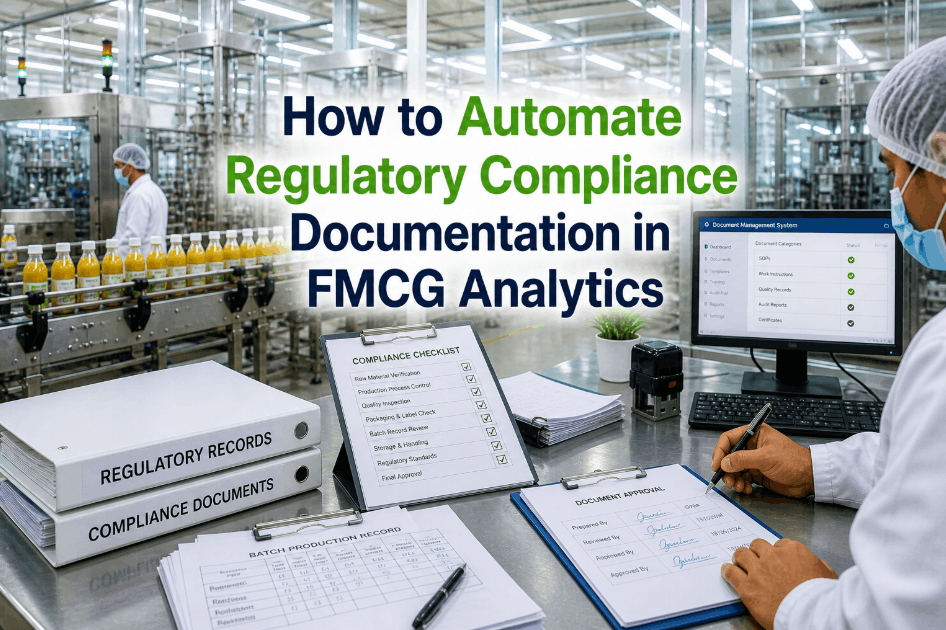
Manual regulatory compliance documentation is one of the most resource-intensive — and highest-risk — operational burdens facing FMCG food manufacturers today. Quality and compliance teams spend an estimated 20 to 35 hours per week manually compiling analytics records, generating audit reports, and maintaining regulatory documentation across multiple formats, systems, and facilities. In a sector where a single documentation failure can trigger product recalls, regulatory penalties, or retailer delisting, the cost of manual compliance is no longer just operational — it is existential. Automating compliance documentation in FMCG analytics is now the defining capability separating high-performing food manufacturers from those perpetually fighting audit fires. If your team is still manually pulling compliance data, now is the time to book a demo and see what automated regulatory documentation looks like in a live FMCG environment.
Eliminate Manual Compliance Work — Automate Your FMCG Regulatory Documentation
iFactory's Automated Compliance and Reporting Engine gives FMCG enterprises real-time audit trails, regulatory record generation, and multi-facility compliance visibility — replacing 20+ hours of weekly manual documentation work.
Why Manual Compliance Documentation Is Failing FMCG Food Manufacturers
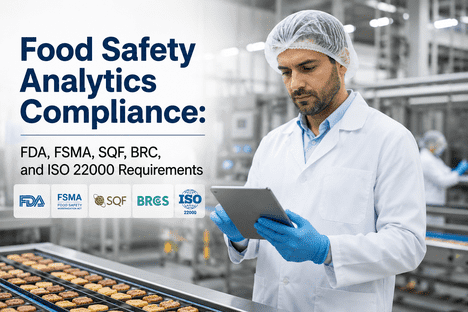
The regulatory landscape for FMCG food manufacturing has never been more demanding. FSMA 204 traceability requirements, BRCGS Issue 9 documentation mandates, retailer-specific compliance frameworks, and internal quality management systems all generate overlapping documentation requirements that manual processes simply cannot sustain at scale. The result is a compliance team permanently in reactive mode — generating documentation after the fact, reconciling data from disconnected systems, and hoping that audit-ready records actually reflect real production conditions.
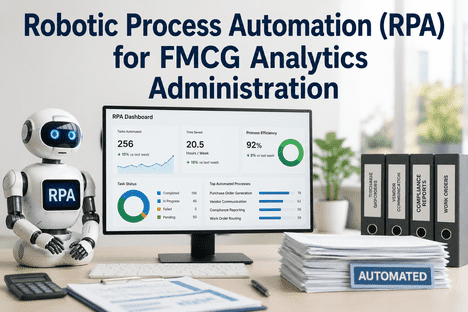
AI-driven compliance automation and RPA compliance bots for FMCG fundamentally restructure this workflow. Instead of humans pulling data from MES, LIMS, ERP, and paper-based records into compliance documents, automated systems ingest, validate, and structure compliance data in real time — creating audit trails that are accurate, timestamped, and audit-ready at all times. FMCG manufacturers serious about eliminating documentation risk should book a demo to map their current compliance workflow against an automated alternative before their next scheduled audit.
What AI-Driven Compliance Automation Actually Does in FMCG Analytics
Understanding exactly which compliance documentation tasks are automatable — and which generate the highest return — requires mapping the FMCG regulatory documentation workflow against available automation capabilities. Three capability categories define current enterprise deployments.
Automated Analytics Records and Real-Time Data Capture
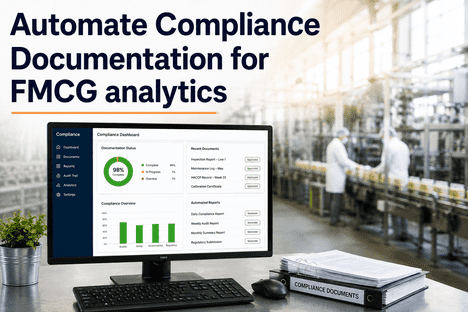
Automated analytics records replace the single highest-volume manual documentation task in FMCG compliance: transcribing production data into regulatory record formats. AI-driven systems connect directly to line sensors, PLC outputs, LIMS instruments, and MES platforms — capturing critical control point data, temperature logs, weight checks, and batch parameters in real time without human transcription. Every record is timestamped, linked to the relevant batch and line, and stored in an immutable audit trail that satisfies FSMA, BRCGS, SQF, and customer-specific traceability requirements simultaneously.
The elimination of manual transcription removes the most common source of compliance documentation error: data entry mistakes between measurement and record. FMCG facilities deploying automated analytics records consistently report documentation accuracy improvements of 94% or higher within the first quarter of deployment. Teams wanting to quantify the documentation error rate in their current operation can book a demo for a live compliance data accuracy assessment against their existing records.
RPA Compliance Bots for Regulatory Report Generation
RPA compliance bots for FMCG automate the structured output layer of regulatory documentation — converting raw compliance data into formatted regulatory reports, CAPA records, supplier compliance summaries, and audit packs that previously required hours of manual assembly. These bots operate on defined templates mapped to regulatory frameworks: FSMA 204 supply chain records, BRCGS non-conformance reports, FDA facility registration updates, and retailer-specific compliance scorecards are all within scope for RPA automation in a mature compliance platform.
The measurable impact of RPA in FMCG regulatory documentation goes beyond time savings. Automated report generation eliminates version control failures — a persistent problem in manual compliance workflows where outdated report templates generate submissions that fail audit schema validation. RPA bots pull from live data sources, apply current regulatory templates, and produce reports that are structurally compliant with the receiving authority's submission format every time.
Automated Audit Trail Generation and Digital Compliance Records
The automated audit trail is the foundational output of digital compliance automation in food manufacturing. Every action taken in a compliant production environment — parameter adjustment, CCP deviation, corrective action, hold release, sanitation verification — must be documented with who, what, when, and why. Manual audit trail maintenance depends entirely on operator discipline across every shift. Automated audit trail systems capture this data at the system level, creating an unbroken compliance record that survives shift changes, staff turnover, and system migrations.
Digital compliance documentation stored in a centralized analytics platform also enables something manual records cannot: cross-facility compliance benchmarking. Multi-site FMCG enterprises can compare audit trail completeness, CCP deviation rates, and corrective action closure times across facilities in real time — giving compliance leadership the visibility to intervene before a site-level issue becomes a regulatory event. Enterprises operating across three or more facilities should book a demo to see how cross-facility compliance dashboards work in a live multi-site deployment.
Manual vs. Automated Compliance Documentation — FMCG Decision Framework
The operational and risk differences between manual and automated compliance documentation are quantifiable across every dimension that matters to FMCG food safety and quality leadership teams.
| Compliance Dimension | Manual Documentation | Automated Compliance System | FMCG Risk Impact |
|---|---|---|---|
| Data Capture Accuracy | 85–92% — transcription errors common | 99.4%+ — direct sensor/system integration | High — errors trigger audit findings |
| Audit Preparation Time | 40–80 hours per audit event | 2–6 hours — pre-compiled audit packs | High — resource drain and error exposure |
| Real-Time Visibility | None — lagging shift records | Live dashboards, instant alerts | Critical — deviations caught in production |
| Regulatory Template Updates | Manual — version control risk | Automated — always current framework | Medium — schema failures on submission |
| Cross-Facility Benchmarking | Not feasible — siloed records | Native — centralized analytics layer | High — enterprise compliance blind spots |
| CAPA Record Management | Spreadsheet or paper — closure risk | Automated workflow with escalation logic | High — open CAPAs are audit liabilities |
| Traceability Response Time | 4–72 hours for full trace | Under 60 seconds — automated trace query | Critical — FSMA 204 requires rapid response |
| Compliance Staff Utilization | 70%+ time on documentation tasks | Under 20% — focus shifts to analysis | Strategic — talent deployed to risk reduction |
Building the Business Case for FMCG Regulatory Compliance Automation
The ROI model for automate compliance documentation FMCG programs extends well beyond labor displacement. FMCG quality and finance leadership teams that build rigorous compliance automation ROI models account for four value categories that together define the true payback period.
Documentation Labor Cost Elimination
A single FMCG facility deploying automated compliance documentation typically recovers 25–35 FTE-hours per week previously consumed by manual record-keeping, report assembly, and audit preparation. At fully-loaded compliance staff costs, this generates $85,000–$160,000 in annual labor savings per facility — before accounting for quality and risk improvements.
Primary driverRegulatory Penalty and Recall Risk Reduction
Documentation failures are the leading cause of FMCG regulatory penalties that are not linked to actual product safety events. Automated audit trails and real-time CCP monitoring eliminate the documentation gaps that generate Form 483 observations, BRCGS major non-conformances, and retailer audit failures — each of which carries remediation costs typically ranging from $50,000 to $400,000 per event.
Risk multiplierAudit Cycle Time Compression
FMCG facilities spending 40–80 hours preparing for each scheduled audit can compress this to under 6 hours with pre-compiled automated audit packs. For enterprises managing 8–12 audit events annually across multiple standards, this represents 280–900 hours of recovered compliance team capacity — redirectable to risk assessment, supplier management, and process improvement activities.
Compounding driverTraceability Response Cost Savings
FSMA 204 and retailer traceability mandates require rapid lot-level trace responses. Manual traceability exercises cost $15,000–$65,000 per event in staff time and production disruption. Automated traceability systems complete the same exercise in under 60 seconds — transforming a high-cost reactive process into a zero-friction compliance capability.
Strategic valueHow to Implement Automated Compliance Documentation in FMCG — Phase by Phase
Compliance automation deployments that fail to deliver expected ROI share a common root cause: insufficient process standardization before automation is applied. FMCG enterprises that attempt to automate chaotic manual workflows simply automate the chaos. The implementation roadmap below reflects the sequencing that consistently produces measurable compliance outcomes. Teams ready to begin scoping their deployment are encouraged to book a demo to receive a site-specific compliance automation complexity assessment before any system is specified.
Compliance Workflow Audit and Documentation Mapping
Map every manual compliance documentation task: what data is captured, from which source, by whom, in which format, and for which regulatory framework. Quantify time spent per task, error rates, and the downstream consequences of documentation failures at your facility. Establish the baseline metrics — audit preparation hours, CAPA closure rates, traceability response times — that the automation program will be measured against.
Data Source Integration and Analytics Architecture Design
Identify all data sources feeding compliance documentation: MES, LIMS, ERP, PLC/SCADA, manual entry points, and supplier portals. Design the integration architecture connecting these sources to the centralized compliance analytics platform. Define the data validation rules, exception handling logic, and regulatory output templates for each compliance framework in scope. Complete data governance and access control design before any integration work begins.
RPA Bot Deployment, Automated Audit Trail Activation, and Validation
Deploy RPA compliance bots for automated report generation and configure real-time audit trail capture across all target compliance processes. Run parallel manual and automated documentation for four to six weeks to validate output accuracy against existing regulatory standards. Complete system validation documentation — IQ, OQ, PQ — required for FDA-regulated environments. Obtain quality management sign-off before decommissioning manual documentation workflows.
Live Compliance Analytics, CAPA Automation, and Multi-Facility Expansion
Activate live compliance dashboards, automated CAPA workflow management, and real-time deviation alerting. Use the first three months of live data to optimize alert thresholds, refine report templates, and build the ROI evidence base. Develop the multi-facility compliance automation expansion program with analytics-supported business cases for each subsequent site deployment — compressing each subsequent facility onboarding using the documented integration playbook from the pilot site.
FMCG Compliance Automation — Verified Performance Benchmarks
Average operational improvements measured within 12 months of compliance documentation automation deployment across FMCG food and consumer goods manufacturing environments.
FMCG Compliance Automation Use Cases — Who Benefits and How
The measurable impact of food safety documentation software and FMCG regulatory automation varies by functional role. Here is how each key stakeholder group experiences the outcomes of a deployed compliance automation program.
Real-Time CCP Monitoring and Deviation Alerting
Automated analytics platforms capture CCP data at source and trigger real-time alerts when parameters breach regulatory or internal thresholds — replacing the lagging shift check review that historically allowed deviations to persist across multiple production runs before detection.
Always-Current Regulatory Template Compliance
RPA compliance bots maintain current regulatory submission templates and automatically apply framework updates — eliminating the version control failures that cause compliant operations to fail audits due to outdated documentation formats rather than actual process non-conformance.
Automated FSMA 204 Traceability Records
Automated traceability systems maintain continuous lot-level records across the supply chain — from raw material receipt through finished goods despatch — enabling sub-60-second trace responses that FSMA 204 Critical Tracking Event requirements demand without manual data assembly under regulatory time pressure.
Compliance Cost Visibility and CapEx Justification
Automated compliance systems convert the diffuse, hard-to-quantify cost of manual compliance into measurable OpEx reduction with clear ROI attribution. The compliance automation investment generates both direct labor savings and risk-adjusted cost avoidance from regulatory penalties that are directly modellable in financial projections.
Unified Compliance Data Architecture
Compliance analytics platforms with open API connectivity to OPC-UA, MQTT, and REST endpoints integrate MES, LIMS, ERP, and SCADA data into a single compliance data layer — eliminating the siloed, manually reconciled system landscape that currently drives both data latency and integration risk in FMCG regulatory documentation.
Automated Environmental and Safety Compliance Records
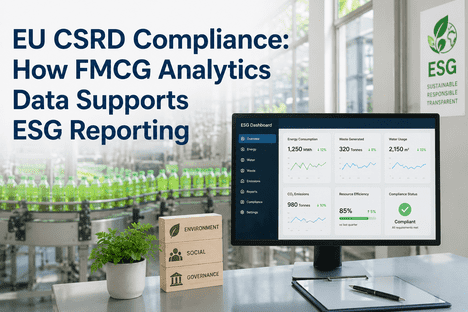
Environmental monitoring records, hygiene verification logs, and EHS compliance documentation are among the highest-volume manual compliance tasks in food manufacturing. Automated capture and record generation in these categories frees operations teams from administrative burden while improving record completeness and audit readiness simultaneously.
Evaluating FMCG Compliance Automation Platforms — Selection Criteria
The market for compliance record management and digital compliance FMCG platforms has expanded rapidly alongside regulatory requirements. Selecting the right automation platform requires evaluating capability against your specific regulatory framework portfolio, facility count, and integration architecture. FMCG teams evaluating platforms are advised to book a demo with an analytics-first compliance platform before selecting a compliance automation vendor — because the data architecture must be defined before the automation layer is built on top of it.
Regulatory Framework Coverage
FMCG facilities typically operate under multiple simultaneous regulatory frameworks — FSMA, BRCGS, SQF, IFS, FDA, and retailer-specific programs. Compliance platforms must support multi-framework documentation with shared data sources and framework-specific output templates, not separate modules requiring duplicate data entry.
Data Integration Architecture
Open API connectivity to OPC-UA, MQTT, REST, and direct database integration with major MES and LIMS platforms is non-negotiable. Compliance platforms that require proprietary data connectors or manual CSV imports create the same data latency and reconciliation burden that manual documentation does — at higher cost.
Audit Trail Immutability and 21 CFR Part 11
For FDA-regulated environments, electronic records and signatures must comply with 21 CFR Part 11 requirements for audit trail immutability, access controls, and electronic signature validation. Platforms must demonstrate validated compliance with these requirements — not just feature-level claims — before deployment in regulated food manufacturing environments.
CAPA Workflow Automation Depth
Corrective and preventive action management is among the highest-risk manual compliance workflows in FMCG. Platforms must support automated CAPA initiation from deviation events, workflow routing, escalation logic, evidence attachment, and closure verification — not just CAPA record storage that still requires manual workflow management.
Multi-Facility Scalability
Enterprise FMCG compliance platforms must support consolidated compliance visibility across multiple facilities with facility-level drill-down, cross-site benchmarking, and enterprise-level regulatory reporting aggregation. Single-facility platforms extended to enterprise use generate the same siloed visibility problem that manual documentation does at greater total cost.
Implementation and Validation Support
Compliance system implementations in regulated FMCG environments require documented validation support: IQ, OQ, and PQ protocols, validation master plans, and regulatory submission support if required. Vendors unable to provide validated implementation documentation add regulatory risk to the technology risk of the deployment program.
Frequently Asked Questions — FMCG Compliance Documentation Automation
What compliance documentation tasks can be fully automated in FMCG food manufacturing?
The highest-volume automatable compliance documentation tasks include: CCP and CQP monitoring record generation, batch record compilation, environmental monitoring logs, supplier compliance verification records, CAPA initiation and closure workflows, traceability trace requests, sanitation verification records, and regulatory report assembly for FSMA, BRCGS, SQF, and IFS frameworks. Manual review and approval steps can be preserved where regulatory requirements mandate human sign-off, while all data capture and document assembly is automated.
How long does FMCG compliance documentation automation take to implement?
A single-facility compliance automation deployment covering core documentation workflows typically requires 16–24 weeks from initial workflow audit to validated live operation. Multi-facility deployments covering full enterprise compliance documentation range from 9–18 months depending on the number of sites, regulatory frameworks, and integration complexity. Pre-deployment process standardization and data source mapping are the activities that most directly determine implementation timeline and outcome quality.
Does compliance documentation automation satisfy FSMA 204 traceability requirements?
Yes, when correctly configured. FSMA 204 requires that food facilities maintain records of Critical Tracking Events (CTEs) and Key Data Elements (KDEs) and be able to produce this information within 24 hours of an FDA request. Automated traceability systems that capture lot-level data at each CTE in real time and store records in queryable form satisfy these requirements — and typically deliver trace responses in under 60 seconds rather than the 24-hour window. Platform validation against the specific CTEs applicable to your food category is required before regulatory reliance.
What is the difference between RPA compliance bots and AI-driven compliance automation?
RPA compliance bots automate structured, rule-based documentation tasks: extracting data from defined sources, populating defined templates, and routing documents through defined workflows. AI-driven compliance automation extends this by applying machine learning to detect anomaly patterns in compliance data, predict deviation risk before threshold breaches occur, and continuously optimize alert thresholds based on historical compliance performance. Enterprise FMCG compliance programs benefit from both — RPA for documentation efficiency and AI for predictive compliance risk management.
Can compliance automation work alongside existing MES and LIMS systems?
Yes. Compliance analytics platforms with open API architecture integrate as an overlay layer above existing MES, LIMS, ERP, and SCADA infrastructure — ingesting compliance-relevant data from these systems without requiring system replacement. This integration model is the dominant deployment pattern in FMCG because it preserves existing system investments while adding the compliance documentation automation and analytics layer that these systems do not natively provide.
How does iFactory's platform support FMCG regulatory compliance documentation automation?
iFactory's Automated Compliance and Reporting Engine connects directly to FMCG production systems via OPC-UA, REST, and MQTT APIs — ingesting compliance-critical data in real time and generating automated analytics records, audit trails, CAPA workflows, and regulatory report packs for FSMA, BRCGS, SQF, IFS, and customer-specific frameworks. Plant and enterprise compliance teams receive live dashboards showing deviation events, CAPA closure status, audit readiness scores, and cross-facility compliance benchmarks. Multi-facility enterprises gain the consolidated compliance visibility that disconnected manual documentation systems structurally cannot provide.
Replace Manual Compliance Documentation With Real-Time Automated Analytics
iFactory's compliance automation platform connects to your FMCG production systems — delivering automated analytics records, audit-ready documentation, CAPA workflow management, and cross-facility regulatory compliance visibility purpose-built for food and consumer goods enterprises.