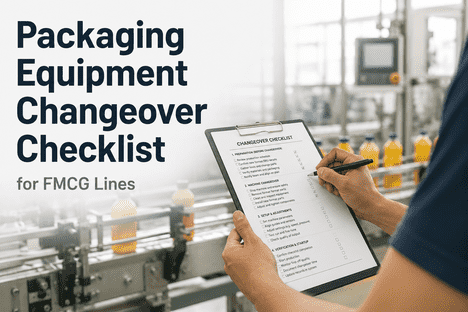
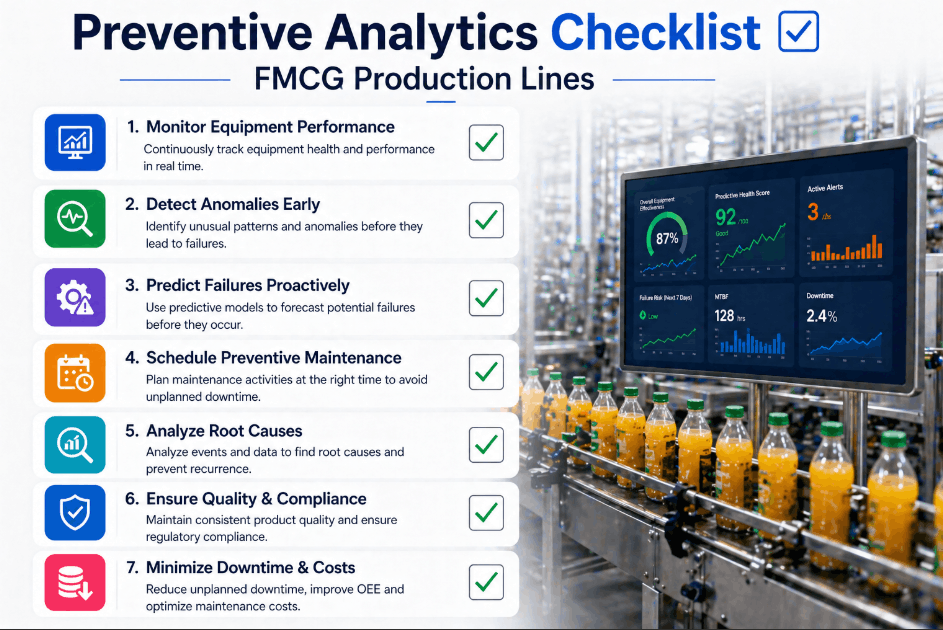
Preventive analytics Checklist for FMCG Packaging Lines
By Josh Turley on May 2, 2026
Preventive analytics for FMCG packaging lines is the operational baseline that separates high-performing plants from those absorbing avoidable downtime and excessive parts spend. This checklist covers every critical machine on a modern FMCG packaging line — filling machines, robotic pick-and-place, labeling systems, cartoners, case packers, and robotic palletizers — with daily, weekly, and monthly tasks calibrated to real-world failure modes.
Automate Your FMCG Packaging Line PM Scheduling with iFactory
iFactory digitizes your packaging line checklists, automates task dispatch, and tracks completion — so nothing falls through the cracks on your filling, labeling, or palletizing equipment.
Why FMCG Packaging Lines Need a Structured PM Checklist
FMCG packaging equipment accumulates wear faster than almost any other industrial machinery class. A single missed lubrication interval on a high-speed filling machine can escalate from minor friction to catastrophic seal failure within hours. Structured preventive analytics checklists break this chain — and book a demo to see how iFactory automates every task on this list for your specific packaging line.
$260K
Average hourly downtime cost on FMCG packaging lines
35%
Of packaging failures preceded by a missed PM task
50%+
Downtime reduction with structured PM programs
6–12 mo
Typical ROI payback for digitized PM scheduling
SECTION 1: Filling Machine & Labeling
Filling Machine & Labeling System Checklist
Filling machines and labelers are the two highest-consequence failure points on any FMCG packaging line — a stoppage on either halts the entire line. Book a demo to see how iFactory tracks PM compliance across both equipment types in real time.
Daily
Inspect all filler head seals and gaskets for wear or product residue buildup
Verify fill volume accuracy — check first and last fill of each production run
Check nozzle condition for blockage or misalignment on every format changeover
Clean print head and platen roller — remove adhesive residue from contact surfaces
Verify label placement accuracy — check for skew, misregistration, or bubble defects
Confirm barcode and date-code print quality against verification standard at shift start
Weekly
Lubricate all specified bearing points per OEM lubrication chart — record grease type and quantity
Check drive belt tension and condition on filler head drive systems
Test all safety interlock switches and emergency stop circuits
Replace thermal transfer ribbon and clean ribbon path components per print volume threshold
Inspect and clean photocell sensors and reflectors — verify label gap detection accuracy
Monthly
Replace all elastomeric seals and diaphragms per OEM service manual schedule
Full calibration verification of fill volume, flow meters, and level measurement instruments
Full print head cleaning and resistance measurement — replace if below OEM minimum
Full registration system calibration — encoder verification, sensor alignment, and register error test
SECTION 2: Robotic Pick-and-Place
Robotic Pick-and-Place Analytics Checklist
Delta robots, SCARA arms, and cobots are among the fastest-degrading assets on high-speed packaging lines. Joint wear, EOAT degradation, and vision system drift are the dominant failure modes. Book a demo to see how iFactory's PM platform manages robotic system schedules automatically.
Daily
Inspect end-of-arm tooling (suction cups, grippers, clamps) for wear or contamination
Verify vision system camera lens cleanliness and lighting module functionality
Confirm vacuum generator pressure and suction cup seal integrity at production start
Review controller fault log for joint torque limit warnings from previous shift
Weekly
Lubricate all robot joint gearboxes per manufacturer specification
Inspect all cable management systems for chafing or connector loosening on high-cycle axes
Run TCP calibration verification — recalibrate if deviation exceeds tolerance
Inspect robot base mounting bolts for loosening from vibration accumulation
Monthly
Complete joint backlash measurement on all axes — compare against OEM tolerance limits
Full vision system optics cleaning, calibration target verification, and re-teach if required
Controller battery backup test — log battery voltage and replacement date
Review cumulative axis hour logs against OEM service interval for overhaul scheduling
SECTION 3: Cartoner & Case Packer
Cartoner & Case Packer Analytics Checklist
Cartoning and case packing equipment executes hundreds of mechanical interactions per minute. Hot-melt glue systems and cam mechanisms demand dedicated PM attention. Book a demo to explore how iFactory manages multi-task cartoner checklists across your packaging hall.
Daily
Inspect all hot-melt glue nozzles for blockage, stringing, or carbonization buildup
Verify glue tank temperature against setpoint and check carton blank magazine alignment
Inspect tucker and folder blades for edge damage on cartoner
Check case blank magazine feed mechanism for jam flags or misalignment on case packer
Confirm case seal integrity on first and last case of each production run
Weekly
Purge and clean hot-melt glue system — remove carbonized adhesive from tank and manifold
Lubricate all cam followers, guide rails, and timing belt tensioners per OEM chart
Inspect and adjust case squaring guides and compression belts for correct tension
Clean all photocells and proximity sensors in the case track and infeed zone
Monthly
Full hot-melt glue system inspection — replace hose filters and verify nozzle flow rates
Inspect and measure all cam profiles for wear against OEM wear limits
Full timing belt inspection and replacement on axes that have reached OEM cycle interval
Review reject rate and downtime data by station — initiate root cause action on repeat faults
SECTION 4: Robotic Palletizer
Robotic Palletizer Preventive Analytics Checklist
Robotic palletizers are the most mechanically demanding and strategically critical asset on an FMCG packaging line — a palletizer failure blocks the entire line regardless of upstream equipment status. The five dominant failure modes are joint gearbox lubricant degradation, EOAT wear, cable management fatigue, controller cooling fouling, and pallet conveyor alignment drift.
Daily
Inspect EOAT vacuum cups, clamp pads, or layer board grippers for wear or contamination
Verify pallet conveyor infeed alignment and pallet stop position against teach tolerance
Check controller cabinet air filter — visual blockage inspection at shift start
Confirm safety light curtain and area scanner functionality with documented functional test
Weekly
Lubricate all joint points per OEM grease type and quantity — do not over-grease hollow shaft joints
Inspect all cable management conduits and flexible energy chains on all major axes
Clean controller cabinet filters and verify cooling fan — log inlet/outlet temperature differential
Tighten all EOAT mechanical fasteners — vibration-induced loosening is a leading stoppage cause
Monthly
Oil sampling from all gearboxes — send for viscosity, contamination, and wear particle analysis
Full TCP calibration verification — measure and document deviation, recalibrate if required
Complete axis backlash measurement on all joints — trend against baseline and OEM wear limit
Replace controller backup battery per OEM interval — test UPS functionality and log results
How to Implement This Checklist in Your FMCG Plant
A checklist delivers reliable results only when embedded in a system that ensures consistent execution and completion tracking. Plants that digitize PM scheduling into an integrated platform consistently outperform those relying on paper forms. Book a demo to see how iFactory converts this checklist into live, automated work orders for your packaging line.
01
Map Tasks to Asset Tags
Assign every checklist task to a specific equipment tag in your CMMS — not generic categories. Tag-level assignment enables failure correlation and interval optimization over time.
02
Digitize Task Dispatch
Replace paper PM rounds with mobile work orders. Timestamped, auditable records eliminate completion ambiguity and support regulatory compliance and continuous improvement.
03
Track PM Completion Rate
Monitor PM completion rate weekly alongside OEE. Plants achieving 95%+ completion on packaging assets consistently outperform on availability metrics.
04
Feed Failures Back to Checklist
Every unplanned event should trigger a review: Was the PM task completed? Did the checklist cover the failure precursor? Update intervals when gaps are identified.
FMCG PACKAGING ANALYTICS · DIGITAL PM SCHEDULING · EQUIPMENT RELIABILITY
Digitize Your FMCG Packaging Line PM Checklists with iFactory
iFactory's preventive analytics scheduling platform transforms static paper checklists into automated, tracked digital work orders — covering filling machines, robotic systems, labelers, cartoners, case packers, and palletizers on every line.