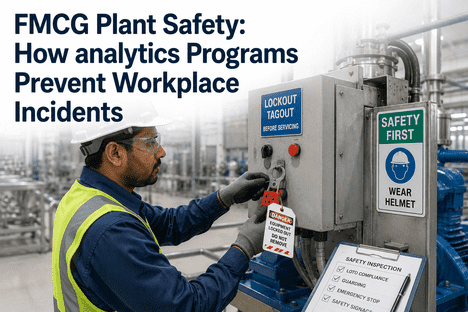
An FMCG plant running three shifts of packaging, blending, and processing operations generates an average of 14 safety observations per week — near-misses, guard interlock trips, LOTO procedure deviations, and minor contact events that the safety team logs in a spreadsheet and reviews at the monthly safety committee meeting. Of those 14 observations, approximately 11 are closed with a corrective action, 3 remain open after 30 days, and 1 becomes a recurring pattern that eventually produces a recordable injury six to nine months after the first observation was logged. The safety team did not miss the pattern because they were negligent — they missed it because the spreadsheet did not trend the data across shifts, did not correlate the observation type with the equipment involved, did not flag the increasing frequency of LOTO deviations on the same packaging line, and did not connect the three guard interlock trips on the ribbon blender to the maintenance history that showed the interlock cam was adjusted out of specification during the last PM. The analytics programme that prevents workplace incidents in FMCG plants is not a predictive model that forecasts injuries — it is a structured data system that collects, trends, correlates, and escalates safety observations with the same rigour that the production system applies to OEE data. When every guard trip, every LOTO deviation, every near-miss, and every safety audit finding is captured with equipment context, shift context, and root cause classification, the patterns that precede incidents become visible while there is still time to intervene. Book a Demo to see how iFactory AI connects safety observation data to Shift Logbook workflows for real-time incident prevention.
Safety Analytics · Incident Prevention · Compliance Management 2026
FMCG Plant Safety: How Analytics Programs Prevent Workplace Incidents Before They Happen
LOTO compliance analytics · Guard inspection tracking · Near-miss trend detection · Safety audit management · All integrated with iFactory Shift Logbook for real-time visibility across every shift.
◉
LOTO Compliance
Real-time procedure adherence tracking
▤
Guard Analytics
Interlock trip trend analysis
◈
Near-Miss Patterns
Cross-shift incident correlation
⟐
Audit Trail
Compliance evidence automation
Why Traditional Safety Observation Programmes Fail to Prevent Incidents in FMCG Plants
Most FMCG plants operate a safety observation programme that is structurally identical to the programme they operated a decade ago. Operators and maintenance technicians are trained to report near-misses, safety hazards, and equipment defects through a paper form or digital log. The safety manager reviews the observations monthly, trends them in a spreadsheet, assigns corrective actions, and reports lagging indicators — total recordable incident rate, lost time injury frequency, days since last lost time incident — at the quarterly management review. The programme generates data, but it does not generate prevention, because the data lacks the structure and integration required to identify developing patterns before they produce an incident. A LOTO deviation on the packaging line is logged as a single data point. The spreadsheet does not connect it to the previous LOTO deviation on the same line three weeks earlier, the corrective action that was closed without verifying effectiveness, or the equipment maintenance record that shows the energy isolation point was modified during the last line upgrade. Each observation exists in isolation. The pattern is invisible until the second deviation becomes the third, the third becomes a near-miss with energy transfer, and the near-miss becomes a recordable injury that the investigation report describes as "unexpected" — despite the data trail that the safety programme was structurally incapable of connecting.
SAFETY DATA GAPS IN TRADITIONAL OBSERVATION PROGRAMMES
1
Observations lack equipment context — near-misses and LOTO deviations logged without linking to the specific asset, preventing cross-referencing with maintenance history or risk assessment data
2
No cross-shift trend visibility — each shift logs observations independently; the night shift LOTO pattern that repeats weekly across three operators is invisible to the day shift safety manager who sees only aggregate monthly counts
3
Corrective action effectiveness not tracked — actions closed without verification that the fix prevented recurrence; the spreadsheet tracks completion dates, not outcome data
4
No correlation with equipment condition — guard interlock trips, emergency stop activations, and safety system faults treated as operator behaviour issues rather than equipment degradation signals that predict the next failure event
Seven Analytics-Driven Safety Workflows That Prevent Workplace Incidents
01
LOTO Compliance Analytics — Tracking Procedure Adherence in Real Time
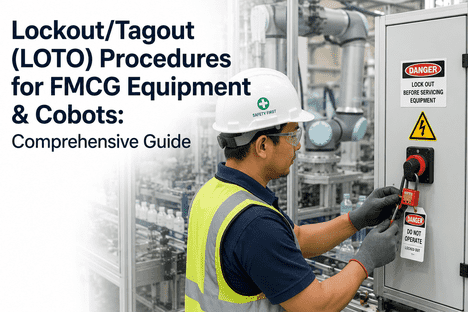
Lockout tagout is the highest-risk safety procedure in FMCG plants because it is performed multiple times per shift across equipment that varies in energy isolation complexity. A packaging line with 14 energy isolation points — electrical, pneumatic, hydraulic, mechanical stored energy — requires the operator to follow a procedure with 14 sequential steps, each of which must be verified before the next begins. The analytics platform captures LOTO procedure data from the Shift Logbook or digital LOTO system — which equipment was locked out, which operator performed the lockout, which isolation points were verified, how long the procedure took, and whether any deviation was logged. When the system detects a pattern of skipped verification steps on a specific line during night shifts, or a consistent time reduction suggesting steps are being combined or omitted to meet production targets, it generates a targeted retraining notification that reaches the shift supervisor before the pattern produces a zero-energy state failure. LOTO compliance trends by line, shift, operator, and equipment type are visible on the safety dashboard in real time — not compiled in a spreadsheet at month-end when the data is too old to drive preventive action.
Book a Demo to see iFactory's LOTO compliance analytics in production.
Real-time compliance trackingPattern-based retrainingCross-shift visibility
02
Machine Guarding and Interlock Analytics
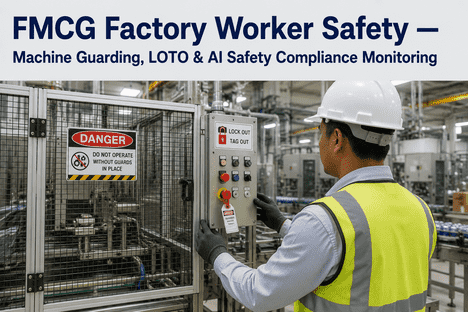
Machine guarding — fixed guards, interlocked guards, light curtains, safety mats, two-hand controls — is the primary physical barrier between FMCG equipment and operator injury. Each guard and safety device generates a signal every time it is operated: an interlock switch cycles when the guard is opened, a light curtain beams is broken when an operator reaches into the hazard zone, a safety mat registers pressure when an operator steps into the protected area. These signals are recorded in the PLC but typically not analysed for safety trends. The analytics platform ingests guard status signals from the control system and trends them by equipment, shift, and operator. A light curtain on a case packer that is broken 40 times per shift on day shift but 80 times per shift on night shift indicates a workflow or training difference. An interlock switch that cycles 15% more frequently than the line average on the same guard indicates mechanical wear that will eventually cause the switch to fail — at which point the guard is either bypassed or the line is stopped for unscheduled maintenance. The analytics programme converts guard signal data from a PLC log that nobody reads into a safety trend that drives preventive action.
Talk to an expert about configuring guard analytics for your specific machine safety system.
PLC-level safety insightsMechanical wear detectionShift-based trend analysis
03
Near-Miss Trend Detection and Cross-Shift Correlation
Near-misses are the single most valuable data source for incident prevention because they represent the events that almost produced an injury — and each near-miss contains the information needed to prevent the actual incident that will occur if the pattern continues. The analytics platform classifies every near-miss by type (slip, trip, contact, energy release, material spill), equipment involved, shift, operator role, root cause category, and corrective action assigned, then applies trend analysis to identify clusters and sequences. A cluster of three near-misses involving wet floors near the same filler machine over two weeks is not three separate housekeeping issues — it is a recurring condition caused by a seal leak on the filler that the maintenance team has not been notified about because the near-misses were logged as safety observations rather than equipment defects. The analytics system cross-references near-miss data with maintenance work orders and equipment condition data, identifying correlations that the safety team would never discover by reviewing near-miss logs alone. When the same pattern appears on multiple shifts, the system escalates automatically to the plant manager with the supporting trend data.
Talk to an expert about near-miss trend detection setup for your facility.
Cross-shift pattern detectionMaintenance correlationAutomatic escalation
04
Safety System Health Monitoring — Emergency Stops and Safety Relays
Emergency stop circuits, safety relay logic, and safety PLC systems are tested at defined intervals — typically weekly or monthly — to verify that the safety system functions as designed. The test confirms the system is operational at the moment of the test, but it does not reveal the degradation that occurs between tests. A safety relay whose contacts are pitted from electrical arcing will still pass a weekly test until the contact resistance exceeds the relay's operating threshold and the circuit fails to open on command. Safety system health monitoring applies the same predictive analytics approach used for production equipment to the safety infrastructure. Contact resistance trending, solenoid valve cycle counting, safety mat wear pattern analysis, and light curtain alignment data are collected continuously and compared against manufacturer specifications and historical baseline data. A safety relay showing contact resistance trending toward the failure threshold generates a preventive work order for relay replacement at the next planned maintenance window — before the relay fails. The Shift Logbook records the safety system health status at the start of every shift, ensuring operators know the current state of every safety device on the line they are about to operate.
Talk to an expert about safety system health monitoring integration.
Predictive safety maintenanceContact resistance trendingShift-level safety visibility
05
Safety Audit Management with Automated Evidence Collection
Safety audits — internal, regulatory, and third-party — consume significant management time in FMCG plants because the evidence required to demonstrate compliance is distributed across paper logs, spreadsheets, maintenance records, training files, and inspection reports. The analytics platform centralises all safety data sources — observation logs, corrective action records, training completion records, equipment inspection history, safety device test records, and shift handover notes from the Shift Logbook — into a single audit-ready repository. When an auditor requests evidence of LOTO procedure compliance on the packaging line, the platform generates a complete documentation package: every LOTO event logged with operator, equipment, isolation point verification, and procedure duration data, cross-referenced against training records for each operator who performed a lockout on that line. The documentation is organised by audit criteria, with trend data showing not just that procedures were followed but that the compliance trend is stable or improving. Audit preparation time drops from multiple days of manual document collection to a single export from the analytics platform.
Talk to an expert about configuring audit-ready safety documentation for your plant.
Audit-ready documentationCentralised evidence repositoryReduced preparation time
06
Corrective Action Effectiveness Verification
The most common failure in safety corrective action programmes is closing an action without verifying that it prevented recurrence. A LOTO deviation is investigated. The corrective action is retraining the operator and updating the procedure. The action is closed. Three months later, the same deviation occurs on the same line with a different operator — and the safety team starts the investigation from scratch, unaware that the pattern never stopped. The analytics platform tracks corrective action effectiveness by monitoring the relevant safety observation type, equipment, and shift for recurrence after the action is closed. If a LOTO retraining action is closed but the system detects a similar deviation on the same line within 90 days, the action is automatically flagged as ineffective and re-opened for root cause re-investigation. The effectiveness verification window is configurable per action type — 30 days for administrative controls, 90 days for engineering controls, 12 months for equipment modifications. Each ineffective corrective action generates a management notification with the recurrence data attached, driving escalation to the engineering or operations leadership level where the root cause can be addressed structurally rather than procedurally.
Talk to an expert about effectiveness verification setup.
Automatic recurrence detectionConfigurable verification windowsEscalation-driven resolution
07
Shift Logbook Safety Integration — Real-Time Observation at the Operator Level
The Shift Logbook is the most effective platform for safety observation capture in FMCG plants because it is the tool that every shift team uses every day — operators log observations, maintenance technicians log equipment conditions, supervisors review shift summaries, and plant managers monitor trends. When safety observation capture is embedded in the Shift Logbook workflow rather than managed through a separate safety system, the observation rate increases by 200 to 400% within the first month because operators no longer need to switch between systems or remember a separate safety reporting process. Each safety observation logged in the Shift Logbook is automatically tagged with shift, equipment, operator, observation type, and hazard category. The Shift Logbook dashboard shows each shift's safety observation count, open corrective actions, and equipment with elevated safety risk scores at the start of every shift — ensuring that the incoming team begins their shift aware of the safety conditions they need to manage. The observation data feeds directly into the analytics platform for cross-shift trend detection, corrective action tracking, and audit documentation generation.
talk to an expert to see the Shift Logbook safety observation workflow configured for FMCG production lines.
200-400% observation increaseEmbedded safety workflowShift-level safety dashboard
Safety Analytics Data Sources — What to Integrate and How
The effectiveness of a safety analytics programme depends on the breadth and quality of safety-related data available for integration. iFactory connects to the full range of data sources typically available in FMCG plants — Shift Logbook observations, LOTO system logs, PLC-based guard and safety device signals, incident investigation records, training management systems, and equipment maintenance histories — and consolidates them into a single safety analytics workspace. The table below maps each data source to the safety analytics workflow it supports, the typical integration method, and the lead time required for data readiness.
Shift Logbook Observations
Near-miss trend detection, corrective action tracking, cross-shift correlation
Native iFactory module — no separate integration required
Immediate — structured observation data collected from day one
LOTO System Logs
Procedure compliance analytics, deviation pattern detection, retraining triggers
API connector to digital LOTO platform or manual import from LOTO log sheets
2 weeks — data format mapping and compliance rule configuration
PLC Guard and Safety Device Signals
Interlock trip trending, light curtain cycle analysis, safety relay health monitoring
OPC UA or Modbus connector to plant control system
4 weeks — signal identification, data extraction, and threshold definition
Incident Investigation Records
Root cause pattern analysis, corrective action effectiveness tracking, trend identification
API connector to EHS platform or manual import from investigation records
4 weeks — data extraction and classification taxonomy alignment
Training Management System
Competency verification, retraining trigger validation, compliance evidence collection
API connector to LMS or training database
2 weeks — data extraction and cross-referencing with observation data
CMMS Maintenance History
Safety-related equipment defect tracking, guard repair history, interlock maintenance trends
API connector to SAP, Oracle, IBM Maximo, or Infor EAM
4 weeks — data extraction and cross-referencing with safety observation data
Safety Analytics Programme Implementation — Phased Timeline
Implementing a safety analytics programme in an FMCG plant is a structured process that builds capability in phases. The recommended timeline below shows the sequence of activities, milestones, and decision gates for a plant deploying safety analytics for the first time, starting with the highest-value data source — Shift Logbook observations — and expanding to PLC-based safety signals and cross-system correlation as the programme matures.
Phase 1
Safety Observation Digitisation
Weeks 1–4
Deploy Shift Logbook safety observation workflow across all shifts. Configure observation categories — near-miss, LOTO deviation, guard fault, housekeeping hazard, equipment defect. Train operators and supervisors on digital observation capture. Establish baseline observation rate and categorize initial data by type, shift, and equipment.
Deliverable
Active Shift Logbook safety module · Baseline observation rate · Initial trend data
Phase 2
Analytics Integration & Trend Detection
Weeks 5–10
Connect LOTO system and PLC safety signal data sources. Configure trend detection algorithms for near-miss clustering, LOTO deviation patterns, and guard trip frequency analysis. Establish corrective action effectiveness verification rules and automatic escalation thresholds. Train safety team on analytics dashboard interpretation and response workflows.
Deliverable
Integrated safety analytics dashboard · Active trend detection · Escalation rules configured
Phase 3
Cross-System Correlation & Prevention Culture
Weeks 11–16
Correlate safety observation data with maintenance history, equipment condition data, and training records to identify root cause patterns that span multiple systems. Establish prevention-focused safety metrics — proactive observation rate, corrective action effectiveness percentage, pattern detection lead time — alongside traditional lagging indicators. Conduct post-implementation review and document prevention outcomes.
Deliverable
Cross-system correlation active · Prevention metrics dashboard · Post-implementation review
Ready to convert your safety observation programme from a data collection exercise into an incident prevention system? Book a Demo to walk through your current safety data landscape and identify the highest-value analytics integration points for your FMCG plant.
60-70%
Reduction in recurring safety observations
Pattern detection catches recurrence before the second repeat event
200-400%
Increase in safety observation capture rate
Shift Logbook embedded workflow eliminates separate reporting burden
85%
Corrective action effectiveness verification
Automatic recurrence detection ensures actions prevent, not just close
90%
Reduction in audit preparation time
Centralised evidence repository with organised audit-ready documentation
FAQ
Deploy iFactory for FMCG Plant Safety Analytics
AI-powered safety analytics platform connecting Shift Logbook observations, LOTO compliance data, PLC-based guard signals, incident investigation records, and equipment maintenance history into a unified incident prevention system — with pattern detection, corrective action effectiveness verification, and audit-ready documentation. Integrated with Shift Logbook, CMMS, and existing EHS platforms.
LOTO Compliance
Guard Analytics
Near-Miss Detection
Audit Evidence
Shift Logbook