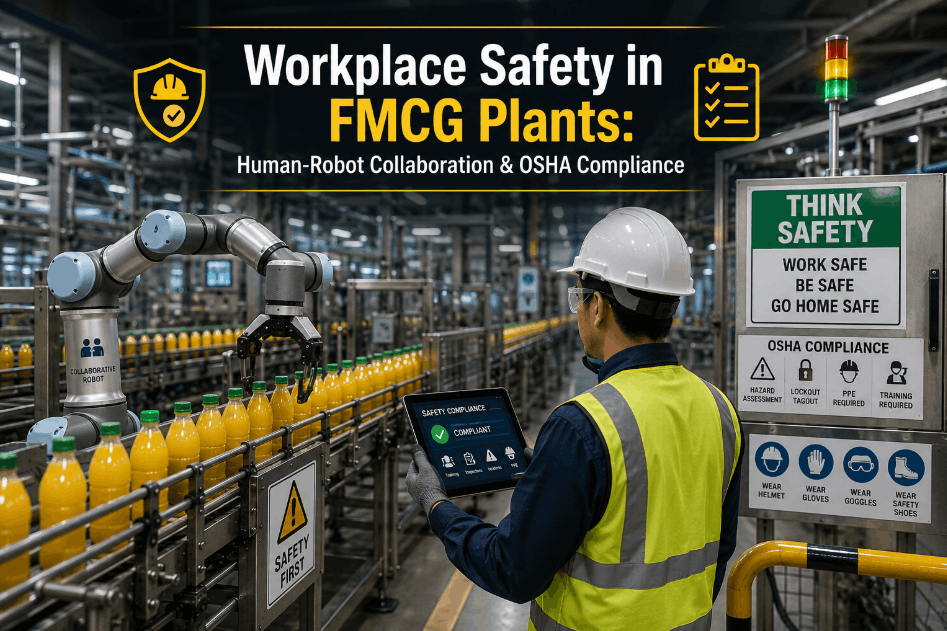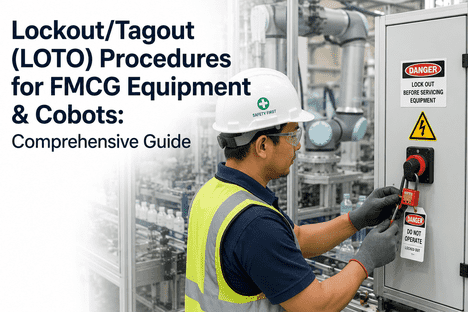
Lockout/Tagout is the single most important safety procedure in an FMCG plant and the one most frequently compromised under production pressure. Every year, proper LOTO compliance prevents an estimated 120 fatalities and 50,000 injuries across US manufacturing. Yet LOTO remains the fifth most cited OSHA standard, with 2,443 violations recorded in FY 2024 alone. The most troubling statistic is not the citation count: it is that 58.8% of fatal incidents reviewed by NIOSH involved no LOTO attempt at all, and 82% of LOTO fatalities are caused by failure to de-energize, block, or dissipate stored energy. In FMCG plants running high-speed packaging lines, multi-axis cobots, and interconnected production systems with electrical, pneumatic, hydraulic, and thermal energy sources simultaneously, the gap between a compliant LOTO program and a paper program that looks compliant in the office is where the risk lives. If your facility relies on laminated binders and clipboard checklists for energy isolation, Book a Demo of iFactory's digital LOTO Management module and see how forced-compliance workflows eliminate the documentation gap that causes 78% of OSHA citations.
The Six-Step LOTO Procedure Required by OSHA 1910.147
Every authorized employee performing lockout/tagout in an FMCG plant must follow the six-step sequence defined in 29 CFR 1910.147(d). Deviating from this sequence — skipping stored energy release, omitting zero-energy verification, or relying on a tag-only approach when a lock is possible — is the leading cause of LOTO failures that result in injury or citation. Each step must be verifiable in the procedure record for compliance.
Notify All Affected Employees
Before any lock is applied, every affected employee operators, line supervisors, sanitation crews, shift relief must be notified that a LOTO procedure will be performed. This prevents accidental re-energization attempts by personnel unaware of the isolation in progress.
Shut Down Equipment
Equipment must be shut down using its normal stopping procedure with all guards in place. Emergency stops are not substitutes for LOTO they provide temporary isolation without the lock and tag that prevent unauthorized restart.
Isolate All Energy Sources
Every energy-isolating device electrical disconnects, pneumatic ball valves, hydraulic block valves, chemical supply valves — must be physically operated to disconnect the equipment from all energy sources. FMCG packaging machines typically require isolation at multiple sub-panels.
Apply Lock and Tag
Each authorized employee affixes their own uniquely keyed personal lock and tag to each energy-isolating device. Group LOTO requires each crew member to apply their personal lock to a group lockout box. Tag-only is permitted only if the device cannot accept a lock — and equivalent protection must be demonstrated.
Release Stored Energy
All potentially hazardous stored or residual energy must be relieved, disconnected, restrained, or rendered safe. Pneumatic lines must be bled to zero PSI. Servo capacitors must discharge (typically 5-15 minutes for 300-800V DC). Seal jaws must cool below 50°C. Springs must be mechanically blocked.
Verify Zero Energy
The most critical and most frequently skipped step. The authorized employee must attempt to start or operate the equipment under safe conditions to confirm de-energization, and verify with test instruments: voltage testers for electrical, pressure gauges for pneumatic/hydraulic, temperature probes for thermal. Book a Demo to see how iFactory enforces verification with photo-captured step confirmation.
FMCG Equipment-Specific LOTO Requirements
Six asset classes account for 91% of LOTO-related incidents in FMCG plants. Each has unique energy isolation requirements that generic LOTO procedures do not cover.
| Asset Class | Energy Sources | Critical Isolation Steps |
|---|---|---|
| Packaging Machines (form-fill-seal, cartoners, case packers) | Electrical (servo motors, heaters), pneumatic (cylinders), thermal (seal jaws 350°F+) | Lock individual sub-panels (infeed, former, sealer, labeller, case packer); seal jaw cooldown below 50°C; servo capacitor discharge at each cabinet; pneumatic header bleed to zero PSI |
| Conveyors | Electrical (drive motors), mechanical (belts, rollers, pinch points), gravitational (accumulated product) | Main isolator lock; individual drive locks on long systems; mechanical blocking of elevated sections; gravity-brake engagement |
| Fillers (volumetric, gravity, pressure) | Electrical, pneumatic, hydraulic, chemical (CIP chemicals), thermal (hot-fill) | Electrical isolation; pneumatic bleed; thermal cooldown of CIP heat circuits; chemical supply valve lock and line drain; capacitor discharge; verify zero voltage, zero pressure, zero temperature |
| Sealers (heat seal, induction, ultrasonic) | Electrical, thermal (heating elements 200-500°F), pneumatic (press platens) | Shutdown and cooldown below 50°C/122°F; pneumatic lock and bleed; capacitor discharge for ultrasonic generators |
| Mixers and Blenders | Electrical (drive motors), mechanical (rotating shafts, agitators), chemical (ingredient residuals) | Disconnect motor; lockout at MCC; mechanical lock on drive shaft or V-belt; block agitator from free rotation; isolate ingredient feed systems |
| CIP (Clean-in-Place) Systems | Chemical (caustic, acid), thermal (180°F+), pneumatic (valve arrays), electrical (pumps) | Chemical supply valve lock and line drain; thermal cooldown verification; pneumatic system bleed; electrical isolator lock at pump panel |
Collaborative Robot LOTO: The Most Misunderstood Isolation in FMCG
The most critical LOTO gap in modern FMCG plants involves collaborative robots. The misunderstanding is straightforward and dangerous: a collaborative stop — where the cobot enters speed-and-force-limited mode — is not LOTO-compliant isolation under OSHA 1910.147 or ISO 14118. A Category 2 supervised stop leaves servo drives energized, and the robot retains full kinetic capability that can be reactivated by a control signal without warning. Any task requiring body entry into the collaborative workspace — end-of-arm-tool changes, joint inspections, cable routing, sensor cleaning — requires full energy isolation, not a collaborative stop.
The correct LOTO sequence for a collaborative robot used in FMCG packaging or palletizing applications requires: Category 0 stop initiation, controller isolator lock application, pneumatic supply isolation and line bleed, OEM-specified capacitor discharge wait (typically 5-15 minutes), zero-voltage verification at the drive panel using a rated voltmeter, and verification of spring-loaded joint mechanical restraints where present. This sequence must be documented in a machine-specific energy control procedure — not a generic cobot LOTO template. OSHA is actively considering revisions to 1910.147 to address robotic energy isolation, but as of 2026, the existing standard applies fully to collaborative robots, and the collaborative stop exception does not qualify as compliant isolation for any maintenance task. Book a Demo to see how iFactory's LOTO Management module supports machine-specific procedures with step-by-step forced workflows and photo verification.
What LOTO Non-Compliance Costs an FMCG Plant
The financial cost of LOTO failures extends far beyond OSHA penalties. Each serious hazardous-energy injury costs an average of $43,000. The maximum OSHA willful violation penalty reached $165,514 per instance in 2025, and penalties have risen 78% since 2015. But the largest cost is operational: a single LOTO-related fatality carries costs exceeding $1.46 million, and the indirect costs — production stoppage during investigation, retraining, insurance premium increases averaging 18%, reputational damage with retailers and regulators — typically multiply direct costs by 3-5x.
How to Move from Paper LOTO to a Compliant Digital LOTO Program
Transitioning from a paper-based LOTO program to a digital, CMMS-integrated system follows a repeatable four-phase roadmap. Facilities that complete this transition typically see 78% of the documentation-related citation risk eliminated immediately, procedure execution time reduced by 60%, and OSHA audit preparation time compressed from 40+ hours to under 3 hours.
The single most important design principle for a digital LOTO program is forced compliance: the system must prevent the user from proceeding to the next step until the current step is verified. Paper procedures cannot enforce this — they rely on the technician's discipline to follow the sequence. Digital LOTO with photo verification, time-stamped step confirmation, and lock-position validation eliminates the compliance gap between "the procedure exists" and "the procedure was followed." Book a Demo to see iFactory's digital LOTO workflow in operation on a live production line.
LOTO Best Practices for FMCG Safety and Compliance Managers
Beyond the regulatory minimums, the following best practices distinguish LOTO programs that pass audits from LOTO programs that prevent injuries. Each practice addresses a specific failure mode identified in NIOSH fatality investigations and OSHA citation patterns across FMCG facilities.
Machine-Specific Procedures for Every Asset
Generic "lock and tag" templates are the single most cited LOTO deficiency. Every machine with more than one energy source or a unique isolation sequence must have its own documented energy control procedure. This is not optional — it is the most frequently violated OSHA LOTO requirement.
Sanitation Crews Are Authorized Employees
In FMCG plants, sanitation workers performing washdowns inside mixers, hoppers, and conveyors are performing servicing — not production. They must be trained and treated as authorized employees under the LOTO program. This is the most commonly overlooked exposure in FMCG safety programs.
Annual Inspections Must Be Documented and Actionable
OSHA requires annual periodic inspections of each energy control procedure. The inspection must be performed by an authorized employee not involved in the procedure being inspected, documented with identified deficiencies, and deficiencies must be corrected and documented as resolved.
Zero-Energy Verification Is Not Optional
The tryout step — attempting to start the equipment after isolation — is the most frequently skipped step in practice. Digital LOTO workflows enforce this step with photo-captured verification using rated test instruments before the system allows the technician to proceed to the work phase.
Frequently Asked Questions: LOTO Procedures for FMCG Equipment and Cobots
I spent 14 years as a safety manager in FMCG, and the LOTO program was always the program I worried about most — not because our technicians were careless, but because the system we had in place could not prove compliance at the moment of truth. A paper binder on a clip board looks compliant in the safety office on Tuesday morning. At 2 AM on a Saturday when a sanitation crew is inside a mixer and the line supervisor is under pressure to restart, the paper procedure is a suggestion, not a control. Digital LOTO with forced workflows changed that. Now every step is verified, every lock is photo-captured, and the audit trail is complete before the work even starts. Our OSHA citation risk dropped to zero in the first year. More importantly, our near-miss reporting went up — because the system gave us the data to find the gaps we could not see with paper.
Conclusion: LOTO Compliance Is a Documentation Problem as Much as a Physical Safety Problem
Seventy-eight percent of LOTO citations are documentation failures — not failures to physically isolate energy, but failures to prove that isolation was performed correctly, by the right person, following the right procedure, and verified before work began. For a safety manager preparing for an OSHA inspection, that distinction offers a clear path forward: the physical safety practices in most FMCG plants are better than the paper record suggests. Closing the documentation gap closes the citation gap. iFactory's LOTO Management module addresses both dimensions simultaneously — forced-compliance workflows that prevent step-skipping, photo verification that proves lock placement, zero-energy verification capture that confirms the tryout step, and a permanent digital audit trail that makes OSHA inspection preparation a matter of minutes rather than days. If your LOTO program is built on paper binders, clipboard checklists, and a shared filing cabinet, Book a Demo and see what a fully digital, forced-compliance LOTO system looks like in operation on your production floor.