The analytics manager reviews the vendor roster for the 8-line FMCG facility. Fifty-three active contractors and robotics vendors -- robot OEM service engineers, conveyor specialists, refrigeration contractors, electrical compliance firms, CIP validation consultants, and packaging equipment teams. Contractor costs represent 31% of total maintenance expenditure. Last quarter, three invoice discrepancies totaling $47,000 were identified only because a junior analyst cross-checked service hours against the original contract. Two robot OEM emergency callouts at $3,200 each could have been avoided if the vendor's response-time SLA had been tracked and enforced. Four compliance document expiry events passed unnoticed, creating an uninsured liability window. And the analytics team has no idea which vendors are performing well, which are costing more than they should, or where to start rationalising. This is the state of contractor and robotics vendor management in most FMCG plants -- and it is the highest-leverage improvement opportunity most analytics teams have not yet addressed.
Why Structured Contractor and Vendor Management Matters to FMCG Analytics
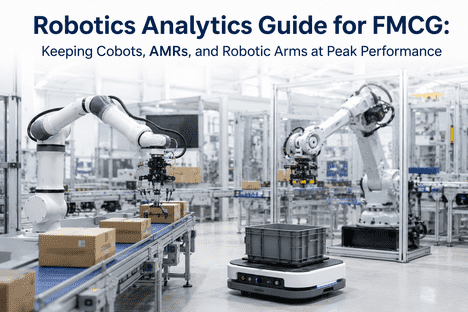
The average mid-size FMCG plant works with 30 to 50 maintenance contractors and vendors annually. Robot OEM service engineers maintain the palletising robots on the case packing lines. Conveyor specialists service the accumulation tables and diverters. Refrigeration contractors keep the cold chain assets running. Electrical compliance firms verify machine safety. CIP validation consultants ensure sanitation effectiveness. Packaging equipment teams maintain the fillers, labelers, and case sealers. Each vendor represents a relationship, a contract, a set of compliance documents, a performance history, and a cost stream. When these are managed in spreadsheets, email threads, and filing cabinets, the analytics team cannot produce a simple answer to the most basic questions: which vendors are performing best? Which are costing more than the contract allows? Where are the compliance gaps? What is the total cost of contractor maintenance per line?
Contractor costs represent 22 to 38% of total maintenance expenditure in FMCG plants. Twenty-three percent of maintenance incidents involve a third-party vendor. Yet 61% of plants have no formal vendor performance scoring system. The analytics team that brings structure to contractor and vendor management unlocks one of the highest-leverage improvement opportunities in the plant -- because vendor performance directly impacts equipment reliability, compliance risk, and maintenance cost. The difference between industry-average and best-in-class maintenance cost performance in a mid-size FMCG plant is $800,000 to $2.1 million annually, and vendor management maturity is the primary driver of that gap.
Contractor Qualification: Building the Tiered Framework
Not all contractors carry the same level of risk. A robot OEM service engineer working on a high-speed palletising robot presents a different risk profile than a waste removal contractor. Qualification must be tiered by risk to ensure that compliance requirements match the criticality of the work. A four-tier qualification framework sorts vendors by risk category, insurance requirements, certification needs, and review frequency. T1 vendors -- robot OEMs, HV electrical contractors, CIP engineers -- require the highest level of scrutiny: comprehensive liability coverage, ISO 10218 or NFPA 70E certification, site-specific LOTO induction, and annual performance review. T2 specialist vendors require trade competency cards and moderate liability coverage. T3 and T4 vendors require standard insurance and basic site induction only.
The qualification framework is not static. Vendor risk classification must be reviewed annually and adjusted based on incident history, compliance record, and changes in scope of work. When a T3 plumbing contractor is asked to work on a high-pressure CIP system, their risk classification must be elevated and the additional compliance requirements enforced before work begins. The analytics team's role is to maintain the qualification data, track review cycles, and produce the compliance status dashboard that the maintenance and procurement teams use to make vendor engagement decisions.
Robotics Vendor and OEM Service Management
Robot OEMs are the most expensive vendors on most FMCG rosters -- and the most difficult to manage. Proprietary dependency gives OEMs pricing power that plants accept because they believe they have no alternative. Emergency callout rates of $1,800 to $3,500 per visit are standard. Parts pricing carries margins of 40 to 60% above market. Service response times are measured in hours that can stretch into days when the OEM's next available engineer is 300 miles away. And because most plants do not track OEM performance systematically, they enter contract renewal negotiations with no data to challenge price increases or demand service improvements.
Tracking OEM performance against contractual KPIs changes the negotiation dynamic. Plants that capture response time, first-visit fix rate, parts availability, invoice accuracy, and repeat fault rate over 12 to 24 months consistently achieve 18 to 32% cost reductions at renewal. The critical OEM KPIs are: emergency response within 4 hours, first-visit fix rate of 85% or higher, critical parts availability of 95% or higher, repeat fault rate of 5% or lower, and invoice accuracy of 100%. When these KPIs are tracked automatically and reported monthly, the OEM knows the plant has data. The renewal conversation shifts from "trust us, our rates are competitive" to "your first-visit fix rate was 72% last year and your invoice accuracy was 94% -- let us discuss how that affects pricing."
Vendor Performance Scoring: The Five-Dimension Scorecard
A robust vendor performance scorecard must capture the dimensions that matter most to FMCG operations: cost and value, safety and compliance, responsiveness, technical quality, and collaboration. Each dimension carries a weight that reflects the plant's priorities. Cost and value typically carries the highest weight at 30%, covering invoice accuracy, budget compliance, and cost per work order. Safety and compliance at 25% covers LOTO adherence, PPE compliance, and certification currency. Responsiveness at 25% covers emergency SLA compliance, planned on-time arrival, and quote turnaround. Technical quality at 20% covers first-time fix rate, repeat fault rate, and post-service uptime.
The scorecard is reviewed at different frequencies depending on vendor strategic value. Strategic vendors with annual spend exceeding $1 million are reviewed monthly. Tactical vendors with spend between $250,000 and $1 million are reviewed quarterly. Transactional vendors are reviewed at contract renewal. The scorecard produces a composite score that drives vendor tier classification, contract renewal decisions, and performance improvement plans. Plants using automated scorecard systems report 34 to 52% reduction in vendor-related rework -- because underperforming vendors are identified and addressed before their performance deteriorates further.
Compliance Tracking for Contractors in Regulated FMCG
Contractors create direct liability under GFSI food safety schemes, OSHA and EPA regulations, and insurer requirements. Every contractor working in a food production area must have a current public liability certificate, employer's liability insurance, trade competency cards where applicable, site-specific induction records, risk assessments and method statements for every job, and GDPR agreements where the contractor accesses CMMS or process data. The compliance document set must be verified before work begins and tracked for expiry through the life of the contract.
The industry average is 14 compliance document expiry events missed per plant per year. Each missed expiry creates an uninsured liability window -- if a contractor without current liability insurance causes an incident, the plant bears the financial and regulatory risk. Automated expiry alerts set at 60 to 90 days before expiry eliminate this exposure. The compliance tracking system must also link each contractor's document set to the specific work orders they execute, so that an auditor can see that every contractor who worked on every job had current compliance documentation at the time of work. This level of traceability is difficult to achieve with paper-based or spreadsheet systems but is produced automatically by an integrated vendor and contractor management platform.
Cost Management and Contract Optimization
Three controllable cost drivers dominate contractor expenditure in FMCG plants. Emergency callout frequency is the largest -- emergency work carries a 2.8 to 4.7 times premium over planned work, so reducing emergency callouts through better vendor performance management and predictive maintenance delivers immediate cost impact. Invoice verification failure is the second -- the average invoice discrepancy rate across unmanaged vendor rosters is 4.8%, representing thousands of dollars in overcharges that go undetected without systematic auditing. Vendor proliferation is the third -- too many vendors per category blocks volume leverage and increases administrative overhead.
Rationalising from 50 to 30 vendors typically delivers 8 to 12% rate improvements on retained contracts because the retained vendors receive higher volume and offer better pricing. The annual ROI of structured vendor management at a mid-size FMCG plant is substantial: OEM cost reduction of $95,000, emergency callout reduction of $68,000, invoice overcharge recovery of $42,000, compliance incident avoidance of $85,000, and vendor rationalisation savings of $52,000 -- netting $342,000 or more annually at 6 to 12 times ROI for a platform investment of $28,000 to $55,000.
AI-Driven Vendor Management: What Changes
AI transforms vendor management from a reactive administrative function into a proactive strategic capability. Predictive contractor demand models forecast seasonal staffing needs from production schedules, ensuring that the right vendors are engaged at the right time without premium-rate emergency procurement. Automated invoice auditing using natural language processing flags rate violations and unbilled time against master service agreements, catching discrepancies that manual auditing misses. Dynamic scorecard weighting adjusts KPI importance based on plant performance trends -- when OEE drops, the responsiveness and technical quality dimensions are weighted more heavily. Agentic procurement systems handle renewal negotiation, compliance document chasing, and SLA credit recovery autonomously.
McKinsey reports that AI can make procurement 25 to 40% more efficient. In FMCG specifically, AI reduces supply chain forecasting errors by up to 50% and cuts supply chain costs by 20% for early adopters. The FMCG analytics team that implements AI-driven vendor management shifts from tracking vendor history to predicting vendor performance -- identifying which contractors are likely to miss SLAs before they miss them, which OEMs are trending toward higher costs, and which compliance documents are approaching expiry. The platform handles the tracking and alerting while the analytics team focuses on strategic vendor relationship management and cost optimisation.
What Changes When FMCG Analytics Teams Automate Vendor Management
The analytics manager who implements automated vendor management shifts from chasing compliance documents and manually auditing invoices to analysing vendor performance trends, identifying cost optimisation opportunities, and driving strategic vendor consolidation. The platform handles the tracking, the alerting, and the reporting. The analytics team focuses on the insights that produce the $342,000 annual savings.
We had 53 contractors on our roster and no way to tell which ones were performing well. Our robot OEM was charging $3,200 per emergency callout and our engineers accepted it because they thought there was no alternative. When we implemented iFactory's vendor management platform, we discovered within the first month that the OEM's first-visit fix rate was only 68% -- meaning 32% of callouts required a second visit that we also paid for. We used that data at renewal and negotiated a 24% cost reduction. The compliance document tracking alone saved us from two audit findings in the first quarter. The platform paid for itself in the first 90 days through invoice discrepancy recovery and OEM cost reduction.
-- Maintenance and Reliability Manager, Multi-Site FMCG Manufacturer -- Dairy and Beverage, 7 production sitesConclusion
Contractor and robotics vendor management is the highest-leverage improvement opportunity that most FMCG analytics teams have not yet addressed. The data is already being generated by every vendor interaction -- every work order, every invoice, every SLA compliance event, every safety observation. The gap is not data availability. It is structured capture, automated analysis, and actionable reporting. When vendor performance data is captured systematically, scored automatically, and reported in real time, the analytics team transforms vendor management from a leak that costs $340,000 per year to a levered asset that drives cost reduction, compliance assurance, and equipment reliability improvement.
The $800,000 to $2.1 million annual gap between industry-average and best-in-class maintenance cost performance in a mid-size FMCG plant is directly attributable to vendor management maturity. The plants that close this gap are the ones whose analytics teams treat vendor management as a data problem rather than an administrative problem -- implementing structured qualification frameworks, automated performance scoring, systematic compliance tracking, and data-driven contract management.
iFactory's AI-driven vendor and contractor management platform is purpose-built for FMCG analytics teams -- delivering tiered vendor qualification, automated performance scoring, compliance tracking with expiry alerts, invoice auditing, and contract renewal analytics. Book a Demo to see the platform running on a vendor roster matched to your FMCG operation, or talk to an expert about a free vendor management maturity assessment and cost leak analysis for your facility.