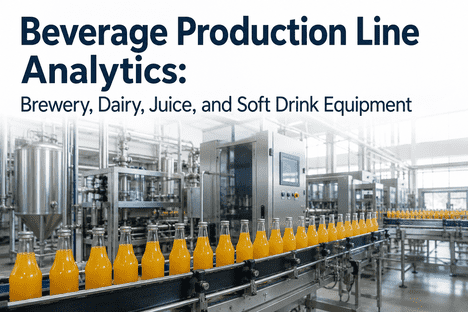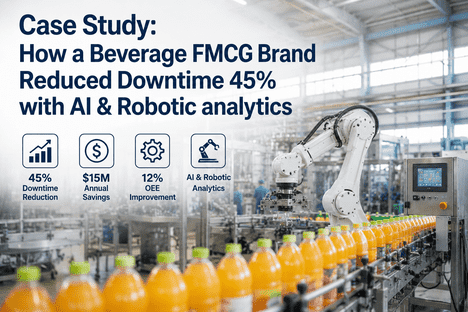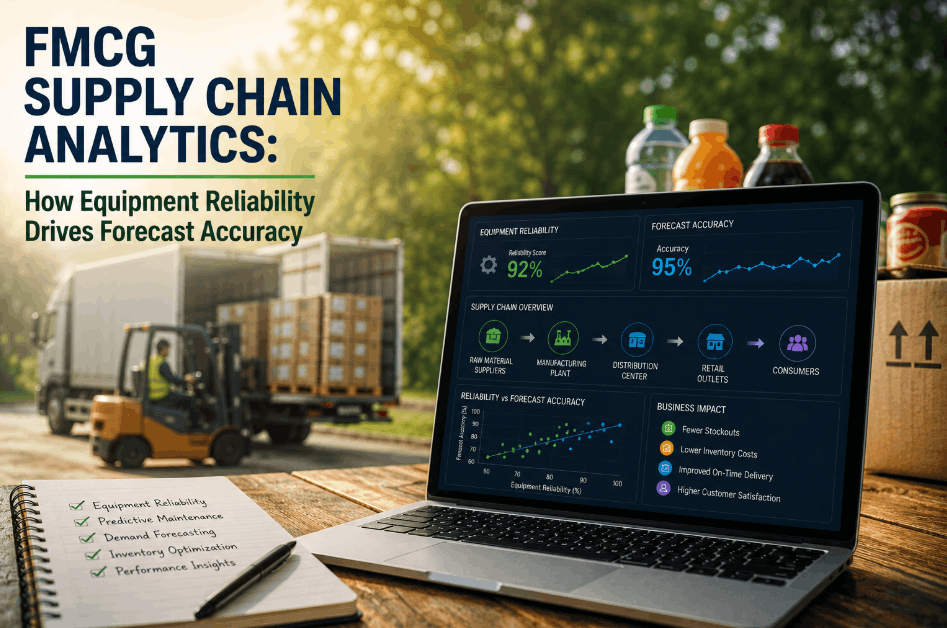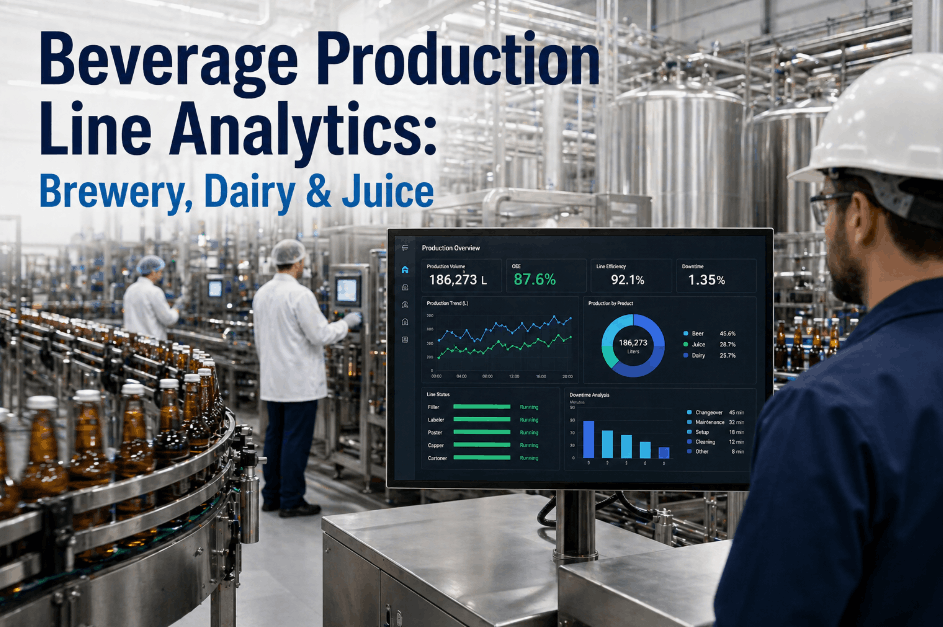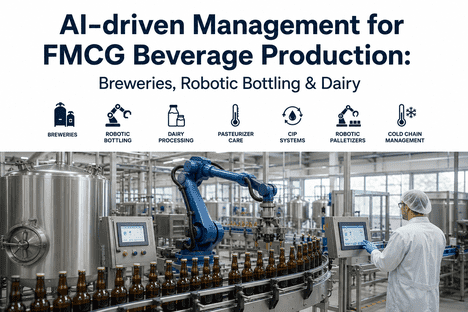
Beverage production in 2026 operates at the intersection of food safety regulation, SKU proliferation, and relentless cost pressure. Breweries managing fermentation cycles across dozens of recipes, dairies running continuous pasteurization lines under FDA and USDA oversight, and juice processors handling high-acid product flows all face one shared operational reality: equipment failures and quality deviations don't announce themselves. They accumulate — through micro-vibrations in robotic filler heads, gradual temperature drift in pasteurizer heat exchangers, incremental pressure loss across carbonation circuits, and CIP cycle degradation that silently extends beyond validated parameters. iFactory's analytics platform connects pasteurizers, robotic bottling lines, CIP systems, carbonation equipment, cold chain assets, and robotic palletizers into a single AI-driven intelligence layer — giving beverage plant managers real-time visibility into equipment health, OEE, compliance documentation, and predictive failure warnings. To see how iFactory maps to your specific beverage production environment, Book a Demo with our beverage manufacturing analytics team today.
Unify Brewery, Robotic Bottling & Dairy Analytics in One Platform
iFactory connects pasteurizers, robotic fillers, CIP systems, carbonators, and cold chain assets into a single AI-driven intelligence layer with real-time OEE, predictive maintenance, and audit-ready compliance documentation.
Why FMCG Beverage Production Demands Purpose-Built Analytics
Beverage manufacturing environments impose mechanical, microbial, and regulatory challenges that no other FMCG sector fully replicates. Pasteurizers, homogenizers, separators, carbonators, and robotic fillers operate under continuous thermal cycling, aggressive CIP chemical exposure, and strict temperature control requirements — all simultaneously. A pasteurizer gasket that begins to fail between inspection intervals does not wait for the next scheduled service window. A robotic filler valve that drifts by microns produces under-fills on thousands of containers before the next quality check. A CIP flow deviation on a dairy line can compromise an entire batch before the next shift arrives. Traditional scheduled maintenance and manual SPC cannot match the precision that modern beverage operations require. iFactory's analytics platform addresses this gap by monitoring equipment health continuously through AI models trained on beverage-specific degradation patterns — detecting developing faults from vibration signatures, thermal drift, and process flow deviations days or weeks before they escalate into production-stopping failures. Book a Demo to understand how AI analytics integrates with your existing beverage processing infrastructure without disrupting ongoing production.
Brewing Equipment Analytics: From Brewhouse to Packaging Line
Craft and commercial breweries operate some of the most analytically complex beverage production environments — combining fermentation biology with precision packaging equipment running at high speeds. Brewing equipment analytics spans fermenter temperature and pressure profiles, bright beer tank conditioning data, yeast health monitoring, and canning line dissolved oxygen pickup tracking. AI-driven brewing analytics platforms detect fermentation deviations early, optimize conditioning schedules, and prevent the dissolved oxygen pickup that destroys shelf life on packaged beer. iFactory connects brewhouse PLCs, fermenter sensors, bright tank instrumentation, and packaging line equipment into a unified analytics platform — with batch record integration, 48-hour advance failure prediction, CIP tracking, and FSMA 204 traceability built in. Book a Demo to see how brewery analytics maps to your specific equipment mix and recipe portfolio.
Fermentation Analytics
Real-time monitoring of fermenter temperature profiles, pressure curves, specific gravity trends, and cooling jacket performance. AI models detect stuck fermentation, temperature excursion, and cooling system degradation 24-48 hours before product quality is impacted.
Brewhouse Vessel PdM
Vibration, motor current, and thermal analysis on mash tuns, lauter tuns, brew kettles, and whirlpools. Predictive models detect heating element failure, agitator wear, and insulation degradation before they cause mid-batch losses.
Packaging Line OEE
Real-time OEE tracking across canning and bottling lines with SKU-level granularity. AI models predict filler valve wear, capper torque drift, and labeller misalignment 48 hours in advance. Changeover analytics identify highest-impact transition bottlenecks.
Robotic Bottling Line Analytics: Vision Inspection, Fill Level, and Line Performance
Beverage bottling lines operating at 300-800 containers per minute cannot afford human inspection gaps. Manual quality checks miss 2-8% of defects while consuming significant labor hours per shift. A single missed fill level deviation, cap defect, or contamination event triggers recalls costing millions and regulatory action that erodes brand equity. Robotic vision inspection systems deployed on bottling lines eliminate the speed-accuracy tradeoff — catching fill level drift, cracks, contamination, and labeling errors at line speed while generating immutable audit-ready inspection records automatically. iFactory's AI vision platform inspects 100% of containers at full line speed with under 100ms inference time per bottle, detecting under-fill, over-fill, missing caps, crooked closures, label defects, and foreign object contamination across every container on the line.
Dairy Analytics: Pasteurizers, Separators, Homogenizers, and Cold Chain
Dairy processing facilities operate under some of the most demanding regulatory and quality requirements in the food industry. HTST pasteurization, UHT processing, separator performance, and homogenizer pressure all require continuous monitoring — and the consequences of monitoring gaps extend from product quality failures to regulatory enforcement action. Dairy line analytics platforms purpose-built for dairy environments address this through deep integration with pasteurizer PLCs, separator sensor arrays, and packaging equipment networks — auto-generating HTST charts, CIP records, and deviation documentation that eliminate the manual documentation burden consuming significant QA team capacity. iFactory's analytics platform monitors every critical asset in your dairy processing environment — pasteurizers, homogenizers, cream separators, evaporation systems, and cold storage — delivering failure predictions up to 72 hours in advance. Book a Demo to see how dairy-specific compliance documentation is handled within the platform.
| Dairy Asset Category | Monitoring Method | Prediction Lead Time | Compliance Documentation |
|---|---|---|---|
| HTST Pasteurizer | Hold-tube temp, flow diversion valve, fouling profile | 24-72 hours | Auto-generated HTST charts, CCP records |
| Centrifugal Separator | Vibration, bowl speed, motor current | 24-48 hours | Maintenance logs, performance trends |
| Homogenizer | Pressure variance, valve wear signature, temp | 24-72 hours | Valve replacement schedule, pressure logs |
| CIP System | Conductivity, flow rate, temperature, caustic concentration | Real-time deviation detection | 3-A 74-07 validated cycle records |
| Cold Storage / Refrigeration | Compressor vibration, refrigerant pressure, temp | 24-48 hours | Temperature logs, alarm records |
| Evaporator / Spray Dryer | Inlet/outlet temp, pressure differential, flow | 24-48 hours | Batch moisture records, energy logs |
CIP System Analytics: Continuous Validation Instead of Static Cleaning Cards
Clean-in-Place systems account for 25-40% of total water and chemical consumption in beverage plants — and in most facilities, CIP cycles run on fixed programs validated at commissioning and never analytically optimized. Traditional CIP management relies on static cleaning cards and annual validation audits. AI-driven CIP analytics inverts this by providing continuous validation — comparing every live cleaning cycle against the golden batch profile and identifying subtle drifts in temperature, pressure, conductivity, and flow velocity that indicate failing gaskets, pump wear, or mineral scaling in product lines. iFactory's analytics platform monitors caustic concentration curves, rinse conductivity return profiles, temperature gradients, and flow velocity per circuit — verifying that cleaning efficacy targets are met with the minimum chemical and water input. When a CIP circuit underperforms, the platform flags the deviation before the next production run begins, preventing both microbiological risk and regulatory non-conformance. The platform also optimizes sanitation schedules based on live production data, correlating product run-times and soil loading with CIP efficacy to recommend the shortest safe cleaning cycle for each product changeover — reducing changeover downtime by 12-18%.
Connecting Beverage Analytics to the Production Workflow
iFactory's analytics platform integrates with your existing beverage production equipment and control systems without requiring new sensor installations or control logic modifications. The data ingestion layer connects to existing OPC-UA servers, PLC networks, inline inspection systems, and MES platforms — creating a unified data stream that feeds AI models trained on beverage-specific degradation patterns. Analytics outputs are delivered through a shift-floor dashboard, mobile alerts, automated compliance reports, and direct integration with your CMMS for automatic work order generation. Schedule a demo to review the integration architecture configured for your specific beverage production environment.
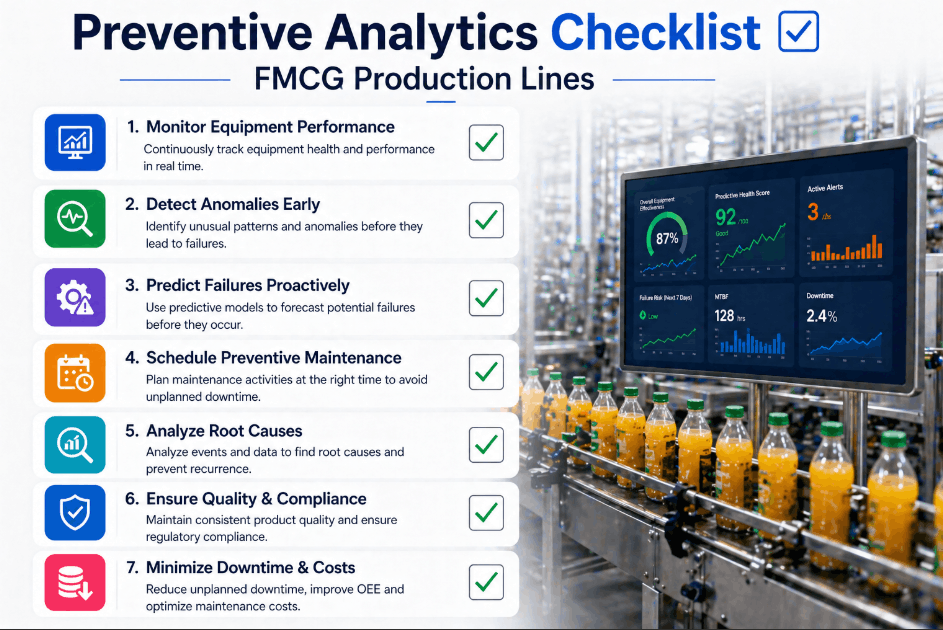
The operator dashboard displays real-time OEE by SKU and shift, asset health scores for every critical piece of equipment, active CIP cycle status with validated parameter tracking, and predicted failure risk for pasteurizers, fillers, carbonators, and compressors. Each risk indicator is linked to the process variables driving the prediction, with recommended corrective actions drawn from the AI model's decision-tree analysis. Operators use the dashboard to prioritize their shift-floor attention, focusing on the equipment and process stages most likely to deviate from optimal performance.
For time-critical forecasts — pasteurizer temperature drift, filler valve degradation, compressor vibration anomalies — the platform sends structured alerts to the shift supervisor's mobile device. Each alert includes the predicted failure mode, affected equipment, current vs. optimal parameter range, and a recommended corrective action. Supervisors acknowledge alerts and document their response within the platform, creating a closed-loop audit trail that supports regulatory compliance and continuous improvement analysis.
Every analytics event, forecast output, and operator response is automatically logged as a structured compliance record. HTST pasteurization charts, CIP validation reports, HACCP deviation documentation, and FSMA 204 traceability records are generated in audit-ready format without manual data entry. The platform integrates with existing quality management systems via API, creating a unified compliance documentation repository that satisfies FDA, USDA, SQF, FSSC 22000, and third-party audit requirements.
Deploy Beverage Analytics in 10-14 Weeks — Purpose-Built for Your Production Environment
iFactory's beverage analytics platform is purpose-engineered for breweries, robotic bottling lines, and dairy processing facilities. Pre-built connectors, beverage-specific AI models, and a structured deployment methodology deliver measurable results in your first production quarter.
We deployed iFactory across our pasteurizer, two robotic fillers, and CIP system in under 12 weeks. The platform predicted a pasteurizer gasket failure 54 hours before it would have caused a shutdown — we scheduled the replacement during a planned CIP window instead of losing a production shift. In the first quarter, we documented a 28% reduction in unplanned downtime and our SQF surveillance audit had zero findings related to CIP documentation. The compliance automation alone saved our QA team approximately 20 hours per week.
Beverage Production Analytics — Frequently Asked Questions
iFactory monitors any beverage production asset with measurable operating signatures — HTST and UHT pasteurizers, plate heat exchangers, centrifugal separators, homogenizers, CIP systems, evaporators, spray dryers, carbonators, deaerators, rotary and linear fillers, cappers, labelers, robotic palletizers, refrigeration compressors, and cold storage systems. The platform supports 500+ industrial protocols and connects via OPC-UA, Modbus, MQTT, EtherNet/IP, and direct PLC interfaces — covering equipment from all major OEMs including Krones, Sidel, KHS, Tetra Pak, Alfa Laval, GEA, FANUC, ABB, and KUKA.
iFactory connects to pasteurizer, filler, and CIP PLCs via read-only OPC-UA, Modbus TCP, and MQTT channels — extracting real-time process data without writing to the control layer. No changes to PLC logic, SCADA configuration, or HMI screens are required. For robotic controllers from FANUC, ABB, and KUKA, the platform parses controller-specific data streams — joint positions, cycle times, payload metrics — through read-only API interfaces. Write-back channels for closed-loop setpoint adjustment are optional and configured with safety limits and manual override.
Yes. iFactory automatically generates audit-ready compliance documentation including HTST pasteurization charts with CCP verification, CIP validation records (3-A 74-07 compliant), HACCP deviation and corrective action logs, FSMA 204 traceability records, SQF and FSSC 22000 inspection documentation, and FDA 21 CFR Part 11 compliant audit trails. The platform's compliance documentation module eliminates manual data entry and chart filing, reducing QA documentation labor by up to 20 hours per week in typical beverage deployments.
Standard deployments covering pasteurizers, fillers, CIP systems, and cold chain assets typically go live in 10-14 weeks. The deployment follows a four-phase methodology: discovery and architecture assessment (2 weeks), connector configuration and pilot on 3-5 critical assets (4-5 weeks), production deployment and validation (3-4 weeks), and scale-out to remaining lines and equipment (3-4 weeks). Pre-built connectors for common beverage equipment significantly accelerate the timeline — pasteurizer and filler integrations typically complete in 5-10 business days for standard configurations.
Yes. iFactory's AI vision platform can ingest camera feeds from existing inline inspection systems or from dedicated vision cameras deployed at filler exit, labeler, and case packer stations. The AI models perform inference on GPU-accelerated edge hardware with under 100ms per container — fast enough to inspect 1,000+ containers per minute at full line speed. The platform detects fill level (with foam compensation), cap presence and orientation, label position and integrity, barcode readability, and foreign object contamination. All inspection results are recorded as audit-ready quality records in the platform's compliance documentation module.
Deploy AI-Driven Analytics Across Your Beverage Production Lines
iFactory's beverage analytics platform connects pasteurizers, robotic fillers, CIP systems, carbonators, and cold chain assets into a single AI-driven intelligence layer — with real-time OEE, predictive maintenance, and audit-ready compliance documentation. Live in 10-14 weeks with pre-built beverage equipment connectors and purpose-built AI models.