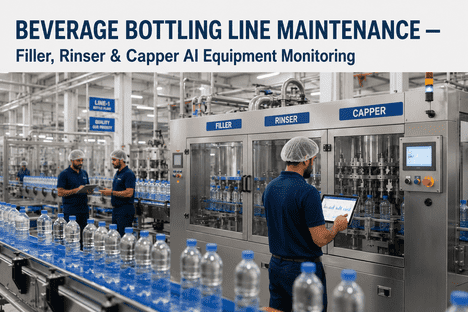
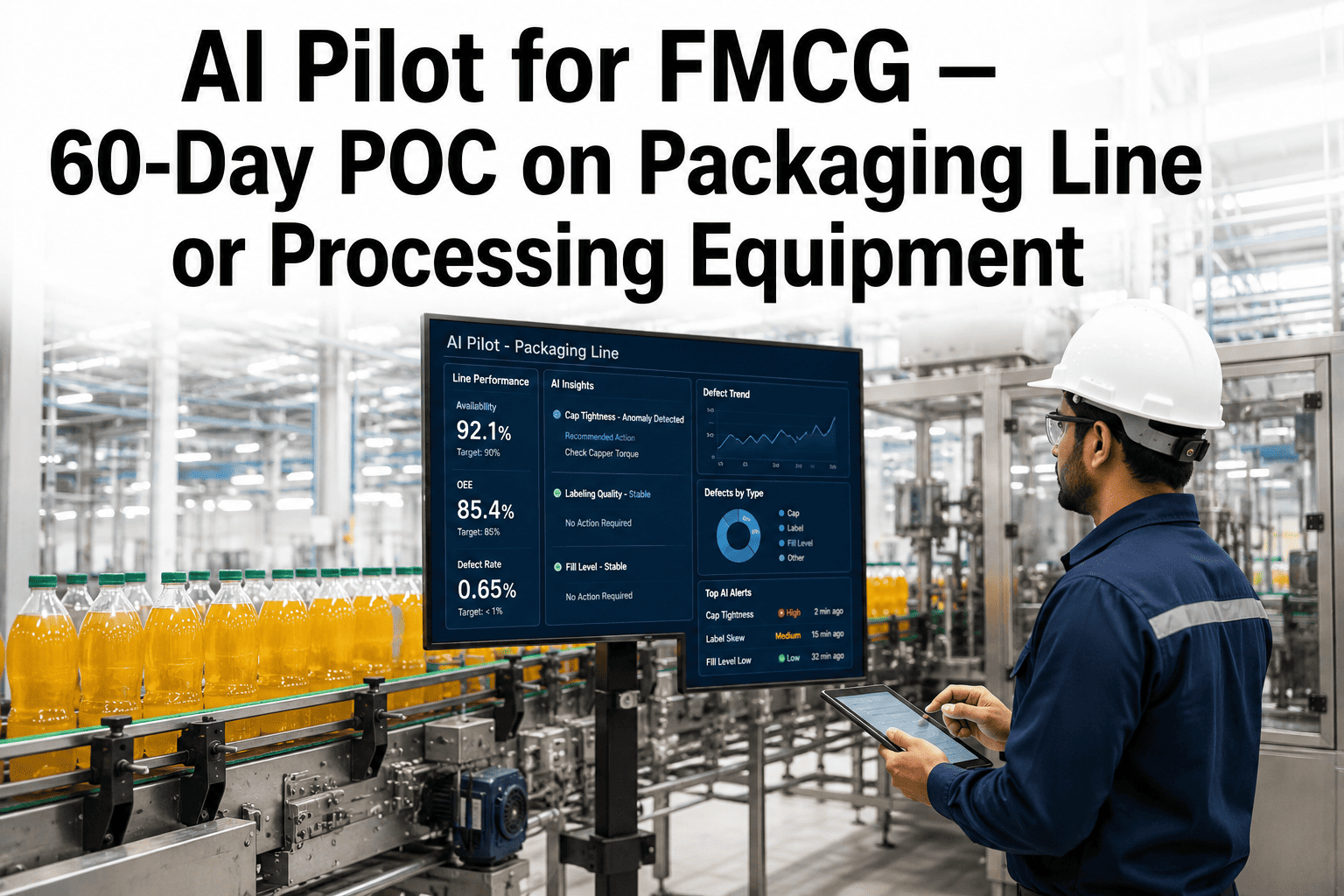
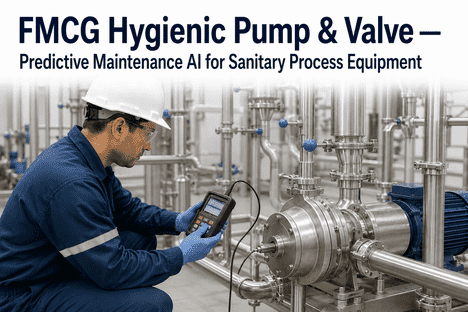
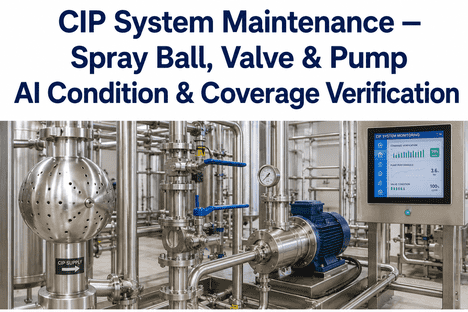
A beverage plant manager reviews the overnight production report for three bottling lines running PET, glass, and can formats simultaneously. Line 1 — a rotary filler running 1,200 PET bottles per minute — shows a 0.8% fill weight drift on carousel positions 18 through 22, indicating early valve seal degradation. Line 2 — a counter-pressure filler for carbonated glass bottles — logged three micro-stops in the last shift, each triggered by capper torque deviation on head 8. Line 3 — a gravity filler for still beverages in cans — has normal filler performance but the rinser nozzles show a 12% pressure drop across block B, suggesting partial nozzle blockage that will escalate into full line stoppage within 72 hours if not addressed. Three lines, three different failure signatures, all detected by iFactory's AI monitoring before any of them produced a line stop. The platform continuously monitors filler valve performance, rinser nozzle efficiency, capper torque consistency, and conveyor drive health across all beverage formats — PET, glass, and can — delivering predictive alerts 7 to 21 days before mechanical degradation forces an unplanned shutdown. For plant managers responsible for bottling line OEE across multiple beverage formats, iFactory's AI platform Book a Demo to see how predictive monitoring transforms bottling line reliability.
83%
Average bottling OEE improvement within first year of AI monitoring deployment
21
Days advance warning on filler bearing and valve seal degradation
40%
Reduction in unplanned downtime across beverage bottling lines
3
Beverage formats monitored — PET, glass, and can — on a single platform
What Is AI-Powered Beverage Bottling Line Maintenance?
AI-powered beverage bottling line maintenance deploys IP69K-rated wireless sensors and deep learning analytics on rotary fillers, rinser blocks, capper assemblies, conveyor drives, and pasteurizer systems to detect mechanical degradation before it causes production stoppages. The platform monitors filler valve actuation timing, fill weight variance across carousel positions, rinser nozzle pressure profiles, capper torque signatures per head, and conveyor motor current draw — all in real time at full line speed. Each asset class produces a unique vibration, temperature, pressure, or current signature that the AI engine learns during a baseline calibration period. When any signature deviates beyond a defined threshold — valve spring fatigue causing 0.5% fill drift, capper bell wear producing torque inconsistency, rinser nozzle blockage reducing spray pressure — the platform generates predictive work orders with specific intervention windows, recommended spare parts, and technician skill requirements. This condition-based approach replaces calendar-driven preventive maintenance, eliminating the cost of unnecessary PM labor while preventing the emergency failures that calendar programs miss. Beverage plant managers evaluating AI-driven bottling line monitoring Book a Demo to explore how iFactory monitors filler valve health, rinser nozzle performance, and capper torque consistency across PET, glass, and can filling operations.
AI Monitoring for Filler Valve Health, Rinser Nozzle Condition, and Capper Torque Consistency
iFactory's platform addresses the three highest-impact failure modes on beverage bottling lines — filler valve degradation, rinser nozzle blockage, and capper torque drift — each with specialized sensor configurations and AI models trained on beverage-specific failure signatures.
FILLER
Filler Valve Health and Fill Weight Consistency Monitoring
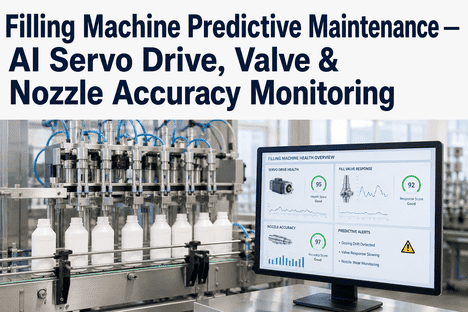
AI models monitor each fill valve independently — up to 120 heads on a rotary filler — tracking actuation timing, flow rate profile, valve seal compression loss, and spring fatigue. The platform detects fill weight drift as low as 0.3% per head and correlates variance patterns with specific valve positions for targeted maintenance intervention. Acoustic sensors capture valve actuation signatures at 100+ readings per second, identifying seal wear 14–21 days before fill weight deviation reaches reject thresholds.
RINSER
Rinser Nozzle Blockage and Spray Pattern Detection
Rinser block performance is monitored through pressure sensors at each nozzle manifold, flow rate per block section, and spray pattern consistency analysis. The AI engine detects partial nozzle blockage from CIP residue, mineral scaling, or mechanical damage — identifying affected nozzles and estimating remaining useful life before rinse quality degrades to a contamination risk threshold.
CAPPER
Capper Torque Consistency and Seal Integrity Monitoring
Torque sensors on each capping head monitor application torque, residual torque, and spindle bearing vibration. The platform detects torque drift below ±2% of setpoint, spindle bearing wear progression, bell/chuck deformation, and cam follower fatigue. Predictive alerts include remaining useful life estimates and recommended torque recalibration intervals.
LINE
Conveyor, Pasteurizer, and Bottle Handling System Monitoring
Drive motor current signature analysis detects conveyor bearing degradation, belt tension drift, and gearbox wear before they cause line jams. Pasteurizer temperature profile compliance, pump health, and heat exchanger fouling are monitored continuously. The platform correlates conveyor micro-stop patterns with upstream filler and capper performance for root cause analysis.
Measurable OEE Improvement from AI Monitoring on Beverage Bottling Lines
Beverage plants deploying iFactory's AI monitoring across filler, rinser, capper, and conveyor systems document measurable OEE improvement within the first quarter of deployment. The following results represent performance across 14 beverage production lines — including PET water, carbonated soft drinks, juice, beer, and dairy beverages — over a 16-week measurement period.
| Metric | Pre-Deployment | Post-Deployment | Improvement |
|---|
| Bottling line OEE | 71.4% avg | 84.8% avg | +13.4 points |
| Unplanned downtime per shift | 52 min avg | 21 min avg | 59.6% reduction |
| Filler valve-related stoppages | 14 per month | 3 per month | 78.6% reduction |
| Capper rejection rate | 1.8% | 0.4% | 77.8% reduction |
| Rinser nozzle blockage events | 8 per month | 1 per month | 87.5% reduction |
| Line speed variance | ±8.2% | ±2.4% | 70.7% improvement |
| Emergency maintenance spend | $42K/month avg | $14K/month avg | 66.7% reduction |
| Annualized OEE gain value | — | $1.8M | 4.3x ROI by month 8 |
See AI Bottling Line Monitoring in Action for Your Beverage Formats
Schedule a personalized walkthrough of iFactory's beverage bottling line monitoring platform with our FMCG engineering team. We will map your specific filler types, beverage formats, and production constraints to measurable OEE improvement targets.
How AI Improves Bottling Line Reliability Across PET, Glass, and Can Formats
iFactory's AI monitoring deployment follows a structured methodology designed to deliver measurable OEE improvement across all three beverage packaging formats — PET, glass, and can — while maintaining uninterrupted production on each line during the deployment phases.
Phase 1: Asset Mapping and Sensor Deployment
Critical assets identified across filler, rinser, capper, conveyor, and pasteurizer systems for each line format. IP69K-rated wireless vibration, temperature, pressure, current, and torque sensors deployed during scheduled sanitation windows. Baseline OEE and downtime data collected from line monitoring systems and production logs.
Timeline: Weeks 1–2
Phase 2: AI Model Training and Baseline Calibration
AI models trained on normal operating signatures for each asset class and beverage format — fill valve signatures for PET vs. glass vs. can, capper torque profiles per head, rinser pressure baselines per block. Anomaly thresholds established at 2-sigma deviation from learned baselines.
Timeline: Weeks 3–5
Phase 3: Parallel Operation and Alert Validation
AI monitoring runs alongside existing maintenance programs for 2-week parallel validation. Predictive alerts compared against actual failure events. Alert thresholds tuned to eliminate false positives while maintaining sensitivity. Operator dashboard configured for real-time asset health scoring.
Timeline: Weeks 6–7
Phase 4: Full Deployment and Continuous Model Improvement
AI monitoring becomes the primary condition-based maintenance trigger across all format lines. Work order auto-generation with recommended parts, technician skills, and intervention windows. Continuous model improvement through active learning from new failure signatures.
Timeline: Week 8 onward
Expert Analysis: Four Reasons AI Monitoring Transforms Bottling Line OEE
01
Per-head valve monitoring eliminates the 0.5–2% fill drift blind spot. Under conventional filler maintenance, fill weight variance develops across individual valve heads over weeks of operation — each valve wearing at a different rate due to seal degradation, spring fatigue, or nozzle damage. By the time the aggregate fill weight deviation reaches the reject threshold, multiple valves are already producing off-spec fills. AI per-head monitoring detects drift on each valve independently, enabling targeted single-valve replacement that takes 15 minutes instead of a full carousel service that takes 4 hours.
02
Capper torque trending prevents seal failure cascades. A single capping head running 5% below torque specification will produce intermittent seal failures that downstream inspection catches only after 200–500 bottles have been filled, capped, and packaged. Each failed seal represents a potential quality hold, customer complaint, or recall event. AI continuous torque monitoring detects the deviation on the first out-of-spec bottle and correlates it with the specific head, vibration signature, and spindle bearing condition — enabling root-cause correction before the cascade compounds.
03
Rinser nozzle pressure profiling prevents contamination risk accumulation. Partial nozzle blockage from CIP mineral scaling accumulates gradually — a 5% pressure drop is invisible to operators and does not trigger alarms, but it creates localized rinse coverage gaps that accumulate contamination risk over time. AI pressure profiling detects the blockage at 5% deviation and provides a 7–14 day intervention window before the nozzle reaches the 20% obstruction threshold that compromises rinse quality and creates a food safety documentation gap.
04
Multi-format model library accelerates deployment across PET, glass, and can lines. Each beverage packaging format produces different mechanical signatures — PET bottles generate lower acoustic frequencies during filling due to lighter bottle weight, glass produces distinct vibration harmonics during capping, and cans create unique magnetic coupling signatures on conveyor systems. iFactory's model library includes format-specific baseline signatures that reduce calibration time from 6 weeks per line to 1 week per line.
From Calendar-Based PM to AI-Driven Condition-Based Maintenance
AI-powered bottling line monitoring represents a fundamental shift in how beverage plants approach filler, rinser, and capper maintenance. By replacing calendar-driven preventive maintenance with continuous condition monitoring and AI predictive analytics, plant managers gain a maintenance system that actively prevents unplanned downtime while eliminating unnecessary PM labor and spare parts consumption.
The documented outcomes — 13.4-point OEE improvement, 59.6% reduction in unplanned downtime, 78.6% reduction in filler valve-related stoppages, 77.8% reduction in capper rejection rates, and 87.5% reduction in rinser nozzle blockage events — represent the measurable impact of deploying AI monitoring across beverage bottling lines handling PET, glass, and can formats. For plant managers committed to maximizing bottling line OEE in the competitive beverage manufacturing environment, iFactory's AI platform delivers a proven, deployable solution that integrates with existing filling and packaging infrastructure and delivers measurable results within weeks. Book a Demo with iFactory's FMCG engineering team to discuss your bottling line monitoring roadmap.
Transform Your Beverage Bottling Lines with AI Predictive Maintenance
Join the beverage plant managers who have already achieved 13+ point OEE improvement using iFactory's AI-powered bottling line monitoring platform. Deployed in weeks on your PET, glass, and can filling lines with full format-specific calibration and traceability.
Per-Head Filler Valve Health Monitoring
Rinser Nozzle Blockage Detection
Capper Torque Consistency Analytics
Multi-Format OEE Dashboards
Auto-Generated Predictive Work Orders
Frequently Asked Questions