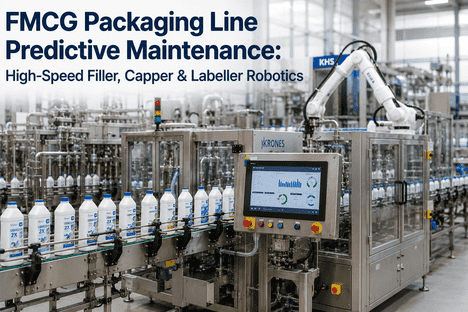
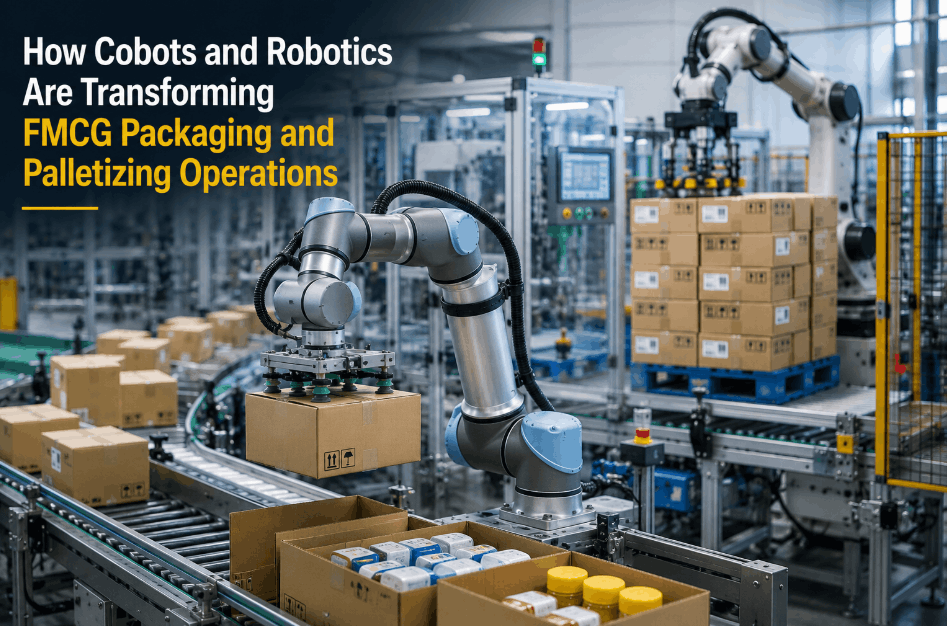
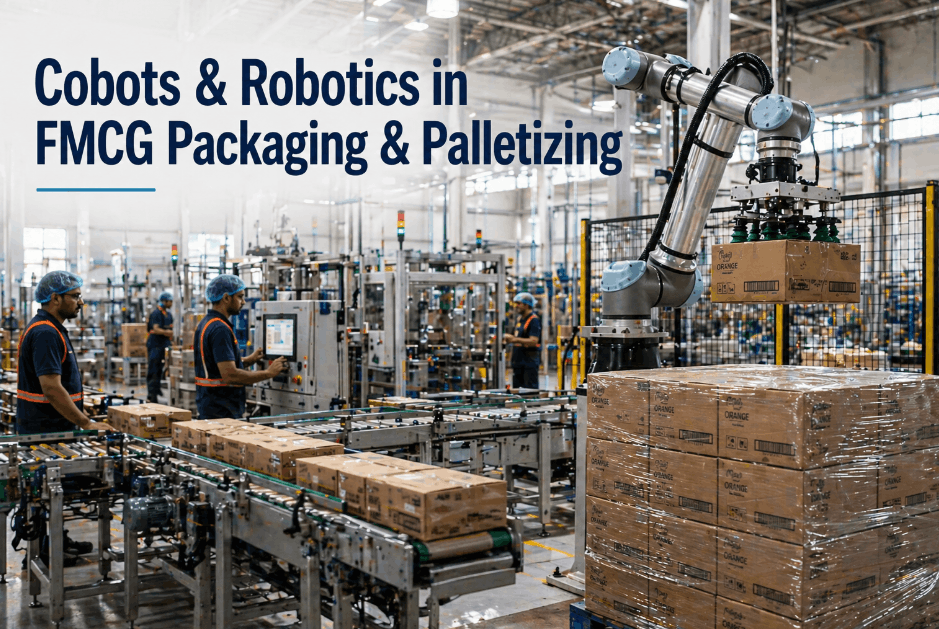
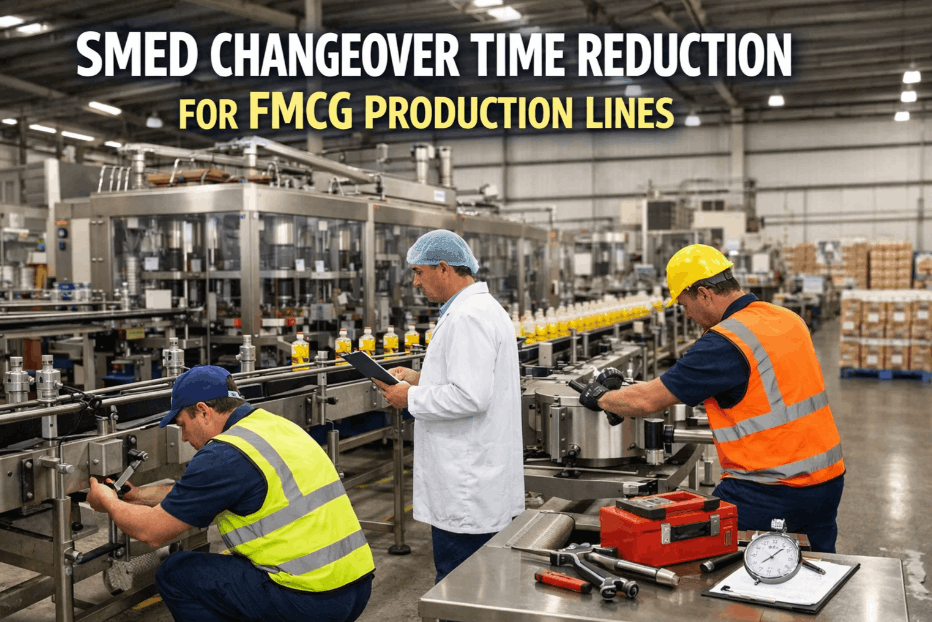
FMCG packaging lines operate at speeds where every second of unplanned downtime costs thousands of dollars in lost throughput — a high-speed filler jam on a 400-bottles-per-minute personal care line can scrap 200+ litres of product and halt downstream capper, labeller, and palletiser robots within 90 seconds. Production and maintenance managers at FMCG plants running Krones, KHS, or Sidel lines face a common set of failure patterns: filler nozzle wear causing fill-weight drift and spillage, capper head misalignment leading to cap rejection and leaker defects, labeller glue-starved laps that peel in transit, and palletiser layer squaring errors that topple loads. These failures share a root cause — rotating equipment degradation and servo-drift that develops over hours and shifts before producing a visible defect or stoppage. FMCG packaging line predictive maintenance applies machine learning to vibration, current, torque, and cycle-time telemetry from filler servos, capper spindles, labeller vacuum drums, and palletiser gantry axes to detect the earliest onset of wear — typically 2–8 shifts before the failure causes a production stop. iFactory AI's industrial software platform — including Shift Logbook, predictive maintenance engine, OEE analytics, and scheduling integration — enables FMCG packaging lines to deploy AI-driven failure prediction, reduce changeover time through SMED-optimised sequencing, and lift OEE by 12–18% without replacing existing Krones/KHS/Sidel line control systems. Book a Demo to see how iFactory predicts filler nozzle wear, capper head drift, and labeller vacuum loss before they stop your line.
FMCG Packaging · PdM · OEE Uplift
FMCG Packaging Line Predictive Maintenance for High-Speed Filler, Capper & Labeller Robotics
Predict filler nozzle wear, capper head misalignment, labeller vacuum drift, and palletiser gantry degradation 2–8 shifts before failure — without replacing Krones, KHS, or Sidel line control infrastructure.
SMED changeover reduction & line balance analytics
Why FMCG Packaging Lines Are the Highest-Value Target for Predictive Maintenance
FMCG packaging is a high-speed, synchronised process where a stop at any station starves or blocks the entire line within seconds. A 400-bottles-per-minute filler produces 6.7 bottles every second — a 30-minute unplanned stop costs 12,000 bottles of lost output plus product scrap costs, re-line labour, and compressed-air/energy waste during restart. The financial impact of packaging line downtime in FMCG plants ranges from $4,000–$15,000 per hour depending on product value and line speed, making it one of the highest-ROI targets for predictive maintenance in the consumer goods industry. The primary packaging section — filler, capper, labeller — accounts for 60–70% of all packaging line downtime events, with mechanical wear on servo-driven rotating assemblies being the dominant failure mode across all three OEM platforms.
01
Filler Servo & Nozzle Wear
Rotary piston fillers and volumetric fillers develop nozzle seat wear, servo encoder drift, and fill-height sensor degradation over 2,000–4,000 production hours. Unaddressed, fill-weight variation drifts outside spec, triggering reject diverters and wasting product until the next scheduled maintenance window.
02
Capper Head Misalignment & Torque Drift
Capper spindles, chuck jaws, and torque clutches wear asymmetrically — especially on ROPP and screw-capping turrets running at 300+ caps per minute. Misaligned heads cause cap skew, cross-threading, and leakers that may not be detected until the package reaches the warehouse or retail shelf.
03
Labeller Vacuum Drum & Glue System Faults
Labeller vacuum drums lose pneumatic seal integrity as felt pads compact and wear. Glue roller gaps drift, starve-labeller glue pattern consistency, and label reel tension control degrades. The result: label flagging, peel-backs on the line, and misapplied labels that trigger rejection at downstream vision inspection.
04
Palletiser Gantry & Layer Squaring
Palletiser robots — both gantry and articulated-arm types — develop drive-chain stretch, encoder feedback drift, and gripper-head pad wear that causes layer squaring errors. Unaddressed, pallet loads become unstable, topple in the stretch-wrapper or in transit, and generate customer damage claims.
Three FMCG Packaging Line Capabilities iFactory Delivers
iFactory ingests cycle-time profiles, servo torque curves, and fill-weight data from Krones/KHS/Sidel filler PLCs and vision systems. ML models trained on combined fleet data detect nozzle seat wear patterns from servo current signature harmonics, encoder drift from cycle-time variance, and fill-weight shift from product temperature and pressure telemetry. Predictions are delivered 3–8 shifts before fill-weight drifts outside spec, giving maintenance teams time to replace nozzles during planned changeovers rather than reacting to reject-diverter alarms mid-production. The same models distinguish between product-change drift (e.g., switching from shampoo to conditioner viscosity) and mechanical wear drift, eliminating false alarms during format changes. Book a Demo to see filler wear prediction models in production.
Capper turrets and labeller vacuum drums are instrumented via existing PLC telemetry streams supplemented with wireless MEMS accelerometers on critical spindles and drums. Capper head misalignment is detected through applied torque variance per cap position — a head running 12% higher torque than its neighbours indicates clutch wear or jaw misalignment. Labeller vacuum loss is predicted from pneumatic pressure decay rates during label pick-and-place cycles, with model confidence calibrated against downstream vision inspection reject rates. The Shift Logbook captures operator observations of cap skips, label flags, and glue-starved laps during start-up and changeover — converting informal shift notes into structured data that feeds the prediction models and improves accuracy by 18–25% across all label formats.
Palletiser Robot Health & Line Balance Optimisation
Palletiser robot degradation — gantry axis encoder drift, gripper pad wear, turntable bearing fatigue — is tracked through cumulative cycle counting combined with torque and position deviation monitoring. When palletiser failure probability exceeds a configurable threshold, iFactory's scheduling engine recommends preemptive maintenance during the next planned changeover window, avoiding unplanned stops that can block the entire packaging line for 45–90 minutes. Line balance analytics compare filler, capper, labeller, and palletiser uptime and speed trends to identify the bottleneck station that constrains overall line OEE. When filler speed must be reduced due to nozzle wear, the platform quantifies the OEE impact and recommends the optimal timing for intervention based on upcoming production schedule and format changeover calendar.
CMMS connectors · line control pass-through · historian sync
FMCG Packaging Line Use Cases
Personal Care Filling
Filler Nozzle Wear Prediction on 400-BPM Rotary Piston Filler
Continuous
A personal care plant running a Krones volumetric rotary filler at 400 bottles per minute on shampoo lines deployed iFactory's filler nozzle wear prediction. Nozzle seat wear had been causing fill-weight drift toward the lower spec limit over 3–4 weeks of production, triggering reject-diverter activation on average 3 times per shift. Each rejection scrapped 200–400 ml of product and required line restart. The filler PdM model detected servo current signature changes indicating nozzle seat wear 5–6 shifts before fill-weight drifted below the Lower Control Limit (LCL). Maintenance replaced affected nozzles during planned format changeovers rather than during emergency stops. Fill-weight Cpk improved from 1.2 to 1.6, product scrap reduced by 34%, and filler-related unplanned downtime dropped by 52% over six months.
ROPP Capper Head Misalignment Detection Across 3 Lines
Continuous
A home care plant with three Sidel capping lines running ROPP aluminium caps on 1-litre and 2-litre bottles experienced intermittent cap leaker defects traced to capper head number 4 wear. The defect pattern was intermittent — 1–3 leakers per shift in batches of 50–200 bottles — making root cause identification difficult. iFactory applied per-head torque variance analytics to the capper turret PLC data and detected that head 4 was applying torque 9–14% higher than the turret average. Deploying a wireless MEMS accelerometer on the spindle confirmed bearing housing degradation. The spindle was replaced during a planned detergent format changeover, eliminating leaker defects entirely from that line. Cross-line comparison revealed heads 2 and 7 on adjacent lines showed early-stage torque drift, enabling proactive replacement before either produced a leaker event.
A beverage FMCG plant running a KHS cold-glue wrap-around labeller at 600 cans per minute experienced recurring label flagging defects that generated customer complaints. The labeller vacuum drum felt pads were compacting unevenly, causing label pick-up failures on 3 of 24 vacuum segments. iFactory's vacuum decay model analysed pneumatic pressure per vacuum segment across each label pick cycle and identified the specific three segments where pressure decay exceeded threshold. The Shift Logbook revealed that operators had been noting "label flag on segment 7" in informal logs for weeks, but the pattern was never escalated to maintenance. The prediction model combined operator Shift Logbook observations, vacuum pressure telemetry, and vision inspection reject rates to forecast vacuum segment failure 4–5 shifts in advance. Felt pad replacement was scheduled during a planned flavour changeover. Label rejection rate dropped from 0.8% to 0.05%, saving $26,000 per month in label and product waste.
Combined impact of filler/capper/labeller/palletiser unplanned stop reduction, SMED changeover optimisation, and line balance improvement delivers measurable OEE gain across all packaging stations.
3–8
Shift prediction lead time
ML models detect filler nozzle wear, capper torque drift, and labeller vacuum loss 3–8 shifts before failure — enough lead time to schedule intervention at the next planned changeover.
18–25%
Model accuracy improvement with Shift Logbook data
Operator observations of cap skips, label flags, and fill-height anomalies — captured digitally in iFactory Shift Logbook — enrich ML model training and improve prediction accuracy by 18–25% across all packaging formats.
30–50%
Changeover time reduction
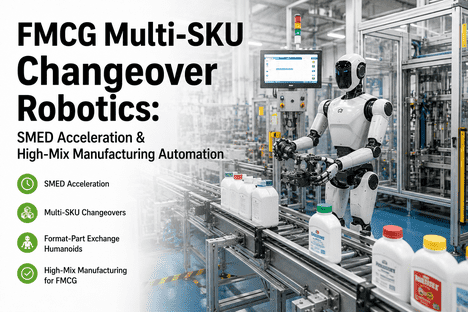
SMED-optimised sequencing integrated with PdM predictions enables maintenance tasks to be bundled with planned format changeovers, reducing total changeover time by 30–50% through parallelised activity scheduling.
FMCG Packaging Line Deployment Paths
FMCG packaging plants vary widely in line automation maturity, OEM platforms, and format-change frequency. iFactory supports three deployment patterns matched to plant readiness and line complexity.
Path A
Lighthouse Line + Expand
6–10 weeks
Deploy full iFactory stack on one high-speed packaging line (filler + capper + labeller + palletiser). Prove PdM accuracy, OEE uplift, and changeover reduction. Expand to remaining lines in monthly waves using learned connector templates.
Best fit
FMCG plants with mixed OEM lines · varying automation maturity · need to build internal reliability case before plant-wide rollout
Wk 1–3 Sensor deployment + PLC connector setup
Wk 4–6 Model training + Shift Logbook go-live
Wk 7–10 Monthly line expansion waves
Path B
Whole-Line Rollout
10–16 weeks
All packaging stations on all lines connected simultaneously. Wireless MEMS sensors deployed on critical filler/capper/labeller rotating assemblies. Predictive models operational across every line at week 12.
Best fit
FMCG plants with standardised OEM platforms (all Krones or all Sidel) · existing sensor infrastructure · strong central maintenance team
Wk 1–5 Fleet-wide sensor deployment + data ingestion
Wk 6–10 Cross-line model training + Shift Logbook standardisation
Wk 11–16 Dashboard rollout + SMED integration
Path C
Multi-Plant FMCG Portfolio
14–22 weeks
Deploy across multiple FMCG plants (personal care, home care, beverage) under a single enterprise portfolio. Compare line OEE, filler/capper/labeller failure rates, and changeover performance across plants. Propagate best practices from highest-performing lines.
Wk 1–6 Plant-by-plant data assessment + federation
Wk 7–12 Multi-plant model deployment + portfolio dashboard
Wk 13–22 Cross-plant benchmarking + best practice rollout
Run the FMCG Packaging Line PdM Workshop for Your Plant
iFactory's FMCG packaging practice runs a structured workshop against your specific line configuration — current OEE, filler/capper/labeller OEM platforms, format-change frequency, changeover practices, and maintenance team structure. You leave with a defended path recommendation, a 6–16 week deployment plan, and an OEE uplift projection grounded in your line's actual stop history and product mix.
"The most expensive failure on an FMCG packaging line is not the one that stops the line — it is the intermittent defect that passes through final inspection, reaches the retail shelf, and generates a customer complaint. Filler fill-weight drift, capper leakers, and labeller flagging that escape detection are the failures that damage brand equity. Predictive maintenance for packaging lines must predict not only catastrophic stops but also quality-drift events that erode product integrity. The Shift Logbook is the single most underutilised data source in FMCG packaging PdM because operators perceive cap skips and label flags as normal variation rather than early failure signals. Converting that operator knowledge into structured data feeds is worth more than adding ten additional sensors."
— FMCG Packaging Reliability Practice, 2026 industry insight
12–18%
OEE uplift across filler, capper, labeller, palletiser
0
Krones/KHS/Sidel line control changes required
30–50%
changeover time reduction with SMED-PdM integration
Vendor Evaluation Framework for FMCG Packaging Line PdM Platforms
FMCG packaging predictive maintenance platforms differ from general industrial PdM solutions across seven dimensions that reflect the unique characteristics of high-speed packaging: format-change frequency, OEE sensitivity, OEM line control complexity, and quality-drift detection requirements.
01
Filler/capper/labeller-specific ML models
Ask:
"Does your platform have pre-trained ML models for rotary filler nozzle wear, capper torque drift, and labeller vacuum drum degradation — or are models generic 'bearing fault' classifiers that require custom training per packaging station?"
FMCG packaging PdM requires failure-mode models specific to each station type — filler nozzle seat wear, capper head misalignment, labeller vacuum loss — not generic rotating equipment classifiers. Pre-trained models accelerate deployment from months to weeks.
02
Format-change aware prediction
Ask:
"How does your platform distinguish between telemetry changes caused by product/package format changes vs. mechanical wear — and avoid generating false alarms during every format changeover?"
FMCG lines change format 2–6 times per shift. A model that cannot distinguish between "fill curve changed because we switched from 500 ml to 1 litre" and "nozzle wear progressing" will generate unacceptable false alarm rates that erode operator trust.
03
OEM line control pass-through
Ask:
"Does your platform connect to Krones LCS, KHS Innoline, and Sidel SGP line control systems without requiring changes to established OEM control logic or safety-rated parameters?"
FMCG packaging OEMs operate proprietary line control systems that cannot be modified without risking line warranty and safety certification. PdM must read telemetry through read-only connectors and never write to OEM line control networks.
04
Quality-drift detection alongside stop prediction
Ask:
"Does your platform predict quality-drift events — fill-weight approaching spec limit, cap torque trending toward leaker threshold, label position moving out of tolerance — not just catastrophic failure stops?"
Intermittent quality defects that escape inspection are the highest-cost failure mode in FMCG packaging. PdM must predict degradation that causes quality drift before the defect occurs, not only failures that stop the line.
05
Shift Logbook integration with operator tagging
Ask:
"Does your digital Shift Logbook allow packaging line operators to tag format-change events, cap skip observations, and label flagging incidents — and does the PdM engine consume that tagged data to improve prediction accuracy?"
Operator observations captured during shift rounds contain early failure signals that no sensor detects. Digital Shift Logbook data — structured, tagged, and timestamped — improves PdM model accuracy by 18–25% in FMCG packaging environments.
06
SMED changeover sequencing with PdM scheduling
Ask:
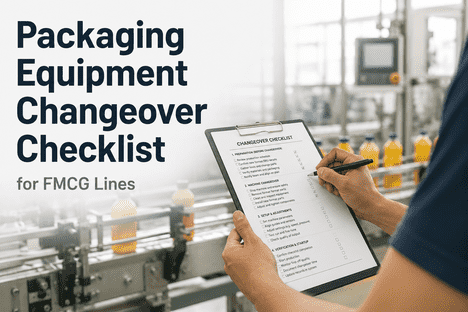
"Does your platform integrate predicted maintenance tasks with SMED-optimised changeover sequencing — enabling maintenance to be performed during format changeovers rather than requiring separate production stops?"
FMCG plants resist additional production stops. PdM value multiplies when predicted maintenance tasks are scheduled to coincide with planned format changeovers. SMED integration reduces the total changeover time impact of PdM-driven maintenance.
07
Line balance analytics with bottleneck identification
Ask:
"Does your platform provide real-time line balance visualisation showing which packaging station is the current OEE bottleneck — and recommend PdM interventions targeted at the bottleneck station?"
Packaging line OEE is constrained by the slowest station. PdM investment focused on the bottleneck station delivers 3–5x the OEE impact of PdM on non-bottleneck stations. The platform must identify the active bottleneck dynamically and prioritise predictions accordingly.
FAQ
Does iFactory require changes to my existing Krones, KHS, or Sidel line control system?
No. iFactory connects to FMCG packaging line PLCs and servo drives through read-only connectors that cannot write to OEM line control networks. Line control logic, safety-rated parameters, and OEM warranty coverage remain untouched. The platform reads existing telemetry from line historians, vision inspection systems, and servo drive parameters — with optional wireless MEMS sensors for additional rotating equipment coverage on capper spindles, labeller drums, and palletiser gantries.
How does iFactory handle format changeovers that change fill curves, cap torque targets, and label positions?
Format-change events are tagged either automatically (from line control format-change signals) or manually (through Shift Logbook operator tagging). ML models are trained to distinguish between telemetry changes caused by format changes vs. mechanical wear, using product viscosity, container geometry, and label dimensions as additional input features. Models are retuned per format family through transfer learning, with format-specific thresholds and prediction parameters stored in the platform's format library.
Can iFactory predict fill-weight drift and capper leaker defects before product reaches final inspection?
Yes. Filler PdM models predict nozzle seat wear and servo encoder drift 3–8 shifts before fill-weight drifts outside specification limits. Capper models detect per-head torque variance 4–6 shifts before cap leakers appear. Labeller vacuum decay models predict label flagging events 3–5 shifts before the defect rate exceeds target. All predictions are cross-referenced against downstream vision inspection reject data for continuous model validation and accuracy improvement.
What OEE metrics does the packaging line dashboard provide?
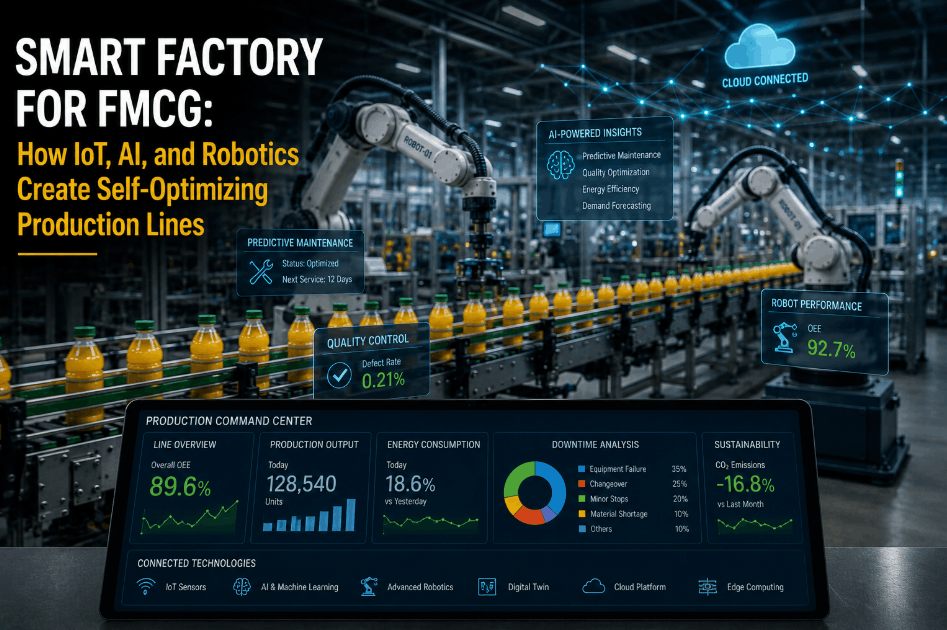
The FMCG packaging line dashboard provides real-time OEE by station (filler, capper, labeller, palletiser) and overall line OEE, including availability loss breakdown by station, performance loss by speed reduction vs. rated speed, quality loss by reject type, changeover time per format with trend, bottleneck station identification with dynamic updates, SMED adoption score with task-level changeover time breakdown, and PdM prediction count with lead time distribution and intervention success rate.
How long does it take to deploy predictive maintenance on a single FMCG packaging line?
Initial deployment on a single packaging line (filler + capper + labeller + palletiser) with standard PLC telemetry access and existing vision inspection takes 6–10 weeks from project start to operational PdM predictions. Deployment includes wireless sensor installation on critical rotating assemblies (2–3 days per line), PLC telemetry connector setup and data validation (1–2 weeks), ML model training and format-change calibration (2–3 weeks), Shift Logbook deployment and operator training (1 week), and dashboard configuration with OEE line balance and SMED analytics (1 week).
Conclusion: OEE Uplift Through Station-Level PdM Is the Next Frontier in FMCG Packaging
FMCG packaging lines operate at speeds and changeover frequencies that make unplanned downtime the single largest cost driver in primary packaging operations. Filler nozzles wear, capper heads drift, labeller vacuum seals degrade, and palletiser grippers fatigue — each failure mode develops over shifts before it stops the line or generates a quality defect. Predictive maintenance applied at the packaging station level — filler, capper, labeller, palletiser — with format-change-aware ML models, Shift Logbook operator data integration, and SMED-optimised scheduling delivers 12–18% OEE uplift without replacing Krones, KHS, or Sidel line control systems. The technology is proven, the deployment paths are defined, and the ROI is measurable from the first predicted nozzle wear intervention. The question facing FMCG packaging and maintenance leadership is not whether to deploy station-level PdM, but which deployment path fits your line configuration, format-change frequency, and organisational readiness. Walk through your specific packaging line OEE data, format-change schedule, and maintenance team structure with our FMCG packaging reliability practice.
Build Your FMCG Packaging Line PdM Roadmap
iFactory's FMCG packaging practice runs a structured workshop against your specific line configuration — current OEE, filler/capper/labeller OEM platforms, format-change frequency, changeover practices, and maintenance team structure. You leave with a defended path recommendation, a 6–16 week deployment plan, and an OEE uplift projection grounded in your line's actual stop history and product mix.