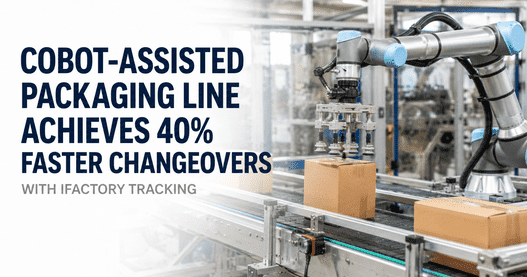
A mid-size CPG manufacturer operating eight packaging lines across a 280,000-square-foot facility was losing 34 hours of production every week to changeovers. Each line ran three product formats — pouches, cartons, and flow wraps — and every format switch required manual adjustment of conveyors, film reels, date coders, seal bars, and case packers. The average changeover consumed 52 minutes with two technicians working in parallel, and first-pass quality after changeover averaged 94.7%, meaning one of every 20 units produced after a format switch required rework or rejection. The operations team had evaluated full robotic automation but rejected it on cost — each line would have required a dedicated gantry robot at $180,000 per station and six weeks of installation downtime. iFactory's Robotics & Cobot Analytics Tracking module combined with collaborative robots provided an alternative: a mobile cobot platform guided by ifactory's changeover workflows and real-time tracking, deployed across all eight lines for a capital investment of $340,000 total with zero production downtime during installation. The results — a 40% reduction in average changeover time from 52 minutes to 31 minutes, an improvement in first-pass quality from 94.7% to 99.2%, and annual savings of $187,000 in rework and waste material — demonstrate a repeatable model for packaging changeover optimization that operations leaders at CPG, FMCG, and pharmaceutical manufacturers can evaluate for their own facilities. Packaging and operations managers evaluating cobot-based changeover automation can Book a Demo to review the ifactory Robotics & Cobot Analytics Tracking deployment playbook and cost model for their line configurations.
The Changeover Problem: 34 Hours of Lost Production Every Week
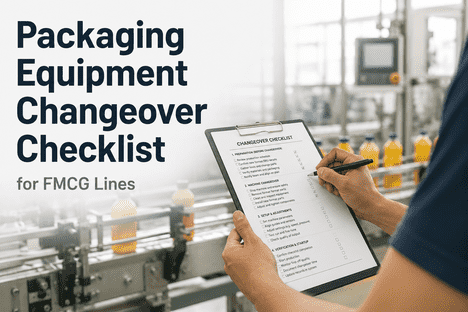
The facility's eight packaging lines produced three primary format types — stand-up pouches (180–250 units per minute), cartons (120–160 units per minute), and horizontal flow wraps (200–300 units per minute). Each format switch required 18 to 24 discrete adjustment tasks performed in a specific sequence: conveyor lane guides had to be repositioned for package width, film reel mandrels swapped for the correct web width, date coders reprogrammed with the new format code and best-before offset, heat seal bars changed to match film composition, case packer magazine guides adjusted for carton dimensions, and checkweigher parameters updated for the new target weight and tolerance band. With a technician-to-line ratio of 1:4, the two available changeover technicians rotated across all eight lines, and a single unplanned changeover could cascade into a three-line queue when a technician was already occupied on a running changeover. The operations team tracked changeover completion through paper checklists and manual entries in a spreadsheet — there was no real-time visibility into changeover progress, no way to predict completion time, and no data on which tasks consumed the most time or which technician was faster at specific changeover types.
Solution Architecture: Mobile Cobot Platform Guided by ifactory Tracking
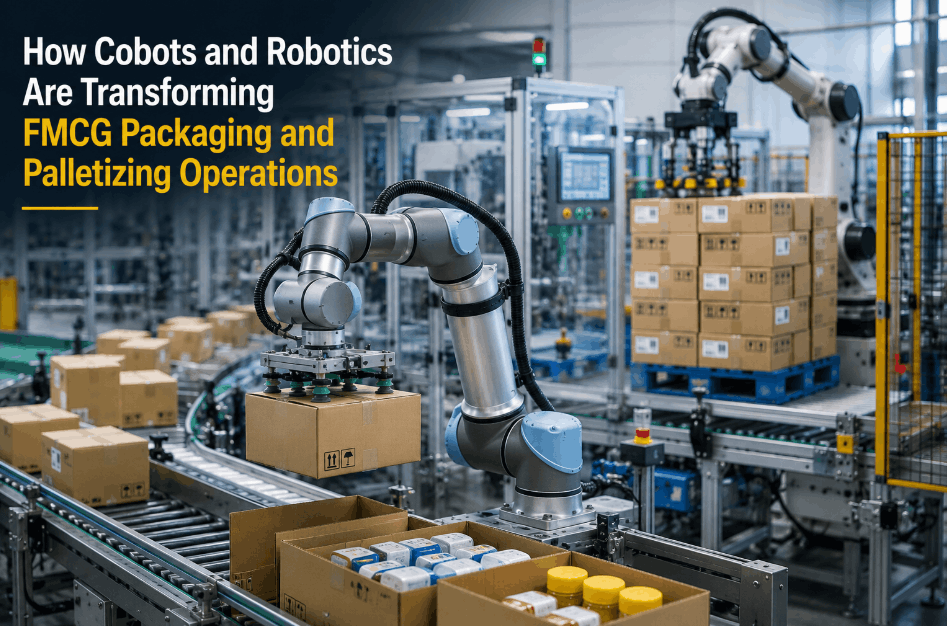
The solution combined a mobile collaborative robot platform — Universal Robots UR10e on a MiR250 autonomous mobile base — with iFactory's Robotics & Cobot Analytics Tracking module, which provided real-time changeover workflow sequencing, task tracking, and performance analytics. The cobot was equipped with a custom end-of-arm tool that included a pneumatic gripper for handling seal bars and change parts, a torque-controlled wrist for date coder adjustments, and an integrated camera for vision-guided alignment of lane guides. The ifactory module managed the changeover workflow through three integrated functions. The first was changeover sequence management — a digital work instruction system that displayed each step of the changeover on the cobot's tablet interface with barcode verification at every step, ensuring no task was skipped or performed out of sequence. The second was real-time tracking — every cobot movement, every adjustment, every verification was logged with timestamps and compared to the standard time for that task, giving the operations team live visibility into changeover progress across all lines from a single dashboard. The third was analytics — after each changeover, the system automatically generated a variance report showing which tasks exceeded standard time, which adjustments required rework, and what the first-pass quality was at line restart. Packaging and operations managers evaluating ifactory's cobot tracking platform can Book a Demo to see the tracking dashboard and workflow management interface configured for their specific packaging formats and line layouts.
Deployment: Zero-Downtime Implementation Across Eight Lines
The deployment was executed in four phases over seven weeks, with zero production downtime. Phase one was cobot programming and end-of-arm tool design — iFactory's robotics team programmed the UR10e with the changeover sequence for each of the three format types, calibrated the vision-guided alignment system, and fabricated the custom gripper and tooling. Phase two was ifactory integration — the cobot's control system was connected to the ifactory Robotics & Cobot Analytics Tracking module via OPC-UA, and the changeover workflows were configured in the digital work instruction engine with barcode verification triggers at every step. Phase three was line-by-line rollout — the cobot was deployed on one line per week, with the first three days dedicated to supervised changeovers where the cobot performed tasks alongside the existing technician and the remaining two days for independent cobot operation with technician supervision. Phase four was optimization — after all eight lines were deployed, the analytics data from the first 30 days of operation was used to refine the cobot's movement speed, gripper approach angles, and task sequencing, further reducing average changeover time by an additional 6%.
Measured Results: 40% Faster Changeovers, 99.2% First-Pass Quality
The metrics below represent the average across all eight packaging lines over a 12-month measurement period, comparing the baseline (manual changeovers with paper checklists) against the cobot-assisted changeovers with ifactory tracking.
IT and Operations Manager's Perspective: Why Cobot-Assisted Changeovers with ifactory Tracking Is the Right Investment
I manage packaging operations for a CPG manufacturer running 14 lines across two facilities, and I had been skeptical about cobots for changeovers. Every integrator I spoke to wanted to sell me a fixed automation solution — a dedicated robot per line with a six-figure price tag and weeks of downtime for installation. The math did not work for a facility where we run three formats and change over four to six times per shift. The payback period on fixed automation was over three years, and I could not justify the production loss from installation. iFactory's approach was fundamentally different. They proposed a single mobile cobot platform that serves all eight lines, guided by their tracking software that tells the cobot exactly which changeover tasks to perform, in what sequence, with barcode verification at every step. The deployment cost per line was $42,500, the cobot moved between lines autonomously, and there was zero downtime during installation because the cobot was programmed and tested offline before it ever touched a line. The operations team was initially concerned about complexity — they assumed a cobot would require dedicated programmers and constant troubleshooting. What they found was that the ifactory module made the cobot easy to manage: changeover workflows are configured through a drag-and-drop interface, the tracking dashboard shows real-time progress on any line from any workstation, and the analytics reports tell us exactly where we can improve. The results speak for themselves — 40% faster changeovers, 99.2% first-pass quality, and a capital investment that paid back in 14 months. The cobot now handles the repetitive physical tasks — seal bar changes, lane guide adjustments, date coder reprogramming — while our technicians focus on verification, line restart, and exception handling. The technicians have more satisfying work, the lines spend more time running, and our quality metrics have never been better. For any packaging operations leader evaluating changeover automation, I would recommend starting with a single mobile cobot and ifactory's tracking module on your highest-changeover line. Run it for 30 days, look at the data, and the ROI will speak for itself.
Conclusion: Cobot-Assisted Changeovers with ifactory Tracking Deliver Measurable, Repeatable Results
The 40% reduction in changeover time and the improvement in first-pass quality from 94.7% to 99.2% were not the result of a single breakthrough technology but of a carefully designed system that combines three elements: a mobile cobot that handles the physical tasks of changeover with precision and consistency, a digital workflow management system that ensures every task is performed in the correct sequence with barcode verification, and a real-time tracking and analytics platform that gives the operations team visibility into every changeover and data for continuous improvement. For packaging operations leaders at CPG, FMCG, pharmaceutical, and food manufacturing facilities, the path to faster changeovers does not require a multi-million-dollar investment in fixed automation or weeks of production downtime. A single mobile cobot guided by iFactory's Robotics & Cobot Analytics Tracking module can serve multiple lines, deploy with zero downtime, and deliver measurable improvement in changeover time, quality, and cost within the first month of operation.