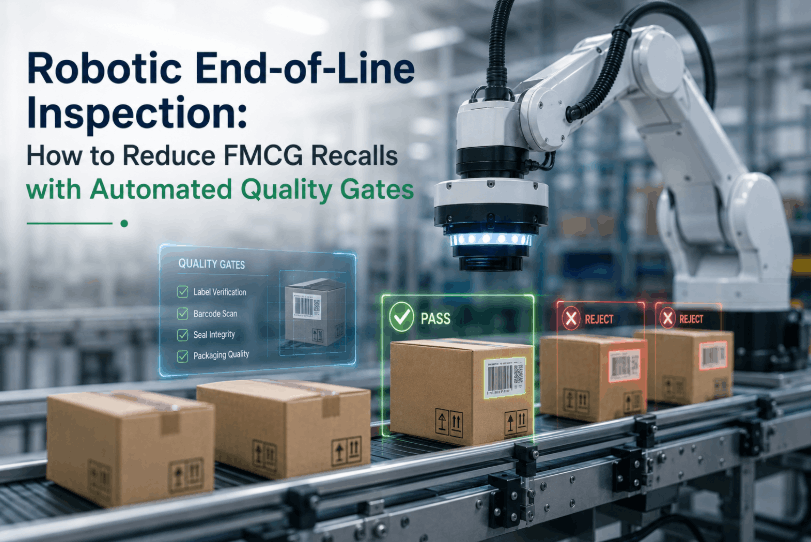
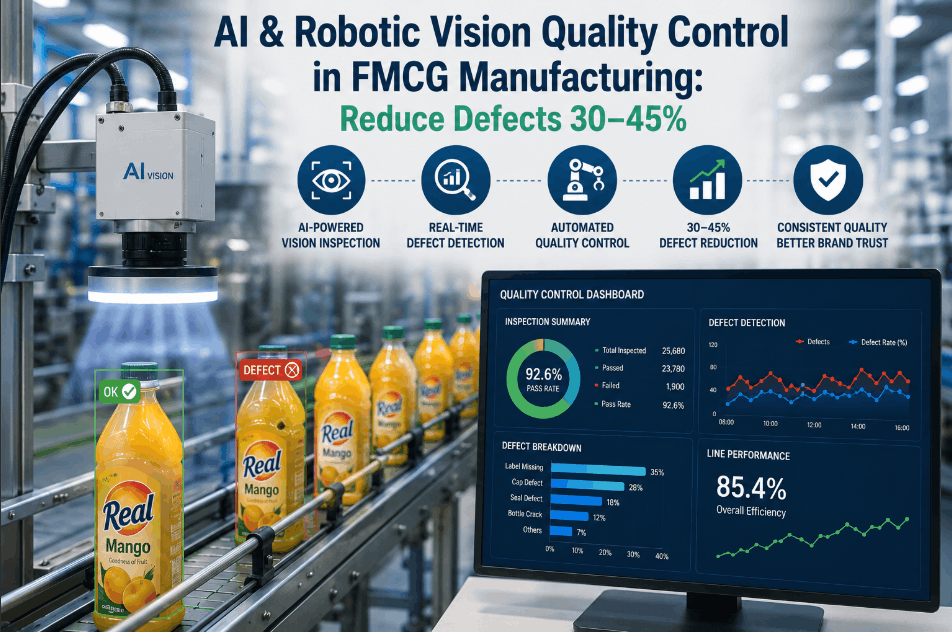
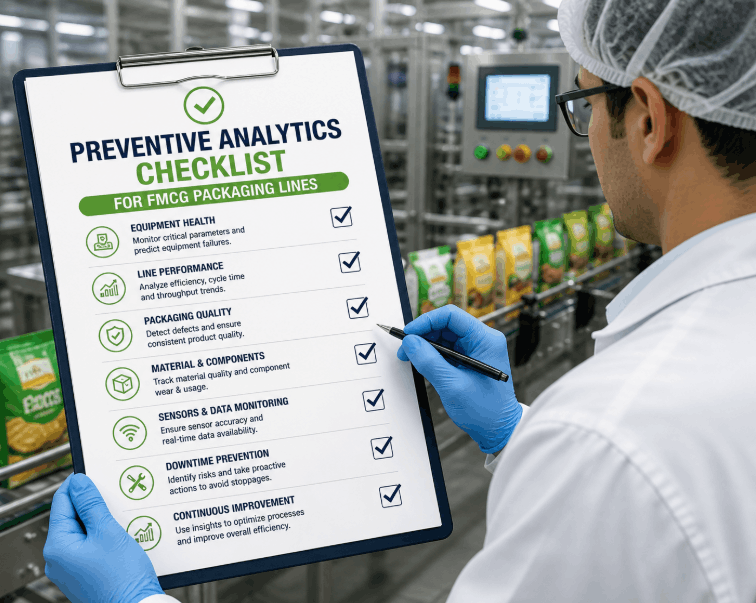
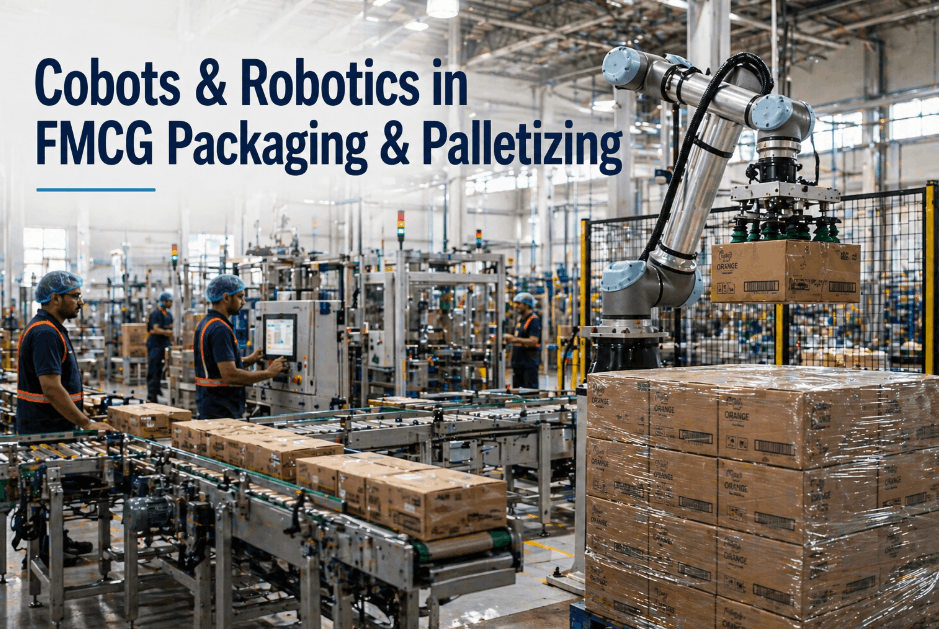
You're an experienced FMCG packaging operator. Your line runs cartoners, case packers, palletizers, labelers. Every shift brings quality challenges: a mislabelled carton slipping through, a case seal failing, a pallet pattern that does not meet retailer spec. You spend 40% of your day reacting — pulling units for manual checks, calling maintenance on the labeller, managing quality alerts. Robotic end-of-line inspection puts you back in control by detecting defects at full line speed before they leave your facility. Instead of spot-checking samples and hoping nothing escapes, the system inspects every single unit and tells you exactly when upstream equipment needs attention. This operator playbook walks through real packaging-line scenarios, shows how robotic inspection changes your daily workflow, and explains what to do when the system needs your input. Book a Demo to see how operators use robotic end-of-line inspection every day.
End-of-Line Robotic Inspection for FMCG Packaging
Automated final quality checks on cartons, pallets, and shipping accuracy before distribution — every unit inspected at machine speed, every shift, every SKU.
The Plant Floor Reality: Why Packaging Operators Chase Defects All Shift
A typical FMCG packaging shift without robotic end-of-line inspection: You start at 8 AM. Line is running well — cartons sealing clean, labels placing correctly. By 10 AM, a retailer complaint from yesterday's shipment: "Pallet 12 had 3 cases with wrong SKU labels." You check the labeller. Looks normal. You pull 5 units from the current run — all correct. You call maintenance to check the print-and-apply system. They find a loose encoder wheel on the label applicator — intermittent fault, hard to reproduce. Total troubleshooting time: 90 minutes. Meanwhile, 2,400 units shipped without 100% inspection coverage. The defect that caused yesterday's complaint may still be slipping through. With robotic end-of-line inspection, the system would have caught the wrong SKU label on case 3 of pallet 12 — rejected it, logged the defect image, and triggered a work order on the labeller before the pallet was finished. The encoder fault would have been flagged by the defect pattern analysis: "Intermittent label skew detected — applicator encoder recommended for inspection." The problem is fixed before it becomes a complaint.
Operator Tasks: Before & After Robotic End-of-Line Inspection
Your Daily Playbook: Operating With Robotic End-of-Line Inspection
Dashboard shows total units inspected, reject count by defect type, and any work orders generated. Check 5–10 alerts (takes 5 min). Approve recommended actions for equipment adjustments flagged by defect patterns.
System auto-runs reference samples through every inspection station. Confirm camera focus, lighting levels, reject mechanism response. Results logged to iFactory Shift Logbook. No manual calibration needed.
Line starts. First pallet completes. System confirms: "All units passed. Carton seal integrity nominal. Label accuracy 100%. Pallet pattern compliant." You visually confirm one pallet and proceed.
Every 15 minutes, glance at inspection dashboard. Green means 100% inspection at spec. If rejects appear, review reject images — confirm correct classification. Most shifts show "all nominal" with zero rejects.
System alerts: "Case sealer temperature trending down — seal integrity will degrade in 1 hour." You call maintenance. They inspect heating element. Issue resolved pre-emptively. Zero defective cases produced.
Periodically check the reject quarantine lane. Confirm rejected units match system logs. Return false rejects (typically <0.5% after 2–4 weeks) to line. Log root cause if pattern emerges.
SKU changeover triggered. System automatically loads correct inspection profile — label template, barcode format, date code layout, pallet configuration. First 3 units verified. No inspection profile errors. Changeover waste eliminated.
Log any observations: "Labeller encoder replaced at 10:45. Sealer element inspected at 11:30. System detected both issues via defect patterns before visible failure." iFactory Shift Logbook captures data for next shift and continuous improvement.
Dashboard: "Shift Summary — 24,800 units inspected. 28 rejects (0.11% reject rate). 2 preventive work orders completed. Zero retailer complaints expected. Cpk 1.42 on label placement." Print shift report for handoff.
Tell next operator: "Labeller encoder replaced. Sealer element inspected. System running nominally. All inspection data logged in Shift Logbook. No open quality issues." Next operator starts with full context and zero surprises.
Real Defect Scenarios: What Alerts Look Like & What You Do
These are the situations where robotic end-of-line inspection proves its value — and where manual sampling consistently fails. If any of these sound familiar, Book a Demo to see how iFactory automates inspection across the same conditions on live FMCG lines.
- System has already generated work order: "Labeller encoder wheel — inspect for wear or loosening."
- Maintenance inspects encoder. Finds loose mounting bracket. Tightens. Verification run shows 0.1mm skew.
- System confirms: "Encoder issue resolved. Label placement back to baseline. 0 units shipped with out-of-spec labels."
- Shift Logbook records defect images, work order, resolution. Full audit trail for BRC/FSSC 22000.
- Call maintenance with system diagnosis: "Sealer heating element degrading — recommend replacement."
- Maintenance replaces heating element during planned 15-minute window. Zero unplanned downtime.
- System confirms: "Sealer temperature 182°C stable. Seal width 2.1mm. Inspection passing at 100%."
- Single seal failure prevented. Potential recall exposure eliminated.
- Diverted pallet automatically routed to correction lane.
- Add missing layer. Adjust stacking pattern. Apply correct pallet label.
- System re-inspects pallet. "Pallet #47 re-verified. All parameters within spec. Approved for dispatch."
- Retailer compliance chargeback avoided ($1,200 saved per incident).
What Robotic End-of-Line Inspection Gives You
After: <0.05% escape rate — fewer than 1 in 2,000 defective units passes
Gain: 100x quality improvement. Zero recall events. Zero retailer chargebacks.
After: 20–30 minutes on predictive alerts and exception handling
Gain: 2–3 hours for equipment monitoring, root cause analysis, continuous improvement
After: "12,400 units inspected. 14 rejects. Labeller encoder replaced. Sealer element inspected. All data in Shift Logbook." Full context transfer.
After: Robotic inspection maintains 99.8% accuracy at 3 AM same as 3 PM. Operator-independent quality. Consistent audit trail every shift.
Frequently Asked Questions
Deploy Robotic End-of-Line Inspection in Under 8 Weeks
Your end-of-line quality gate should catch every defect, every shift, every SKU — at full line speed, with zero fatigue. iFactory connects robotic inspection data to live work orders, asset maintenance histories, and GMP-ready audit documentation through the AI Shift Logbook. Every defect detected triggers the right action, automatically. No implementation fees. No long onboarding. Live in 30 days.