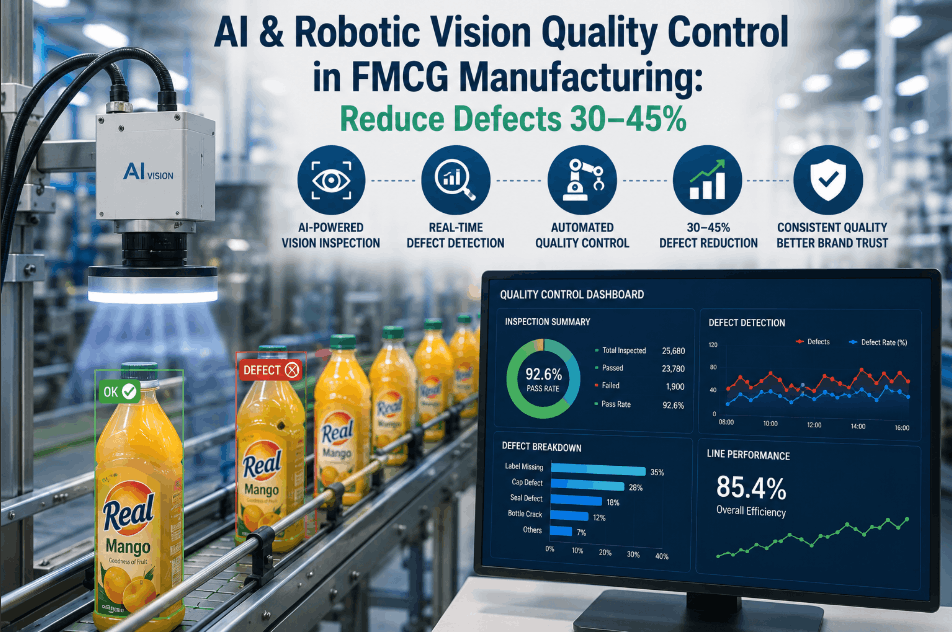
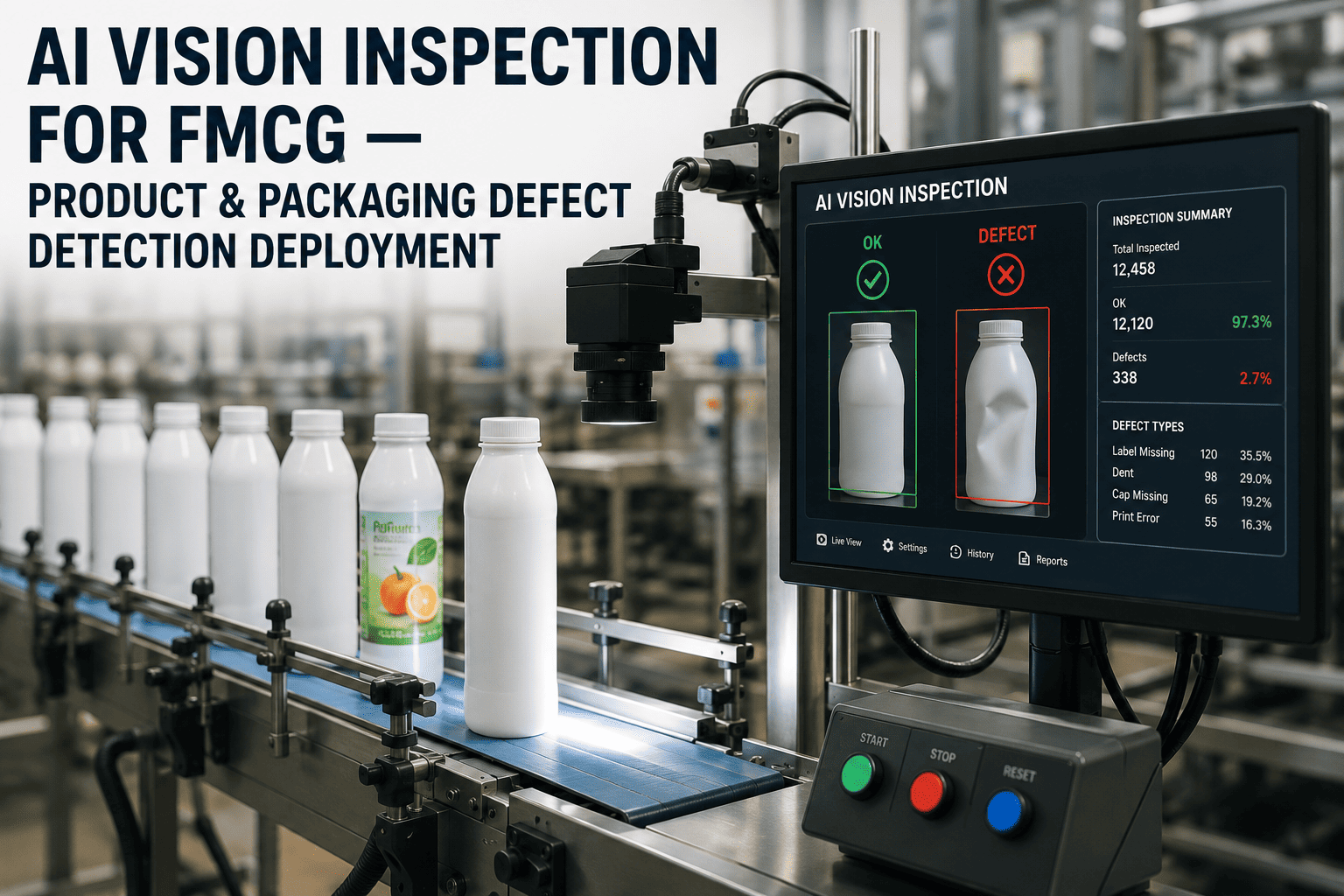
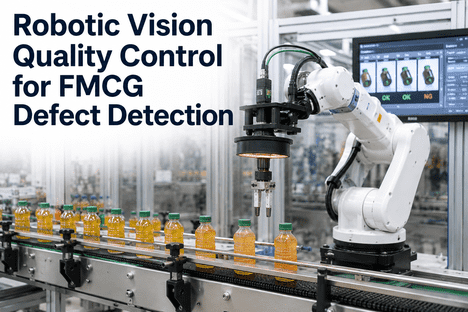
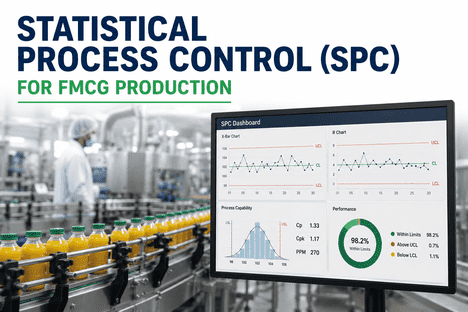
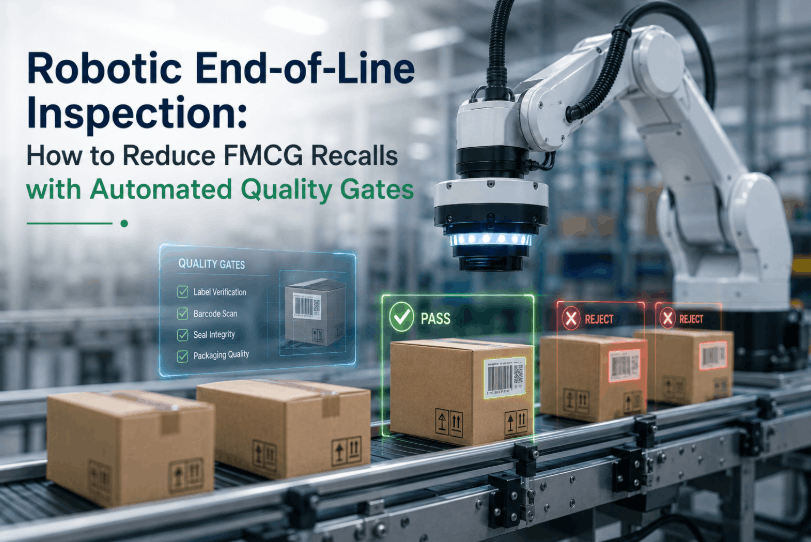
AI quality control in FMCG manufacturing is no longer a competitive advantage — it is rapidly becoming the baseline for survival. Consumer goods manufacturers who still rely on human visual inspection and manual sampling are losing 3–7% of annual revenue to defects, recalls, and rework costs that modern robotic vision inspection systems eliminate at the source. The integration of computer vision, machine learning anomaly detection, and statistical process control has enabled leading FMCG operations to achieve defect reduction rates of 30–45% within the first production year — not through incremental improvement, but through a fundamental shift in how quality is detected, analyzed, and corrected in real time. Book a demo to see how iFactory's AI quality monitoring platform delivers this outcome across your production lines.
AI QUALITY CONTROL
ROBOTIC VISION
FMCG MANUFACTURING
Reduce FMCG Defects by 30–45% With AI-Powered Robotic Vision Inspection
iFactory's AI anomaly detection and quality monitoring platform unifies real-time vision inspection, statistical process control, and predictive quality intelligence — purpose-built for consumer goods manufacturers pursuing zero-defect production.
Why Traditional Quality Inspection Fails FMCG Manufacturers at Scale
The fundamental challenge with manual and semi-automated quality inspection in FMCG operations is throughput mismatch. A modern consumer goods line producing 600–1,200 units per minute cannot be meaningfully inspected by human operators whose sustained detection accuracy drops to 70–80% after 20 minutes of continuous visual monitoring. The result is systematic under-detection — defects that pass through final inspection, reach retail shelves, and generate the consumer complaints and recall events that erode brand equity over years.
Statistical sampling compounds the problem. When only 0.5–2% of production volume is physically inspected, entire defect clusters go undetected until they manifest as field failures. AI-powered robotic vision quality control eliminates sampling by inspecting every unit, every cycle, at production speed — converting quality from a post-production audit function into a real-time production control mechanism.
30–45%
defect reduction achieved by FMCG manufacturers deploying AI vision inspection
99.8%
inspection accuracy achievable with trained deep learning vision models
$2.9M
average annual recall cost reduction per facility after AI quality deployment
6–14mo
typical ROI payback period for robotic vision quality systems in FMCG
Technology Architecture
How AI Robotic Vision Quality Control Works in FMCG Production Environments
A production-grade computer vision quality robot is not a single camera pointed at a conveyor — it is a multi-layer inspection architecture that combines imaging hardware, deep learning inference, real-time anomaly detection, and statistical process control into a unified quality intelligence system. Understanding each layer is essential for evaluating whether a proposed solution will deliver the 30–45% defect reduction that FMCG leaders are achieving.
01
Multi-Modal Imaging Layer
High-speed industrial cameras — 2D area scan, 3D structured light, hyperspectral, and X-ray modalities — capture complete product surface and volumetric data at line speed. Lighting architecture, camera positioning, and trigger synchronization are calibrated to the specific defect signatures of each product category.
02
Deep Learning Inference Engine
Convolutional neural networks trained on curated defect libraries perform pixel-level classification of surface anomalies, dimensional deviations, label placement errors, fill-level inconsistencies, and contamination events — with inference latency under 12ms to support rejection actuation before units exit the inspection zone.
03
Real-Time Anomaly Detection
Beyond unit-level defect classification, the real-time anomaly detection layer monitors population-level defect rate trends, shift patterns, and process drift signals — distinguishing random individual defects from systematic process failures that require upstream correction rather than downstream rejection.
04
Statistical Process Control Integration
Statistical process control in FMCG is elevated from manual charting to automated real-time monitoring when AI vision data feeds directly into SPC engines. Control charts update continuously, Western Electric rules trigger automatically, and process capability indices (Cpk, Ppk) reflect live production state rather than historical batch samples.
05
Rejection and Traceability Actuation
Confirmed defect units trigger high-speed pneumatic or robotic rejection mechanisms with sub-100ms actuation timing. Every rejection event is timestamped, classified, and linked to upstream process parameters — creating a full traceability chain from defect manifestation to root process cause.
06
Manufacturing Intelligence Integration
Quality data from the vision system integrates with MES, ERP, and CMMS platforms — enabling quality events to trigger maintenance work orders, supplier non-conformance reports, and production schedule adjustments without manual data transfer or analyst intervention.
Defect Categories
Defect Types That AI Vision Inspection Detects in FMCG Manufacturing
The scope of defect detection capability is the primary differentiator between entry-level vision inspection systems and production-grade automated quality inspection robots. FMCG manufacturers evaluating AI quality control solutions should map their specific defect portfolio against each system's validated detection capability — not against marketing claims. FMCG operations considering deployment can book a demo to see detection performance against their specific product categories.
AI Vision Defect Detection Capability — FMCG Product Categories
Scroll to view full comparison →
Performance Benchmarks
AI Quality Control vs. Traditional Inspection — The FMCG Performance Gap
The business case for AI robotic quality assurance in FMCG is not built on technology superiority claims — it is built on documented performance differentials that manifest directly in production KPIs, cost structure, and brand protection outcomes. The comparison below reflects validated performance benchmarks from food, beverage, personal care, and household products manufacturing deployments. For manufacturers evaluating whether AI quality control investment is justified, book a demo to walk through the ROI model against your current defect rate and production volume.
Traditional Inspection
Detection Accuracy
70–80% sustained
Inspection Coverage
0.5–2% sampling
Defect Response Time
Hours to days post-batch
Root Cause Identification
3–5 days manual correlation
Recall Risk Exposure
High — systematic miss rate
Throughput Impact
Bottleneck at >400 UPM
Defect Reduction vs Baseline
3–8% annual improvement
AI Robotic Vision Inspection
Detection Accuracy
99.2–99.9% sustained
Inspection Coverage
100% — every unit inspected
Defect Response Time
Real-time — <12ms inference
Root Cause Identification
Under 20 minutes automated
Recall Risk Exposure
Dramatically reduced — full traceability
Throughput Impact
Zero — inspects at full line speed
Defect Reduction vs Baseline
30–45% within first production year
Industry Application
AI Vision Quality Control Applications Across FMCG Sub-Sectors
FMCG defect detection requirements vary significantly across product categories — the defect signatures, detection modalities, and regulatory compliance requirements for a beverage bottling line differ fundamentally from those of a pharmaceutically-adjacent personal care manufacturing environment. Production-grade AI quality systems address this through category-specific model training and sensor fusion architectures. Manufacturers evaluating deployment can book a demo to see pre-configured detection profiles for their specific product categories.
Beverages, packaged foods, dairy, confectionery, and baked goods operations deploy AI vision for fill-level accuracy, seal integrity verification, label compliance, foreign object detection, and freshness indicator monitoring. Vision systems operating at 800–1,200 containers per minute achieve detection accuracy that eliminates the systematic miss rates inherent to manual sampling inspection.
Color consistency, fill accuracy, pump and closure functionality, label placement, and expiry date legibility are core inspection requirements. AI colorimetric analysis and 3D surface scanning detect batch-to-batch color drift and cosmetic surface defects that human inspectors miss under high-throughput conditions — protecting brand premium positioning.
Structural integrity, volume accuracy, label and compliance marking, and closure torque verification are primary quality requirements. AI-guided robotic inspection systems verify these parameters across high-volume, mixed-SKU production runs — maintaining consistent quality standards without the throughput penalty of mechanical inspection fixtures.
Tablet appearance, blister pack integrity, serialization verification, and tamper-evident seal inspection operate under GMP and regulatory traceability requirements. AI vision systems provide audit-ready inspection records for every unit produced — meeting FDA 21 CFR Part 11 and EU Annex 11 documentation standards automatically.
Case Study Insight
A mid-sized European personal care manufacturer producing 14 million units monthly was experiencing a 4.2% defect escape rate that their manual inspection team — 18 full-time quality technicians across three shifts — could not reduce below 3.8% despite retraining efforts. After deploying iFactory's AI anomaly detection and vision-guided inspection platform across four production lines, they achieved a 41% reduction in defect escape rate within the first production quarter, eliminated a pending line stoppage from their quality audit findings, and reallocated 12 of their 18 quality technicians to process improvement roles. The inspection system operates at 100% unit coverage across all four lines at full production speed.
Book a demo to see a live demonstration of AI vision inspection performance against your current defect categories.
Implementation Framework
Deploying AI Robotic Vision Quality Control in FMCG — A Structured Implementation Approach
The difference between AI quality control deployments that achieve 30–45% defect reduction and those that stall at 8–12% improvement is almost always implementation methodology rather than technology capability. A structured deployment approach — built around defect taxonomy, model training quality, process integration depth, and operator adoption — determines whether the investment generates documented ROI or becomes a stranded pilot.
01
Defect Taxonomy and Training Data Development
A comprehensive audit of historical defect categories, escape rates, recall events, and customer complaint data establishes the training data requirements. High-quality annotated image datasets — covering all confirmed defect types plus intentional false-positive scenarios — are the foundation of detection accuracy that holds up in production conditions.
Outcome: Model trained to your actual defect population, not generic benchmark datasets
02
Sensor Architecture and Integration Engineering
Imaging modality selection, camera positioning, lighting design, and trigger synchronization are engineered specifically to the product geometry, line speed, and defect detection requirements of each installation. Integration with existing conveyor, rejection, and PLC systems maintains production flow without throughput compromise.
Outcome: Full-speed inspection with zero throughput penalty on existing infrastructure
03
SPC and Analytics Platform Integration
Statistical process control for FMCG is activated automatically when vision inspection data streams into the analytics platform — generating real-time control charts, process capability reports, and drift alerts that connect inspection outcomes to upstream process variables requiring correction.
Outcome: Quality data drives process improvement, not just defect rejection
04
Operator Adoption and Workflow Integration
AI inspection outputs are delivered through the operational tools shift supervisors, line operators, and quality managers already use — push notifications, integrated dashboards, and automated work order generation. Quality intelligence reaches the people who can act on it without requiring system navigation or data export.
Outcome: 80%+ daily active floor team adoption versus typical 20–30%
05
Continuous Model Governance and Performance Monitoring
Detection model performance is monitored continuously against live production data — drift in false positive and false negative rates triggers retraining workflows before accuracy degradation affects floor outcomes. Model version governance ensures the inspection system maintains performance as products, packaging, and processes evolve.
Outcome: Sustained 99%+ detection accuracy as operations change over time
Key Metrics That AI Quality Control Moves in FMCG Operations
FMCG operations evaluating AI quality control investment need to understand which production KPIs shift as a direct result of deploying AI vision inspection — and by how much. The following benchmarks reflect documented outcomes from FMCG deployments across food, beverage, personal care, and household products categories.
30–45%
Overall Defect Rate Reduction
Achieved within first 12 months of full deployment across inspected lines
60–75%
Reduction in Customer Complaints
Downstream brand protection impact from eliminating systematic defect escapes
85%+
Reduction in Root Cause Analysis Time
From 3–5 day manual correlation to under 20 minutes automated
2–4%
Yield Recovery
False rejections eliminated as vision model precision improves through continuous learning
100%
Inspection Coverage
Every unit inspected at production speed — eliminating sampling-based miss rates
6–14mo
ROI Payback Period
Driven by defect cost reduction, rework elimination, and recall risk mitigation
AI ANOMALY DETECTION
VISION-GUIDED INSPECTION
FMCG QUALITY
Deploy AI Vision Quality Control That Delivers 30–45% Defect Reduction
iFactory's quality monitoring and AI anomaly detection platform integrates real-time vision inspection, statistical process control, and manufacturing intelligence — delivering documented defect reduction outcomes for FMCG manufacturers within the first production quarter.
Frequently Asked Questions — AI & Robotic Vision Quality Control in FMCG
How much defect reduction can FMCG manufacturers realistically expect from AI vision inspection?
Documented deployments in food, beverage, personal care, and household products manufacturing consistently achieve 30–45% defect rate reduction within the first 12 months. The range reflects differences in baseline defect rates, product category complexity, and the thoroughness of model training — facilities with higher initial defect rates tend to see improvements at the upper end of the range.
Does AI vision inspection work at high FMCG production speeds?
Yes. Production-grade AI vision systems are designed to operate at full line speed — typically 400–1,200 units per minute for FMCG applications — with inference latency under 12ms. The inspection system introduces no throughput constraint on existing production lines.
What is the difference between traditional machine vision and AI-powered vision inspection?
Traditional rule-based machine vision requires engineers to manually program detection rules for each defect type — it is rigid, requires extensive reprogramming for new products, and cannot handle the natural variation in FMCG packaging. AI vision inspection uses trained neural networks that learn defect patterns from examples, adapt to product variation, and improve accuracy continuously through production experience.
How does real-time anomaly detection differ from standard defect rejection?
Unit-level defect rejection catches individual non-conforming products. Real-time anomaly detection operates at the population level — monitoring defect rate trends, shift patterns, and process signals to identify when a systematic process failure is generating defects that require upstream correction rather than continued downstream rejection. This distinction is what enables proactive quality control rather than reactive product sorting.
Can AI quality control systems integrate with existing FMCG production infrastructure?
Modern AI quality control platforms integrate with existing PLCs, conveyors, rejection mechanisms, MES, ERP, and LIMS systems through standard industrial protocols and APIs. Deployment does not require replacement of existing production infrastructure — the vision and analytics layers are added on top of current equipment.
What is the typical ROI payback period for AI vision quality control in FMCG?
FMCG manufacturers typically achieve documented ROI payback within 6–14 months, driven by defect cost reduction, rework elimination, recall risk mitigation, and reallocation of quality labor from inspection to process improvement roles. Facilities with higher defect rates or recent recall exposure often see payback at the shorter end of this range.