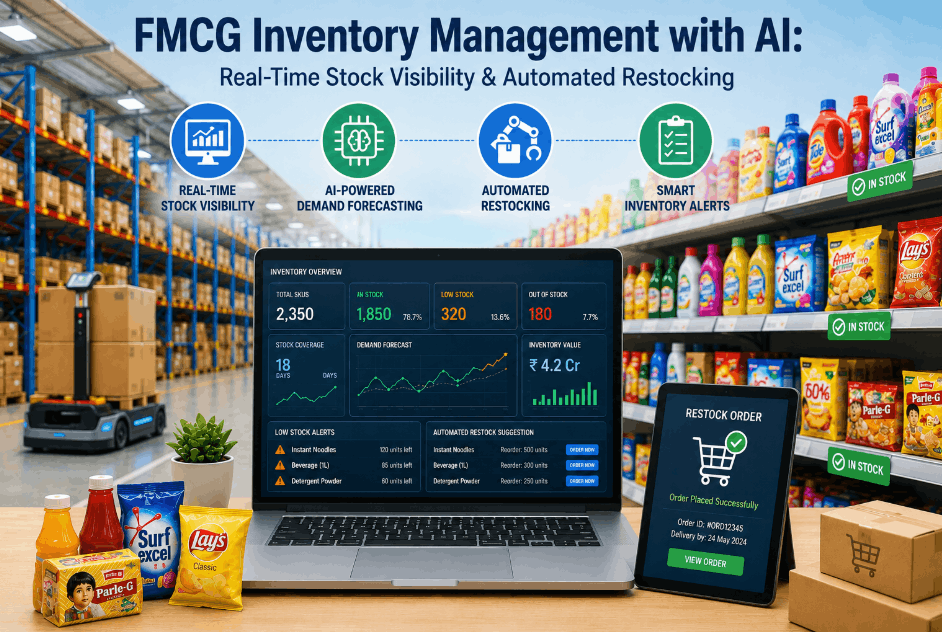
FMCG inventory management has entered a transformative era. With AI-powered stock visibility and AMR stock-counting robots, consumer goods brands can now track every SKU across every location in real time—eliminating stockouts, slashing overstock waste, and automating restocking decisions before shelves go empty. Traditional spreadsheet-driven inventory systems simply cannot keep pace with the velocity of modern FMCG supply chains, where demand fluctuates hourly and distribution networks span hundreds of retail points. This article explores how AI inventory automation is redefining stock management for FMCG operations, and why real-time visibility is now the single most important competitive advantage in consumer goods logistics.
Why Traditional FMCG Inventory Management Is Failing in 2025
FMCG brands operating at scale face an inventory paradox: too much stock in the wrong locations drives expiry losses, while too little stock at high-velocity retail points triggers revenue-destroying stockouts. Manual cycle counts conducted weekly—or even daily—cannot capture the granular, real-time stock movements that modern FMCG supply chains demand. According to supply chain research, the average FMCG manufacturer loses between 3% and 8% of annual revenue to inventory inefficiencies, a figure that compounds across multi-warehouse, multi-retailer distribution networks. The root cause is always the same: a fundamental lack of real-time stock visibility at both the warehouse and shelf level.
Demand fluctuation management adds another layer of complexity. Promotional spikes, seasonal demand surges, and new product launches create inventory volatility that static reorder-point systems simply cannot handle. When a promotional campaign drives a 40% volume spike in a product category, manual restocking workflows trigger purchase orders days after the stockout has already occurred. AI-powered inventory management solves this by predicting demand fluctuations before they materialize, automatically adjusting reorder quantities and distribution priorities in real time. If you want to see how leading FMCG brands are solving this today, book a demo with our inventory specialists.
Stockout Losses
Manual reorder systems respond to stockouts after they occur, causing an average of 4–7% lost sales across FMCG categories. High-velocity SKUs at peak demand periods suffer disproportionately, with shelf availability dropping below 85% during promotional windows.
Impact: 4–7% revenue lossExpired Product Waste
Without real-time FIFO visibility, FMCG warehouses consistently rotate stock incorrectly, pushing near-expiry product to the back of racks. Expired product write-offs in food and beverage FMCG average 2.3% of total inventory value annually under manual management systems.
Impact: 2.3% inventory write-offOverstock & Carrying Costs
Safety stock buffers built to compensate for poor demand visibility tie up capital in slow-moving inventory. FMCG manufacturers commonly carry 20–35% more inventory than necessary due to inaccurate demand forecasting and limited cross-location stock transfer visibility.
Impact: 20–35% excess capitalManual Count Inaccuracy
Human cycle counts in large FMCG warehouses carry an average error rate of 1.5–3%, meaning inventory records diverge significantly from physical reality within weeks of an audit. This systemic inaccuracy cascades into procurement errors, order fulfillment delays, and customer service failures.
Impact: 1.5–3% count error rateAMR Stock-Counting Robots: Autonomous Inventory Scanning at Scale
Autonomous Mobile Robots (AMRs) purpose-built for inventory scanning represent the most significant advancement in FMCG stock management in two decades. Unlike stationary barcode scanners or handheld RFID readers, AMR stock-counting robots navigate warehouse aisles independently—scanning barcodes, QR codes, and RFID tags on every pallet, shelf, and bin without human intervention. Equipped with multi-directional cameras, LiDAR navigation, and edge computing hardware, these robots deliver complete physical inventory counts in hours rather than the days required by manual teams. For FMCG operations running 24/7 distribution cycles, robotic inventory scanning enables continuous cycle counting that maintains perpetual inventory accuracy without disrupting pick-and-pack workflows.
The precision advantage of AMR-based stock counting is substantial. Robotic scanning systems achieve inventory accuracy rates above 99.5%, compared to the 97–98.5% accuracy ceiling of well-managed manual systems. For an FMCG distributor managing 50,000 active SKUs, a 1.5% accuracy improvement eliminates approximately 750 phantom inventory records—each of which represents a potential stockout, overorder, or fulfillment failure. FMCG brands that want to deploy autonomous inventory robots across their warehouse network can book a demo to see AMR counting technology in their specific operational environment.
24/7 Cycle Counting Without Labor Overhead
AMR robots operate during off-peak hours, scanning entire warehouse sections overnight and uploading updated inventory records to the WMS before morning shifts begin. Full physical inventory audits that previously required two days of manual labor complete in under four hours with robotic scanning systems.
Barcode, RFID & Visual Recognition
Modern AMR inventory robots read standard 1D barcodes, 2D QR codes, UHF RFID tags, and use computer vision to identify unlabeled or damaged packaging. This multi-modal scanning capability ensures near-100% detection rates even in high-density racking configurations where labels are partially obscured.
Live WMS & ERP Integration
Robotic scan data streams directly into warehouse management systems and ERP platforms via API integration, updating inventory records in real time as the robot progresses through aisles. Discrepancies between physical counts and system records trigger immediate alerts, enabling same-shift investigation and resolution.
Automated FEFO Compliance & Expiry Alerts
AMR robots scan and log batch codes and expiry dates during every cycle count pass, automatically flagging near-expiry stock for priority picking and updating FEFO (First Expired, First Out) rotation priorities across all storage locations. Expired product reduction targets of 60–80% are consistently achieved within six months of deployment.
Automated Restocking for FMCG: How AI Eliminates Manual Replenishment Decisions
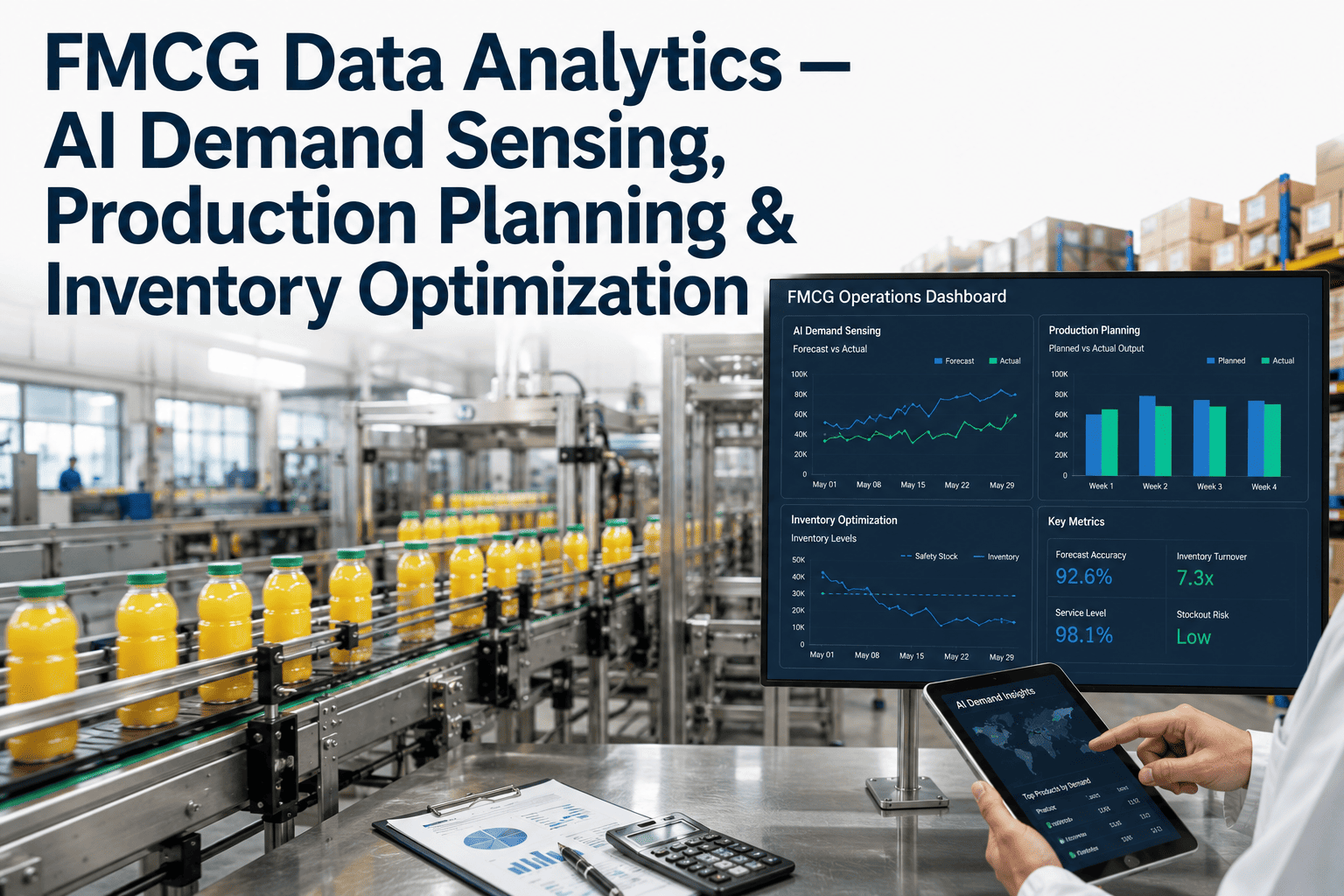
AI-powered automated restocking transforms FMCG replenishment from a reactive, labor-intensive process into a fully autonomous supply chain function. Traditional reorder point models trigger purchase orders when inventory falls below a static safety stock threshold—a simplistic approach that ignores demand velocity, supplier lead time variability, and real-time sales signals. AI inventory automation replaces static thresholds with dynamic, continuously-updated replenishment models that factor in point-of-sale data, weather-driven demand patterns, promotional calendars, and supplier performance history. The result is a self-optimizing restocking engine that minimizes both stockout risk and overstock accumulation simultaneously. Smart inventory management platforms using AI can reduce total inventory carrying costs by 18–28% while improving product availability rates above 98%.
The practical implementation of automated restocking in FMCG environments relies on three interconnected AI capabilities: demand forecasting, supplier lead time modeling, and multi-location stock balancing. Demand forecasting engines analyze historical sales patterns at SKU-location level, incorporating external variables such as promotional uplift factors, seasonal indices, and competitor activity signals. Supplier lead time models maintain probabilistic estimates of delivery windows for each vendor, automatically adjusting safety stock buffers when supplier reliability declines. Multi-location stock balancing algorithms identify excess inventory at one distribution center that can fulfill demand at a neighboring facility before triggering an external purchase order—reducing procurement costs while accelerating replenishment speed. FMCG supply chain teams exploring AI restocking capabilities are encouraged to book a demo to review demand forecasting models specific to their category mix.
| Restocking Method | Response Time | Stockout Risk | Overstock Risk | Labor Requirement | Accuracy |
|---|---|---|---|---|---|
| Manual Reorder Points | 24–72 hours | High (8–12%) | High (25–35% excess) | High | 65–75% |
| Spreadsheet Forecasting | 12–48 hours | Medium (5–8%) | Medium (15–25% excess) | Medium-High | 72–82% |
| Basic ERP Replenishment | 6–24 hours | Medium (4–6%) | Medium (12–20% excess) | Medium | 78–86% |
| AI Automated Restocking | Real-time (minutes) | Low (<2%) | Low (3–8% excess) | Minimal | 94–99% |
Real-Time Stock Visibility Across All FMCG Locations: From Warehouse to Shelf
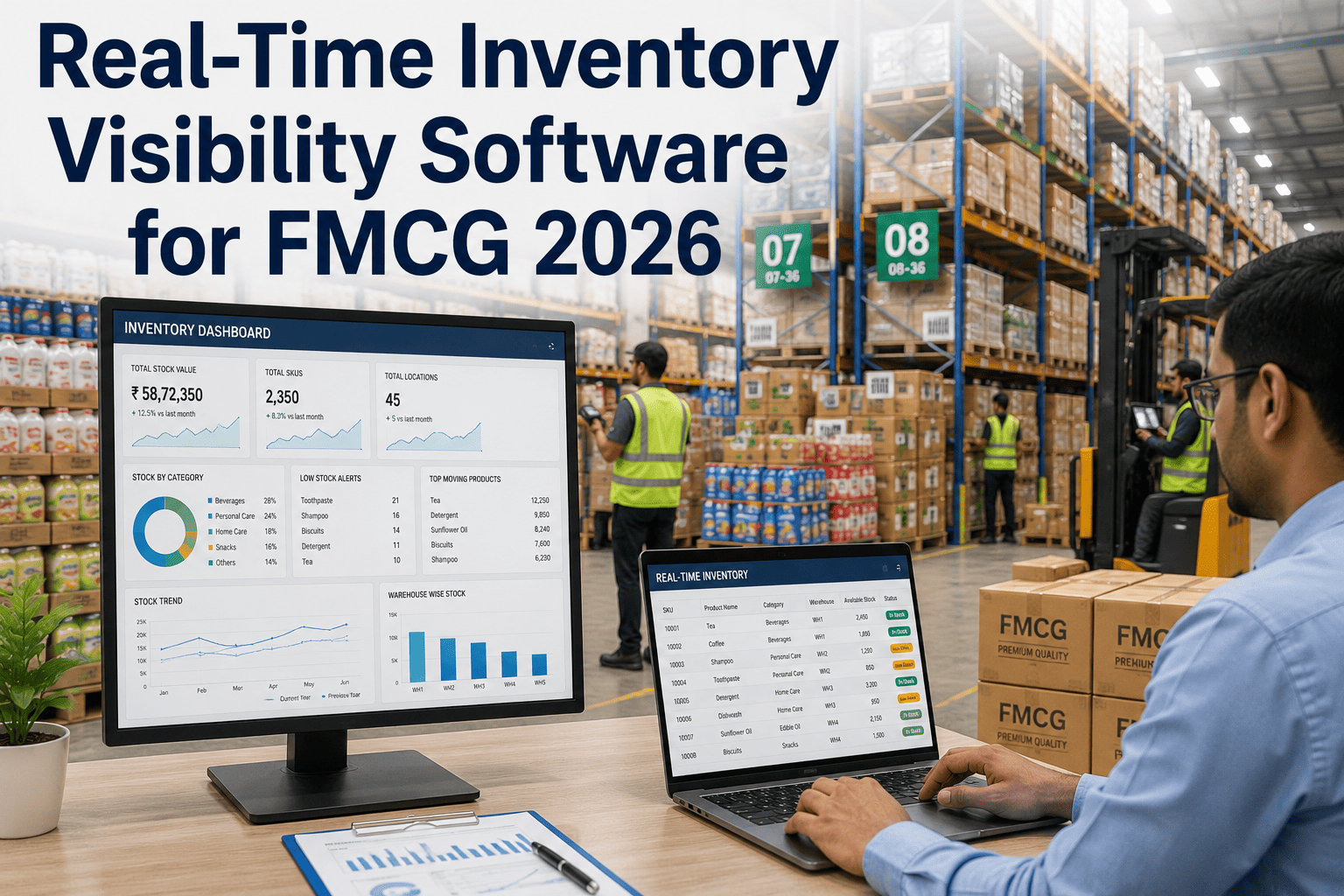
Real-time stock visibility in FMCG operations means knowing the exact quantity, location, condition, and age of every SKU across every warehouse, distribution center, and retail point at any given moment. This sounds straightforward in principle but requires a sophisticated integration of AMR scanning data, IoT sensor feeds, POS system integrations, and cloud-based inventory analytics platforms to execute at scale. The value of true real-time visibility extends far beyond accurate stock counts—it enables proactive decision-making across procurement, distribution, merchandising, and sales functions simultaneously.
For FMCG brands managing products across 50 to 500 retail locations, centralized visibility dashboards aggregate stock levels from every point in the distribution chain into a single command view. Procurement teams see supplier pipeline inventory alongside warehouse stock to avoid double-ordering. Distribution teams identify imbalances between regional hubs before stockouts materialize at individual stores. Category managers monitor shelf availability rates in real time during promotional campaigns, enabling immediate intervention when specific locations fall below target availability thresholds. Operations leaders who want to explore real-time stock visibility architecture for their network can book a demo and see a live demonstration of multi-location inventory dashboards.
Pallet & Bin-Level Stock Tracking
AMR robots and fixed RFID readers maintain perpetual inventory accuracy at pallet, case, and bin level within distribution centers. Every movement—inbound receipt, put-away, pick, transfer, and dispatch—updates inventory records in real time, eliminating the gap between physical stock and system records that plagues manual warehouse operations.
In-Transit Inventory Visibility
GPS-enabled shipment tracking integrated with inventory platforms provides real-time visibility of stock in transit between warehouses and delivery destinations. FMCG distribution teams can view in-transit inventory as virtual available-to-promise stock, reducing the need for safety stock buffers at destination warehouses and accelerating order commitment timelines.
Shelf Availability & OSA Monitoring
Computer vision cameras and smart shelf sensors feed real-time On-Shelf Availability (OSA) data to FMCG inventory platforms, flagging phantom stockouts where inventory exists in the stockroom but shelves remain empty. AI systems automatically generate replenishment tasks for store staff when shelf counts fall below planogram allocations, reducing lost sales from invisible out-of-stocks.
AI Demand Fluctuation Management: Staying Ahead of FMCG Volatility
Demand fluctuation is the defining challenge of FMCG inventory management. Consumer goods categories are subject to demand volatility driven by promotions, seasonality, weather events, social media trends, and competitive pricing shifts—none of which follow predictable patterns that traditional statistical forecasting models can reliably capture. AI inventory systems built on machine learning address demand volatility at a fundamentally different level than rule-based or statistical approaches. By training on thousands of historical demand patterns across categories, channels, and geographies, AI forecasting models develop the pattern recognition capability to anticipate demand inflection points days or weeks before they would be detectable through conventional analysis.
Promotional demand management is where AI forecasting delivers its most measurable FMCG value. Promotions are the single largest source of demand volatility in consumer goods supply chains, yet many FMCG manufacturers still rely on historical promotional uplifts as simple multipliers applied to base demand. AI models account for promotional cannibalization effects, competitor promotional activity, retailer execution variability, and consumer price sensitivity dynamics to generate more accurate promotional volume forecasts. FMCG supply chain planners who want to understand AI demand forecasting capabilities for their specific product portfolio can book a demo with our demand intelligence team.
Promotional Uplift Modeling
AI models analyze promotional response patterns across hundreds of past campaigns, learning the demand multipliers specific to each SKU-retailer-promotion type combination. Automated pre-build inventory recommendations ensure sufficient stock arrives at distribution centers 5–10 days before promotion launch, eliminating the last-minute scramble that characterizes manual promotional planning.
Seasonal & Event-Driven Forecasting
Machine learning models identify seasonal demand patterns at granular SKU level, automatically adjusting forecast horizons and safety stock parameters as seasonal inflection points approach. Integration with external event calendars—festivals, sporting events, school calendars—enables FMCG planners to anticipate demand spikes tied to recurring consumer behavior patterns.
New Product Launch Inventory Optimization
NPD launches represent high-risk inventory events where historical data is unavailable and demand uncertainty is maximum. AI platforms use analogous product performance data, category trend analysis, and retailer distribution breadth to generate launch inventory recommendations that balance availability risk against overstock exposure across the launch window.
Real-Time Demand Signal Integration
AI inventory systems integrate with POS data feeds from key retail accounts, updating demand forecasts in near real time as actual sales velocity deviates from planned rates. When a product trends significantly above or below forecast during its first week of a promotional period, the system automatically recalculates replenishment requirements and adjusts distribution priorities accordingly.
Expired Product Reduction: AI Inventory Strategies That Cut FMCG Waste
Expired product waste is one of the most visible and financially damaging consequences of poor FMCG inventory management. For food, beverage, and personal care categories with shelf lives ranging from 30 days to 24 months, the financial impact of expired write-offs compounds across manufacturing, warehousing, distribution, and retail levels of the supply chain. AI inventory platforms address expired product waste through a combination of intelligent FEFO rotation enforcement, expiry-aware demand allocation, and proactive markdown and redistribution recommendations that create value from near-expiry stock before it crosses the write-off threshold.
The key mechanism enabling expired product reduction is real-time batch-level inventory visibility maintained by AMR scanning systems. When every pallet's batch code and expiry date is recorded and continuously updated in the inventory platform, AI algorithms can apply sophisticated expiry management logic that manual FEFO rotation simply cannot execute at warehouse scale. Near-expiry stock is automatically identified, prioritized for the next available outbound shipment to high-velocity retail accounts, and flagged for potential inter-depot transfer or promotional markdown before expiry loss occurs. FMCG operations teams seeking to quantify their expiry reduction opportunity can book a demo to receive a waste analysis using their own inventory data.
Automated FEFO Enforcement Across All Storage Locations
AI inventory systems maintain batch-level expiry data for every storage location, automatically generating pick instructions that enforce First Expired First Out rotation across multi-aisle, multi-level racking configurations. FEFO compliance rates exceeding 99.2% are achievable with automated enforcement versus the 85–92% compliance rates typical of manually supervised FEFO programs.
Proactive Near-Expiry Redistribution Alerts
Configurable expiry horizon alerts notify distribution planners when specific batches cross defined proximity-to-expiry thresholds—typically 30%, 20%, and 10% of total shelf life remaining. At each threshold, the system automatically evaluates redistribution options: priority shipment to fastest-turning accounts, inter-depot transfer to reduce regional overstock, or markdown recommendation to drive accelerated sell-through.
Expiry-Aware Purchasing & Production Planning
AI inventory platforms integrate expiry risk signals into upstream purchasing and production planning workflows. When near-expiry stock levels exceed a configurable threshold for a specific SKU, automated purchase order suppression prevents additional receipts from compounding the write-off risk. Production scheduling integrations allow FMCG manufacturers to align production runs with actual consumption rates rather than creating excess finished goods inventory with compressed remaining shelf life.
Implementing AI Inventory Management in FMCG: A Phased Deployment Approach
Successful AI inventory management deployment in FMCG environments follows a structured phased approach that delivers measurable value at each stage while building the organizational capability required for sustained adoption. Unlike large ERP implementations that require 18–24 months before delivering any operational benefit, AI inventory platforms using AMR robots and cloud-based analytics can demonstrate measurable ROI within 60–90 days of initial deployment. The phased approach prioritizes high-impact, quick-win implementations in the first quarter, expanding to enterprise-wide deployment as organizational confidence and technical infrastructure mature.
Infrastructure & Baseline Assessment
Weeks 1–4Deploy AMR robots and IoT sensors across primary warehouse locations. Integrate with existing WMS and ERP systems via API connectors. Establish baseline inventory accuracy benchmarks and identify high-value SKUs for priority monitoring and AI model training.
- AMR robot commissioning and navigation mapping
- WMS/ERP API integration and data validation
- SKU prioritization matrix development
Real-Time Visibility & Alert Activation
Weeks 5–10Activate real-time inventory dashboards for operations, procurement, and distribution teams. Configure stockout and expiry alert thresholds. Launch automated FEFO enforcement and near-expiry redistribution workflows. Begin AI demand model training on historical sales and inventory data.
- Multi-location visibility dashboard deployment
- Alert threshold configuration and testing
- AI demand model initialization and calibration
Automated Restocking & Full Optimization
Weeks 11–24Activate automated restocking engine for qualifying SKUs. Expand AI demand forecasting to full product range. Deploy promotional inventory planning modules. Implement continuous improvement reviews based on forecast accuracy and service level performance data.
- Automated purchase order generation activation
- Promotional demand planning integration
- Enterprise-wide rollout to all distribution centers
ROI of AI Inventory Management in FMCG: Measurable Financial Outcomes
The financial return on AI inventory management investment in FMCG operations is compelling and multi-dimensional. Unlike single-dimension cost reduction initiatives, AI-powered stock visibility and automated restocking generate simultaneous improvements across revenue, cost, and working capital dimensions. Product availability improvements drive top-line revenue recovery from eliminated stockouts. Inventory optimization reduces working capital tied up in excess safety stock. Expired product reduction cuts write-off expenses and disposal costs. Labor reallocation from manual counting to higher-value supply chain activities reduces operational overhead without headcount reductions.
| Financial Metric | Typical Baseline | After AI Implementation | Improvement | Annual Value Impact |
|---|---|---|---|---|
| Inventory Accuracy | 97.0–98.5% | 99.4–99.8% | +1.5–2.5 points | Reduced fulfillment errors & claims |
| Stockout Rate | 4–8% | 1–2% | –60–75% reduction | +3–5% recovered revenue |
| Expired Product Write-offs | 1.8–3.2% of inventory value | 0.4–0.8% of inventory value | –70–80% reduction | Direct margin recovery |
| Safety Stock Inventory | Baseline carrying cost | 18–28% reduction | Significant working capital release | Capital redeployment opportunity |
| Manual Counting Labor | Baseline FTE allocation | 60–75% reduction in count hours | FTE reallocation to higher value work | Operational efficiency gain |
The compounding effect of these improvements typically delivers full ROI on AI inventory management platform investment within 6–12 months for mid-to-large FMCG operations. Businesses with existing high expired product write-off rates or severe stockout frequency often see payback within 3–5 months when a single high-value expiry prevention event or stockout elimination materializes early in deployment. FMCG finance and operations teams who want a facility-specific ROI projection can book a demo and receive a customized business case analysis.
Key Success Factors for AI Inventory Optimization in Consumer Goods Operations
FMCG organizations that achieve the highest returns from AI inventory management share a set of consistent implementation principles that distinguish transformative deployments from marginal improvements. These success factors span technical architecture decisions, data quality disciplines, organizational change management, and ongoing performance management practices that sustain inventory optimization beyond the initial deployment period.
Data Quality Is the Foundation
AI inventory models are only as accurate as the data they consume. Before deploying AI restocking engines, FMCG operations must invest in master data cleansing—accurate product hierarchies, supplier lead time records, and historical demand data free from promotional outliers and data entry errors. Organizations that skip this step see AI forecast accuracy plateau 15–20 points below achievable benchmarks.
Start with High-Velocity, High-Risk SKUs
Focusing initial AI inventory deployment on the 80 SKUs responsible for 80% of stockout incidents and expiry losses generates visible ROI within the first 90 days. This concentrated approach proves the technology's value to skeptical stakeholders and builds organizational confidence before expanding to the full product portfolio.
Integrate AI Alerts with Daily Workflow Tools
Inventory alerts that live only inside a separate analytics platform quickly get ignored by operations teams managing day-to-day workloads. The most successful deployments integrate AI inventory alerts directly into existing workflow tools—ERP task queues, WMS work order systems, and mobile notifications—ensuring that restocking recommendations and expiry warnings are acted on within the same shift they are generated.
Measure Service Level, Not Just Accuracy
Inventory accuracy is a necessary but insufficient KPI for AI inventory management success. Leading FMCG operations track On-Shelf Availability (OSA), Perfect Order Rate, Days of Inventory on Hand by ABC classification, and Expired Product Write-off Rate as the primary performance indicators that connect inventory management quality directly to customer service and financial outcomes.
Collaborative Forecasting with Key Retail Accounts
The most advanced FMCG-AI inventory deployments extend demand visibility beyond the manufacturer's own systems to include retailer POS data and promotional plans shared through collaborative forecasting programs. When AI models consume real sell-out data rather than relying solely on sell-in shipment history, forecast accuracy improves dramatically and supply chain response to real consumer demand accelerates.
Continuous Model Retraining & Refinement
AI inventory models require ongoing retraining as product portfolios evolve, consumer behavior patterns shift, and supply chain configurations change. Organizations that treat AI inventory platforms as set-and-forget deployments see forecast accuracy degrade over 12–18 months. Quarterly model reviews and continuous learning pipelines that incorporate recent demand signal data maintain AI forecasting performance at peak accuracy.
FMCG AI Inventory Management — Frequently Asked Questions
How quickly can FMCG operations achieve real-time stock visibility after deploying AMR robots?
AMR robot deployments in FMCG warehouses typically achieve full operational real-time scanning capability within 2–4 weeks of installation, including navigation mapping, WMS integration, and initial inventory baseline establishment. Cloud-based inventory dashboards providing real-time multi-location visibility are generally live within the same timeframe, giving operations teams immediate access to accurate stock data across all instrumented locations.
Can AI inventory management integrate with legacy ERP and WMS systems commonly used in FMCG?
Yes. Modern AI inventory platforms are built with pre-configured API connectors for the most widely used FMCG ERP and WMS systems, including SAP, Oracle, Microsoft Dynamics, and major warehouse management platforms. Integration typically takes 2–6 weeks depending on data structure complexity and IT access, and does not require replacing or significantly modifying existing systems.
What is the typical inventory accuracy improvement achieved with AMR stock-counting robots?
FMCG warehouses deploying AMR inventory robots typically move from 97–98.5% inventory accuracy under managed manual counting to 99.4–99.8% accuracy with robotic scanning. This improvement eliminates phantom inventory records, ghost locations, and miscounted pallet quantities that consistently cause stockout and fulfillment failures in high-SKU-count FMCG distribution environments.
How does AI automated restocking handle sudden demand spikes in FMCG supply chains?
AI restocking engines monitor demand velocity in real time and apply pre-configured demand spike detection algorithms that automatically escalate reorder quantities when actual demand significantly exceeds forecast. Multi-source supply logic allows the system to simultaneously trigger purchase orders to primary suppliers, request inter-depot transfers from surplus locations, and flag production planning teams for accelerated manufacturing runs—all within minutes of detecting a demand spike rather than hours or days under manual processes.
What ROI can FMCG companies expect from AI inventory management investment?
FMCG companies typically achieve full ROI on AI inventory management platform investment within 6–12 months of deployment. The combined financial impact of reduced stockout losses, lower expired product write-offs, decreased safety stock carrying costs, and reduced manual counting labor generates total annual benefit equivalent to 4–8% of the managed inventory value for most FMCG operations, with higher returns in categories with elevated expiry risk or high promotional volatility.
Is AI inventory management suitable for small and mid-size FMCG brands, or only enterprise operations?
AI inventory management platforms built on cloud architecture and modular AMR robot deployments are accessible and commercially viable for FMCG operations managing as few as 5,000 active SKUs across two or more locations. SaaS pricing models and scalable hardware configurations mean that mid-size FMCG brands can access the same AI forecasting and automated restocking capabilities as enterprise manufacturers without the capital expenditure historically associated with large-scale automation deployments.