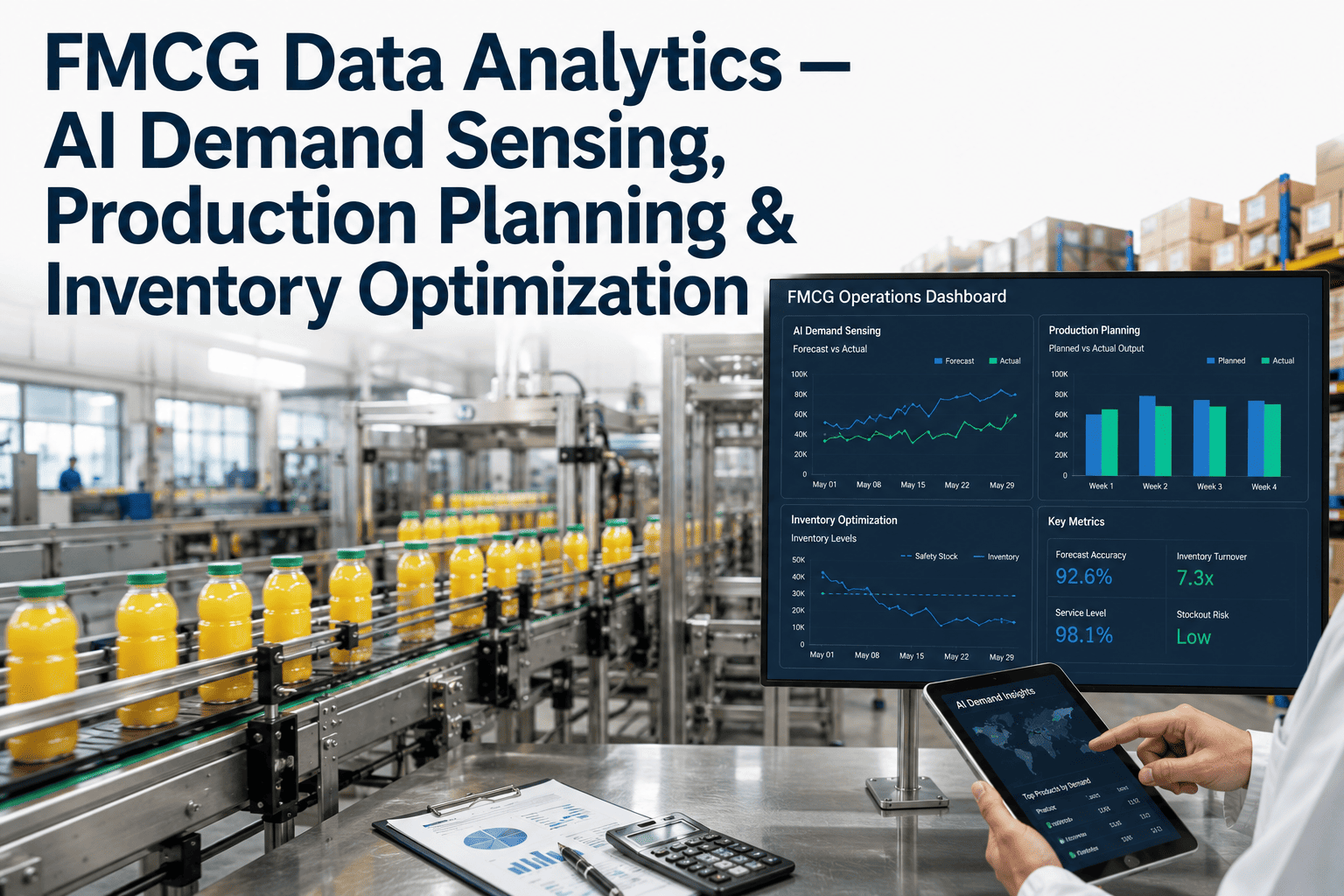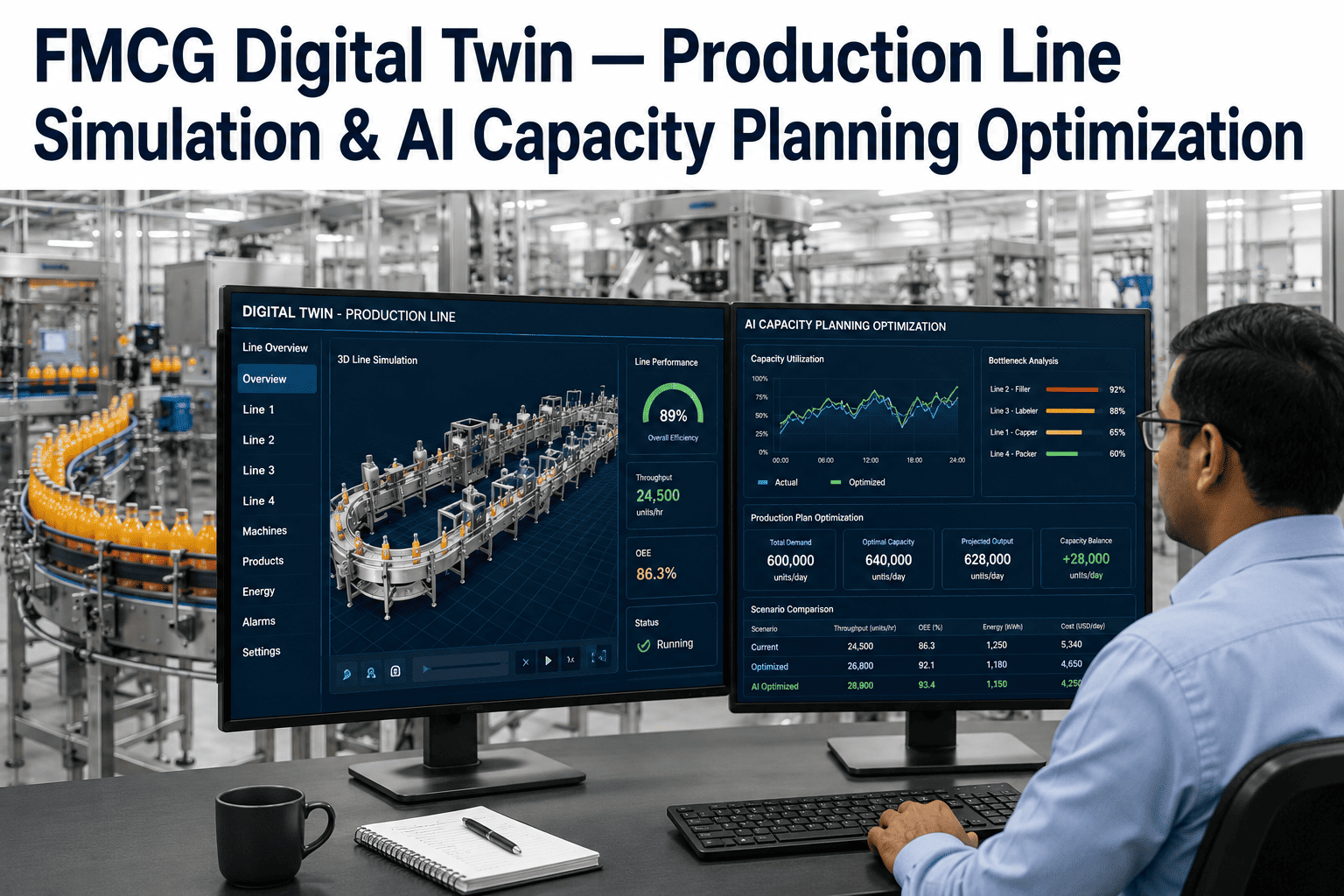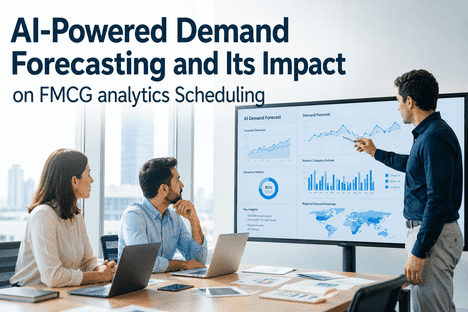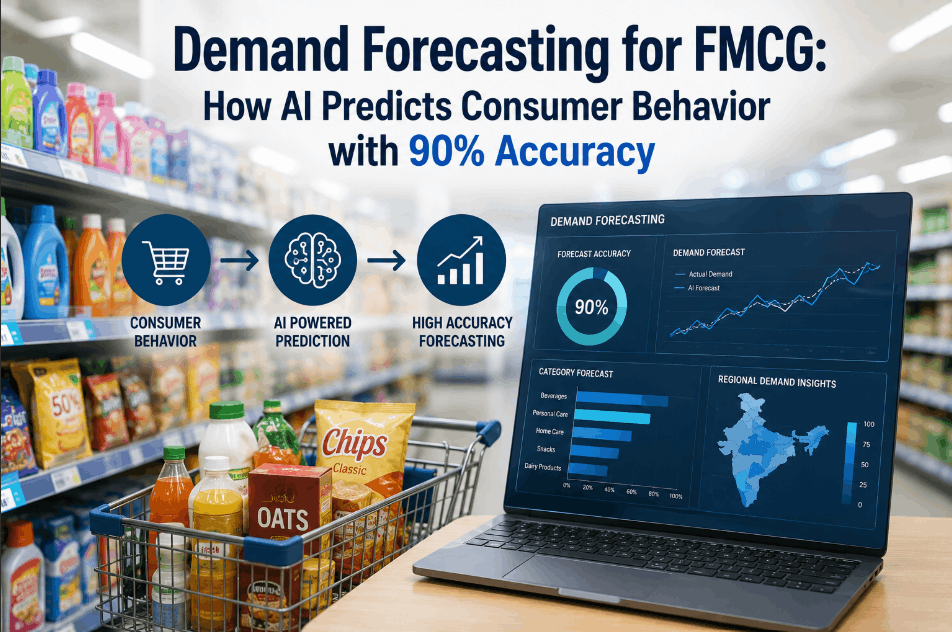
Demand forecasting for FMCG has entered a new era. AI-driven demand prediction models are now achieving over 90% accuracy by analyzing hundreds of variables simultaneously — from seasonal consumption patterns and promotional uplift to macroeconomic signals and real-time point-of-sale data. For fast-moving consumer goods manufacturers, this level of precision is no longer a competitive advantage reserved for market leaders. It is rapidly becoming a baseline operational requirement, as supply chain volatility, retailer replenishment expectations, and margin pressure force brands to replace intuition-led planning with machine learning demand planning that reacts to consumer behavior before it materializes on the shelf. Organizations exploring this shift frequently begin by choosing to book a demo to understand how AI forecasting platforms integrate with existing ERP and production planning systems.
Achieve 90%+ Forecast Accuracy with AI-Driven FMCG Demand Planning
iFactory's Mobile AI-driven App delivers real-time demand sensing, seasonal analytics, promotional forecasting, and inventory demand alignment — purpose-built for FMCG production environments.
The Limits of Legacy FMCG Demand Planning in a Volatile Consumer Market
Traditional FMCG demand planning relies on historical sales averages, static seasonal indexes, and spreadsheet-based adjustments that commercial planners manually apply based on past experience. This approach has two fundamental weaknesses: it is always backward-looking, and it cannot process the volume of external signals that now influence consumer purchasing behavior. In a market shaped by social media trend cycles, sudden promotional activations, weather-driven category spikes, and e-commerce channel fragmentation, static historical models consistently generate forecast errors that result in either costly overproduction or lost revenue from stockouts.
The financial consequences of inaccurate FMCG demand forecasting are substantial. Industry benchmarks consistently show that a 10% improvement in forecast accuracy translates directly into 5–8% reductions in inventory carrying costs, with corresponding gains in production scheduling efficiency and customer service levels. Machine learning demand planning closes this gap not by improving the same backward-looking analysis, but by fundamentally changing the inputs — incorporating real-time demand signals, external data streams, and behavioral pattern recognition that human planners simply cannot process at scale. FMCG brands that want to evaluate this transition practically can book a demo and run a forecast accuracy comparison against their current planning outputs before committing to full implementation.
Static Historical Models
Legacy FMCG forecasting relies on static seasonal indexes that cannot adapt to emerging consumer behavior patterns, social commerce demand signals, or competitor promotional activity.
Promotional Demand Blindspots
Manual promotional demand forecasting cannot account for cross-category cannibalization, halo effects, or channel-specific uplift patterns — creating inventory misalignment at peak demand moments.
Slow Signal Processing
Weekly or monthly planning cycles cannot respond to demand signals that emerge and peak within days — including weather-linked category spikes, viral product moments, and sudden retailer replenishment pulls.
SKU-Level Forecast Failure
At the SKU and location level, traditional FMCG demand analytics degrade rapidly — with forecast errors exceeding 40% for tail SKUs that nonetheless represent significant aggregate demand volume.
How Machine Learning Predicts Consumer Behavior with 90%+ Accuracy for FMCG Brands
AI demand forecasting for FMCG operates through a multi-layer modeling architecture that processes both internal sales history and external behavioral signals simultaneously. Unlike traditional statistical models that use a single demand driver, machine learning demand planning algorithms weight hundreds of variables dynamically — adjusting their relative importance based on how well each variable has predicted demand in recent periods. This self-optimizing architecture is what enables AI forecasting platforms to maintain 90%+ accuracy even as consumer behavior shifts, promotional calendars change, and external market conditions evolve.
Layer 1 — Baseline Demand Sensing and Time-Series Modeling
The foundation of AI-driven FMCG demand prediction is a time-series modeling layer that processes granular POS and shipment data to establish a statistical baseline demand curve for each SKU-location combination. Advanced platforms use ensemble models — combining gradient boosting, LSTM neural networks, and Bayesian structural time series — to capture both the trend and volatility components of demand simultaneously. This layer accounts for organic demand growth, category lifecycle dynamics, and distribution change effects that distort raw shipment history. FMCG analytics teams that have moved from single-model to ensemble demand sensing consistently report accuracy improvements of 15–25% at the SKU level without any additional data inputs.
Layer 2 — External Signal Integration and Causal Demand Drivers
The second modeling layer integrates external causal demand drivers that correlate with but are not captured by internal sales history. For FMCG categories, the most powerful external signals include weather data (temperature and precipitation correlations for beverages, personal care, and seasonal food categories), macroeconomic indicators (disposable income indices, consumer confidence scores), social media engagement metrics (search volume trends, influencer-driven category interest), and competitor promotional calendars derived from retail shelf pricing intelligence. AI demand forecasting platforms that incorporate these signals reduce promotional forecast error by up to 35% compared to models using only internal history — a particularly significant improvement for categories where promotional volume regularly exceeds 40% of total sales. Brands evaluating multi-signal forecasting capabilities often book a demo to assess which external signal categories are most relevant for their specific product portfolio.
Layer 3 — Promotional Demand Forecasting and Event Modeling
Promotional demand forecasting is the highest-impact application of AI in the FMCG planning cycle — and the area where traditional methods fail most visibly. Machine learning promotional models are trained on historical promotion response data to recognize how specific promotional mechanics (price reduction depth, feature and display activation, multi-buy structures) interact with category, seasonality, and channel context to drive volume uplift. These models decompose promotional demand into base volume, incremental promotional lift, timing effects, and post-promotion dip — providing planners with a complete demand shape rather than a single volume estimate. AI platforms that incorporate cross-category cannibalization modeling add a further layer of accuracy by quantifying how promoting one SKU suppresses demand for adjacent items in the same category.
Key AI Demand Forecasting Applications Across FMCG Categories and Planning Functions
AI demand forecasting delivers measurable impact across every major FMCG planning function — from new product launch demand estimation and seasonal inventory positioning to SKU rationalization analytics and retailer-specific replenishment optimization. The following applications represent the highest-ROI deployment scenarios for FMCG brands implementing machine learning demand analytics for the first time.
Seasonal Demand Forecasting for FMCG Production Planning
Seasonal demand management is the most established use case for AI in FMCG forecasting, and for good reason — seasonal volume spikes create the highest risk of simultaneous overproduction and stockout when managed with static seasonal indexes. AI seasonal forecasting models learn the specific demand shape of each SKU's seasonal pattern — including lead-lag relationships between weather triggers and purchase behavior, year-over-year trend adjustments, and channel-specific seasonal timing differences. For chilled food, beverages, personal care, and seasonal homecare categories, AI seasonal forecasting consistently reduces pre-season inventory builds by 15–20% while improving in-season availability by 8–12% — a combination that directly improves both working capital efficiency and category revenue capture. Production planners using book a demo sessions report that seeing seasonal accuracy comparisons side-by-side is the most compelling proof point for internal investment approval.
New Product Launch Demand Prediction for Consumer Goods
New product demand forecasting is traditionally one of the most error-prone activities in FMCG planning — with launch volume forecasts regularly deviating from actual sell-through by 30–50% in the first 12 weeks. AI new product forecasting platforms address this challenge by building launch demand models from analogue product data — identifying which historical SKUs most closely match the new product's category positioning, pack format, price point, and channel distribution profile, and using those analogues to construct a probabilistic demand range rather than a single-point estimate. This approach gives supply chain planners a risk-calibrated view of launch demand that supports scenario-based inventory positioning — building conservative base stock with flexible surge capacity rather than committing to a single forecast that is almost certain to be wrong.
Retailer-Specific Demand Sensing and Replenishment Optimization
Modern FMCG demand analytics must operate at the retailer and channel level, not just at aggregate national volume. Different retail partners have distinct demand patterns driven by their customer demographics, promotional mechanics, store footprint, and replenishment frequency. AI demand sensing platforms that process retailer-specific POS data generate individual replenishment forecasts for each trading partner — enabling FMCG brands to optimize delivery schedules, allocate production output across customer accounts, and identify retailer-level demand anomalies that signal distribution gains or losses before they appear in national shipment data. This granularity transforms demand forecasting from a production planning input into a commercial intelligence asset that improves both supply chain and sales team decision-making.
| FMCG Forecasting Application | Traditional Method | AI-Driven Approach | Accuracy Improvement | Primary Business Impact |
|---|---|---|---|---|
| Seasonal Demand Forecasting | Static seasonal index applied to prior year volume | Multi-signal seasonal ML model with weather and trend integration | +18–25% | Inventory reduction + availability improvement |
| Promotional Demand Prediction | Manual uplift factors from sales team input | Causal promotional response modeling with cannibalization | +28–35% | Promotion ROI and waste reduction |
| New Product Launch Forecasting | Analogue product comparison with single-point estimate | Probabilistic analogue modeling with scenario distribution | +30–40% | Launch inventory risk management |
| Retailer Replenishment Forecasting | Aggregate national forecast allocated by historical share | Retailer-specific POS-driven demand sensing per account | +22–30% | Service level improvement by customer |
| SKU Tail Demand Forecasting | Average sales rate with manual planner adjustment | Cluster-based ML model grouping tail SKUs by demand pattern | +35–45% | Long-tail inventory waste reduction |
| Short-Term Demand Sensing | Weekly rolling average with promotional flag | Daily AI demand signal processing with real-time POS integration | +40–50% | Agile production scheduling response |
What FMCG Demand Analytics Platforms Must Deliver to Achieve 90% Forecast Accuracy
Achieving and sustaining 90%+ forecast accuracy in FMCG demand planning requires more than a machine learning algorithm applied to historical data. It requires a platform architecture that continuously ingests fresh demand signals, retrains models at appropriate intervals, surfaces forecast uncertainty for planner review, and integrates seamlessly with production scheduling and inventory replenishment systems. The following capabilities define what separates high-performance AI demand forecasting platforms from analytics tools that produce impressive dashboards but limited operational impact.
Continuous Model Retraining and Forecast Drift Detection
Consumer behavior patterns shift continuously — category trends emerge, competitor launches disrupt established demand baselines, and channel mix evolves as shopper behavior changes across retail and e-commerce. AI demand forecasting platforms must include automated model retraining pipelines that detect when forecast accuracy is degrading and trigger model updates without requiring data science team intervention. Platforms with embedded forecast drift detection — monitoring accuracy metrics by SKU group, region, and channel in real time — enable FMCG demand planners to identify which forecast segments are losing accuracy before the errors reach production scheduling. This capability is what distinguishes a production-grade AI forecasting system from a static model deployed once and left unchanged.
Demand Forecast Uncertainty Quantification for Supply Chain Risk
A single-number forecast, however accurate on average, is insufficient for production and inventory planning decisions that carry asymmetric cost consequences. Overproducing a short-shelf-life FMCG product is often more costly than a stockout, while for premium personal care categories the reverse is true. AI demand forecasting platforms that output probabilistic demand distributions — providing P10, P50, and P90 demand estimates for each SKU and planning period — enable supply chain planners to make inventory positioning decisions that explicitly account for demand risk. This capability is particularly valuable for FMCG brands managing products with high promotional volume variability or significant seasonal demand uncertainty, and it is one of the platform features that FMCG planning directors prioritize when they book a demo evaluation.
Demand-to-Production Integration for FMCG Manufacturing Execution
The operational value of AI demand forecasting is only fully realized when forecast outputs are connected directly to production scheduling and materials requirements planning systems. Standalone demand forecasting platforms that output Excel files for manual re-entry into ERP systems introduce both latency and data integrity risk into the demand-to-production cycle. Integrated AI forecasting and manufacturing execution platforms pass demand signals directly to production scheduling modules — automatically generating capacity-constrained production plans that balance forecast demand against available line time, material availability, and minimum run quantity constraints. This integration closes the loop between consumer demand prediction and plant floor execution, creating a continuous planning cycle that responds to demand changes within hours rather than weeks.
How FMCG Brands Successfully Implement AI Demand Forecasting: A Phased Approach
Successful AI demand forecasting implementation in FMCG environments requires a phased approach that builds data infrastructure, model maturity, and organizational capability in parallel. Brands that attempt to deploy full multi-signal machine learning demand planning in a single implementation phase consistently encounter data quality barriers, organizational change resistance, and model performance gaps that undermine early ROI. A structured three-phase implementation roadmap — data readiness and baseline modeling, external signal integration and promotional modeling, and full production integration with continuous improvement — delivers measurable accuracy gains at each stage while building the internal capability needed to sustain and improve the platform over time.
Data Readiness and Baseline Demand Modeling
Foundation: Data infrastructure and statistical baseline
- POS and shipment data cleansing and harmonization
- SKU master data alignment and hierarchy validation
- Statistical baseline model deployment by category
- Initial forecast accuracy benchmarking vs legacy method
Multi-Signal Integration and Promotional AI Modeling
Core build: External signals and causal modeling
- Weather, macroeconomic, and search signal integration
- Promotional response model training by mechanic type
- Cross-category cannibalization model deployment
- Planner review workflow and override protocol design
Production Integration and Continuous Model Optimization
Scale: ERP integration and performance governance
- ERP and MES direct API integration for demand-to-production
- Automated model retraining pipeline deployment
- Forecast drift monitoring dashboard activation
- Continuous accuracy improvement governance framework
FMCG AI Demand Forecasting — Frequently Asked Questions
How does AI demand forecasting achieve 90% accuracy in FMCG environments?
AI demand forecasting achieves 90%+ accuracy by processing hundreds of demand-driving variables simultaneously — including historical sales, weather signals, promotional calendars, macroeconomic indicators, and real-time POS data. Ensemble machine learning models combine multiple algorithm outputs, dynamically weighting each signal based on recent predictive performance rather than applying fixed model assumptions.
What data does an FMCG brand need to implement AI demand forecasting?
The minimum data requirement is 2–3 years of clean SKU-level sales or shipment history. Additional data inputs that significantly improve accuracy include retailer POS data, promotional event history with mechanic details, distribution coverage records, and any available external data feeds such as weather, search trends, or consumer confidence indices.
How does AI handle seasonal demand forecasting for FMCG categories?
AI seasonal demand models learn the specific demand shape of each SKU's seasonal pattern — including the lead-lag relationship between weather triggers and purchase behavior, year-over-year trend adjustments, and channel-specific seasonal timing differences. This approach consistently outperforms static seasonal indexes by 18–25% at the SKU-week level, enabling more precise pre-season inventory positioning.
Can AI demand forecasting models handle new product launches with no history?
Yes — AI new product forecasting uses analogue modeling to identify existing SKUs with similar category positioning, pack format, and price point, and uses those analogues to construct a probabilistic demand range for the launch period. This approach produces more realistic launch volume estimates than extrapolating from category averages, reducing launch inventory risk significantly.
How long does it take to implement AI demand forecasting for an FMCG manufacturer?
A phased implementation typically spans 20–36 weeks from data readiness assessment to full production integration. Phase 1 baseline modeling can be operational within 8 weeks, delivering initial accuracy improvements. Full multi-signal AI forecasting with ERP integration and continuous retraining pipelines is typically achieved within 36 weeks for mid-size FMCG manufacturers.
How does AI demand forecasting integrate with existing ERP and production planning systems?
Modern AI demand forecasting platforms integrate with ERP and MES systems via direct API connections, passing demand forecast outputs in formats compatible with SAP, Oracle, and major MES platforms. This integration enables demand-driven production scheduling without manual forecast re-entry, closing the loop between consumer demand prediction and plant floor execution in near real time.
Transform Your FMCG Demand Planning with AI That Predicts Consumer Behavior at 90%+ Accuracy
iFactory's Mobile AI-driven App delivers multi-signal demand sensing, promotional forecasting, seasonal demand analytics, and demand-to-production integration — built for FMCG manufacturers ready to replace spreadsheet planning with machine learning demand intelligence.