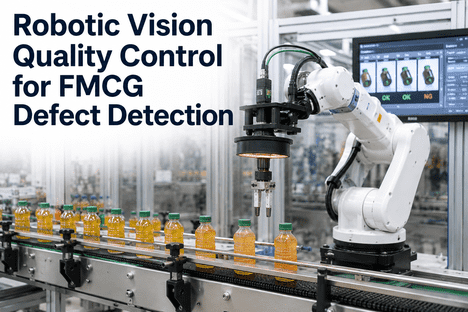
Robotic Vision Quality Control for FMCG Defect Detection

By Seren on June 3, 2026

robotic-vision-quality-control-fmcg-defect-detection-url.png_optimized_300

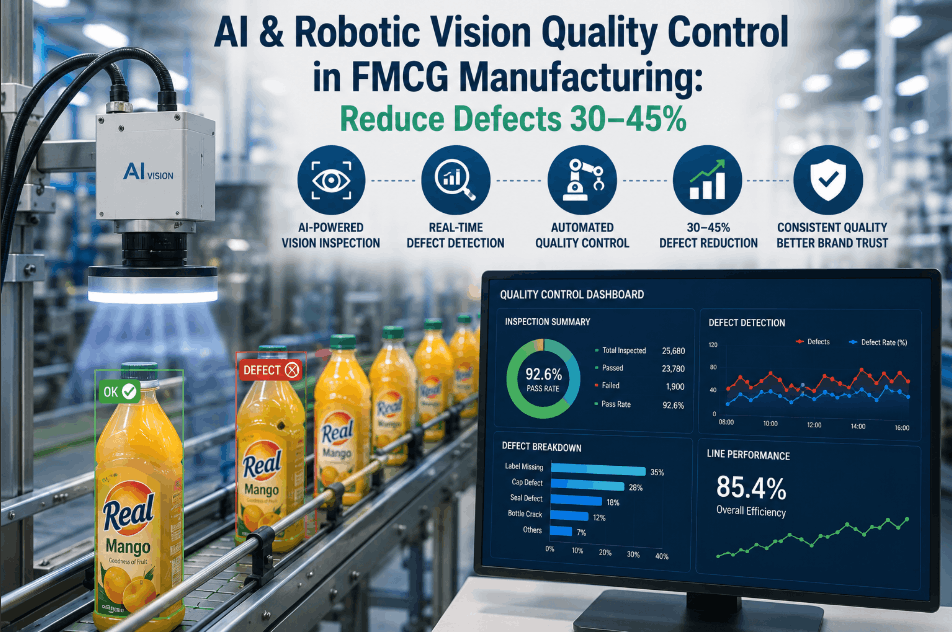
A high-speed snack food production line running at 240 bags per minute across 18 SKUs was losing $2.3 million annually to defects that human inspectors on the packaging line could not consistently detect seal integrity failures, missing product weight, packaging misprints, and foreign material contamination. Manual inspection using six roving quality technicians achieved only 78% defect detection at line speed, with average detection latency of 4–8 seconds after the defective unit passed the inspection station. After deploying an integrated robotic vision quality control cell combining iFactory AI Vision Camera with a delta robot sorting arm, the line achieved 99.6% defect detection, 100% automated removal of defective units at line speed, and a 14-month ROI driven by eliminated rework, reduced liability risk, and recovered production throughput. Book a Demo with iFactory to see how AI vision and robotics integration transforms FMCG quality control economics.

ROBOTIC VISION QC DEFECT DETECTION AI INSPECTION

Deploy Robotic Vision Quality Control That Detects and Removes Defects at Full Line Speed

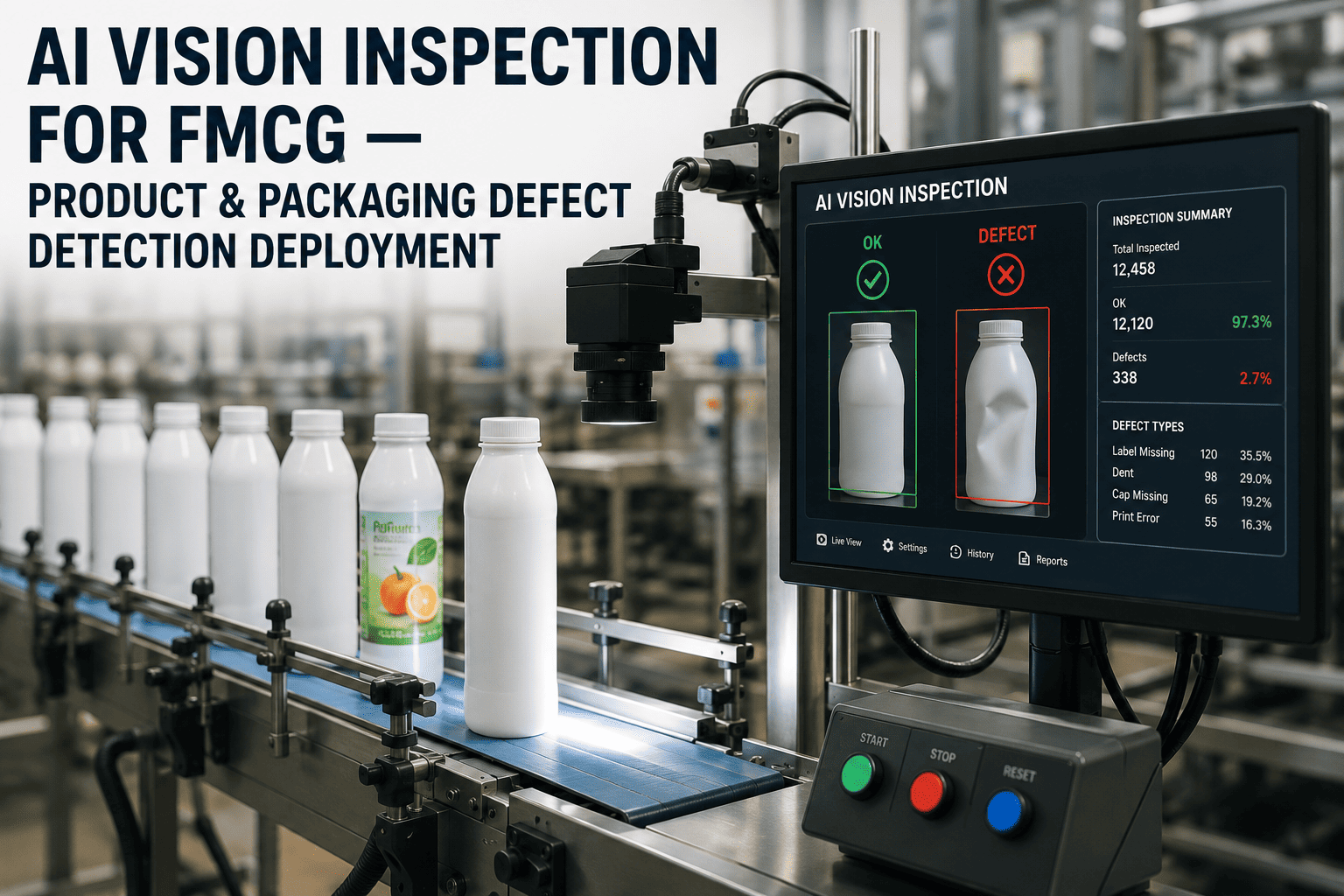
iFactory integrates AI-powered vision cameras, deep learning defect detection models, and high-speed robotic sorting arms into unified quality control cells purpose-built for FMCG production environments — delivering 99.6% detection accuracy with zero production speed impact.

Why Robotic Vision Quality Control Is Critical for High-Speed FMCG Production

Human Visual Inspection Cannot Keep Pace With Modern FMCG Line Speeds

The average FMCG packaging line operates at 120–400 units per minute depending on product category snack foods at 200–300 bpm, beverages at 400–800 bpm, confectionery at 300–600 bpm. At 240 units per minute, a human inspector has approximately 250 milliseconds per unit to detect a seal defect, a misprint, a weight deviation, or foreign material contamination. Studies consistently show that human visual inspection accuracy drops below 80% at cycle times under 500 milliseconds per unit, and fatigue-related accuracy degradation becomes significant after 45 minutes of continuous inspection — driving false negative rates of 22–35% on afternoon and night shifts. Robotic vision quality control systems using high-speed industrial cameras with dedicated processing hardware evaluate every unit at line speed without fatigue, achieving 99.4–99.8% defect detection across all inspection categories and all shifts.

Vision-Guided Robotics Enables Instant Defect Removal Without Line Stops

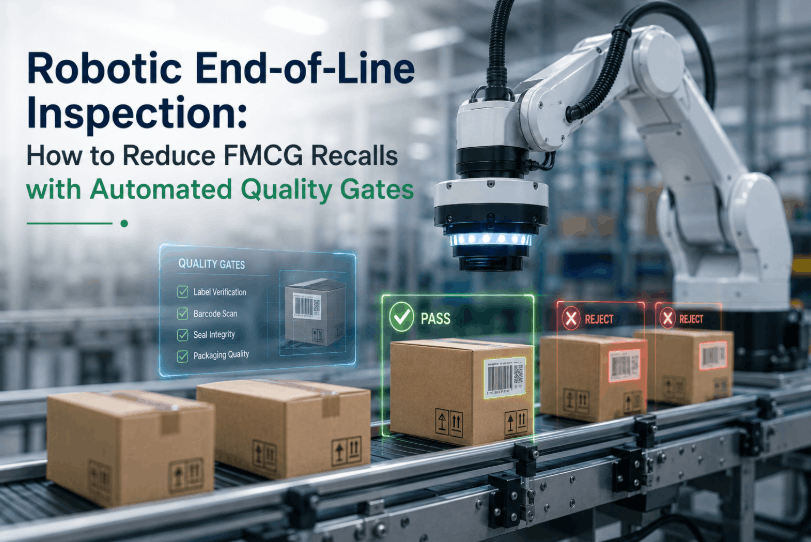
Detecting a defect is only half the problem removing the defective unit from the production flow without stopping the line or slowing throughput is the engineering challenge that separates practical quality automation from laboratory demonstrations. Vision-guided delta robots and articulated arms with cycle times under 300 milliseconds can intercept defective units on the conveyor, remove them by vacuum gripper or pusher, and place them in a reject bin — all within the product pitch spacing at full line speed. iFactory's integrated QC cell synchronizes the AI vision inference pipeline with the robot controller through deterministic real-time communication, ensuring the detection decision arrives at the robot before the defective unit reaches the removal zone. This vision-robotics synchronization is the critical capability that makes end-of-line quality automation viable for high-speed FMCG production.

1. Inspection Vision System Configuration & AI Model Training
2. Robotic Sorting Cell Design & Integration
3. Vision-Robotics Synchronization & Real-Time Control
4. Quality Data Integration & Analytics Platform
5. Deployment, Validation & Change Management
6. ROI Measurement, Scale Planning, and Continuous Optimization
DEPLOY ROBOTIC VISION QC DEFECT DETECTION

Ready to Deploy Robotic Vision Quality Control on Your FMCG Production Line?

iFactory's robotics and AI vision engineering team designs, integrates, and validates complete robotic vision quality control cells — AI-powered cameras, deep learning defect detection models, high-speed robotic sorting, and full CMMS and shift logbook integration — delivering 99.6% defect detection with measurable ROI from month one.

Industry Perspective: What Separates Successful Robotic Vision QC Deployments from Pilot Programs That Never Scale

The most common failure pattern I see in FMCG quality automation initiatives is that companies invest heavily in the vision system — high-resolution cameras, powerful inference hardware, sophisticated AI models — but treat the robotic rejection cell as an afterthought. They end up with a vision system that can detect defects with 99% accuracy but a robot that cannot remove them at line speed because the vision-to-robot latency was never specified as a system-level requirement. The key insight is that vision and robotics must be engineered as a single system with a unified latency budget, not as two independent subsystems that are expected to communicate after installation. Companies that define the end-to-end detection-to-removal latency as the primary system specification — not camera resolution or robot speed in isolation — are the ones that successfully deploy at full production speed and scale across multiple lines.

Director of Automation — Multi-Plant FMCG Manufacturing, U.S. Southeast
99.6% Defect detection with AI vision
240+ Units per minute at full line speed
14 Month ROI payback period
$2.3M Annual defect cost recovered

Robotic Vision Quality Control: The Intersection of AI Inspection and High-Speed Automation

Robotic vision quality control represents the convergence of two mature industrial technologies — AI-powered machine vision and high-speed robotic automation — into a single system that solves the most persistent quality challenge in FMCG manufacturing: detecting and removing defective units at full production speed without human intervention. The technology components — industrial cameras with global shutter sensors, deep learning defect detection models, delta and articulated robots with sub-300-millisecond cycle times, and deterministic industrial communication protocols — are each proven in their respective domains. The engineering challenge is integrating them into a unified quality control cell with a defined end-to-end latency budget, fail-safe architecture, and continuous improvement pipeline. FMCG manufacturers that invest in this integration discipline achieve defect detection rates above 99.5%, eliminate manual inspection labor on high-speed lines, and build the data foundation for predictive quality and closed-loop process control. Quality leaders ready to evaluate robotic vision quality control for their production environment are encouraged to schedule a robotic vision QC assessment with iFactory and receive a system design proposal with quantified ROI projections for your specific production line.
Robotic Vision Quality Control — Frequently Asked Questions

1. What is the maximum production line speed that iFactory's robotic vision QC system can support?
iFactory's integrated vision and robotics QC cell supports line speeds up to 400 units per minute for individual product inspection and removal, depending on product size, defect complexity, and robot reach requirements. For packaging inspection at 240–300 bpm, the standard configuration with a single delta robot and dual-camera vision station delivers 99.6% detection with 100% removal at full speed. Higher-speed lines (400–800 bpm for beverage canning) can be configured with multiple parallel vision stations and dual-robot removal cells operating on alternating product groups. The system design begins with the line speed specification as the primary constraint, and all component selection — camera frame rate, inference hardware, robot cycle time, communication protocol — is driven by the required end-to-end detection-to-removal latency.
2. How does iFactory handle product changeovers for different SKUs on the same line?
iFactory's recipe management system stores complete configuration profiles for each SKU — vision inspection parameters (camera exposure, lighting intensity, inspection regions, defect detection model), robot motion profile (pick position, place position, trajectory speed, gripper force), and reject handling configuration. Changeover between SKUs is executed by selecting the recipe from the HMI touchscreen, which automatically loads the vision parameters, switches the AI model, updates the robot program, and adjusts conveyor tracking coordinates. Typical recipe changeover takes 2–5 minutes and can be performed by the line operator without programming or engineering support. New SKU recipes are created during a 30–60 minute teach-in process using production samples.
3. What happens if the vision system or robot fails during production?
iFactory's robotic vision QC cell is designed with a comprehensive fail-safe architecture. If the vision system fails to produce a detection decision within the allocated latency window, the system defaults to reject the product (fail-closed for quality safety). If the robot fails to complete a removal cycle (missed pick, gripper fault, trajectory error), the product passes to a designated manual inspection station with visual indication for quality team review. Dual-redundant vision inference on separate processing hardware is available for critical inspection categories where false negatives carry regulatory or safety risk. All faults are logged to the iFactory CMMS with automatic work order creation for the maintenance team, and the system can be configured to either continue production in limited mode or trigger a controlled line stop depending on the fault severity.
4. How long does it take to deploy a robotic vision QC system on an existing production line?
Typical deployment timeline is 10–14 weeks from system design approval to full production operation. The timeline includes: vision system design and AI model training (3–4 weeks), robotic cell fabrication and integration (4–5 weeks), on-site installation during scheduled maintenance windows (1–2 weeks), validation testing including accuracy, speed, and reliability verification (1–2 weeks), and operator training and go-live support (1 week). iFactory's deployment team works within the customer's production schedule, performing installation during planned downtime windows and ramping throughput during off-peak production periods where possible.
5. What defect types can iFactory's AI vision system detect on FMCG production lines?
iFactory's AI vision system is trained to detect a wide range of defect categories across FMCG packaging and product types: seal integrity defects (pinholes, wrinkles, incomplete seals, leak paths), package integrity defects (dents, tears, punctures, crushed corners), product quality defects (color deviation, shape irregularity, surface blemishes, foreign material), fill accuracy defects (underweight, overweight, missing product, settled product), label and print defects (misregistration, smearing, barcode unreadable, missing date/lot code), and assembly defects (missing cap, loose closure, misaligned components). The deep learning model is trained on production-line image data for each specific product and defect type, with model accuracy validated against human inspection teams and destructive testing.
6. How does iFactory's robotic vision QC system integrate with existing quality management and production systems?
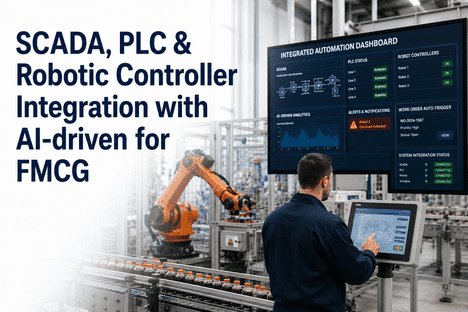
iFactory's platform integrates the robotic vision QC cell with the full suite of industrial software systems: CMMS integration for automatic work order creation from quality trend alerts, Shift Logbook integration for operator shift reporting on quality events, MES/MOM integration for production order quality tracking, ERP integration for defect cost accounting, and SCADA integration for upstream process parameter correlation. All integration is through standard industrial communication protocols (OPC-UA, REST API, MQTT) and requires no changes to the host systems. The quality data from every detection event is stored with full traceability — product image, defect category, timestamp, line speed, shift, operator, and upstream process parameters at the moment of detection.
GET STARTED ROBOTIC VISION QC

Start Your Robotic Vision Quality Control Deployment With an Engineering Assessment

iFactory's robotics and AI vision engineering team evaluates your production line speed, product mix, defect categories, and integration requirements — delivering a complete system design proposal with quantified ROI projections before any deployment commitment is made.


Share This Story, Choose Your Platform!