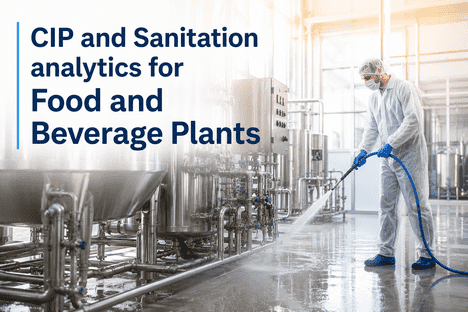
Food and beverage processing facilities operate under some of the most demanding hygiene standards in manufacturing — from FDA 21 CFR Part 117 (FSMA Preventive Controls) to USDA sanitation requirements and third-party GFSI scheme certifications like SQF, BRCGS, and FSSC 22000. At the center of every compliance strategy is CIP (Clean-in-Place) sanitation the automated circulation of cleaning solutions through process piping, tanks, heat exchangers, and fillers without disassembly. Yet most food plants still manage CIP programs through paper logbooks, manual cycle tracking, and reactive responses to sanitation failures creating compliance risk, water and chemical waste, and hidden downtime that erodes production efficiency. iFactory AI's next-gen industrial software platform including Shift Logbook, CMMS, production monitoring, and IoT sensor integration brings CIP sanitation and robotic cleaning operations into the digital age with automated verification, real-time tracking, and data-driven continuous improvement that protects both product safety and production efficiency.
Automate CIP Verification and Robotic Cleaning Management Across Your Food Plant
iFactory AI delivers digital CIP cycle tracking, Shift Logbook automation, sanitation compliance dashboards, and robotic cleaning integration — purpose-built for food and beverage processors under FDA, USDA, SQF, BRCGS, and FSSC 22000 frameworks.
The Four Pillars of Effective CIP Sanitation — Temperature, Concentration, Time, and Turbulence
CIP sanitation effectiveness is governed by the TACT framework — Temperature, concentration (chemistry), time, and turbulence (flow). Each variable is interdependent: reducing any one parameter requires increasing one or more of the others to maintain cleaning effectiveness. Understanding how each variable interacts — and how digital CIP management with iFactory AI lets you optimize the full equation — is the foundation of a sanitation program that protects product safety while minimizing water, chemical, and energy costs.
CIP Temperature Management
Temperature is the single most influential variable in CIP effectiveness. Caustic wash solutions (NaOH) are typically circulated at 140–185°F (60–85°C), with sanitization rinses at 165–180°F. Higher temperatures reduce the required chemical concentration and cycle time by accelerating the chemical reaction rate with organic soils — but also increase energy costs and can damage heat-sensitive equipment components like gaskets and seals.
The critical challenge in most food plants is maintaining consistent temperature throughout the CIP circuit. Heat loss through uninsulated piping, cold spots in complex vessel geometries, and temperature stratification in large tanks all create zones where cleaning effectiveness drops below specification — producing hidden food safety risks that manual temperature logging at the return line cannot detect.
- Caustic wash target: 140–185°F depending on soil type and concentration
- Sanitization rinse target: 165–180°F for thermal kill step
- Monitor temperature at multiple points — not just return line
- Log and trend temperature profiles per CIP cycle for audit evidence
- Use iFactory AI Shift Logbook to digitize temperature verification records
CIP Chemical Concentration Control
Chemical concentration in CIP systems is typically monitored through conductivity sensors that correlate solution strength with electrical conductivity. Caustic (sodium hydroxide) is maintained at 1–3% for general cleaning, with acid rinses (nitric or phosphoric acid) at 0.5–2% for mineral scale removal and pH neutralization. The challenge is that conductivity readings drift with temperature and soil loading — meaning a conductivity reading at the start of a cycle may not reflect actual active concentration after soil neutralization begins.
Real-time concentration trending with automated data logging — captured in iFactory AI's Shift Logbook and production monitoring platform — provides the audit trail that certifiers require and that manual titration checks cannot deliver. Facilities using digital CIP tracking consistently demonstrate lower chemical consumption per cycle and fewer sanitation deviations during GFSI scheme audits.
- NaOH target: 1–3% for organic soil removal on process surfaces
- Acid rinse target: 0.5–2% for mineral scale and pH neutralization
- Conductivity sensors require temperature compensation and calibration
- Trend concentration over full cycle — not just start-of-cycle readings
- Digitize all concentration records in iFactory AI for instant audit access
CIP Cycle Time Optimization
A standard CIP cycle follows a five-step sequence: pre-rinse to remove gross soil, caustic recirculation for organic soil removal, intermediate rinse, acid rinse for mineral scale, and final sanitization rinse. Total cycle time typically ranges from 30 to 90 minutes depending on soil type, equipment geometry, and production schedule. CIP consumes up to 20% of total production time in dairy processing and 20–30% of a facility's total water footprint — making time optimization a direct production capacity lever.
The industry trend is toward shorter, validated cycles using real-time endpoint detection — turbidity sensors on the return line signal when rinse water is clean rather than running fixed-time rinses. iFactory AI's Shift Logbook and production monitoring platform captures every cycle parameter and endpoint reading, building the data set needed to validate shorter cycles with regulatory agencies and certification bodies while maintaining full compliance documentation.
- Standard 5-step CIP cycle: pre-rinse → caustic → rinse → acid → sanitize
- Total cycle time: 30–90 minutes depending on soil and equipment
- Turbidity sensors enable endpoint-based rinsing vs. fixed-time rinsing
- Digitized cycle logs support regulatory validation of shortened cycles
- Shift Logbook provides instant time-stamped CIP records for audit readiness
CIP Turbulence and Flow Velocity
Turbulence — the mechanical scouring action of cleaning solution against soiled surfaces — is the most overlooked of the TACT variables. CIP effectiveness requires a minimum flow velocity of 5 ft/s (1.5 m/s) in piping to maintain turbulent flow conditions. Below this threshold, flow transitions to laminar regime, dramatically reducing the shear force that physically removes soil from equipment surfaces. In spray devices for tanks and vessels, static spray balls require 20–60 psi while rotating jet cleaners require 40–100+ psi.
Flow decay from pump wear, partially closed valves, or fouled spray devices is a common hidden failure mode in CIP systems — one that manual pressure gauge readings at the pump discharge cannot detect. IoT-enabled pressure and flow monitoring, integrated with iFactory AI's platform, provides real-time verification that every CIP circuit is operating at the required turbulent conditions throughout every cycle.
- Minimum 5 ft/s (1.5 m/s) flow velocity for turbulent pipe cleaning
- Static spray ball pressure: 20–60 psi for tank/vessel cleaning
- Rotating jet cleaner pressure: 40–100+ psi for heavy soil removal
- Flow and pressure sensors detect pump wear, fouling, and valve drift
- Digital flow monitoring provides real-time turbulence verification per cycle
Autonomous Robotic Cleaning for Food Processing Plants — From Floor Scrubbers to Open-Plant Sanitation Robots
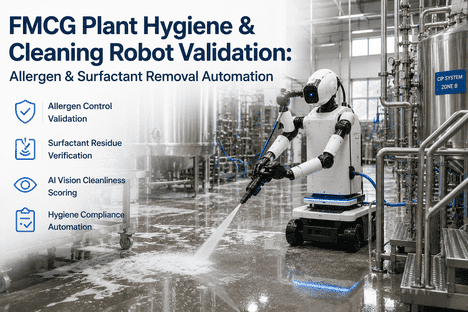
Robotic cleaning in food and beverage manufacturing is advancing beyond autonomous floor scrubbers into purpose-built sanitation robots capable of executing the full rinse-foam-sanitize sequence on processing equipment, walls, floors, and drains. The technology addresses the three most persistent challenges in food plant sanitation: consistency of execution, documentation for compliance, and labor availability in an industry where sanitation workers face 60% higher injury rates than the national average.
Autonomous Floor Scrubbers
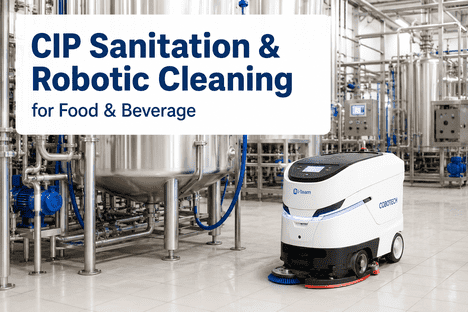
AI-guided scrubber-dryer robots navigate food plant layouts autonomously, executing scheduled floor sanitation with consistent chemical dosing, path coverage, and drying performance. Multi-sensor SLAM navigation adapts to changing floor conditions without facility modifications. Typical ROI: 1–2 years on labor replacement alone.
Open-Plant Sanitation Robots
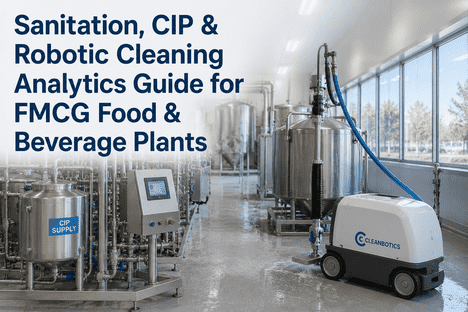
Purpose-built platforms like CleanBotix Rosie combine a 6-axis robotic arm with a wheeled mobile base to execute the full sanitation sequence — rinse, foam, dwell, rinse, sanitize — on processing equipment, floors, walls, and drains. Published test results show average RLU of 6.1 vs. 22.9 for manual cleaning, with zero recleans required vs. 40% reclean rate for manual.
Robotic Tank & Vessel Cleaning
Advanced rotating jet cleaners and robotic crawlers provide internal vessel cleaning for mix tanks, storage silos, heat exchangers, and spray dryers — eliminating confined space entry requirements and reducing cleaning time by 40–70% compared to manual tank entry methods.
The common thread across all robotic cleaning platforms is the need for digital task scheduling, execution verification, and compliance documentation — precisely the capabilities that iFactory AI's Shift Logbook, work order management, and production monitoring platform delivers.
The Hidden Cost Stack of Ineffective Sanitation — and the Automation ROI Case
Most food and beverage plant managers evaluate sanitation costs by looking at the line item for chemicals, water usage, and sanitation labor hours. The full cost picture is five layers deep, and the visible costs are typically less than 30% of the total. Understanding the full economic impact of sanitation gaps — and how CIP automation and robotic cleaning eliminate each cost layer — is the foundation for building a capital justification that leadership will approve.
Chemicals, water, energy for heating, and sanitation labor hours. The line items that appear in the monthly P&L. A Fortune 500 dairy processor spends $2–5M annually on these visible costs alone — before counting the hidden layers below.
When a CIP cycle fails verification — ATP swab above limit, allergen residue detected, or temperature excursion during sanitization — the affected equipment must be recleaned, delaying production startup. At $4,000–$30,000/hour of unplanned downtime in food and beverage (ABB), each reclean event costs far more than the sanitation operation itself.
Product manufactured before a sanitation failure is detected — or product from the first production run after an inadequate CIP cycle — often requires rework, reprocessing, or disposal. The cost of lost raw materials, reprocessing energy, and rejected product margin is rarely attributed to the sanitation program in facility accounting.
Average direct cost per food recall: $10M (FMI/GMA joint study). Severe recalls can erase $100M+ in shareholder value within days. With only 1-in-5 recalls detected by the manufacturer before regulators or consumer complaints trigger the process, inadequate sanitation documentation is a liability exposure that few food companies fully quantify.
55% of consumers temporarily switch brands after a recall; 15% never return. In the $980B U.S. food manufacturing market, losing a significant retail customer due to a supplier-driven recall event carries long-term revenue consequences that dwarf all other sanitation costs combined.
iFactory AI's platform — combining Shift Logbook, CMMS, production monitoring, and IoT sensor integration — tracks all five cost layers, giving food plant management the complete financial picture needed to justify CIP automation and robotic cleaning investment.
How iFactory AI's Industrial Software Platform Manages CIP Sanitation and Robotic Cleaning
iFactory AI's platform is purpose-built for the process-critical, compliance-intensive reality of food and beverage manufacturing — where one sanitation failure can trigger a recall that erases a year of margin, and where every CIP cycle and cleaning robot mission must be documented, verified, and audit-ready. The platform delivers unified visibility across your entire sanitation operation: CIP circuits, robotic cleaning fleets, manual sanitation tasks, ATP verification results, and compliance documentation — all in a single digital system accessible from any device on the plant floor.
Shift Logbook & Sanitation Logging
Replace paper CIP logs and shift handoff notebooks with iFactory AI's digital Shift Logbook. Every CIP cycle, robotic cleaning mission, ATP swab result, and sanitation deferral is time-stamped, attributed, and stored in an immutable audit trail — accessible in seconds during SQF, BRCGS, or FSSC 22000 audits.
PM Scheduling & Sanitation Checklists
Pre-built and customizable sanitation PM templates for CIP circuit inspections, spray device replacement, sensor calibration, and robot maintenance — automatically triggered by operating hours, calendar date, or production cycle count. Every task includes GFSI-compliant checklists with mandatory fields for verification results.
Production Monitoring & OEE Analytics
Real-time production monitoring connects sanitation events to production OEE — showing exactly how CIP cycle time, cleaning verification failures, and sanitation-driven production delays affect overall equipment effectiveness. Identify the hidden micro-downtime patterns that manual tracking never captures.
IoT Sensor & PLC Integration
iFactory AI connects to CIP system PLCs, flow meters, temperature transmitters, conductivity sensors, turbidity sensors, and robotic cleaning fleet APIs — ingesting real-time sanitation process data and generating alerts when parameters drift outside validated ranges.
Work Order & Corrective Action Management
Generate, assign, and track sanitation corrective actions from any device — ATP failure triggers automatic work order, CIP deviation escalates to maintenance supervisor, robotic cleaning mission exception creates documented investigation record. Full CAPA traceability for GFSI audit compliance.
Compliance Dashboard & Audit Reports
Pre-configured compliance dashboards map every sanitation activity to your chosen GFSI scheme requirements — SQF, BRCGS, or FSSC 22000. Generate audit-ready sanitation reports, CIP cycle summaries, and cleaning verification trend charts with one click from the plant floor.
6-Week CIP Digitization and Robotic Cleaning Program Implementation with iFactory AI
Deploying a digital sanitation management program for a food and beverage processing facility does not require a multi-year IT transformation or a dedicated digital team. iFactory AI's implementation approach is designed for food plant operations — fast to deploy, configured to your specific CIP circuits and cleaning equipment mix, and delivering measurable compliance and cost improvements within the first 60 days.
CIP Circuit and Cleaning Asset Registry
Every CIP circuit — process piping loops, tanks, heat exchangers, fillers — is catalogued in iFactory AI's asset hierarchy with circuit specifications, validation parameters, and current sanitation SOPs. Robotic cleaning platforms, spray devices, and manual cleaning stations are registered with maintenance history and current PM schedules. Criticality scores are assigned based on food contact surface classification and allergen status.
Digital Shift Logbook and Sanitation Checklist Configuration
Paper CIP logs and shift handoff sheets are converted to iFactory AI digital Shift Logbook templates — with mandatory fields for all critical parameters: temperature profile, chemical concentration, flow rate, ATP verification results, and deviation comments. Sanitation PM checklists are configured for each CIP circuit and robotic cleaning platform, with interval triggers based on production hours, calendar schedule, or cycle count.
IoT Integration and Real-Time Parameter Monitoring
iFactory AI's IoT gateway connects to CIP system PLCs and available sensor networks — pulling real-time temperature, conductivity, flow, pressure, and turbidity data into the platform. Condition-based alert thresholds are configured for critical sanitation parameters: temperature deviation during caustic cycle, conductivity drop indicating chemical depletion, flow rate below turbulent minimum. Robotic cleaning API integration enables real-time mission status and completion verification.
Sanitation Team Onboarding and Workflow Activation
Sanitation supervisors, CIP operators, and maintenance technicians are onboarded to iFactory AI's mobile-first interface — logging CIP cycles, recording verification results, and closing sanitation work orders directly from the plant floor. Shift handoff reviews and daily sanitation briefings are conducted through the digital Shift Logbook, creating a real-time communication channel between production and sanitation teams.
Compliance Benchmarking and Continuous Improvement
After 60 days of full program operation, iFactory AI generates a validated compliance and cost performance report — comparing pre- and post-implementation sanitation deviation frequency, CIP cycle time trends, chemical and water consumption per cycle, and sanitation-driven OEE impact. This data drives the continuous improvement cycle: refining cycle parameters, adjusting verification thresholds, and identifying the next set of CIP circuits or robotic cleaning workflows for analytics expansion.
Deploy iFactory AI Sanitation Intelligence Across Your Food & Beverage Plant
iFactory AI delivers digital Shift Logbook, CIP cycle tracking, robotic cleaning management, IoT sensor integration, sanitation compliance dashboards, and work order management — purpose-built for food processors under FDA, USDA, SQF, BRCGS, and FSSC 22000 compliance frameworks. Live in 6 weeks.
Industry Research and Expert Consensus on CIP Automation and Robotic Cleaning in Food Manufacturing
The food and beverage processing industry has accumulated substantial field research on CIP sanitation best practices — from Tetra Pak's process engineering expertise to CleanBotix's published autonomous sanitation validation data to Schneider Electric's digital CIP optimization studies. The consensus across this body of knowledge is consistent: digitized CIP management and robotic cleaning are not emerging technologies — they are proven solutions whose adoption gap is driven by the same factor — the absence of integrated software platforms like iFactory AI that make digital sanitation management practical for plant-floor operations.
Schneider Electric's published analysis of digitalized CIP systems documents up to 20% reduction in cleaning cycle times through real-time endpoint detection — turbidity and conductivity sensors that stop rinses when the return line is clean rather than running fixed-duration cycles. For a dairy plant running 6–10 CIP cycles per day across multiple circuits, each minute of cycle time reduction compounds into hundreds of additional production hours annually — making CIP optimization one of the highest-ROI digital investments available to food processors.
- Digitalized CIP reduces cycle time by up to 20% through endpoint-based rinsing
- Turbidity sensors eliminate over-rinsing and reduce water consumption per cycle
- Cycle time optimization compounds directly into increased production capacity
CleanBotix Rosie, the first purpose-built autonomous sanitation robot for open-plant food processing environments, underwent published validation testing comparing its performance against manual cleaning crews. Results demonstrated average ATP RLU readings of 6.1 for robotic cleaning vs. 22.9 for manual cleaning — with 0 recleans required versus 4 out of 10 manual cleanings failing the initial post-sanitation verification. The robot operated at 80% of human speed in initial deployment, with clear optimization potential as path planning and chemical application algorithms improve through software updates.
- Robotic RLU: 6.1 vs. manual RLU: 22.9 — 73% cleaner surfaces
- 0% reclean rate vs. 40% reclean rate for manual sanitation
- ROI accelerates as labor availability tightens and sanitation standards tighten
Food safety certification bodies consistently report that documentation gaps are among the most frequent non-conformances identified during SQF, BRCGS, and FSSC 22000 certification and surveillance audits — incomplete sanitation records, missing CIP cycle logs, untraceable corrective actions, and undocumented deferrals. Digital sanitation management through platforms like iFactory AI directly addresses the root cause: paper-based systems cannot deliver the searchability, traceability, and real-time visibility that GFSI auditors expect in modern food processing facilities.
- Incomplete sanitation records are among the top GFSI audit non-conformances
- Digital CIP logs eliminate the documentation gaps that trigger audit findings
- iFactory AI Shift Logbook creates an immutable, searchable sanitation audit trail
CIP Sanitation and Robotic Cleaning — Frequently Asked Questions
CIP cleaning effectiveness is governed by the TACT framework: Temperature (typically 140–185°F for caustic wash), chemical Concentration (1–3% NaOH, 0.5–2% acid), Time (30–90 minute total cycle depending on soil and equipment), and Turbulence (minimum 5 ft/s flow velocity in piping, 20–60 psi for static spray balls, 40–100+ psi for rotating jets). These four variables are interdependent — reducing any one parameter requires compensating increases in others. The most effective approach is real-time monitoring of all four parameters throughout each CIP cycle, with automated data logging in a platform like iFactory AI's Shift Logbook that provides instant visibility into cycle performance and an immutable record for audit compliance. Book a Demo to see how iFactory AI monitors and documents your CIP TACT parameters in real time.
Published validation data for open-plant sanitation robots demonstrates measurably superior cleaning consistency compared to manual methods. CleanBotix Rosie, validated in food processing environments, achieved average ATP RLU readings of 6.1 versus 22.9 for manual cleaning crews — with zero recleans required versus a 40% manual reclean rate. Robots deliver consistent chemical dosing, always-followed dwell times, and repeatable path coverage that eliminates the variability inherent in human-performed sanitation. Combined with iFactory AI's Shift Logbook for mission scheduling, execution verification, and compliance documentation, robotic cleaning becomes a fully traceable, audit-ready sanitation operation.
iFactory AI's Shift Logbook replaces paper CIP logs, shift handoff notebooks, and spreadsheet-based sanitation tracking with a fully digital, immutable time-stamped record of every sanitation event in your facility. Every CIP cycle start and end time, temperature profile, chemical concentration reading, flow rate verification, ATP swab result, and deviation comment is automatically captured and stored with operator attribution. When a GFSI auditor requests sanitation records for a specific production date and equipment circuit, the Shift Logbook delivers a complete, searchable, exportable record in seconds — eliminating the most common source of audit non-conformances and reducing audit preparation time by 80–90% compared to paper-based systems.
ROI from digital CIP management through iFactory AI's platform is typically visible within the first 60 days of operation through three primary channels: chemical and water consumption reduction from optimized CIP cycles (20–30% typical savings), decreased sanitation-driven production delays from real-time deviation alerts and automated corrective action workflows, and audit preparation time reduction of 80–90% from instant digital record retrieval. Robotic cleaning ROI cases are facility-specific, but published data from food plant deployments shows 1–2 year payback periods driven by labor replacement, reduced reclean rates, and improved sanitation consistency that reduces recall risk. iFactory AI's platform combined with robotic cleaning integration typically achieves positive ROI within the first operating year through these combined savings streams.
A full iFactory AI sanitation management program deployment for a food and beverage processing facility — including CIP circuit asset registry, digital Shift Logbook configuration, IoT sensor and PLC integration where available, sanitation team onboarding, and compliance dashboard activation — typically completes in 6 weeks. The implementation is structured in phases that allow each component to go live progressively: Shift Logbook and sanitation checklists are operational within the first 3 weeks, IoT integration and real-time parameter monitoring activate in weeks 4–5, and full compliance benchmarking is available at the 60-day mark. Facilities transitioning from paper-based systems can be fully operational faster than those migrating from legacy CMMS platforms, as there is no complex data migration required. First measurable compliance improvements — reduced CIP cycle deviations and improved sanitation PM completion rates — are typically visible within 30 days of platform activation.
CIP Sanitation and Robotic Cleaning: The Competitive Advantage Starts with Digital Management
The economics of food and beverage sanitation are unambiguous: digitized CIP management, robotic cleaning integration, and automated compliance documentation cost a fraction of the recall risk, sanitation-driven downtime, chemical waste, and audit non-compliance expenses that paper-based sanitation programs produce. The challenge in most food processing facilities is not understanding this — it is having the operational software infrastructure to execute digital sanitation management consistently under the production pressure that always seems more urgent than system implementation.
iFactory AI solves the execution problem by making digital sanitation management the path of least resistance for your sanitation team. iFactory AI's Shift Logbook replaces paper CIP logs with immutable digital records. Automated PM scheduling ensures every spray device is inspected on time. IoT integration catches parameter drift before it becomes a compliance deviation. Compliance dashboards deliver audit-ready reports at one click. All in a single platform configured for your specific CIP circuits and cleaning equipment mix, deployed in 6 weeks, and delivering measurable compliance improvement within the first 60 days. Book a Demo to see iFactory AI configured for your food and beverage plant and take the first step toward a sanitation program where digital verification is the standard — not paper-based guesswork.
Deploy iFactory AI Sanitation Intelligence at Your Food Plant — Live in 6 Weeks
Join food and beverage processors using iFactory AI's next-gen industrial software platform — including Shift Logbook, CMMS, production monitoring, and IoT integration — to manage CIP sanitation, robotic cleaning, compliance documentation, and sanitation-driven OEE analytics in one unified system.